Create my document
Login

Choose country

United StatesUnited StatesChoose country
Real Estate

Contract for Deed Template | Tex. Prop. Code 5.061

Land contract drafted to state law: Texas Property Code 5.061, Minnesota 559.21, Ohio 5313. Correct cure periods, equity caps and recording deadlines.
4.8/517 reviews50 000+ downloadsInstant download
Share

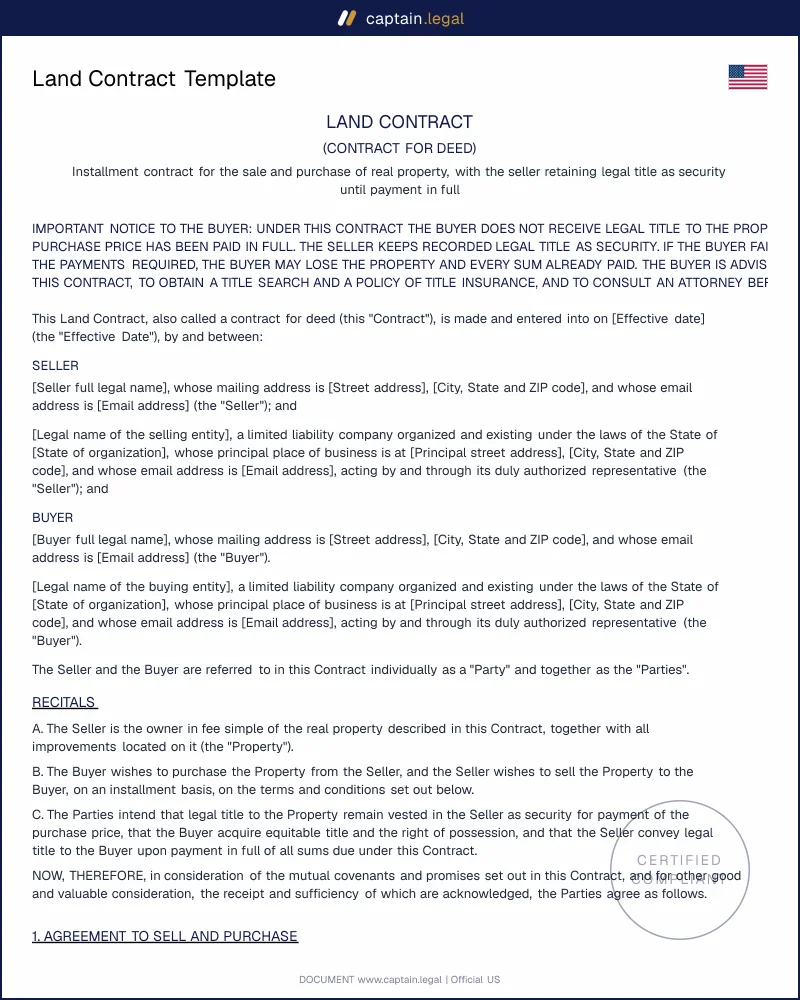
A land contract, also called a contract for deed or an installment land contract, is a seller financed sale in which the buyer takes possession and pays the price in installments while the seller keeps legal title as security until the final payment clears. It is the working instrument of owner financing in the United States, used by buyers who cannot qualify for a bank mortgage, by families passing land to the next generation, and by sellers who prefer an income stream to a lump sum at closing. Our template covers the installment schedule, interest, taxes and insurance, default and cure, limits on forfeiture, and recording, with wording drafted to statutes such as Texas Property Code §5.061 and Minnesota Statutes §559.21.

Compliant

2026 Legislation

50,000+ clients

trust us

Affordable

From $4.90 / doc

Secure payment

Instant download

Contract for Deed Template | Tex. Prop. Code 5.061

Secure payment

Fill in the template

What is a land contract?

A land contract splits ownership in two. The seller keeps legal title, which stays on the county records until payoff, while the buyer takes equitable title and possession, along with the burdens that follow ownership: property taxes, hazard insurance, repairs, and the risk of loss. Courts in most states describe the seller's retained title as security for the unpaid price and nothing more. That characterization decides almost every dispute that follows, because a security interest has to be enforced the way security interests are enforced, not by changing the locks on a Saturday morning.

The document is easy to confuse with three neighbors. A state specific real estate purchase agreement closes in weeks with bank money or cash and delivers a deed at the closing table; a contract for deed holds that deed back for years. A lease with an option to purchase gives the tenant a right to buy rather than an obligation, though Texas folds long lease options into the same statutory regime anyway. A purchase money mortgage also lets the seller finance the sale, but there the buyer gets the deed immediately and the seller records a lien. That last distinction is the one buyers underestimate. Under an installment contract the buyer has no deed to show a lender, an insurer, or a county assessor until the balance is paid.

2

When do you need this document?

The most common trigger is a buyer with real income and a thin credit file. Self employed borrowers, recent immigrants, people two years out of a bankruptcy, and gig workers with deposits no underwriter will average all fall into the same gap, and a contract for deed closes it without an appraisal or an underwriting committee. The second recurring scenario is the property no bank will touch: a manufactured home on acreage, a rural parcel with no comparable sales, a house with a failing septic system. Sellers of those properties often finance because financing is the only way to reach the price they want.

Family transfers make up much of the rest. Parents sell the homestead to one child at a set price with a modest down payment, which fixes the value, keeps the deal at arm's length for probate purposes, and spreads the capital gain across years under the installment method of IRC §453. Those transactions usually sit alongside a revocable living trust template so the seller's remaining interest passes cleanly on death.

Two edge cases deserve flagging. If the property still carries a mortgage, the sale almost certainly triggers the due on sale clause permitted by the Garn St Germain Act, 12 U.S.C. §1701j-3. And if the buyer plans to build, confirm the county will accept an unrecorded equitable interest before any permit application goes in.

3

Key clauses included in our template

Each clause is drafted so the mandatory statutory language for your state replaces the generic wording, which is the difference between an enforceable installment contract and a document a judge reads as a lease.

  • The identification of the parties and the property carries the full legal description from the deed or plat, never the mailing address. A contract describing the parcel as "the house on County Road 12" fails the statute of frauds, and a defective description clouds title for both sides.
  • The price, down payment, and amortization schedule set out principal, the annual interest rate, the payment amount and due date, and the number of payments. Interest below the applicable federal rate gets recharacterized under the imputed interest rules of IRC §§483 and 1274, so the rate field is never left blank.
  • The balloon and refinancing clause states the maturity date and the amount due, because most land contracts amortize over twenty or thirty years but mature in three to seven. Minnesota requires disclosure of balloon terms in residential contracts under chapter 559A.
  • The taxes, insurance, and escrow clause allocates ad valorem taxes, names the seller as an additional insured, and sets minimum coverage. Skipping it is how a seller learns about a tax lien on property they still legally own.
  • The default, notice, and cure clause is the heart of the document. It reproduces the statutory notice format your state demands, including the Texas Property Code §5.063 requirement that the notice appear in fourteen point boldface or uppercase type, and sets the cure period at the statutory floor or above.
  • The conveyance clause commits the seller to deliver a recordable warranty deed within a fixed window after final payment. Placing a signed quit claim deed in escrow at signing removes the risk that an uncooperative or deceased seller strands the buyer at payoff.
4

State-specific considerations

Texas runs the most detailed executory contract regime in the country, and the burden falls on the seller. Subchapter D of Property Code chapter 5 applies whenever residential property is sold under a contract that delivers the deed more than 180 days after execution. The buyer may cancel without cause before the fourteenth day under §5.074. The seller must record the contract with its condition disclosure within thirty days under §5.076, send a written accounting every January under §5.077, and hold title free of liens under §5.085. Once the buyer has paid forty percent of the amount due or forty eight monthly payments, §5.066 replaces forfeiture with a trustee sale and sends any surplus to the buyer.

Minnesota cancels contracts for deed administratively rather than through the courts. A contract executed after July 31, 1985 terminates sixty days after service of the notice required by §559.21, subdivision 2a, unless the buyer cures, brings payments current, and pays service costs plus two percent of the amount in default. Contracts executed by an investor seller now require ninety days notice, plus a certified mail warning at least thirty days before that notice is served. Subdivision 4b blocks cancellation where the seller failed to record as §507.235 requires, and chapter 559A adds written disclosures, a buyer right to cancel, and a ban on churning.

Ohio governs land installment contracts at Revised Code chapter 5313. The contract must contain the items listed in §5313.02, reach the recorder within twenty days, and be followed by an annual statement of account under §5313.03. Forfeiture waits thirty days after default under §5313.05, and the dividing line sits at §5313.07: once the buyer has paid for five years or twenty percent of the price, the seller must foreclose judicially. Either route is an exclusive remedy under §5313.10.

Florida has no installment land contract statute, so the courts apply section 697.01, Florida Statutes, which deems any instrument given as security for a debt to be a mortgage. An agreement for deed is enforced by judicial foreclosure under chapter 702, the buyer keeps a right of redemption, and a forfeiture clause is largely decorative. Budget for documentary stamp tax at execution.

California calls the instrument a real property sales contract at Civil Code §2985. Sections 2985.1 through 2985.3 limit the seller's power to convey or encumber the property and require installments to be applied to any existing encumbrance first. Petersen v. Hartell (1985) 40 Cal.3d 102 still controls: a buyer who has substantially performed keeps an unconditional right to complete the purchase.

5

How to fill out this land contract

You start by selecting the state where the property sits, because that one choice rewrites the default provisions, the notice format, the cure period, and the equity threshold that caps forfeiture. The form then asks whether the property is residential and occupied by the buyer or a relative, since Texas, Minnesota, and Ohio apply their protective regimes only to residential deals.

From there the questionnaire moves through the commercial terms in the order a closing attorney takes them: parties and vesting, legal description pulled from the current deed, price and down payment, interest rate, payment amount and due date, term and any balloon maturity, then the allocation of taxes, insurance, maintenance, and the right to record. You indicate whether a deed will be held in escrow and who serves as escrow agent, and the document assembles the matching conveyance language.

The last stage handles execution. The template generates signature blocks for every titled owner and buyer, adds a spousal joinder where the state requires it for homestead property, and produces a notarial acknowledgment formatted for recording. Download in Word to keep editing or in PDF to sign, then take the executed original to the county recorder.

6

Common mistakes to avoid

The first mistake is treating a land contract as a lease with a promise attached. Sellers who send a notice to quit and file an eviction discover that the buyer holds equitable title, that the eviction court has no jurisdiction over the question, and that the statutory notice they skipped has to be served again from the beginning. The second is failing to record. In Minnesota an unrecorded contract blocks cancellation outright, in Texas it triggers statutory damages, and everywhere it exposes the buyer to a seller who mortgages or resells the property to someone else. The third is the silent existing mortgage: a seller who never mentions the underlying loan, then falls behind on it, hands the buyer a foreclosure notice on a house the buyer has been paying for faithfully.

Two more show up constantly in litigation. Sellers write an absolute forfeiture clause and rely on it after the buyer has paid for years, which is the exact fact pattern the statutes were built to defeat. And both sides let the taxes drift, the buyer assuming the seller pays them because the seller is on the deed and the seller assuming the opposite. Name the responsible party, set a due date, and require proof of payment every year. Checking your draft against the other instruments in our US real estate document library catches what it leaves out.

Key takeaways

How it works

You get possession, not the deed

A contract for deed splits ownership: the buyer takes possession and equitable title, while the seller keeps legal title on the county records until the final payment clears. That means no deed to show a lender, insurer, or assessor during the term. You still carry owner-like burdens such as property taxes, hazard insurance, repairs, and risk of loss.

Legal limits

Default enforcement is not self-help

Courts often treat the seller’s retained title as a security interest, which affects what happens on default. You cannot assume the seller can simply lock the buyer out or declare an instant forfeiture. State statutes set hard rules on default, cure, limits on forfeiture, and recording, with this template drafted to regimes like Texas Property Code §§5.061 to 5.085, Minnesota Statutes §559.21, and Ohio Revised Code chapter 5313.

Federal rules

Seller financing can trigger credit law

A seller financing a home is extending credit, and federal consumer credit rules may apply alongside state property law. Under Regulation Z, a person can be treated as a creditor after exceeding five dwelling-secured transactions in a calendar year (12 CFR §1026.2(a)(17)), which can pull the deal into Truth in Lending disclosures and ability-to-repay duties (12 CFR §1026.43). CFPB guidance shifted in 2024 and 2025, but the underlying statutory risk remains.

Frequently Asked Questions

Yes, provided it is written, signed by all titled owners and buyers, and carries a legal description sufficient to identify the parcel. A land contract satisfies the statute of frauds like any other conveyance instrument, and courts enforce it as a contract and as a security instrument at once. Clauses that conflict with a protective statute, such as a Texas waiver of the right to cure, are struck while the rest survives. Recording the executed original protects the buyer against later purchasers and lenders.

With a mortgage or deed of trust, the buyer receives the deed at closing and the lender records a lien against it. With a contract for deed, the seller keeps the deed and the buyer holds equitable title until the last payment. The economics are similar, but the buyer's paper position is weaker: no recorded ownership, no automatic homestead exemption in some states, real difficulty refinancing. Most states narrow the gap by treating the arrangement as an equitable mortgage once the buyer accumulates equity.

The cure period comes from statute, not from the contract. Texas gives at least thirty days after the seller serves the notice required by §5.063, Ohio gives thirty days from the date of default under §5313.05, and Minnesota runs a sixty day clock from service under §559.21, extended to ninety days for investor sellers. A contract that shortens these periods does not shorten them in practice. A seller who serves a fifteen day notice in a thirty day state has effectively served nothing.

Both come with the document. The Word version is fully editable, which matters when a title company or closing attorney asks for a rider, a different escrow agent, or an amended payment schedule. The PDF is formatted for signature and recording, with margins and type sizes county recorders accept. For the rest of the transaction, the catalog of US legal templates covers deeds, disclosures, and closing paperwork.

Texas requires recording within thirty days of execution and imposes damages on sellers who fail. Ohio requires it within twenty days. Minnesota conditions the seller's right to cancel on having recorded. Even where no mandate exists, a buyer who does not record has no defense against a seller who takes out a new mortgage, sells to a third party, or dies leaving heirs who dispute the arrangement. Do it the week you sign and keep the stamped copy with the payment ledger.

Legally yes, practically it is the riskiest structure in owner financing. Selling under a land contract almost always triggers the due on sale clause authorized by 12 U.S.C. §1701j-3, which lets the lender call the balance immediately. Texas requires the seller to hold title free of liens under §5.085 unless the lienholder consents in writing. If an underlying loan stays in place, require monthly proof of payment, give the buyer a right to pay the lender directly and offset, and place a signed deed in escrow.

4.8/5

17 verified reviews · 50 000+ downloads

Contract for Deed Template | Tex. Prop. Code 5.061
  • Immediate access to the document
  • PDF + Word download
  • Compliant with 2026 legislation
  • Reviewed by lawyers
Fill in the template
Secure payment
Updated on July 29, 2026

You might also like

Roommate Agreement Template
Vacation Rental Agreement