Create my document
Login

Choose country

United StatesUnited StatesChoose country
Real Estate

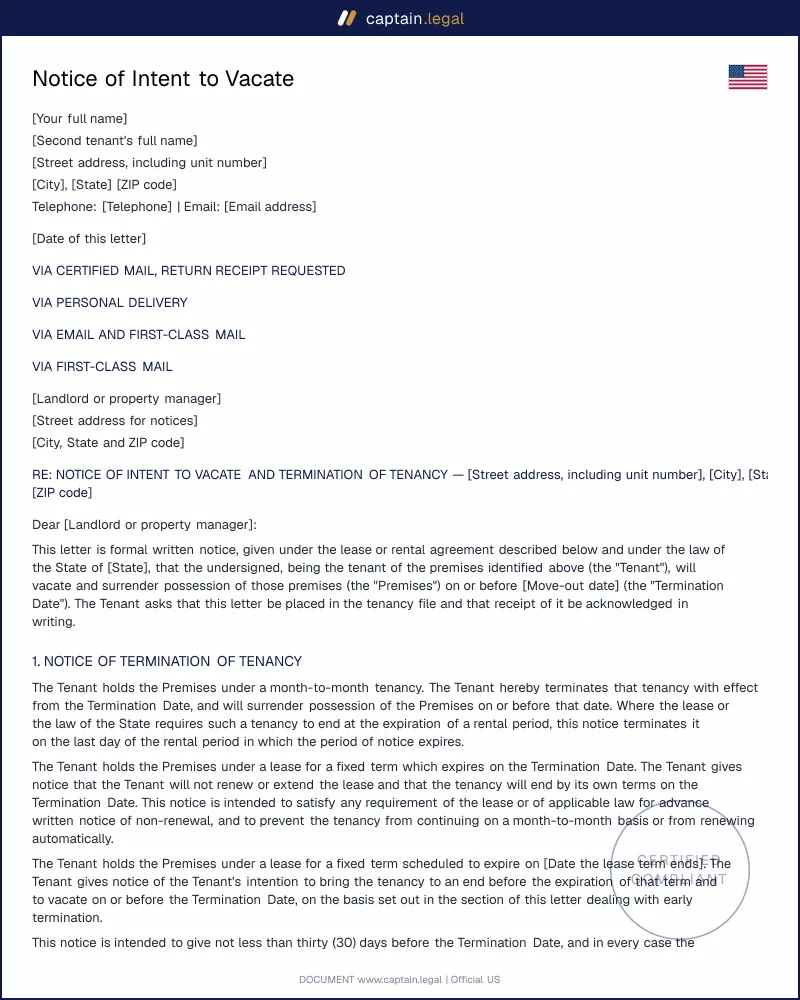
Notice of Intent to Vacate | Cal. Civ. Code 1946 Compliant

Lawyer-grade notice to vacate drafted to your state's rules: Cal. Civ. Code 1946, Tex. Prop. 91.001, Fla. 83.57. Correct notice period, Word & PDF.
4.7/526 reviews50 000+ downloadsInstant download
Share

Ending a tenancy is one of the few moments where a tenant, not the landlord, controls the paperwork. A Notice of Intent to Vacate is your written statement that you are ending a lease or month-to-month tenancy on a specific date, delivered far enough in advance to satisfy the notice period your state imposes. Whether you owe 30 days, 60 days, or the 15 days Florida requires, the notice is what starts the clock cleanly. It also does quiet, practical work behind the scenes: it protects your security deposit, closes out your rental history on good terms, and cuts off any argument that you left without warning and owe another month's rent.

Most tenants treat this letter as a formality, then discover at move-out that a missed deadline or a vague date cost them a deposit refund. This page walks through what a 30-day lease termination letter must contain, which statute governs your situation, and how to serve it so it actually counts.

Compliant

2026 Legislation

50,000+ clients

trust us

Affordable

From $4.90 / doc

Secure payment

Instant download

Notice of Intent to Vacate | Cal. Civ. Code 1946 Compliant

Secure payment

Fill in the template

What is a notice of intent to vacate?

A notice of intent to vacate is a dated, written communication from a tenant to a landlord announcing the tenant's decision to end the tenancy and surrender the unit by a stated date. It is the tenant-side counterpart to the landlord's notice of non-renewal, and courts treat the two as mirror images: each ends a periodic tenancy without fault, provided the notice period is respected. The document is sometimes called a 30-day notice to vacate, a lease termination letter, or a notice to quit when the tenant initiates it, though "notice to quit" more often refers to the landlord's pre-eviction demand.

Do not confuse this notice with breaking a lease. If you are still inside a fixed term with months left on the clock, a notice of intent to vacate does not release you from the remaining rent unless you have a statutory right to leave early, such as military deployment under the Servicemembers Civil Relief Act or documented domestic violence protections. The notice shines in two situations: ending a month-to-month tenancy, where it is the standard exit mechanism, and confirming that you will not renew a fixed-term lease as it approaches expiration. In both cases the letter converts a casual intention into a legally recognized act with a firm date attached. You can pair it with a request for a move-out inspection so the condition of the unit is documented before you hand back the keys, a step worth reading about alongside our move-in and move-out condition documentation for US rentals.

2

When do you need this document?

The everyday trigger is a planned move at the end of a month-to-month tenancy. You have found a new place, your circumstances changed, or you simply want out, and you need to end the arrangement without owing an extra month. Serving a clean notice fixes the last day you are responsible for rent and stops the tenancy from silently rolling into another period. The second common scenario is declining to renew a fixed-term lease that is approaching its end date. Many leases convert to month-to-month automatically at expiration unless one side gives notice, so a tenant who wants a hard stop must say so in writing within the window the lease specifies.

Beyond the routine cases, several situations make the notice legally load-bearing. Tenants leaving under a domestic violence protection need the written notice plus supporting documentation to invoke the early-exit statute, and the paper record is what shields them from a rent claim. Service members relocating on orders should attach a copy of those orders to the notice to trigger SCRA protection cleanly. One edge case catches people constantly: a lease that demands 60 days from the tenant in a state like California, where that clause is unenforceable, still leaves many tenants overpaying because they assume the contract controls. It does not; the statutory floor does. If your move also involves handing the unit to someone else temporarily, a notice of intent to vacate is the wrong tool, and you would instead look at a sublease arrangement for US tenants to keep the original lease intact.

3

Key clauses included in our template

  • The tenant and property identification block names every tenant on the lease and states the full unit address, because a notice signed by one roommate rarely binds the others, and a landlord can reject a letter that omits a co-tenant or gets the address wrong.
  • The termination date is the heart of the document, drafted to fall on or after the last day of your state's notice period counted from the delivery date. Our template calculates backward from a firm move-out date so you never serve a notice that is short by three or four days.
  • The statement of intent declares in plain terms that you are ending the tenancy and surrendering possession, language courts want to see so there is no argument that the letter was merely a complaint or a negotiation.
  • The forwarding address gives the landlord a place to send your security deposit refund and the itemized deduction statement, and omitting it is a common reason deposits vanish into an unclaimed-property void.
  • The rent-through date and key-return line confirms what you still owe up to termination and how you will return keys, closing off the classic dispute where a landlord claims you abandoned the unit or left rent unpaid.
  • The service and signature block records how and when the notice was delivered, with a dated signature, so you hold proof the notice was served on time if the landlord later claims it never arrived.
4

State-specific considerations

California gives tenants a strong default under Civil Code § 1946: 30 days' written notice ends a month-to-month tenancy, and § 1953 voids any lease clause demanding more from the tenant. That protection matters because many California leases still print a 60-day tenant-notice clause that is simply unenforceable. Deliver by personal service or by certified mail to the person you pay rent to, and keep the mailing receipt as proof of service.

Texas works on a rent-period model under Texas Property Code § 91.001 rather than a fixed 30-day count. A month-to-month tenancy ends one month after you give notice or at the end of the current rent-paying period, whichever falls later, so timing your notice to the start of a rental period avoids paying into a partial extra month. Texas also lets the landlord and tenant agree in writing to a shorter period or none at all, so check whether your lease already sets different terms.

Florida is the state tenants misjudge most. Under Florida Statutes § 83.57, a month-to-month tenancy requires only 15 days' notice before the end of a monthly period, half the assumed 30. Giving 30 days is never wrong in Florida, but assuming Florida mirrors California can cause tenants to hold the unit and pay longer than the law requires.

New York scales the period to how long you have lived there under Real Property Law § 226-c and the Housing Stability and Tenant Protection Act of 2019: 30 days under one year, 60 days from one to two years, and 90 days beyond two years. Count your occupancy carefully, because a tenant of twenty-six months who serves 60 days has served short and may owe the difference. If your move also ends a shared arrangement, settle obligations first with a clear roommate agreement for New York and other states.

5

How to fill out this notice of intent to vacate

You start by selecting the state where the property is located, and from there the template applies the correct statutory notice period and citation so the letter matches your jurisdiction rather than a generic template written for somewhere else. You then enter every tenant named on the lease and the full unit address, followed by your intended move-out date. The tool counts backward to confirm the date gives your landlord enough lead time, and it flags the letter if you have picked a date that falls short of the statutory minimum. Next you add a forwarding address for your deposit refund and confirm how you will deliver the notice, whether by hand, certified mail, or the method your lease requires. Once the fields are complete you download the finished notice as an editable Word file and a ready-to-sign PDF, sign and date it, and serve it using a method that leaves you proof of delivery. Keep a copy of the signed notice and the delivery receipt together, because that pair is what protects you if the landlord later disputes the timing. Tenants renting under a flexible arrangement can cross-check their obligations against our month-to-month rental agreement guidance before serving.

6

Common mistakes to avoid

The most expensive error is miscounting the notice period. Tenants routinely assume 30 days is universal, then serve short in a state like New York where longer occupancy demands 60 or 90, or overpay in Florida where 15 days is enough. A notice that is a few days short is frequently treated as void, meaning the tenancy rolls into another full period and you owe that rent. Almost as common is serving notice mid-period when your lease or statute ties termination to the end of a rent-paying period, which quietly extends your liability into a partial extra month. Tenants also forget that the letter must actually reach the landlord in a provable way; a text message or a note slipped under a door invites a later claim that nothing was ever served.

Two smaller errors do real damage. Leaving off a forwarding address strands your security deposit, because the landlord has nowhere to mail the refund and the itemized statement your state may require. And signing a notice that only names one tenant on a joint lease can leave co-tenants technically bound, exposing everyone to continued rent. If a dispute over the deposit does surface after you move, the follow-up tool is a security deposit demand letter for all 50 states, which cites the return deadline and penalties your landlord may have triggered.

Key takeaways

NOTICE PERIOD

Your letter starts the legal clock

A Notice of Intent to Vacate is only effective if it is delivered far enough in advance to meet your state’s notice period. Many month-to-month tenancies default to 30 days, but Florida’s tenant timeline is different, and Texas ties timing to the rent-paying period. A late or mis-timed notice can make you owe an extra month of rent or trigger a dispute at move-out.

WHAT IT DOES

Set a firm move-out date in writing

This notice is a dated, written statement from you to the landlord that you will surrender the unit by a specific date. Courts treat it like the tenant-side mirror of a landlord non-renewal notice, so precision matters: a clear end date and proper delivery turn a casual heads-up into a legally recognized termination. Pairing it with a move-out inspection request can help document condition before keys are returned.

LEASE VS TERM

It ends tenancies, not leftover rent

Do not confuse a notice to vacate with breaking a fixed-term lease early. If you still have months left on the lease, giving notice does not automatically wipe out remaining rent unless you have a separate legal right to terminate early, such as under the Servicemembers Civil Relief Act or certain domestic violence protections. Used correctly, the notice cleanly ends month-to-month tenancies or confirms non-renewal at lease expiration.

Frequently Asked Questions

Yes, once properly served it is a legally recognized act that ends the tenancy on the stated date, provided it meets your state's requirements for form, content, and notice period. The letter must be in writing, name the tenant and the unit, state a clear termination date, and be delivered in a way your statute accepts. A notice that satisfies California Civil Code § 1946 or Texas Property Code § 91.001 binds both you and the landlord, fixing the last day you owe rent. What makes it fail is not a missing signature line but a short notice period or a delivery method the tenant cannot prove, so keep your dated copy and delivery receipt.

The period is set by state law and depends on your tenancy type and how long you have lived there. Most states require 30 days for a month-to-month tenancy, but Florida requires only 15 days under Florida Statutes § 83.57, and New York scales from 30 to 90 days based on occupancy length under Real Property Law § 226-c. California fixes the tenant's obligation at 30 days and voids any lease clause demanding more. Texas ends the tenancy one month after notice or at the close of the rent period, whichever is later. Always count from the delivery date, not the date you wrote the letter.

It depends on your state. In California, no: Civil Code § 1953 voids any residential lease clause requiring a tenant to give more than 30 days' notice to vacate, even if you signed a lease saying 60. Other states are more permissive and will enforce a longer contractual notice period if both parties agreed to it in writing, as Texas allows under Property Code § 91.001. Read your lease against your state statute before assuming the contract controls, because tenants in tenant-protective states routinely overpay by honoring an unenforceable clause. When the statute and the lease conflict, the more tenant-favorable rule usually wins.

You receive the notice in two formats, an editable Word file and a ready-to-sign PDF. The Word version lets you adjust names, dates, and any lease-specific language before you finalize, while the PDF is formatted for clean printing and signature. Having both means you can customize the letter to your exact situation and still hand over or mail a professional-looking document. Keep the signed copy together with your proof of delivery, because that combination is what defends the timing of your notice if a dispute arises later.

Delivery method matters as much as timing, and the safest approach is one that generates proof. Personal delivery with a witness or a signed acknowledgment works, but certified mail with return receipt is the gold standard because it timestamps both sending and delivery. Some states and leases specify the method, and California expressly allows certified or registered mail to the person you pay rent to under Civil Code § 1946. Avoid text messages, emails, and notes under the door as your only method, since a landlord can later claim nothing arrived. Whatever you choose, keep the receipt with your copy of the notice.

No. A notice of intent to vacate ends a periodic tenancy or confirms non-renewal at the end of a term; it does not break a fixed-term lease that still has months to run. Leaving early under a fixed term generally leaves you liable for the remaining rent unless you have a statutory escape, such as military relocation under the Servicemembers Civil Relief Act or a documented domestic violence exit. If your fixed term is simply ending, serve the notice within the window your lease specifies to prevent an automatic renewal into a month-to-month arrangement.

Yes, you owe rent for the entire notice period, through the termination date, and remaining in possession does not change that. If you serve a 30-day notice, you are responsible for rent for those 30 days even if you move out on day five. Tenants sometimes stop paying once they give notice, which hands the landlord grounds to pursue non-payment separately. The one relief is that if your tenancy ends mid-period in a state like Texas, you are liable for rent only up to the termination date under Property Code § 91.001, not the full month.

4.7/5

26 verified reviews · 50 000+ downloads

Notice of Intent to Vacate | Cal. Civ. Code 1946 Compliant
  • Immediate access to the document
  • PDF + Word download
  • Compliant with 2026 legislation
  • Reviewed by lawyers
Fill in the template
Secure payment
Updated on July 26, 2026

You might also like

Vacation Rental Agreement
Lease with Option to Purchase