A Service Agreement, often called a Master Services Agreement (MSA) when it governs an ongoing commercial relationship, is the contract two businesses sign before any work begins, money changes hands, or proprietary information leaves the building. It pins down who delivers what, on what timeline, against what fee, and under whose ownership the deliverables ultimately fall. In the United States, services contracts sit outside the scope of UCC Article 2 (which governs the sale of goods) and are instead controlled by state common law of contracts as restated in the Restatement (Second) of Contracts. That distinction matters more than founders realize: the warranties, perfect-tender rules, and statute of frauds thresholds you may have read about for product sales simply do not apply here, and the playbook for negotiating, performing, and litigating a services contract is its own discipline.
This page is written for the people who actually sign these contracts: founders putting their first agency on retainer, GCs reviewing a SOW before it lands on the CEO's desk, agencies and consultants tired of rewriting the same agreement every quarter, and procurement teams standardizing vendor onboarding. The template available on this page is built around the MSA + Statement of Work (SOW) architecture used by every serious B2B operation in the US — a single master agreement that fixes the legal terms, paired with lightweight SOWs that describe each engagement.
Compliant
2026 Legislation
50,000+ clients
trust us
Affordable
From $4.90 / doc
Secure payment
Instant download
Service Agreement / Master Services Agreement (MSA)
Secure payment
What is a Service Agreement (Master Services Agreement)?
A Service Agreement is a binding written contract under which one party — the service provider, vendor, or contractor — agrees to perform defined services for the client in exchange for compensation. When the same two parties expect to do business repeatedly across multiple projects, the standard US practice is to sign a Master Services Agreement once, then attach successive Statements of Work that specify the scope, schedule, and price of each individual engagement. The MSA carries the heavy legal terms (intellectual property, confidentiality, indemnification, limitation of liability, dispute resolution); the SOW carries the commercial details. This separation is what makes the MSA the workhorse of US business contracts — drafted once, used dozens of times.
A Service Agreement is not an employment contract and not an independent contractor agreement in the IRS sense, although the lines blur in practice. The MSA is typically signed entity to entity (an LLC contracting with another LLC or corporation), whereas an independent contractor agreement frequently binds a company to an individual and triggers a Form 1099-NEC analysis under IRS classification rules. It is also distinct from a consulting agreement, which is usually narrower in scope and shorter in duration, and from a services purchase order, which is a unilateral instrument lacking the negotiated terms of an MSA. Treat the Service Agreement as the umbrella; everything else hangs from it.
Legal framework
US Service Agreements are governed by the common law of contracts of the state chosen in the governing law clause, supplemented by the Restatement (Second) of Contracts — a treatise courts cite as persuasive authority across all fifty states. Unlike a sale of goods, a services transaction falls outside UCC Article 2, which §2-102 expressly limits to "transactions in goods." For mixed contracts where services and goods are bundled (a SaaS implementation that includes hardware, for instance), courts apply the predominant purpose test: if the deal's center of gravity is the service, common law controls; if it is the good, the UCC does. The leading authority on this distinction, Cornell Legal Information Institute's overview of US contract law, is the standard starting point most practitioners use to brief a junior associate.
Several federal statutes also reach into the MSA even when neither party realizes it. The Defend Trade Secrets Act of 2016 (18 U.S.C. §1833) requires a specific whistleblower immunity notice in any contract or agreement with an employee or contractor that governs the use of trade secrets — omit it and you forfeit exemplary damages and attorneys' fees. The FTC's Non-Compete Rule, in flux since its 2024 publication and partial vacatur, has reshaped how restrictive covenants are drafted into MSAs that touch employees of either party. Federal preemption is the exception, not the rule: most issues — capacity, formation, breach, remedies, indemnification, limitation of liability — turn on the law of the chosen state.
State-level rules vary in ways that affect drafting decisions. California Civil Code §1668 invalidates contractual exculpation for fraud, willful injury, or violation of law, narrowing how aggressively a California-governed MSA can disclaim liability. New York General Obligations Law §5-1401 lets parties pick New York law for any contract worth $250,000 or more even if the deal has no New York nexus, which is why many cross-border MSAs end up under New York governing law by default. Delaware remains the favored forum for MSAs between sophisticated entities thanks to its Court of Chancery and its receptive treatment of LLC operating agreements and other commercial instruments. The governing law clause is not a throwaway; it determines whose courthouse, whose case law, and whose default rules govern every silent corner of the contract.
When do you need this document?
The textbook trigger is the start of an ongoing commercial relationship between two businesses where the service provider expects to perform multiple discrete engagements. Marketing agencies onboarding a new client, IT consultancies winning a multi-year managed-services contract, fractional CFO firms taking on a startup, and law firms outside the partnership track all reach for an MSA on day one. Signing an MSA first lets the parties negotiate the heavy legal terms once, in calm, before any deadline pressure, and then move at speed for each subsequent SOW. A team that tries to negotiate IP ownership on the eve of a product launch invariably loses ground to the side that drafted the MSA cleanly six months earlier.
A second common trigger is the single, high-value engagement where the dollar amount, the IP transfer, or the access to confidential information justifies a fully-papered contract even if no follow-on work is contemplated. A product design studio building a flagship app, a consulting firm running a $400,000 strategy engagement, a software vendor implementing an ERP — any of these warrants a stand-alone Service Agreement (sometimes labeled simply "Services Agreement" without the Master prefix) covering both the scope and the legal terms in one document.
The third scenario is vendor onboarding at scale. Mid-market companies and enterprises require every vendor over a certain spend threshold to sign the company's standard MSA before the first invoice is paid. Procurement teams use the MSA as a gating mechanism: no signed MSA, no PO, no payment. This is also the moment when a company that previously relied on handshakes or one-page SOWs discovers it has no enforceable non-disclosure agreement covering its existing vendors. Backfilling MSAs across an active vendor base is painful; doing it before the first engagement is trivial.
One edge case deserves a flag. When the service provider is an individual rather than an entity, the IRS classification analysis becomes the dominant concern, and an independent contractor framework often serves the parties better than a corporate-style MSA. Misclassifying an individual as a contractor under an MSA does not protect the client from a Form SS-8 determination or a state unemployment insurance audit.
Key clauses included in our template
- The scope of services is the contractual fulcrum and is deliberately drafted to live in the SOW rather than the MSA itself. The master agreement contains a placeholder cross-referencing each SOW; the SOW carries the deliverables, milestones, acceptance criteria, and any service-level commitments. This order-of-precedence clause sits in the MSA so the parties know that, when SOW and MSA conflict, the MSA controls on legal terms while the SOW controls on commercial scope.
- The fees and payment terms clause specifies the pricing model (fixed fee, time-and-materials capped at a not-to-exceed amount, monthly retainer, milestone-based), the invoicing cadence, the payment due date (Net 30 is standard, Net 15 is aggressive, Net 60 is what enterprise clients impose), the late-payment interest rate (capped by state usury statutes), and the right to suspend services for non-payment. The clause is silent on dollar amounts; those live in the SOW so the MSA can be reused indefinitely.
- The intellectual property clause is the single most negotiated provision in any US Service Agreement. Our template defaults to a work-for-hire assignment of all deliverables to the client under 17 U.S.C. §101, with a separate carve-out for the provider's pre-existing IP and generally applicable tools, methodologies, and know-how, licensed back to the client on a perpetual, non-exclusive basis. Founders should pay attention to the moral rights waiver and to the further assurances language that obliges the provider to sign whatever supplemental documents are needed to perfect the assignment.
- The confidentiality clause carries the DTSA whistleblower notice required under 18 U.S.C. §1833(b)(3) and a five-year survival period running from the disclosure date. It defines Confidential Information broadly enough to cover oral disclosures, marks-and-legends are not required to trigger protection, and it expressly preserves the receiving party's right to disclose under SEC Rule 21F-17.
- The representations and warranties are kept narrow on purpose. The provider warrants workmanlike performance, non-infringement of third-party IP, and authority to enter the agreement. Aggressive open-source warranties, uptime guarantees, and fitness-for-purpose representations are intentionally absent and must be added through the SOW when the engagement justifies them.
- The limitation of liability caps direct damages at the fees paid in the trailing twelve months and excludes indirect, consequential, and lost-profits damages on both sides. Carve-outs are reserved for indemnification obligations, breach of confidentiality, willful misconduct, and gross negligence — the four categories where US courts routinely refuse to enforce a cap.
- The indemnification clause is mutual but asymmetric: the provider indemnifies for IP infringement claims arising from the deliverables; the client indemnifies for misuse of the deliverables and for materials it furnishes to the provider. Defense control, settlement consent, and notice mechanics are spelled out so neither party is surprised when a third-party claim lands.
- The term and termination clause sets an initial term keyed to the SOW, with auto-renewal optional, plus termination for cause (uncured material breach after 30 days' written notice) and for convenience (typically 30 to 90 days' notice with payment for work performed through termination).
State-specific considerations
California. A California-governed MSA must reckon with Civil Code §1668, which voids contractual provisions purporting to exempt a party from responsibility for fraud, willful injury, or violation of law. Liability caps and exclusions therefore survive only insofar as the breach is non-intentional. Business and Professions Code §16600 renders most non-compete clauses void, and the 2024 amendments under AB 1076 require employers to notify former employees of any unenforceable post-employment restrictions. California also enforces the moral rights doctrine more aggressively than other states under the California Art Preservation Act, which can affect IP assignments touching visual artworks.
New York. General Obligations Law §5-1401 allows parties to designate New York law for any contract involving at least $250,000, regardless of where the parties or the work are located, and §5-1402 allows them to consent to New York jurisdiction for contracts of at least $1,000,000. This makes New York the default neutral forum for cross-state MSAs. CPLR §5001 sets pre-judgment interest at 9 % simple, a rate that punishes late-paying clients meaningfully when an MSA dispute reaches judgment. Restrictive covenants tied to MSAs face the BDO Seidman v. Hirshberg reasonableness test, narrower than the standard in Texas or Florida.
Texas. Texas common law enforces the economic loss rule more strictly than most states, meaning that a party whose only injury is economic must sue in contract rather than tort, with consequences for the indemnification and limitation-of-liability clauses. Texas Business and Commerce Code §15.50 permits non-compete restrictions ancillary to an otherwise enforceable agreement, including an MSA, provided they are reasonable in time, geographic area, and scope of activity. Texas courts apply Stewart Title v. Sterling to pre-litigation notice clauses, and an MSA that requires written notice of a claim before suit is generally enforceable.
Delaware. Delaware is the venue of choice for sophisticated B2B contracts thanks to the Court of Chancery and a corpus of case law that respects party autonomy on liability caps and indemnification. 6 Del. C. §2708 honors choice-of-law clauses for contracts above $100,000 even absent any Delaware connection. The Delaware Rapid Arbitration Act offers an expedited dispute-resolution path that can deliver an enforceable award in 120 days when both parties opt in.
Florida. Florida's §542.335 governs restrictive covenants and treats MSAs as legitimate vehicles for non-solicitation and confidentiality protections, with a presumption of reasonableness for two-year post-engagement durations. The state's prevailing-party attorneys' fees default under §57.105 and various contract statutes makes fee-shifting clauses unusually consequential — drafting an MSA without addressing fees in Florida leaves money on the table for whichever side prevails.
How to fill out this Service Agreement
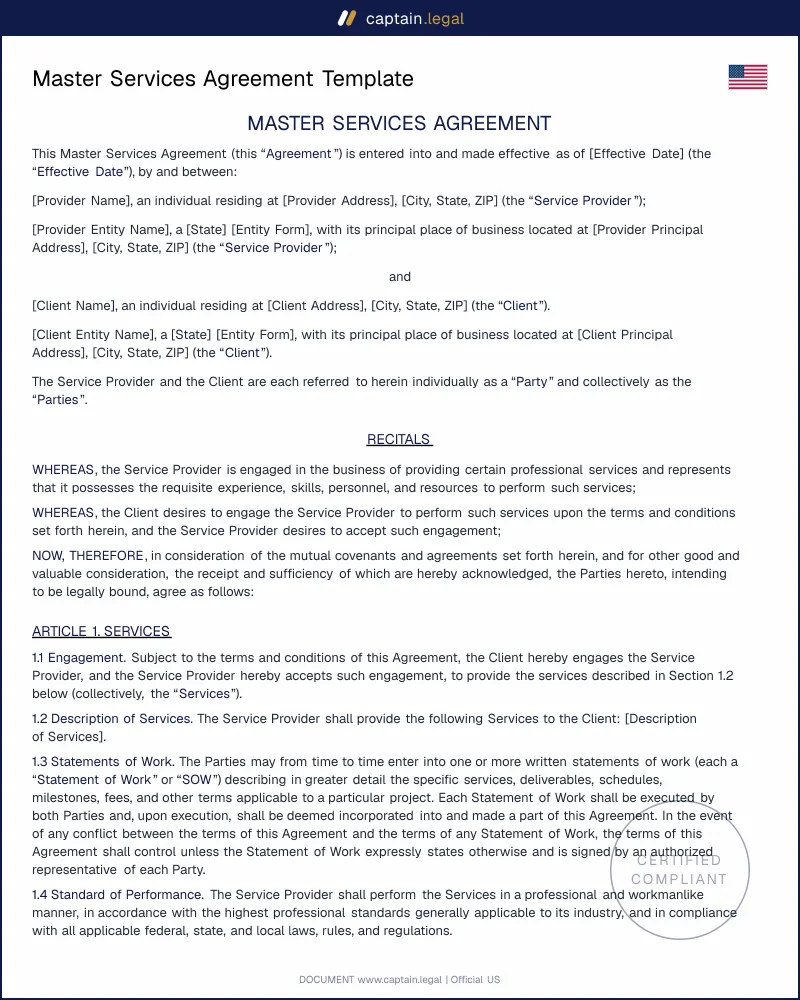
You start by selecting the state of governing law on the first screen, since that single choice rewires several downstream clauses: the limitation-of-liability language, the non-solicitation duration, the dispute-resolution venue, and the late-payment interest cap all adjust to the state you pick. From there, the form asks for the legal names and entity types of both parties as they appear in the Secretary of State registry — getting the entity suffix right (Inc., LLC, LP, PLLC) matters because a misnamed party can defeat enforcement on a capacity defense. The next step gathers the contact addresses for legal notices, which the template defaults to certified mail with return receipt unless you select an alternate method.
The middle of the flow handles the commercial architecture. You choose between an MSA + SOW structure (recommended for ongoing relationships) and a single Services Agreement covering one engagement. If you pick MSA, the form generates a master document plus a first SOW you can edit immediately or save as a template for later. You then specify the IP regime (work-for-hire, license-back, or hybrid), the confidentiality survival period, and the liability cap multiplier (one-times-fees, two-times-fees, or a fixed dollar amount). The questionnaire surfaces an insurance requirements section if you indicate the engagement involves on-site work, handling of personal data, or a contract value above $100,000.
The final screen lets you review the populated draft, toggle optional clauses (arbitration, AAA Commercial Rules or JAMS Streamlined Rules, mutual non-solicitation of employees, audit rights), and download the finished agreement in Word and PDF formats. The Word file is fully editable for the inevitable redlines from the other side's counsel; the PDF is what you sign. The full catalogue of related contracts is browsable from the US legal documents library once your MSA is saved.
Common mistakes to avoid
The first and most expensive mistake is treating the SOW as the contract. Founders routinely send a one-page scope to a vendor, the vendor signs, work begins, and only when the relationship sours does anyone notice there is no governing law clause, no IP assignment, and no liability cap. A SOW without an underlying MSA is enforceable as a contract, but it inherits the gap-filler default rules of whatever jurisdiction the court decides applies, and those defaults rarely favor the side that didn't draft them. The second mistake is copying an MSA from a public template without adapting the IP clause. A generic "all work product belongs to the Client" sentence sounds bulletproof until the provider points out it would also assign the agency's reusable codebase, methodologies, and trade secrets. The fix is the background IP carve-out described above; without it, the assignment either collapses in negotiation or, worse, leaves the provider's core assets dangling.
A third recurring error is omitting the DTSA whistleblower notice required by 18 U.S.C. §1833(b)(3). The notice is short, the consequence of skipping it is forfeiture of exemplary damages and attorneys' fees in any subsequent trade-secret action, and yet it is missing from the majority of MSAs we review. The fourth is the automatic-renewal trap: an MSA that auto-renews for successive one-year terms with a 90-day non-renewal window that no one diaries. Two years in, the client realizes it has been billed quarterly for services it stopped using twelve months ago, and the unilateral termination for convenience it thought it had is gated by a notice it missed. The fifth is the liability cap that swallows itself — capping aggregate liability at "fees paid in the prior 12 months" while the indemnification obligation is uncapped, then reading the carve-out language as if it shrinks rather than expands the exposure.
Frequently Asked Questions
60 verified reviews · 50 000+ downloads
- Immediate access to the document
- PDF + Word download
- Compliant with 2026 legislation
- Reviewed by lawyers
You might also like