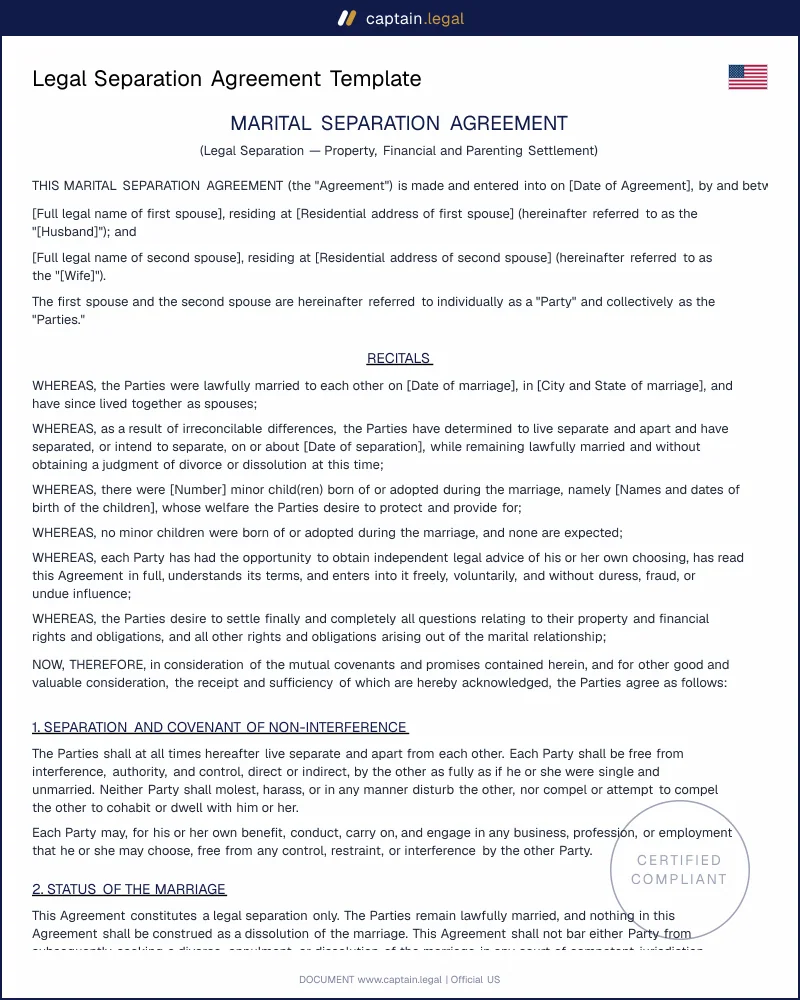
Family law in the United States is overwhelmingly state law, so a separation agreement is "valid" only when it is matched to the right state and executed correctly there. As a baseline, a separation agreement is a contract between spouses, and once both sign it willingly and with full asset disclosure, each is legally bound. If one spouse breaches it, the other can sue for breach of contract or specific performance, exactly as with any other agreement. The clearest authoritative summary of this principle is the Legal Information Institute's entry on marital settlement agreements, which explains how courts treat and enforce these contracts. You can review the Cornell Legal Information Institute overview of marital settlement agreement enforcement for the underlying doctrine.
Enforcement gets stronger when a court incorporates the agreement into an order or decree. Before incorporation, the contract is enforced through ordinary civil litigation. After a judge folds it into a judgment of legal separation or a divorce decree, violating it means violating a court order, which unlocks contempt powers, wage garnishment, and other collection tools. This single distinction, contract versus court order, is the most important practical fact in the whole document.
Two state-law features routinely trip people up. First, child support and custody are never fully private. Most states set support under a guideline formula and require income worksheets, and courts will reject or modify terms that fall short of guideline support or fail the best interests of the child standard. Parents generally cannot waive child support in a way that harms the child, even by mutual consent. Second, property characterization depends on your state's regime. Community property states such as California and Texas start from a roughly equal split of marital property, while equitable distribution states divide what is "fair," which is not always 50/50. Retirement accounts, the marital home, and any business interest are where sloppy drafting causes lasting damage, often surfacing in a related prenuptial agreement reviewed under the UPAA when couples reconcile and renegotiate.