Create my document
Login

Choose country

United StatesUnited StatesChoose country
Personal

HIPAA Authorization for Release of Medical Records

HIPAA medical records release authorization drafted to 45 CFR 164.508: six core elements, three required statements. Editable Word and PDF, all 50 states.
4.8/523 reviews50 000+ downloadsInstant download
Share

A HIPAA medical records release authorization is the written permission that lets a hospital, physician, insurer, or attorney legally access your protected health information. Without it, a covered entity cannot hand your file to anyone outside your own treatment team, and "I told them it was fine" carries no weight at a records desk. This HIPAA authorization form exists for the ordinary but high-stakes moments: an adult child coordinating a parent's care, an attorney building a personal injury claim, a new physician who needs your prior imaging, or a life insurer verifying a history before issuing a policy. Get the fields right and the records move in days. Get one core element wrong and the release is void under federal law, even with your signature on it.

Compliant

2026 Legislation

50,000+ clients

trust us

Affordable

From $4.90 / doc

Secure payment

Instant download

HIPAA Authorization for Release of Medical Records

Secure payment

Fill in the template

What is a HIPAA medical records release authorization?

A HIPAA medical records release authorization is a signed document that permits a covered entity (a provider, hospital, health plan, or clearinghouse) to disclose your protected health information to a person or organization you name. It is not the same thing as the consent form you sign at check-in. That consent covers treatment, payment, and routine operations. This authorization is narrower and stricter: it targets a specific recipient, a specific set of records, and a specific purpose, and it is revocable at any time.

The distinction that trips people up is authorization versus request. When you ask your own provider for your own records, that is a patient access request under the right to access, and different timelines apply. When you direct records to a third party such as a spouse, an insurer, or an attorney, that is a formal authorization governed by 45 CFR §164.508. The form on this page is built as a compliant authorization, so it works whether you are pulling your file for yourself or routing it to someone else. One legal quirk worth knowing: an authorization covering psychotherapy notes cannot be bundled with anything else and must stand alone, a rule that invalidates a surprising number of DIY forms. If your situation involves broader estate or medical planning, our power of attorney template often works alongside a records release rather than replacing it.

2

When do you need this document?

The most frequent trigger is a caregiving handoff. An aging parent moves in with an adult child, and suddenly that child needs to speak with cardiologists, read discharge summaries, and coordinate specialists. Without a signed authorization naming the child as recipient, every hospital call ends the same way: the desk cannot confirm the patient is even there. A second common scenario is litigation. Personal injury attorneys cannot build a case without the underlying treatment file, and providers will not release it on a subpoena alone in many circumstances; a patient-signed authorization naming the firm as recipient creates a clean, enforceable obligation to disclose. Our affidavit of identity template frequently accompanies these requests when a records custodian wants extra proof that the signer is who they claim to be.

Insurance underwriting drives another wave of these forms. Life and disability insurers routinely request a medical history authorization before issuing a policy, and the language must be broad enough to cover the relevant years without becoming so vague that a custodian balks. Switching physicians is the quieter, everyday use: your new practice wants your prior imaging, lab panels, and medication history, and the fastest route is a release directed from the old provider to the new one. The edge case that catches families off guard is the death of a loved one. After death, the authority to release records passes to the personal representative of the estate, typically the executor, and the form must document that representative's legal authority, not merely their relationship. A grieving spouse who signs in their own name, without executor authority, will often see the request denied.

3

Key clauses included in our template

  • The description of the information disclosed is drafted to be specific rather than a blanket "all records" grab. You can scope it to date ranges, record types, or a named condition, which is exactly what §164.508(c)(1)(i) means by identifying information in a specific and meaningful fashion. Vague descriptions are the most common reason a hospital records office bounces a form back.
  • The identification of the disclosing party and the recipient names each side explicitly, whether that recipient is a person, a class of persons, or an organization such as a law firm or insurer. Institutions will not act on a form that leaves either party ambiguous, and a missing recipient is a documented top-four defect in audited authorizations.
  • The statement of purpose is included even though "at the request of the individual" is legally sufficient when you initiate the release yourself. Many form authorizations omit purpose entirely, which is a recurring validity failure, so the template prompts you to state it clearly.
  • The expiration date or triggering event ties the authorization to a concrete endpoint, such as a fixed date or the conclusion of a claim. An open-ended release is valid only in narrow circumstances like research, so the template steers you toward a defensible expiration.
  • The three required statements on written revocation, treatment conditioning, and redisclosure are built in verbatim to the regulatory standard, so the form does not fail for the single most common compliance defect.
  • The representative authority block lets a personal representative, guardian, or agent sign on the patient's behalf while documenting the legal basis for that authority, which record custodians scrutinize closely.
4

State-specific considerations

While HIPAA sets the federal floor, several states layer stricter rules on top, and those state rules govern whenever they offer greater protection.

California applies the Confidentiality of Medical Information Act (Cal. Civ. Code §56 et seq.), which imposes disclosure limits that in places exceed HIPAA and gives patients a private right of action for improper release. A California authorization directed at mental health, HIV, or genetic information often needs more specific language than a bare HIPAA form provides, and providers there tend to demand tighter scoping before releasing sensitive categories.

New York protects HIV-related information with unusual force under Public Health Law Article 27-F, which requires a specific, dedicated authorization that a general medical release will not satisfy. New York also uses a standardized statewide authorization form (OCA-960) that many providers prefer for litigation-related releases, so a claimant should expect the recipient to request that specific format.

Texas operates under the Texas Medical Records Privacy Act (Tex. Health & Safety Code Chapter 181), which extends HIPAA-style duties to a broader set of entities than the federal rule and sets its own penalties for improper disclosure. Texas providers generally honor a compliant HIPAA authorization but may attach their own cover sheet for internal tracking.

Florida governs patient records through Fla. Stat. §456.057, which spells out who may authorize release and how quickly a provider must respond, and it treats psychiatric and substance use records with added care. Across all four states, the safest approach is a form that satisfies the federal core elements first, then adapts the sensitive-category language to the state where the records physically sit.

5

How to fill out this HIPAA medical records release authorization

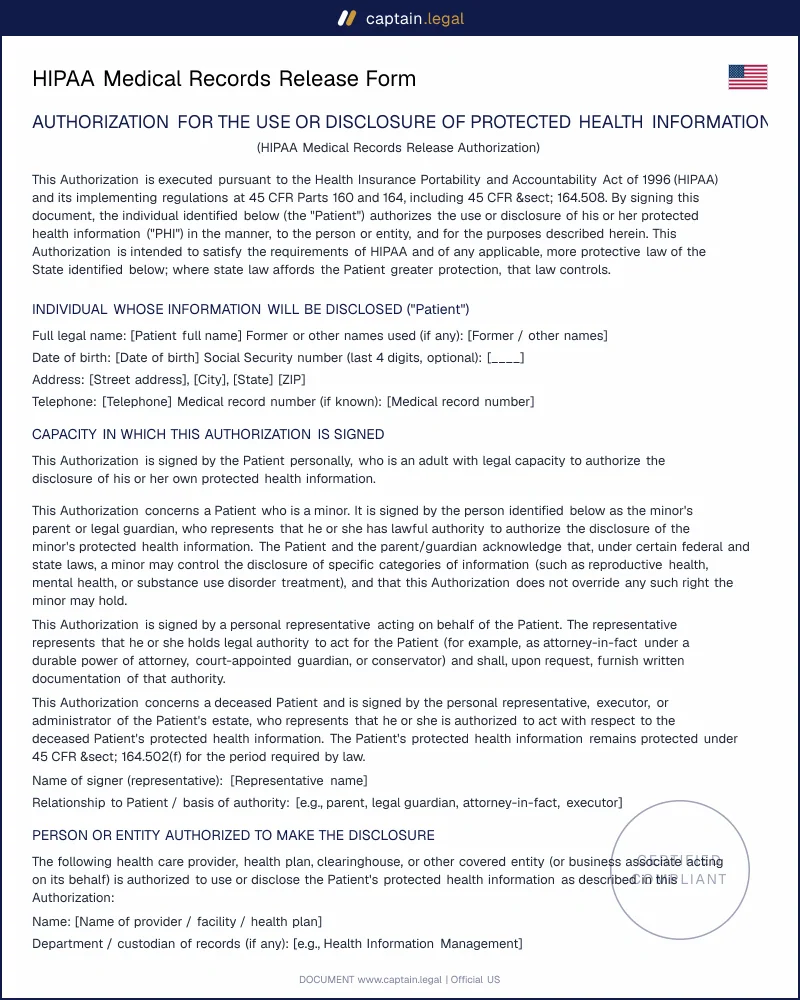
You start by identifying the patient exactly as their name appears in the medical record, including date of birth, so the custodian can match the request to the right file without ambiguity. From there you name the disclosing party, meaning the specific hospital, clinic, or physician that holds the records, and then the recipient, whether that is you, a family member, an attorney, or an insurer. The template then walks you through scoping the information: you choose date ranges and record types rather than checking a blanket "everything" box, because specificity is what makes the form enforceable. Next you set the purpose and an expiration, either a fixed date or an event such as the close of a claim. The form supplies the three mandatory statements automatically, so you do not have to draft revocation and redisclosure language yourself. Finally you sign and date, and if you are signing as a personal representative you document the authority that lets you do so. If the release supports estate administration, pairing it with our last will and testament template keeps the paperwork consistent. You can download in editable Word and print-ready PDF formats across the personal documents library once complete.

6

Common mistakes to avoid

The mistake that voids more authorizations than any other is the blanket description. A form that says "any and all records, no expiration" fails the specificity requirement, and a careful records office will reject it rather than risk an over-disclosure. Close behind is the omitted expiration, since an authorization with no endpoint is valid only in the narrow research context. People also forget that the three required statements are not optional decoration; a form missing the revocation, conditioning, or redisclosure notice is void even though it looks complete and bears a signature. Another frequent error is trying to bundle a psychotherapy notes release into a general form, which HIPAA forbids because those notes demand a standalone authorization.

On the signing side, the recurring failure is the representative who signs without documenting authority. A spouse or adult child who signs in their own name, without executor letters, a guardianship order, or an agent designation, gives the custodian a reason to refuse. Substance use records add their own trap, because a standard HIPAA form does not satisfy 42 CFR Part 2 for federally assisted treatment programs. When a claim or dispute is involved, keeping the release aligned with your broader family and divorce document set prevents the contradictions that arise when separate forms describe the same records differently.

Key takeaways

LEGAL VALIDITY

One missing element makes it void

This is not a casual permission slip. Under 45 CFR 164.508, a HIPAA authorization must include six core elements: specific description of the information, who may disclose, who receives it, the purpose, an expiration date or event, and a dated signature (patient or authorized representative). If any one is missing, the release can be invalid even if signed, and the records desk may refuse to send anything.

REQUIRED WARNINGS

Three disclosures must be on the form

A compliant authorization must also include three required statements in 45 CFR 164.508(c)(2): you can revoke it in writing, treatment and payment generally cannot be conditioned on signing, and once information is disclosed it may be re-disclosed and lose HIPAA protection. Leaving out any one of these warnings is a common compliance failure and can make the authorization unusable when time matters.

PRACTICAL PATH

Authorization is different from access requests

Know whether you are requesting your own records or directing them to someone else. Getting your own chart is a patient access request with different rules, including a 30-day response timeline under 45 CFR 164.524. Sending records to a third party like an attorney, insurer, or spouse is an authorization under 45 CFR 164.508. Also, psychotherapy notes require a standalone authorization, and some substance use disorder records may trigger separate 42 CFR Part 2 requirements.

Frequently Asked Questions

Yes, provided it contains every element the regulation demands. A valid authorization under 45 CFR §164.508 must include the six core elements and the three required statements, and a covered entity is obligated to honor a compliant, patient-signed authorization that names a recipient. Refusing a valid release can itself violate §164.508 and §164.524 and become grounds for a complaint to the HHS Office for Civil Rights. The template is drafted to the federal standard so that a hospital or physician cannot reject it on a technicality. What makes an authorization binding is not the letterhead or notary stamp but the presence of each mandatory field, which is precisely where homemade forms fail.

You receive the authorization in both Microsoft Word and PDF. The Word version lets you edit every field, adjust date ranges, add multiple recipients, or tailor the sensitive-category language to your state before printing. The PDF is the clean, signature-ready copy that most records offices expect to receive. Because HIPAA does not require notarization for a standard authorization, a printed signature is generally enough, though some institutions add their own cover sheet. Keeping the editable Word file also means you can revise a single detail later, such as extending an expiration date, without rebuilding the whole document from scratch.

For your own records requested under the right of access, §164.524 gives a provider 30 days to act, with one possible 30-day extension if they notify you in writing of the reason. That timeline applies to patient access requests. When you authorize disclosure to a third party such as an attorney or insurer, HIPAA does not impose the same fixed deadline, and providers may take longer or charge reasonable copying fees. State law sometimes tightens these windows, so a Florida or California provider may face a shorter statutory clock than the federal default. If a provider stalls past 30 days on your own access request, that delay is itself a HIPAA violation.

Only if you are their personal representative with documented legal authority. A parent can generally authorize release for a minor child, and an executor can authorize release for a deceased patient's estate, but the form must record the legal basis for that authority, not just the family relationship. An agent under a medical power of attorney can sign if the underlying document grants records access, which it does not always do by default. Signing in your own name without that authority is the fastest way to have a request denied, because the custodian has no way to verify you may act for the patient.

Often, yes. Psychotherapy notes require a standalone authorization under HIPAA and cannot be combined with any other release. Records from federally assisted substance use disorder programs fall under 42 CFR Part 2, which requires its own distinct consent elements that a general HIPAA form does not satisfy. Several states add further protection for HIV, genetic, and psychiatric information, sometimes demanding a dedicated state form. If your request touches any of these categories, expect the recipient to ask for specific language, and scope the authorization narrowly to the sensitive records at issue rather than lumping them into a general release.

Yes. Every valid HIPAA authorization must tell you that you can revoke it in writing at any time, and this form includes that statement. Revocation takes effect prospectively, meaning it stops future disclosures but cannot undo information already released in reliance on the authorization before you revoked it. To revoke, you send written notice to the party you named as the discloser, and the form identifies where that notice should go. This is one reason to set a sensible expiration date at the outset, since a tightly scoped authorization limits how much can be disclosed even if you never formally revoke it.

Not necessarily, and the form warns you of this directly. HIPAA protects information while it sits with a covered entity, but once records are disclosed to a recipient who is not itself a covered entity, such as an attorney, a family member, or many insurers, the information may be redisclosed and lose its federal protection. This redisclosure notice is one of the three mandatory statements, and it exists so you understand the practical limit of the release. If you are sending sensitive records to a non-covered recipient, it is worth asking about their own confidentiality safeguards, because federal privacy law will no longer be doing that work for you.

4.8/5

23 verified reviews · 50 000+ downloads

HIPAA Authorization for Release of Medical Records
  • Immediate access to the document
  • PDF + Word download
  • Compliant with 2026 legislation
  • Reviewed by lawyers
Fill in the template
Secure payment
Updated on July 14, 2026

You might also like

Living Will & Advance Directive
Affidavit of Identity Template