Filing Articles of Incorporation is the first legal act of a US nonprofit, the moment a mission goes from intention to legal entity. The document is filed with a state Secretary of State (or equivalent agency) to bring a nonprofit corporation into existence, and it doubles as the foundation the IRS reads when deciding whether the organization qualifies for 501(c)(3) tax-exempt status. Founders, board chairs, and incorporators draft it before bylaws, before opening a bank account, before signing leases or hiring staff. Get the language wrong and Form 1023 comes back rejected, sometimes after a six-month wait. Get it right and the rest of the formation work falls into place.
This page covers what the document is in US law, the IRS-mandated clauses that distinguish a charitable corporation from a regular one, when you actually need to file, what is in our template, how filing requirements differ across major states, and the mistakes that delay tax-exempt determination.
Compliant
2026 Legislation
50,000+ clients
trust us
Affordable
From $4.90 / doc
Secure payment
Instant download
Nonprofit Articles of Incorporation — Word & PDF, All 50 States
Secure payment
What is a nonprofit articles of incorporation document?
A nonprofit Articles of Incorporation is the charter of a nonprofit corporation filed with the state to create the entity as a separate legal person. It is sometimes called a certificate of incorporation (Delaware, New York), certificate of formation (Washington), or simply articles of organization in IRS language, but the function is identical: it tells the state who is forming the corporation, what it will do, where it sits, and who acts as its agent for service of process. Once accepted by the Secretary of State, the corporation exists. Before that, the incorporators are personally liable for anything done in the corporation's name.
The nonprofit version differs from the for-profit articles of incorporation template in two ways that matter. First, it states a charitable purpose drawn from the language of Internal Revenue Code §501(c)(3): charitable, religious, educational, scientific, literary, public-safety testing, fostering amateur sports, or prevention of cruelty to children or animals. Second, it permanently dedicates assets to that purpose, so that on dissolution everything remaining flows to another exempt organization or to a government for public use. Those two features are what convert a state-law corporation into a candidate for federal tax exemption. They are not optional, not negotiable, and the IRS reads them word for word.
Legal framework
Three layers of law govern this document, and they have to align. The first is your state's Nonprofit Corporation Act. Most states have adopted some version of the Revised Model Nonprofit Corporation Act or the Model Nonprofit Corporation Act, Third Edition, but each has local quirks: California's Nonprofit Corporation Law (Title 1, Division 2 of the Corporations Code) distinguishes between public benefit, mutual benefit, and religious corporations, while Delaware files nonprofits under the general Delaware General Corporation Law with a non-stock structure. The state statute dictates the minimum contents of the articles, the filing fee, and the rules for amending them later.
The second layer is federal tax law. To qualify under §501(c)(3), the organizational test set out in Treas. Reg. §1.501(c)(3)-1(b) requires three clauses in the articles: a purpose clause limited to exempt purposes, a dissolution clause dedicating assets permanently to an exempt purpose, and a prohibited-activities clause restricting lobbying to an insubstantial part of activities and barring political campaign intervention entirely. The IRS publishes official guidance on required organizing-document provisions under Publication 557, and a wise drafter copies the suggested language almost verbatim because Form 1023 reviewers compare your filing against that wording. Private foundations need one additional set of clauses under §508(e) to comply with the chapter 42 restrictions on self-dealing and excess holdings.
The third layer is state charitable solicitation and registration law. Filing the Articles of Incorporation does not by itself authorize you to ask the public for donations. Roughly forty states require a separate charitable solicitation registration with the state Attorney General or Secretary of State before fundraising begins, and several require initial and annual reports keyed to the corporation's gross receipts. Founders who skip that step often discover the gap when a major donor's grantmaking platform asks for proof of state registration. Our nonprofit bylaws template and the related governance documents are designed to slot directly into the structure created by the articles, so the organization speaks with one legal voice across state, federal, and donor scrutiny.
When do you need this document?
The most common trigger is founding a new charity with the intention of applying for 501(c)(3) status. You cannot file Form 1023 or Form 1023-EZ without an organizing document, and the IRS expects to see the state-stamped, file-stamped articles attached to the application. Unincorporated associations can technically apply, but they expose founders to personal liability and most banks will not open an account without a state certificate of incorporation. Filing first, then bylaws, then 1023 is the standard sequence.
A second scenario is the conversion of an unincorporated group that has been operating informally. A neighborhood mutual-aid network, a school parents' association, a religious congregation that has been collecting offerings for years: at some point the volume of money, the desire to receive deductible contributions, or the need to sign a lease forces incorporation. The articles you file then need to recite both the charitable purpose and, if you want to backdate exemption, a careful timeline that matches IRS look-back rules. The fifteen-month window from incorporation to Form 1023 filing is the deadline that makes exemption retroactive to the date of formation, and missing it means the exempt status only takes effect on the date of the IRS application.
A third trigger is the redomestication or restructuring of an existing nonprofit, which usually requires filing new articles in the new state and dissolving the old entity, or filing articles of merger or domestication where the state allows it. One edge case worth flagging: an organization that wants to convert from a for-profit LLC to a nonprofit corporation cannot simply amend its existing filings. It must form a new nonprofit corporation, transfer assets through a board-approved process that respects the original investors' rights, and reapply for tax status under the new entity. The mistakes in this sequence are mostly tax mistakes, and they are expensive.
Key clauses included in our template
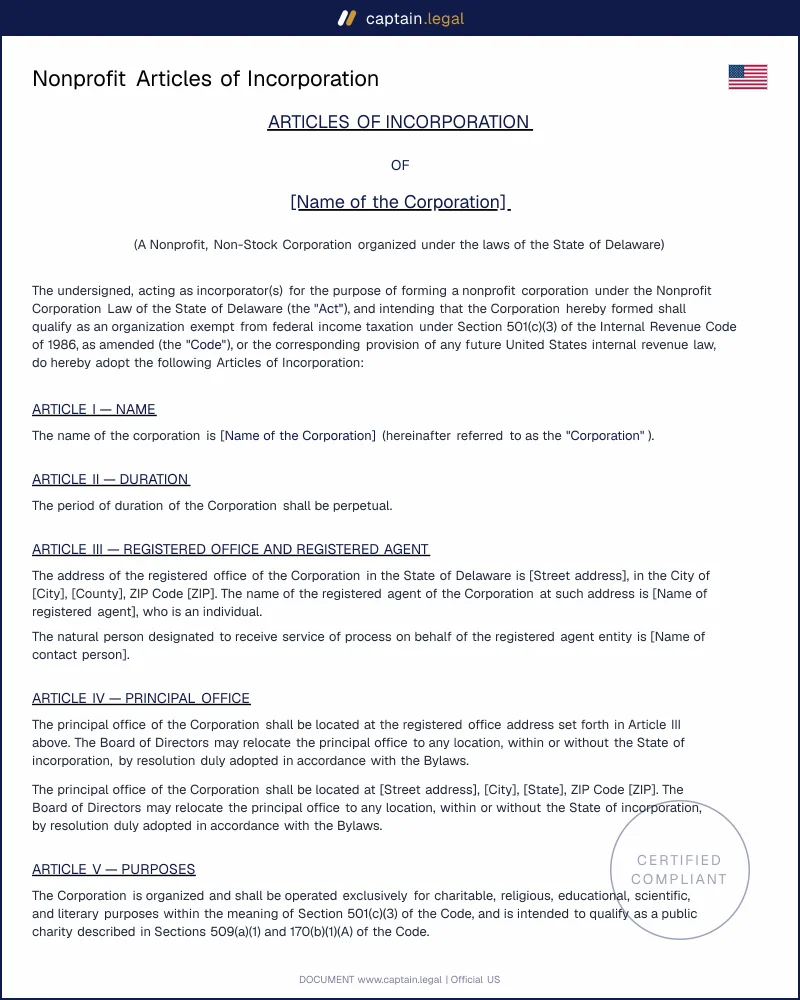
Our nonprofit articles template tracks the IRS suggested language and adapts it to each state's filing form, so the document is filed once and survives both state acceptance and IRS scrutiny. Each clause below corresponds to a section in the generated document.
- The name of the corporation is checked against the state's business-entity database before filing and adjusted if a conflict exists. We include the corporate identifier required by your state ("Inc.", "Corp.", "Corporation", or none, depending on jurisdiction) and reserve the name when state law allows it. A name that survives state review but conflicts with a registered trademark can still be challenged later, so the template flags a separate USPTO search as a recommended step.
- The purpose clause is drafted directly from §501(c)(3) language: "organized exclusively for charitable, religious, educational, and scientific purposes within the meaning of Section 501(c)(3) of the Internal Revenue Code." The template lets you narrow the purpose to your specific mission (educational, environmental, medical research) while keeping the umbrella language the IRS expects. Vague mission statements get deferred at the Form 1023 review stage.
- The registered agent and registered office designate the individual or service authorized to receive legal process for the corporation. Many founders use their own address in the first year and switch to a commercial registered agent once the organization scales; the template handles both setups and produces the registered-agent consent form where the state requires one.
- The board structure clause states that the corporation is managed by a board of directors and lists the initial directors. The IRS expects a minimum of three for a public charity, and most states require at least one. The template also includes language clarifying whether the corporation will have members in the statutory sense, which is the source of most early governance confusion.
- The dissolution clause uses the exact wording the IRS provides: on dissolution, all remaining assets must be distributed to another §501(c)(3) organization or to a government for public purposes. This clause is the most common reason Form 1023 applications are rejected, and the template removes the guesswork.
- The prohibited-activities clause restricts lobbying to an insubstantial part of activities and prohibits political campaign intervention entirely, mirroring Treas. Reg. §1.501(c)(3)-1(c)(3).
State-specific considerations
Each state writes its own corporation statute, and the differences are concrete enough to change how the document is drafted. The US nonprofit document library collects state-aware templates that build on the articles you file here.
Delaware files nonprofits under the Delaware General Corporation Law as non-stock corporations. The state form is short, but the filing requires a registered agent inside Delaware and a certificate of incorporation signed by at least one incorporator. Delaware is popular with national nonprofits and grantmaking foundations because the state's case law on board fiduciary duties is the most developed in the country, but it adds the cost of foreign qualification in every other state where the nonprofit operates. The filing is made with the Delaware Division of Corporations, and stamped copies are returned within a day for standard-fee submissions.
California is the most prescriptive state in the US for nonprofits. The Secretary of State requires articles filed under the California Corporations Code §5100 et seq. for public benefit corporations, with mandatory dissolution language reproduced almost word-for-word from the IRS sample. After filing, the corporation must register separately with the California Attorney General's Registry of Charitable Trusts (Form CT-1) within thirty days of receiving any assets. Skipping the CT-1 step is the single most common compliance gap in California nonprofit formation, and it blocks the organization from soliciting in the state until corrected.
New York files certificates of incorporation under the New York Not-for-Profit Corporation Law (N-PCL), which classifies nonprofits into Types A, B, C, and D depending on purpose. Most charitable nonprofits file as Type B. Certain purposes such as education, healthcare, religion, or cemetery operations require pre-filing consent from a state agency like the Department of Education or the Department of Health, which adds weeks to the timeline. The template walks through whether consent is needed before you file.
Texas uses a certificate of formation filed with the Texas Secretary of State under the Texas Business Organizations Code, and the form is one of the simplest in the country. Texas nonprofits are not automatically required to register for charitable solicitation, which makes the state friendlier for organizations with a primarily local donor base. Texas does require an initial registered agent consent on Form 401-A, and the IRS purpose and dissolution clauses must still be added because the state form does not include them by default.
Florida files under Chapter 617 of the Florida Statutes (the Florida Not For Profit Corporation Act). The Division of Corporations form is functional but bare: the IRS-mandated 501(c)(3) purpose and dissolution language must be added in the "other provisions" section, because Florida's default form does not satisfy the federal organizational test. Florida also requires annual reports with the Division of Corporations and, for fundraising organizations, registration with the Florida Department of Agriculture and Consumer Services.
How to fill out this nonprofit articles of incorporation
You start by selecting the state of incorporation, which sets the form layout, the filing fee schedule, and the mandatory clauses. The template loads the state-specific certificate template and asks for the corporate name, performs a quick check against the state's name-availability rules, and proposes alternatives if the proposed name is already taken or fails to meet the state's identifier requirement. You then enter the principal office address, the registered agent's name and physical address inside the state, and the names of the initial directors. A minimum of three is suggested even where state law requires only one, because the IRS expects three for a public charity.
The next step is the purpose statement. The template offers the IRS suggested language as the default and lets you append a specific mission description so that the state-filed document mirrors what you will write later on Form 1023, Part IV. The dissolution clause and the prohibited-activities clause are inserted automatically with IRS-compliant wording. You add the incorporator's name and signature, and the document generates as a state-ready PDF along with an editable Word file you can adapt during attorney review. Once filed and stamped by the Secretary of State, the document becomes the founding evidence you attach to Form 1023 and present to banks, grantmakers, and the executive director offer letter template you will use to formalize the first hire.
Common mistakes to avoid
The first and most damaging mistake is using a state's bare-bones default form without adding the IRS organizational-test language. Many state forms ask only for the name, agent, and incorporator; nothing more. A nonprofit that files such a stripped certificate and then submits Form 1023 will receive an IRS deficiency letter requiring an amended certificate filed with the state and refiled with the application. This adds three to six months to determination and roughly doubles the filing cost. The fix is to draft a full set of articles with purpose, dissolution, and prohibited-activities clauses, even when the state form does not request them. Pairing the articles with a clean at-will employment agreement for nonprofit staff from day one also prevents the parallel mistake of running operations on informal hiring letters.
The second mistake is drafting a purpose so broad that it looks like a for-profit business. Phrases like "any lawful purpose" or "general charitable activities" trigger IRS skepticism because they suggest the corporation could pivot to non-exempt work. The cure is to bind the purpose to the §501(c)(3) categories and then describe the specific mission. The third mistake is omitting the dissolution clause or wording it as a discretionary board decision. The IRS requires the dedication of assets to be mandatory and permanent. The fourth mistake is mixing up the incorporator and the registered agent: the incorporator signs the founding document, the registered agent receives legal process for the life of the corporation, and they have different responsibilities. The fifth mistake is filing the articles and assuming the work is done. The articles create the entity, but they do not produce bylaws, board minutes, an EIN, a state charitable registration, or Form 1023 approval. Each of those is a separate step, and skipping any of them leaves the organization legally formed but operationally exposed.
Frequently Asked Questions
22 verified reviews · 50 000+ downloads
- Immediate access to the document
- PDF + Word download
- Compliant with 2026 legislation
- Reviewed by lawyers
You might also like