A prenuptial agreement is a written contract two prospective spouses sign before marriage to define how their property, debts, and financial obligations will be treated during the marriage and, more importantly, if the marriage ends by divorce or death. Lawyers also call it a premarital agreement or, in older case law, an antenuptial agreement. It overrides the default state rules on community property, equitable distribution, spousal support, and inheritance, replacing them with terms the couple negotiates themselves. People sign one to protect a business interest, shield separate property brought into the marriage, keep pre-marital debt isolated, plan around children from a prior relationship, or simply remove uncertainty from a question most couples would rather not litigate later. Done right, the document quietly does its job for decades. Done poorly, it gets torn up on the courthouse steps.
Compliant
2026 Legislation
50,000+ clients
trust us
Affordable
From $4.90 / doc
Secure payment
Instant download
Prenuptial Agreement: Protect Assets Before Marriage | All 50 States
Secure payment
What is a prenuptial agreement?
A prenuptial agreement is a contract between two people who intend to marry, executed before the wedding, that governs the property and financial aspects of their relationship. The Uniform Premarital Agreement Act defines it as "an agreement between prospective spouses made in contemplation of marriage and to be effective upon marriage". It takes effect the moment the marriage is valid, and not a day earlier. If the marriage never happens, the agreement dies with it.
People often confuse it with a postnuptial agreement, which is the same kind of contract signed after the wedding. The difference matters: postnups face heavier judicial scrutiny in many states because the parties already owe each other fiduciary duties as spouses, while prenups are negotiated between two legal strangers who are still free to walk away from the marriage entirely. Different again is a cohabitation agreement, used by unmarried couples, which has no statutory framework in most jurisdictions and rests entirely on ordinary contract law.
The scope of a prenup is narrower than most people assume. It can address property division, spousal support (with limits), life insurance, retirement benefits, inheritance rights, the choice of law governing the contract, and the handling of pre-marital debt. It cannot adjudicate child custody or child support, which remain subject to a judge's review of the child's best interest. It also cannot include terms that violate public policy, such as penalties for infidelity tied to property forfeiture, which several state supreme courts have struck down as unenforceable. A prenup is a financial instrument, not a lifestyle contract.
Legal framework
Prenuptial agreements in the United States are governed by state law, not federal law, and the doctrinal landscape splits between two camps. Twenty-eight states plus the District of Columbia have enacted some version of the Uniform Premarital Agreement Act (UPAA), drafted by the Uniform Law Commission in 1983, or its 2012 successor the Uniform Premarital and Marital Agreements Act (UPMAA). The remaining twenty-two states apply their own common-law and statutory rules, which often track the UPAA's substance while differing on procedural details. Whichever camp applies, four constants run through every state: the agreement must be in writing, signed by both parties before the wedding, supported by full and fair financial disclosure, and entered into voluntarily without duress, fraud, or unconscionability. Oral agreements have no value, and a marriage itself is the only consideration the law requires.
Beyond those constants, states diverge on the formalities. Notarization is treated very differently across jurisdictions: in New York, the Domestic Relations Law §236(B)(3) requires the agreement be "acknowledged or proven in the manner required to entitle a deed to be recorded", the same formal acknowledgment used in real estate transfers, and an ordinary jurat is not enough. California's Family Code §1615 imposes a mandatory seven-day waiting period between the moment one party first receives the draft and the moment the parties sign, designed to defeat last-minute pressure. Florida's §61.079 tracks the UPAA closely but requires that the financial disclosure either be substantial or expressly waived in writing.
The question of independent legal counsel is the second major fault line. No state strictly requires each spouse to retain a separate lawyer, but courts in New York, California, Massachusetts, and a growing number of UPMAA states treat representation as a near-decisive factor on enforceability. California Family Code §1612(c) goes further and bars enforcement of any spousal-support waiver if the party giving up the right was not represented by independent counsel when signing. For background and state-by-state context, the Legal Information Institute summary of premarital agreements at Cornell Law School is the cleanest starting point.
When do you need this document?
The most common driver is asset protection. One or both spouses arrive at the wedding with property already in hand: a home, a stake in a closely-held business, a vested 401(k), an inheritance, sometimes a portfolio assembled over a decade of single life. Without a prenup, the appreciation on those assets during the marriage often flips into the marital pot, and in community-property states like California or Texas a portion can become joint property even if titled in one name. A short, clean prenup keeps the separate column separate. The same logic runs in reverse for pre-marital debt: federal student loans, a guaranty on a startup, an unpaid tax bill from a previous year. Without an explicit clause walling off pre-marital debt, creditors and divorce courts in several states can reach the new spouse's earnings to satisfy it.
The second classic scenario is the second marriage with children from a prior relationship. Here the prenup pairs with a last will and testament covering all 50 states to make sure the children inherit what their parent intends, instead of having the surviving spouse's elective share absorb the assets and disinherit them by operation of statute. The third driver is business ownership. An entrepreneur with a stake in an operating company or business formation documents already in place rarely wants a divorce court ordering the forced sale of equity or appointing a receiver. A well-drafted prenup carves the business out and protects co-owners who never agreed to be married to anyone.
Two edge cases deserve a flag. The immigrant-marriage scenario, where a foreign-born spouse signs a prenup just before entry on a fiancée visa, often falls apart in court because language barriers and visa pressure look like duress to a judge. The other is the shotgun-prenup signed within forty-eight hours of the ceremony: even outside California's seven-day rule, a last-minute signature is the single most reliable way to make the document unenforceable.
Key clauses included in our template
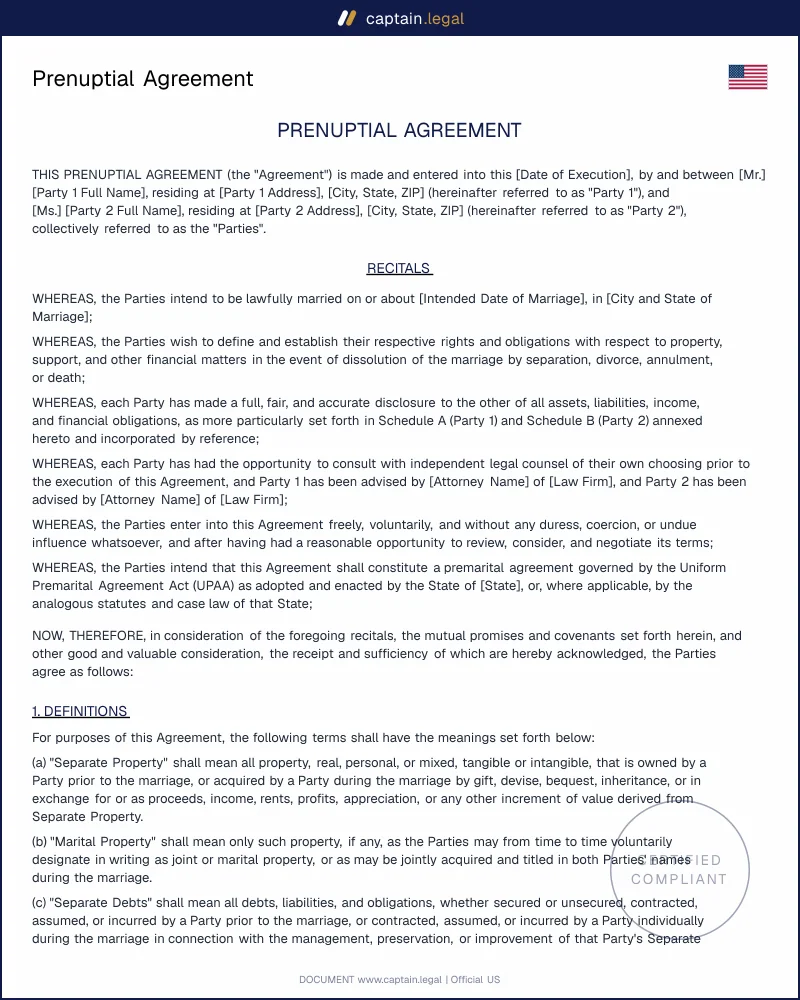
- The identification and representations clause names both parties as they appear on government-issued ID, recites the planned marriage date, and includes a statement that each party enters the agreement voluntarily, after adequate time for review, with the ability to seek independent counsel. Courts read this clause first when enforceability is challenged.
- The full financial disclosure schedule is the backbone of the document. Each spouse attaches a sworn schedule of assets, liabilities, income, and reasonably anticipated inheritances. A signed waiver of further disclosure is permitted under the UPAA but disfavored: the safer practice is complete disclosure, even when assets are modest, because §1615(a)(2) and its state analogues make an undisclosed asset the single most common ground for setting a prenup aside.
- The separate property clause defines what each spouse owns going in, including appreciation, rents, profits, and reinvestments derived from those assets. This is where careful drafting matters most: a vague reference to "my business" gets construed against the drafter, while a specific schedule listing the entity, the percentage owned, and the valuation date is bulletproof.
- The marital property clause covers what the spouses will treat as jointly owned during the marriage, including the family home, joint accounts, and post-marriage earnings if the couple chooses that route. In community-property states this clause often opts out of community treatment for specific categories; in equitable-distribution states it often opts in to clearer joint ownership.
- The debt allocation clause walls off pre-marital debt and assigns responsibility for debts incurred during the marriage. It binds the spouses against each other but does not bind outside creditors, who can still pursue any party they have a direct claim against. Couples sometimes pair the clause with an indemnification provision so the spouse who pays a debt the contract assigned to the other can recover.
- The spousal support clause defines whether alimony will be paid, in what amount, and for how long, if the marriage ends. California Family Code §1612(c) and its sister statutes restrict the enforceability of any waiver unless the receiving party had independent counsel, and most UPMAA states refuse to enforce a waiver that would leave a spouse on public assistance.
- The death and inheritance clause coordinates the prenup with each spouse's estate plan, typically waiving the surviving spouse's elective share against the deceased spouse's estate in exchange for life insurance, a trust interest, or specified property. This clause must be drafted hand-in-hand with the will and any power-of-attorney instruments, or it creates internal contradictions a probate court will exploit.
- The choice of law and severability clauses select the governing state and provide that if any single provision fails, the rest of the agreement survives. Couples who expect to relocate frequently should pay particular attention to choice of law, since enforceability turns sharply on which state's rules apply at the time of divorce.
State-specific considerations
California sits at the strict end of the spectrum. The Uniform Premarital Agreement Act is codified at Family Code §§1600-1617, and §1615 imposes a mandatory seven-day cooling-off period between presentation of the final draft and signature, with no exceptions even when both parties want to sign earlier. As a community-property state, California treats post-marriage earnings as jointly owned by default, which makes the separate-property clause essential for any couple who wants a different result. Any spousal-support waiver requires the affected party to have independent legal counsel at signing, under §1612(c), with no possibility of waiving the requirement itself. Courts also scrutinize agreements signed by a party who does not speak fluent English, and the statute requires the document and the financial disclosure to be in the language the party reasonably understands.
Texas has enacted the Uniform Premarital Agreement Act at Family Code chapter 4, sections 4.001-4.010. Section 4.002 requires only a writing and signatures, with no notarization or witness requirement, which makes Texas one of the easier states for execution. The trap is enforcement under §4.006: a Texas prenup falls if the challenging spouse proves the agreement was both unconscionable when signed and lacked fair financial disclosure. Texas is also a community-property state, so couples who want anything other than the default 50/50 split of post-marriage earnings need a clear partition or exchange clause under the parallel §4.102. Choice-of-law clauses are honored aggressively by Texas courts as long as the chosen state has a real connection to the parties.
Florida codified the UPAA at §61.079 of the Florida Statutes, and the structure is familiar: writing, signatures, voluntariness, disclosure or written waiver. The Florida twist is the In re Estate of Lutgert line of cases, which sets a particularly high bar for disclosure when the agreement affects rights at death. Florida courts also pay close attention to the time between signature and ceremony, with a few decisions invalidating agreements signed in the final week before the wedding. As an equitable-distribution state, Florida treats marital and separate property under different rules at divorce, and a properly drafted Florida prenup typically focuses on protecting the separate-property column from commingling claims.
New York is the major outlier in this group because it has not adopted the UPAA. Prenups instead fall under Domestic Relations Law §236(B)(3), which requires the agreement be "in writing, subscribed by the parties, and acknowledged or proven in the manner required to entitle a deed to be recorded". This deed-style acknowledgment trips up more New York prenups than any other technical requirement: an ordinary notarial jurat is not enough, and the parties must each appear separately before a notary and acknowledge the agreement as their own free act. Courts in Galetta v. Galetta and its progeny have invalidated prenups for acknowledgment defects alone, even where both parties admitted signing the document. New York is an equitable-distribution state, and judicial review of spousal-support waivers under the J.M. v. G.V. line is markedly stricter than in UPAA jurisdictions.
How to fill out this prenuptial agreement
You start on Captain.Legal by selecting the state of intended marriage and residence. From there the template adapts automatically: a California path adds the seven-day waiting period acknowledgment and the §1612(c) counsel-warning clauses, a New York path inserts the deed-style acknowledgment block and a separate notarial certificate, a Texas path keeps the structure lean while including the partition language of §4.102. You then enter each party's full legal name as printed on government-issued ID, the planned wedding date, and the state where the ceremony will be held, which becomes the default choice of law.
The next stage is the financial schedule. You list each spouse's assets, liabilities, income from employment, income from investments, and any reasonably anticipated inheritance or business interest. The tool guides you to attach valuations rather than rough ranges, because vague disclosure is the single most common ground on which prenups are later set aside. You then select the treatment of separate property, the allocation of debts, the spousal-support provision (waiver, formula, or fixed amount), and the death-and-inheritance coordination with any existing will. Each choice triggers the corresponding statutory citation in the final document. After review you export the final agreement in Word for further legal review and PDF for signature, ready to take to a notary and, where appropriate, independent counsel. The full library is also accessible from the complete catalog of US legal documents.
Common mistakes to avoid
Most prenups that fail in court fail for the same handful of reasons, and almost all of them are avoidable. The first is inadequate financial disclosure. Couples sometimes attach a one-line summary of net worth and call it a schedule. Courts call it grounds for vacatur. Every asset of meaningful value gets listed, valued at a recent date, and supported with a brief description of how the value was calculated. The second is signing too close to the wedding. Even in states without a statutory waiting period, judges read a signature dated three days before the ceremony as evidence of duress, particularly when one side carried more leverage in the relationship. A sound practice is to finalize the agreement no fewer than thirty days before the ceremony.
The third recurring mistake is trying to govern things a prenup cannot govern. Child custody, child support, household chores, fidelity penalties, religious upbringing of future children: courts will sever those clauses and, if they look central to the bargain, may invalidate the entire agreement on public-policy grounds. The fourth is the DIY notarization that ignores state-specific acknowledgment requirements, especially in New York where the §236(B)(3) deed-style acknowledgment is non-negotiable. The fifth, and the most painful, is failing to coordinate the prenup with the estate plan. A spouse signs a prenup waiving the elective share, then leaves the existing will untouched, and the survivor inherits anyway through a beneficiary designation the prenup never addressed. The prenup, the will, and any trust documents covering real property need to speak with one voice.
Frequently Asked Questions
79 verified reviews · 50 000+ downloads
- Immediate access to the document
- PDF + Word download
- Compliant with 2026 legislation
- Reviewed by lawyers
You might also like