Create my document
Login

Choose country

United StatesUnited StatesChoose country
Business

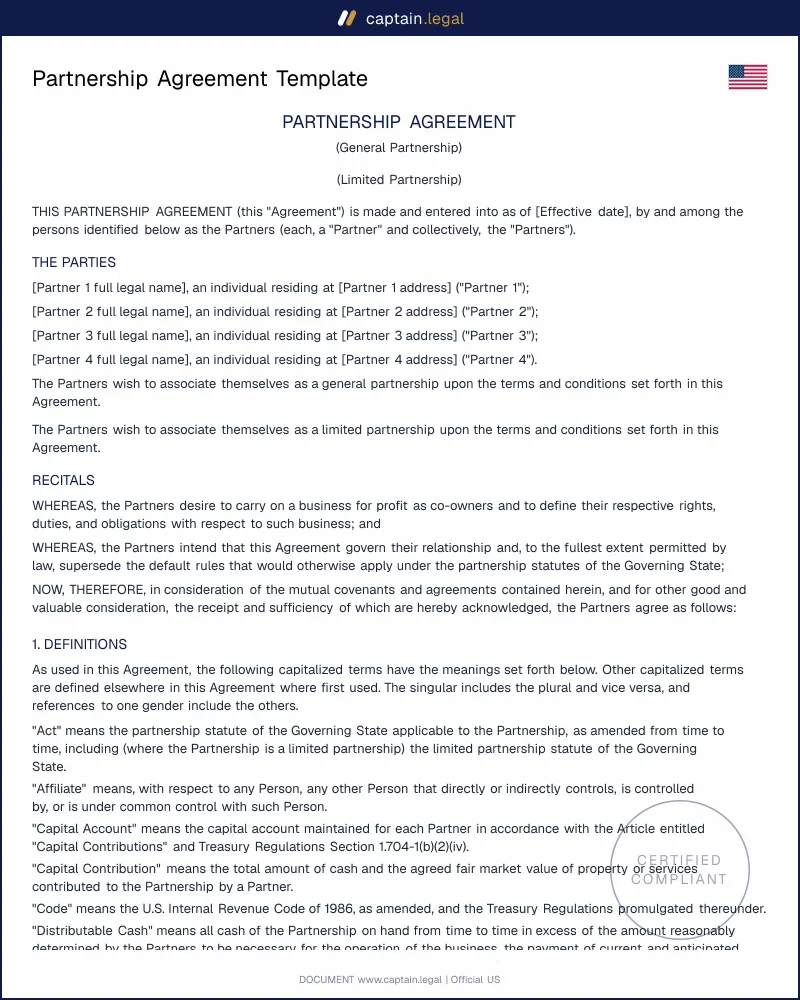
Partnership Agreement Template | RUPA-Compliant, All 50 States

Lawyer-grade Partnership Agreement drafted to RUPA and state law: Corp. Code §16100, Texas BOC Ch. 152, DRUPA §15-101. General & limited partnerships. Word & PDF.
4.8/531 reviews50 000+ downloadsInstant download
Share

A partnership agreement is the private rulebook two or more people sign before they pool money, time, or a client list into a shared business. It fixes profit splits, capital contributions, voting rights, and the buyout math that decides who walks away with what when a partner dies, divorces, or simply wants out. Skip it, and your state's default statute writes those rules for you, usually in ways no founder would choose. Whether you are forming a general partnership between two co-founders or layering passive investors into a limited partnership, this template gives you state-aware language for California, New York, Texas, Delaware, and Florida, delivered in editable Word and signed PDF.

Most partnership disputes are not really about the law. They are about a conversation two partners remember differently three years later. A signed agreement turns that conversation into evidence.

Compliant

2026 Legislation

50,000+ clients

trust us

Affordable

From $4.90 / doc

Secure payment

Instant download

Partnership Agreement Template | RUPA-Compliant, All 50 States

Secure payment · No subscription

Fill in the template

What is a partnership agreement?

A partnership agreement is a contract among the owners of a partnership that governs how the business runs internally: who contributes what, how profits and losses are allocated, who has authority to bind the firm, and how a partner exits. It is the partnership equivalent of an LLC's operating agreement or a corporation's bylaws, and it controls over the statutory defaults on almost every point the partners choose to address.

The structure you pick changes the document. A general partnership makes every partner a manager and exposes each to unlimited personal liability for the firm's debts, which is why the agreement spends real ink on decision thresholds and indemnification. A limited partnership splits the roles: at least one general partner runs the business and carries the liability, while limited partners contribute capital and stay passive, shielded from debts so long as they do not cross into management. That control line is statutory and unforgiving, so a limited partnership agreement reads very differently from a general one. A limited partner who starts directing operations can forfeit the liability shield that was the entire point of the structure.

People confuse a partnership agreement with a joint venture agreement or a simple founders' agreement, but the legal weight differs. A partnership agreement presumes an ongoing business with shared profit motive and triggers fiduciary duties between the partners. If you only mean to collaborate on one project, you may want a narrower contract instead. Our non-disclosure agreement template covering CA, NY, TX and Delaware handles the confidentiality piece if your conversation is still at the exploratory stage.

2

When do you need this document?

The cleanest moment to sign is the one nobody thinks about it: the start, when two or more people agree to run a business together and split the upside. A partnership can form by conduct alone, with no paperwork, so the question is never whether you have a partnership but whether you have one on terms you chose. The most common trigger we see in practice is a 50/50 split between co-founders who assume equality solves everything, right up until one wants to reinvest profits and the other wants to take distributions. The agreement is where you settle that in advance.

You need one when capital contributions are unequal. One partner puts in cash, the other puts in sweat equity or a book of clients, and without written terms the default rule may divide profits equally regardless. That mismatch breeds resentment faster than almost anything else in a small firm. You also need it when bringing in a limited partner or passive investor, because the line between funding the business and controlling it determines whether that investor keeps their liability shield.

The harder cases are the ones that legitimize the document. A partner going through a divorce can see their partnership interest pulled into a marital estate, which is why a well-drafted agreement restricts transfers and gives the firm a right of first refusal. A partner who dies triggers the buyout machinery, and the Virginia Supreme Court's reasoning in Creel v. Lilly confirmed that under RUPA the surviving partners may continue the business and buy out the estate rather than liquidate. If your agreement is silent on valuation, that buyout becomes a lawsuit. The same logic applies to a partner's bankruptcy, disability, or sudden decision to compete against the firm.

3

Key clauses included in our template

  • The identification of the partners and partnership type establishes who is bound and whether the firm is general or limited, which determines the entire liability structure that follows. For a limited partnership it names each general partner and each limited partner separately, because the statutory roles carry different rights and exposures.
  • The capital contributions clause records exactly what each partner brings, whether cash, property, or services, with an agreed valuation for non-cash contributions. It also sets whether and how future capital calls work, so a cash-strapped partner cannot be diluted by surprise or forced to contribute against their will.
  • The profit and loss allocation fixes the percentages, which need not match ownership and need not be equal. This is the clause that overrides RUPA's default of equal sharing, and getting it explicit prevents the single most common partnership argument.
  • The management and voting rights provision defines who decides what, separating ordinary-course decisions from major actions like taking on debt, admitting a partner, or selling assets. It sets the vote threshold for each tier, because a firm where every decision needs unanimity will deadlock by month three.
  • The fiduciary duties and non-compete language states the duties of loyalty and care, and in Delaware in particular it may narrow them by contract where the statute permits. It also restrains partners from diverting opportunities or competing during the partnership. Our state-correct non-compete agreement template covers the standalone version where a broader restraint is needed.
  • The buyout and dissociation terms are the heart of the document, setting the valuation method, payment schedule, and triggering events when a partner exits. A buyout that names a formula, an appraisal process, and a payout period turns a partner's departure into a transaction instead of a fight.
4

State-specific considerations

California governs partnerships under the Corporations Code §16100 et seq., its enactment of RUPA, with limited partnerships under §15900 et seq. The state imposes a fiduciary duty framework that courts read strictly, and partners cannot eliminate the duty of loyalty by agreement, only define its boundaries. California also requires a partnership operating under a name that does not include all partners' surnames to file a fictitious business name statement with the county, a step founders routinely forget. Profit allocations and management terms set in your agreement will control over the statutory defaults, but the underlying fiduciary obligations survive.

New York stands apart by retaining its older Partnership Law rather than fully modernizing to current RUPA, so several defaults differ from the uniform model, particularly around dissolution and a partner's power to force a winding-up. New York also enforces Article 8-B registration requirements for limited liability partnerships, common among the state's law and accounting firms. Because New York's defaults are less partner-friendly on continuity, an explicit dissociation and continuation clause matters more here than in RUPA states. Drafting to the statute rather than a generic template is not optional in New York.

Texas consolidates everything into the Business Organizations Code, with general partnerships under Chapter 152, limited partnerships under Chapter 153, and shared provisions in Chapter 154. §152.204 BOC codifies the duties of loyalty and care, while §153.102 preserves the rule that a limited partner who participates in control can become liable to third parties who reasonably believed they were a general partner. Texas LLPs also carry an annual report obligation to the Secretary of State, due each June 1, and a lapse terminates the liability shield. The state's franchise tax reaches most partnerships, a planning point worth flagging before you choose the structure.

Delaware runs on the Delaware Revised Uniform Partnership Act, 6 Del. C. §15-101 et seq., and is the jurisdiction of choice for sophisticated partnerships precisely because it gives partners the widest freedom of contract. Delaware permits partners to expand, restrict, or even largely eliminate fiduciary duties in the agreement, subject only to the implied covenant of good faith and fair dealing. The Court of Chancery's expertise in entity disputes is a real asset when money is at stake. If you select Delaware law while operating elsewhere, confirm you can also register as a foreign partnership in your home state.

Florida governs through Chapter 620, Florida Statutes, covering both its RUPA enactment and its Revised Uniform Limited Partnership Act. Florida follows the entity theory and the dissociation framework, so a departing partner does not automatically dissolve the firm where the agreement provides for continuation. The state requires limited partnerships and LLPs to file with the Division of Corporations and maintain a registered agent. Florida's lack of a state income tax makes the partnership pass-through especially attractive, which is part of why the structure is so common among the state's real estate and service businesses.

5

How to fill out this partnership agreement

You start by choosing the structure, general or limited, because that single choice reshapes the rest of the form. From there you select the governing state, and the template loads the correct statutory citations and adjusts the default rules it needs to override, so a California agreement reads differently from a Delaware one without you tracking the differences yourself. You then name each partner and specify their role, which for a limited partnership means tagging each person as a general or limited partner so the liability language attaches correctly.

Next you enter the economic terms: what each partner contributes, how contributions are valued, and the percentages for profit and loss allocation. The form lets you decouple profit splits from ownership, which is where unequal contributions get fairly handled. You set the voting thresholds for ordinary and major decisions, then work through the exit mechanics, choosing a buyout valuation method and a payment schedule that survive a death, withdrawal, or dispute. Once the terms are in, you download an editable Word file and a clean PDF ready for signature. If you are forming a company at the same time, the LLC operating agreement drafted to your state's LLC Act covers the alternative entity structure.

6

Common mistakes to avoid

The error that causes the most damage is leaving the buyout clause vague or absent. Partners write "we'll figure out a fair price" and then discover, when one of them dies or quits, that "fair" means a six-figure spread between two appraisers and a year in court. A real buyout names the valuation method, the appraisal process if one is needed, and the payout period, and it specifies every triggering event including death, disability, divorce, bankruptcy, and voluntary withdrawal. The second frequent mistake is treating an equal profit split as automatic fairness when contributions are unequal, which quietly poisons the partnership until the under-rewarded partner walks.

Founders also routinely rely on the statutory defaults without reading them, assuming the law will produce sensible results. It often will not: RUPA's default gives every partner equal management votes regardless of contribution, and in New York the older Partnership Law lets a single partner force dissolution in ways that can blindside the others. A fourth mistake is letting a limited partner drift into management, which in Texas under §153.102 BOC and similar statutes elsewhere can strip the liability shield the limited partnership was built to provide. Finally, partners forget the administrative filings, the fictitious name registrations, the annual reports, the foreign qualifications, and a lapsed filing in a state like Texas terminates LLP protection entirely. The independent contractor agreement template is the right tool when someone is working with the firm rather than owning part of it, a distinction partners blur at their peril.

Key takeaways

Default rules

If you do not sign, the statute does

A partnership agreement is your private rulebook for profit splits, capital contributions, voting, authority, and exit terms. If you skip it or leave gaps, your state’s partnership statute (often based on RUPA) supplies the defaults, and those defaults may be nothing like what founders expect. Put the hard conversations in writing now, before money, labor, or a client list is on the line.

Liability

General vs limited partnership changes exposure

The structure you choose drives both the document and the risk. In a general partnership, every partner is a manager and can face unlimited personal liability for the firm’s debts, so decision thresholds and indemnification matter. In a limited partnership, at least one general partner runs the business and carries liability, while limited partners stay passive and are shielded only if they do not cross into management.

Exits

Plan for dissociation and buyouts upfront

Under RUPA-style rules, a partner leaving does not automatically end the business; the concept is dissociation, not dissolution. That continuity only works smoothly if your agreement spells out the buyout math for common flashpoints like death, divorce, expulsion, or a partner who simply wants out. Without a clear valuation and payout process, the dispute becomes a he-said-she-said fight years later.

Frequently Asked Questions

Yes. A partnership agreement is a contract, and once signed by all partners it binds them on every term it addresses, controlling over your state's statutory defaults under RUPA and its state equivalents. The agreement does not need to be filed with the state to be enforceable between the partners, though limited partnerships and LLPs do require a separate registration with the Secretary of State or Division of Corporations to establish the entity itself. Courts enforce these agreements routinely. The one limit worth knowing is that some fiduciary duties, particularly the duty of loyalty in states like California, cannot be eliminated entirely by contract, only defined within statutory bounds. Delaware allows the widest contractual freedom on this point.

Trust is exactly when you should sign. A partnership forms by conduct alone, so without a written agreement your state's default statute silently governs your profit splits, voting, and exits, often in ways neither partner would have chosen. The "we trust each other" phase is the calm before any disagreement exists, which makes it the only time the terms get negotiated without anyone feeling cornered. Most partnership disputes trace back to a conversation two partners later remember differently, and a signed document is what converts that memory into evidence. You are not signing because you distrust your partner. You are signing so a future disagreement stays a business problem instead of becoming a personal one.

In a general partnership, every partner shares management authority and carries unlimited personal liability for the firm's debts, so each partner can bind the business and each is exposed if it fails. In a limited partnership, the roles split: at least one general partner runs the operation and bears the liability, while limited partners contribute capital, stay passive, and are shielded from the firm's debts. The catch is that a limited partner who participates in controlling the business can lose that shield. Under §153.102 BOC in Texas and parallel rules elsewhere, a limited partner who acts like a general partner becomes liable to anyone who reasonably believed they were one. Choose the structure before you draft, because it reshapes the whole agreement.

Partnerships are pass-through entities for federal tax, meaning the firm itself pays no income tax. Profits and losses flow through to the individual partners, who report their share on their personal returns, whether or not the cash was actually distributed. The partnership files an informational return, Form 1065, and issues each partner a Schedule K-1 showing their allocated share. State treatment varies: California requires its own partnership return and imposes an annual fee on LPs and LLPs, while Texas reaches most partnerships through its franchise tax. Florida, with no state income tax, makes the pass-through especially efficient. Your profit allocation in the agreement controls how that taxable income is divided, which is one more reason to set it explicitly.

You receive the document in editable Microsoft Word format and as a clean, signature-ready PDF. The Word file matters because partnership terms are negotiated, and you will almost always adjust contribution amounts, profit percentages, or buyout terms before everyone signs, which a flat PDF will not let you do cleanly. The PDF is the version you sign and keep, suitable for your records, your accountant, and any bank or investor who asks to see your governance documents. Both formats carry the state-specific clauses you selected, so the file is ready to use rather than a generic skeleton you have to rework. You can revisit and regenerate as the partnership grows or partners change.

Generating the document itself takes only a few minutes once you have your terms decided. The real time is in the conversation beforehand: agreeing on profit splits, voting thresholds, and buyout valuation is where partners should spend their effort, because those are the terms a dispute will turn on. Plan to have the economic and exit terms settled before you sit down with the form. After generating, give every partner time to read the draft and raise questions before signing, since a partner who signs without understanding the buyout clause is the partner most likely to contest it later. There is no statutory waiting period; the agreement is effective as soon as all partners sign.

Yes, and well-run partnerships do. A partnership agreement is meant to be amended as the business grows, partners join or leave, or the economics shift. The agreement itself should contain an amendment clause stating the vote required to change it, commonly unanimous consent for fundamental terms like profit splits and a lower threshold for routine updates. Any amendment should be in writing and signed by the partners whose approval the clause requires, then kept with the original. Avoid informal "we agreed to change it" understandings, since an unwritten amendment recreates the exact ambiguity the agreement was meant to eliminate. Revisit the document whenever you admit a partner, change contributions, or restructure management.

Under RUPA and its state equivalents, a partner's departure is a dissociation, not an automatic dissolution, so the business can continue if the agreement provides for it. The departing partner, or their estate in the case of death, is bought out according to your buyout clause: the valuation method, payment schedule, and triggering events you set in advance. Where the agreement is silent, the statutory default applies, which often forces a valuation fight or even a winding-up that nobody wanted. This is why the buyout terms are the most consequential part of the document. A clear clause turns a partner's exit into a defined transaction; a missing one turns it into litigation while the business stalls.

4.8/5

31 verified reviews · 50 000+ downloads

Partnership Agreement Template | RUPA-Compliant, All 50 States
  • Immediate access to the document
  • PDF + Word download
  • Compliant with 2026 legislation
  • Reviewed by lawyers
Fill in the template
Secure payment · No subscription
Updated on June 30, 2026

You might also like

Terms of Service Template
Non-Compete Agreement