Create my document
Login

Choose country

United StatesUnited StatesChoose country
Business

Post-Money SAFE | Rule 506 & Securities Act Compliant

Lawyer-grade post-money SAFE modeled on Y Combinator's form, drafted to the Securities Act of 1933 and Reg D Rule 506. Form D guidance and side letter included.
4.8/515 reviews50 000+ downloadsInstant download
Share

A post-money SAFE is the fastest way for an early-stage startup to take in capital without negotiating a priced equity round. Modeled on the Y Combinator post-money SAFE, this template lets a founder and an investor agree on the two numbers that actually matter, the valuation cap and the discount, and defer the heavy machinery of a Series A to later. The instrument converts into preferred stock when the company raises its next equity financing, gets acquired, or goes public. It carries no interest, no maturity date, and no debt on your balance sheet, which is exactly why it has become the default simple agreement for future equity for pre-seed and seed founders raising on a rolling basis.

This page walks through what a post-money SAFE does, the federal securities framework that governs it, the clauses our template includes, and the practical mistakes that sink first-time raises.

Compliant

2026 Legislation

50,000+ clients

trust us

Affordable

From $4.90 / doc

Secure payment

Instant download

Post-Money SAFE | Rule 506 & Securities Act Compliant

Secure payment · No subscription

Fill in the template

What is a post-money SAFE?

A SAFE, short for simple agreement for future equity, is a contract in which an investor gives a startup cash now in exchange for the right to receive equity later, at the price set by a future financing round. Y Combinator introduced the original SAFE in late 2013 as a cleaner replacement for the convertible note, stripping out the interest rate and the maturity date that made notes a recurring headache. In 2018 it released the post-money version, which is the standard founders use today and the one this template follows.

The word "post-money" describes how ownership is calculated. In a post-money SAFE, the investor's percentage is measured against the company's capitalization after all SAFE money is counted but before the new Series A money comes in. The practical effect is that the investor locks in a fixed ownership percentage that does not move as you stack on more SAFEs. That certainty is good for investors and worth understanding before you sign, because every additional SAFE you issue dilutes the founders, not the earlier SAFE holders. A pre-money SAFE spreads that dilution differently, which is the single most important distinction to grasp when you compare the two.

A SAFE is not a loan and not equity at signing. It sits in between: a binding promise to issue shares on a defined trigger. Until that trigger fires, the investor holds a contract right, not stock, and has no vote and no board seat unless a separate side letter grants one.

2

When do you need this document?

The most common scenario is a pre-seed or seed raise where you want money in the bank fast and neither side wants to spend weeks negotiating a priced round. A SAFE collapses the entire negotiation to one or two numbers, so a founder can close an angel check in days rather than the month a Series A term sheet demands. This is the textbook use, and it covers the large majority of SAFEs signed in the U.S. each year.

A SAFE also fits a rolling close, where you bring in investors one at a time over several months instead of coordinating a single round. Because each SAFE stands alone, you sign them as commitments arrive rather than waiting for a lead to set terms. Founders raising from a mix of angels, accelerators, and early funds lean on this flexibility heavily.

The instrument earns its keep in two edge cases worth flagging. The first is the bridge between rounds, when a company that already raised a priced round needs a quick top-up before the next one and does not want to reopen the prior round's documents. The second is the strategic or first-money-in investor who wants a defined ownership stake but no governance rights yet; pairing the SAFE with a founders' agreement covering vesting and IP keeps the cap table clean before outside money lands. Where a SAFE is a poor fit is a situation that demands immediate voting rights or a fixed repayment date, which is the territory of priced equity or a convertible note.

3

Key clauses included in our template

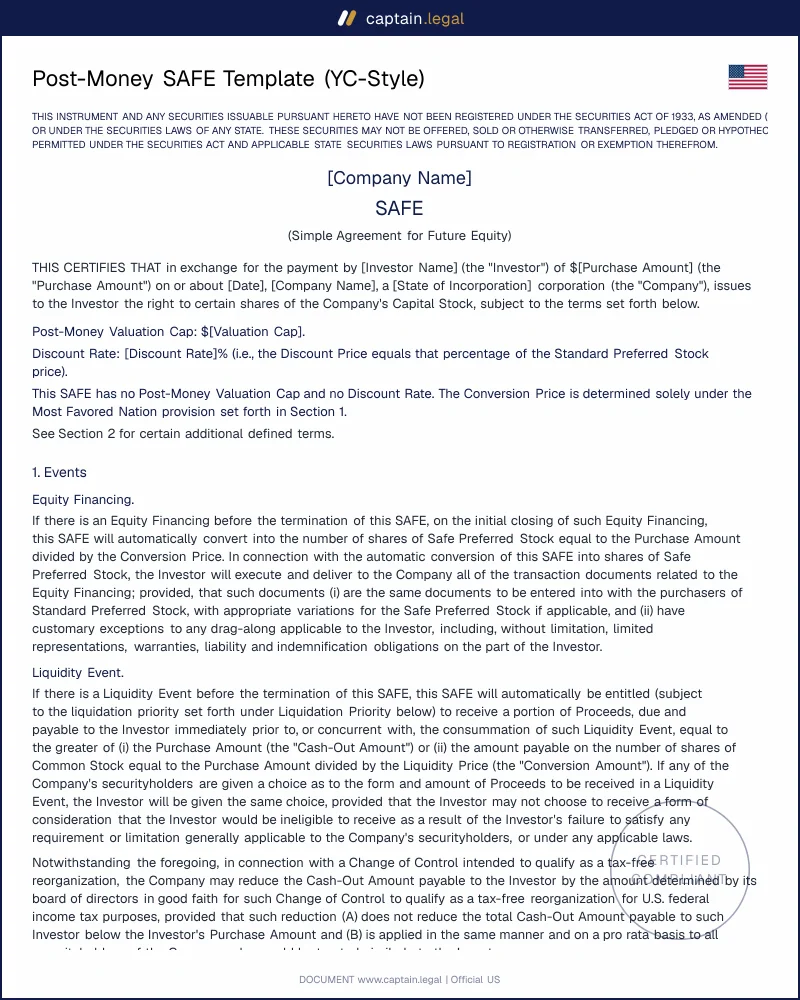
  • The valuation cap sets the maximum company valuation at which the investor's money converts into shares. If your Series A prices the company above the cap, the SAFE holder still converts at the lower cap number and receives more shares for the same dollars, which rewards them for taking early risk. A typical market reference point in recent data is a cap around $10 million for a $1 million raise, though your number depends entirely on traction and leverage.
  • The discount rate gives the investor a percentage reduction off the Series A price per share, commonly 20 percent. Where the template includes both a cap and a discount, the investor converts using whichever produces more shares, the most investor-friendly structure. Many post-money SAFEs run on a cap alone, so you can delete the discount language when it does not apply to your deal.
  • The conversion mechanics define the trigger events: an equity financing, a liquidity event such as an acquisition or IPO, and a dissolution. Each path specifies what the investor receives, so there is no ambiguity about how the contract resolves when money or a sale arrives.
  • The pro-rata side letter is an optional companion document, not a clause inside the SAFE itself. It grants larger investors the right to buy enough shares in the round where the SAFE converts to maintain their ownership percentage. The standard YC pro-rata letter is written for the cap-only SAFE, so adapting it for a cap-plus-discount deal needs careful drafting.
  • The most favored nation provision lets an investor with no cap or discount automatically adopt better terms if you later issue a SAFE on more generous numbers. It protects the earliest believer from being undercut by a subsequent investor.
4

State-specific considerations

Although Rule 506 federally preempts state registration, the blue sky notice filing obligation lives at the state level, and the rules differ enough to match the document to where your investors actually reside.

California is among the strictest enforcers. The Department of Financial Protection and Innovation requires a notice filing with a copy of your Form D for any sale to a California resident, with a fee that scales with offering size, and the state defines a "sale" broadly enough to catch investors who merely use a California address. Treat any ambiguous residency as a California filing to stay safe.

New York historically had a heavy and expensive blue sky regime, and while the state now accepts the federal Form D framework for Rule 506 offerings, its filing mechanics still demand attention and its fees for larger offerings have long run higher than peers. Confirm current New York e-filing requirements before your first New York close rather than assuming parity with other states.

Delaware is where most venture-backed startups incorporate, so your converted SAFE shares will be governed by Delaware corporate law even if you operate elsewhere. That makes your articles of incorporation and authorized share count the documents that must accommodate the future preferred stock the SAFE promises. A Delaware C-corp is effectively a prerequisite for a clean SAFE conversion into the Standard Preferred Stock the YC form contemplates.

Texas and Florida both require blue sky notice filings for resident investors, generally a straightforward submission of the Form D with a modest fee, but the timing windows vary, so calendar each state's deadline from the date of first sale in that state.

5

How to fill out this post-money SAFE

You start by identifying the two parties: the company as the entity issuing the SAFE, and the investor as the individual or fund providing the cash. From there you enter the purchase amount, the dollars the investor is committing, which is the figure that drives the entire conversion calculation later. Next you choose your structure, selecting a valuation cap, a discount, both, or a most favored nation term, and the template adjusts the conversion language to match your selection so you are not left with clauses that contradict each other.

You then set the governing law, which for a Delaware corporation is almost always Delaware, and confirm the company's state of incorporation aligns with where your shares will eventually issue. Once the economic terms are in, both parties sign, and the company keeps the executed SAFE with its cap table records. Before you accept funds, line up your Form D and any state notice filing, because the 15-day clock starts at the first close, not when the round formally ends. If you are issuing several SAFEs across a rolling raise, our terms of service and privacy templates help keep the rest of your founder paperwork consistent as the company scales.

6

Common mistakes to avoid

The error that costs founders the most is stacking SAFEs without modeling dilution. Because a post-money SAFE fixes each investor's percentage, every new SAFE you sign comes entirely out of the founders' ownership, not the earlier investors'. Founders who sign five SAFEs at the same cap without running the math are routinely shocked at how little equity they hold by the time the Series A prices. Build a cap table that adds up all SAFE percentages before you sign the next one, because the conversion is little more than addition and division and is entirely predictable if you do it in advance.

The second cluster of mistakes is regulatory. Treating the SAFE as a handshake and skipping the Form D filing is common and dangerous, since a late filing can void the very exemption that makes the raise legal. Selling to a non-accredited investor under a Rule 506(b) round, or advertising the raise publicly without moving to 506(c) and verifying accreditation, breaks the exemption just as cleanly. Founders also forget that a side letter, not the SAFE body, is where pro-rata and information rights live, so promising an investor pro-rata rights and then handing them a bare cap-only SAFE creates a gap you will have to paper over later. A clean shareholder agreement at the priced round is where those governance rights properly settle.

Key takeaways

Economic Terms

Cap and discount drive the deal

A post-money SAFE is designed to keep the negotiation tight: you usually agree on a valuation cap and a discount, then postpone a priced equity round. It does not pay interest, has no maturity date, and is not booked as debt. The SAFE converts into preferred stock later, typically on the next equity financing, an acquisition, or an IPO.

Dilution Math

Post-money fixes investor ownership early

With a post-money SAFE, the investor’s percentage is measured after all SAFE money is included, but before new Series A money arrives. That structure tends to lock in a fixed ownership slice for earlier SAFE holders as more SAFEs are issued. The tradeoff is straightforward: stacking additional SAFEs typically dilutes founders, not the investors who already signed earlier SAFEs.

Compliance

A SAFE is a securities offering

A SAFE is a security under federal law, so you need SEC registration or a valid exemption. Most founders rely on Regulation D Rule 506(b) (no public advertising; accredited investors plus up to 35 sophisticated non-accredited) or 506(c) (public solicitation allowed, but you must verify every investor is accredited). File Form D on EDGAR within 15 days of the first sale, or you can jeopardize the exemption. States usually still require blue sky notice filings.

Frequently Asked Questions

Yes. A properly completed and signed post-money SAFE is a binding contract and a security under the Securities Act of 1933. Both the company and the investor sign it, and on signing the company owes a legally enforceable obligation to issue shares when a conversion trigger fires. To keep that obligation enforceable and the offering lawful, you must sell only to eligible investors under your chosen Regulation D exemption and file your Form D with the SEC within 15 days of the first sale. The contract is valid without notarization or witnesses; what protects you is correct securities compliance, not extra signatures.

The difference is how the investor's ownership is calculated. A post-money SAFE fixes the investor's percentage against the company's value after all SAFEs are counted but before new round money arrives, giving the investor certainty about exactly what they own. A pre-money SAFE measures ownership before other convertibles are added, which makes dilution harder to predict because it depends on how much you raise in total. The practical consequence is that post-money SAFEs push more of the dilution onto founders, which is why modeling your cap table before signing matters so much.

Most post-money SAFEs use a valuation cap alone, and that covers the large majority of seed deals. A discount-only SAFE rewards the investor with a percentage off the Series A price, commonly 20 percent. When you include both, the investor converts on whichever gives them more shares, the most investor-friendly structure. The right choice depends on negotiating leverage: a sought-after company can often close on a cap alone, while an investor writing an early, high-risk check may push for both. Our template lets you select any combination and adjusts the conversion language to match.

You receive the document in an editable Word file and a clean signature-ready PDF. The Word version lets you adjust the cap, discount, party names, and governing law without retyping the agreement, which matters when you are issuing several SAFEs across a rolling raise. The PDF is formatted for signing and for storing alongside your cap table and Form D records.

A SAFE converts on a defined trigger, most often the next equity financing, typically a priced Series A round, where it turns into preferred stock at the cap or discount price. It also converts on a liquidity event such as an acquisition or IPO, and it resolves on a dissolution. There is no maturity date, so unlike a convertible note a SAFE does not come due on a calendar deadline. It simply waits until one of those events occurs, which is part of what makes it administratively light for both sides.

Under a Rule 506(b) offering you may include up to 35 sophisticated non-accredited investors, but doing so triggers heavier disclosure obligations and most founders avoid it for that reason. Under Rule 506(c), which allows public solicitation of the round, every investor must be accredited and you must take reasonable steps to verify it. The safest default for a first raise is to sell only to verified accredited investors, which keeps your compliance burden light and your exemption clean.

You file a federal Form D electronically through EDGAR within 15 days of your first sale, meaning the date the first investor commits funds. On top of that, most states require a blue sky notice filing wherever an investor resides, usually a copy of the Form D plus a state fee, and some states want that notice before the first sale to their residents rather than after. Track each state's deadline from its own first-sale date, and treat any uncertain investor residency as requiring a filing rather than risking the exemption.

4.8/5

15 verified reviews · 50 000+ downloads

Post-Money SAFE | Rule 506 & Securities Act Compliant
  • Immediate access to the document
  • PDF + Word download
  • Compliant with 2026 legislation
  • Reviewed by lawyers
Fill in the template
Secure payment · No subscription
Updated on June 30, 2026

You might also like

Non-Compete Agreement
LLC Operating Agreement Template