Create my document
Login

Choose country

United StatesUnited StatesChoose country
Employment

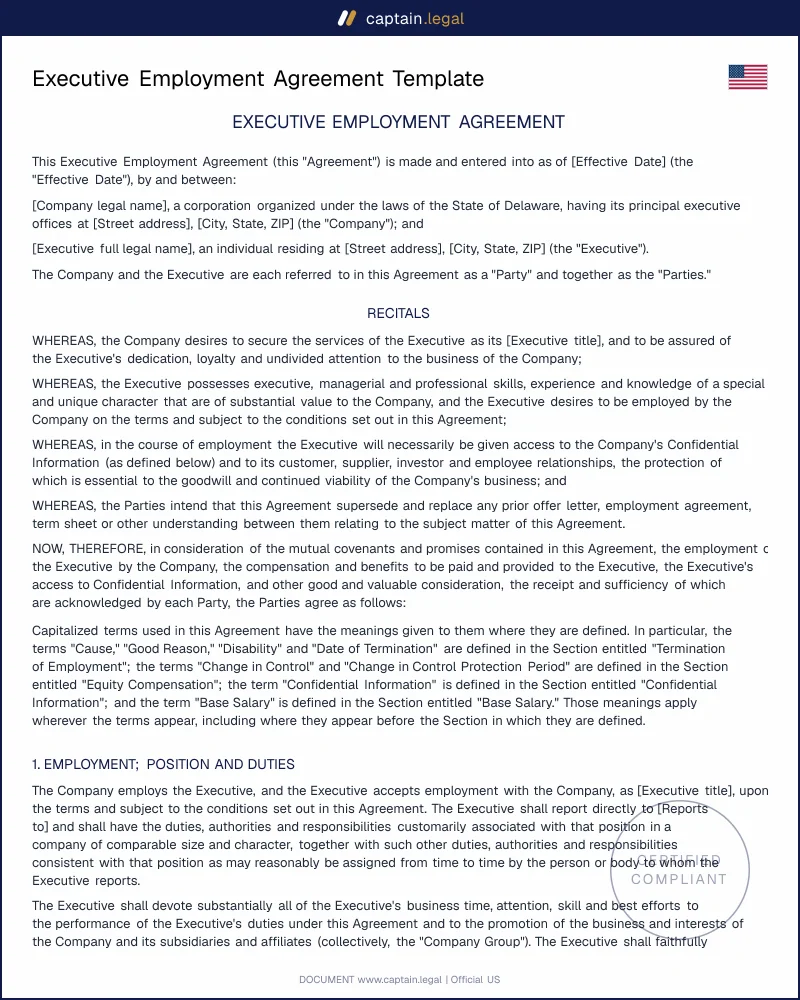
Executive Employment Agreement | 409A & 280G Compliant

Executive contract built to IRC §409A severance timing and §280G parachute rules, with state-specific non-compete clauses for all 50 states. Word & PDF.
4.8/527 reviews50 000+ downloadsInstant download
Share

An executive employment agreement is the contract a company signs with a C-level hire when an offer letter no longer covers the risk on either side of the table. It fixes base salary and target bonus, documents the equity grant and its vesting schedule, and states what happens to that package when the executive resigns for good reason, is terminated without cause, or exits after an acquisition. Boards use it for chief executives, CFOs, CTOs and division presidents, and investors expect to find one in the data room. This template is built around the tax rules that actually govern senior pay, section 409A and section 280G of the Internal Revenue Code, and it adjusts its restrictive covenant language to the law of the state where the executive will work.

Compliant

2026 Legislation

50,000+ clients

trust us

Affordable

From $4.90 / doc

Secure payment

Instant download

Executive Employment Agreement | 409A & 280G Compliant

Secure payment

Fill in the template

What is an executive employment agreement?

An executive employment agreement is a negotiated contract between a corporation and a senior officer, signed before the first day of work and approved by the board or its compensation committee. It differs from an offer letter in scope and in enforceability. An offer letter confirms title, start date and salary, then leaves the rest to default at-will rules. This contract negotiates parts of that default away. Most C-level agreements keep at-will status on paper, then attach a severance obligation to termination without cause, which produces the economics of a fixed term without the tax friction of a guaranteed multi-year commitment. True fixed-term contracts survive in sports, media and university administration, rarely in operating companies.

The document also parts company with the at-will employment agreement used for individual contributors and middle managers on one structural point: it allocates equity. A rank-and-file contract references the stock plan and stops there. An executive agreement states the grant size, the vesting commencement date, the treatment of unvested awards on a change in control, and whether acceleration is single trigger or double trigger. That difference is why boards route these documents through tax and securities counsel before signature, and why a two-page letter for a chief revenue officer almost always ends in a renegotiation.

2

When do you need this document?

The classic trigger is the first outside executive hire in a founder-led company. A board running on offer letters suddenly has to promise a CFO two years of vesting protection and a defined severance package, and no informal document carries that weight. The second trigger is promoting an insider into an officer role, which raises a consideration problem employers rarely anticipate: in several states, continued employment alone will not support a new non-compete signed mid-tenure, so the promotion has to come with a fresh grant or a signing payment the agreement recites as consideration.

Financing and sale processes drive the third wave. Investors reviewing a Series B, or a buyer running diligence, will ask for signed executive agreements, IP assignments and a 280G model, and missing paperwork gets priced into the deal. Relocation is the fourth: moving a California-based officer to Texas changes which covenant statute applies from day one.

Two edge cases deserve attention. An executive who also sits on the board needs this contract plus a separate indemnification agreement, since board service and officer service carry different exposure. And a retired executive returning as an interim officer through a professional employer organization is not covered by the PEO's standard paperwork; the officer duties, the equity and the covenants belong in a direct agreement with the company.

3

Key clauses included in our template

  • The compensation architecture separates base salary from the annual bonus and states whether that bonus is formulaic or discretionary, because the two words carry very different consequences in a wage claim. It also fixes whether a bonus survives a mid-year departure, the term most often litigated after a resignation.
  • The equity grant and vesting schedule records grant size, vesting commencement date, the four-year schedule with a one-year cliff, and the treatment of unvested awards on a change in control. Single trigger and double trigger acceleration appear as drafted alternatives, with a note on the section 83(b) election window for restricted stock.
  • The cause definition is written as a closed list with a cure period for curable conduct, not as an open standard. A vague cause clause hands the executive a strong argument that the termination was really without cause, which turns a clean exit into a severance claim.
  • The good reason clause mirrors the Treasury Regulation safe harbor: material reduction in duties, compensation or reporting line, or relocation beyond a stated radius, with written notice, a company cure period and an outside date for resignation.
  • The severance and benefit continuation package conditions payment on an effective release, sets a fixed payment date independent of when the executive signs, and covers group health continuation for a defined number of months.
  • The 280G protection clause offers a modified cap, sometimes called best-net, cutting payments back below the safe harbor when that leaves the executive better off after tax. Excise tax gross-ups are drafted out by default, since proxy advisers treat them as a governance red flag.
  • The restrictive covenants and clawback cover non-competition, customer and employee non-solicitation, non-disparagement and recovery of incentive pay, each drafted to the standard of the selected state. Founders taking an officer role should also check the stockholders' agreement governing share transfers and drag-along rights.
4

State-specific considerations

California voids employee non-competes under Business and Professions Code §16600, and recent amendments went further: entering into or attempting to enforce a void covenant is itself a civil violation, even where the contract was signed in another state under another state's law. Labor Code §925 removes the usual escape route by making a choice of law or forum clause voidable for an employee who lives and works primarily in California, unless that executive was individually represented by counsel. Customer non-solicitation has fared badly since Edwards v. Arthur Andersen, so California drafts rely on trade secret protection instead.

New York enforces reasonable covenants under the BDO Seidman standard, and statutory ban proposals have not become law. The pressure point is transparency: Labor Law §194-b requires a compensation range in job advertisements, so the posting and the agreement should not diverge. Recoupment of a signing bonus is drafted as a repayment obligation rather than a payroll offset, because Labor Law §193 restricts deductions.

Massachusetts applies the Noncompetition Agreement Act, M.G.L. c. 149 §24L, capping most covenants at twelve months and requiring either garden leave at half the executive's highest annualized base salary or other mutually agreed consideration stated in the contract. The agreement must be delivered before the formal offer or at least ten business days before the start date, and it must tell the executive that counsel may be consulted. It is unenforceable against an executive terminated without cause.

Texas takes the opposite posture. Business and Commerce Code §15.50 enforces a covenant ancillary to an otherwise enforceable agreement, which for an executive usually means the promise to provide confidential information, and §15.51(c) directs courts to reform an overbroad covenant rather than strike it.

Florida now runs two parallel regimes. Fla. Stat. §542.335 remains the general statute, while the CHOICE Act at §§542.41 to 542.45 creates a presumption of enforceability for covered non-compete and garden leave agreements lasting up to four years, provided the executive earns above twice the county mean wage, gets seven days to review, and is advised in writing of the right to counsel. Licensed health care practitioners are excluded. Washington, Colorado, Illinois and Minnesota impose earnings thresholds, notice periods or outright bans, all tracked in the state-by-state non-compete and non-solicitation agreement.

5

How to fill out this executive employment agreement

You start by naming the hiring entity and the state where the executive will primarily perform services, because that selection drives the covenant module, the notice periods and the final pay language. The form then asks whether the role is a corporate officer position and whether the executive joins the board, which switches on the board resignation covenant and the indemnification cross-reference. Compensation comes next: base salary, bonus target as a percentage, and whether the bonus is earned pro rata on departure.

The equity section takes grant type, share count, vesting schedule and acceleration structure, then adapts the change in control definition to your existing stock plan. Severance is built from three inputs, the multiple, the benefit continuation period and the release deadline, and the generated clause inserts a fixed payment date that keeps the arrangement inside the §409A separation pay exception. The last screens cover confidentiality, invention assignment, the 280G cutback and governing law. Output is a Word file for redlining with the candidate's counsel and a signature-ready PDF. Companion documents for the same hire sit in the full catalog of US legal document templates.

6

Common mistakes to avoid

The most expensive mistake is copying a severance clause from a public company proxy without checking payment timing. Filings show the economics, not the §409A plumbing, and a clause paying "within 60 days following execution of a release" across a year boundary is a defect the executive pays for, not the company. A close second is the untested cause definition. Boards that write cause as "conduct detrimental to the company" learn at the worst moment that courts read ambiguity against the drafter, and without-cause severance becomes payable anyway.

Two governance errors surface repeatedly in diligence. Agreements get signed by a fellow officer instead of approved by the compensation committee, which raises a self-dealing question under Delaware General Corporation Law §144 and can reopen the whole package. And 280G is treated as a closing item rather than a drafting item, so the parties discover mid-sale that acceleration triggers an excise tax nobody modeled. Run the base amount calculation when the contract is written. Finally, covenants get recycled across states, and a Massachusetts hire signed on arrival day with no garden leave has effectively signed nothing.

Key takeaways

409A TAX

Severance timing must be locked down

This agreement is drafted around Internal Revenue Code Section 409A, which governs compensation that can be paid after the year it is earned, especially severance and installment bonuses. If the severance language is defective, the executive can face immediate income inclusion, a 20% additional tax, and premium interest. A common trap is a release period that crosses two tax years without a fixed payment date.

280G CHANGE IN CONTROL

Parachute payouts can trigger excise tax

Change in control terms are built to address Internal Revenue Code Section 280G (and Section 4999). If change-in-control payments reach three times the executive’s base amount (based on the prior five years of taxable compensation), amounts above one times the base amount become excess parachute payments. Result: the executive owes a 20% excise tax and the company loses its deduction, unless an exception applies.

DEAL TERMS

Equity and exit outcomes are spelled out

Unlike a simple offer letter, this contract sets the executive’s full package and what happens when the relationship ends. It typically keeps at-will status on paper, then adds severance if termination is without cause (or the executive resigns for good reason), creating fixed-term economics without a guaranteed multi-year term. It also allocates equity: grant size, vesting start, change-in-control treatment, and single-trigger vs double-trigger acceleration.

Frequently Asked Questions

Yes. Once both parties sign and consideration passes, it binds in every state. The template follows standard US corporate practice, with cause, good reason and severance built to the section 409A safe harbors and covenant language matched to the state you select. Two conditions matter in practice. Signing authority has to be real, which for a C-level hire means board or compensation committee approval rather than a fellow officer's signature. And the equity terms must match the underlying stock plan, since the plan controls where the two conflict.

Both formats come with the document. The Word file is the working version, and executive agreements almost always go through a round of redlining with the candidate's counsel, so tracked changes matter more than a locked file. The PDF is the execution copy, formatted for signature blocks and exhibits such as the equity term sheet. Keep it with the board consent that approved the package, because diligence teams ask for both.

Ten business days is the working standard, and in some states it is the statutory floor. Massachusetts requires delivery of a non-compete before the formal offer or at least ten business days before employment starts. Florida's CHOICE Act requires seven days for covered agreements. No state imposes a review period for compensation terms alone, but a candidate who signs an unreviewed contract on day one is the candidate most likely to argue duress two years later.

That depends on the acceleration structure you choose. With no acceleration, unvested awards are forfeited on the termination date and the executive keeps only what has vested, subject to the plan's exercise window. Single trigger vests everything on a change in control regardless of employment. Double trigger, the common structure in venture-backed and public companies, accelerates only when a change in control is followed by a qualifying termination inside a protection window, usually twelve to eighteen months after closing.

Not at signing, but the contract has to be drafted so the analysis is possible later. Section 280G only bites on a change in control, and the calculation needs five years of compensation history. What you decide at drafting is the protection mechanism: a modified cap that reduces payments below the safe harbor when that leaves the executive better off after tax, or no protection at all. Private companies should confirm the agreement permits the shareholder approval procedure, which can remove the excise tax if it is run before closing.

No, and attempting it carries its own exposure. Business and Professions Code §16600 voids employee non-competes, and recent amendments make entering into or enforcing a void covenant an independent violation, including where the contract was signed elsewhere. The practical substitute is a well-drafted confidentiality and invention assignment agreement combined with trade secret protection and a garden leave notice period during employment, none of which depend on a post-employment restraint.

4.8/5

27 verified reviews · 50 000+ downloads

Executive Employment Agreement | 409A & 280G Compliant
  • Immediate access to the document
  • PDF + Word download
  • Compliant with 2026 legislation
  • Reviewed by lawyers
Fill in the template
Secure payment
Updated on July 30, 2026

You might also like

Nanny Employment Agreement
Independent Contractor Agreement