Employment

OSHA 300/301 Injury Report Form | 29 CFR 1904 Ready

Injury and incident report drafted to 29 CFR 1904: seven-day entry, eight and 24-hour reporting, five-year retention. Word & PDF, all 50 states.
4.8/512 reviews50 000+ downloadsInstant download
Share

A workplace injury and incident report form is the internal record an employer completes when an employee is hurt, exposed to a hazard, or involved in a near miss. It fixes the facts while they are still verifiable: the task in progress, the equipment involved, the witnesses, the treatment, the corrective action taken. Federal rules give it a second life: the same information feeds the OSHA Form 301 Incident Report, the Form 300 Log, the annual 300A Summary, and the first report of injury your workers compensation carrier expects within days. Safety coordinators, HR managers and owner operators in all 50 states use this template to keep one defensible record instead of four inconsistent ones.

Compliant

2026 Legislation

50,000+ clients

trust us

Affordable

From $4.90 / doc

Secure payment

Instant download

OSHA 300/301 Injury Report Form | 29 CFR 1904 Ready

Secure payment

Fill in the template

What is a workplace injury and incident report form?

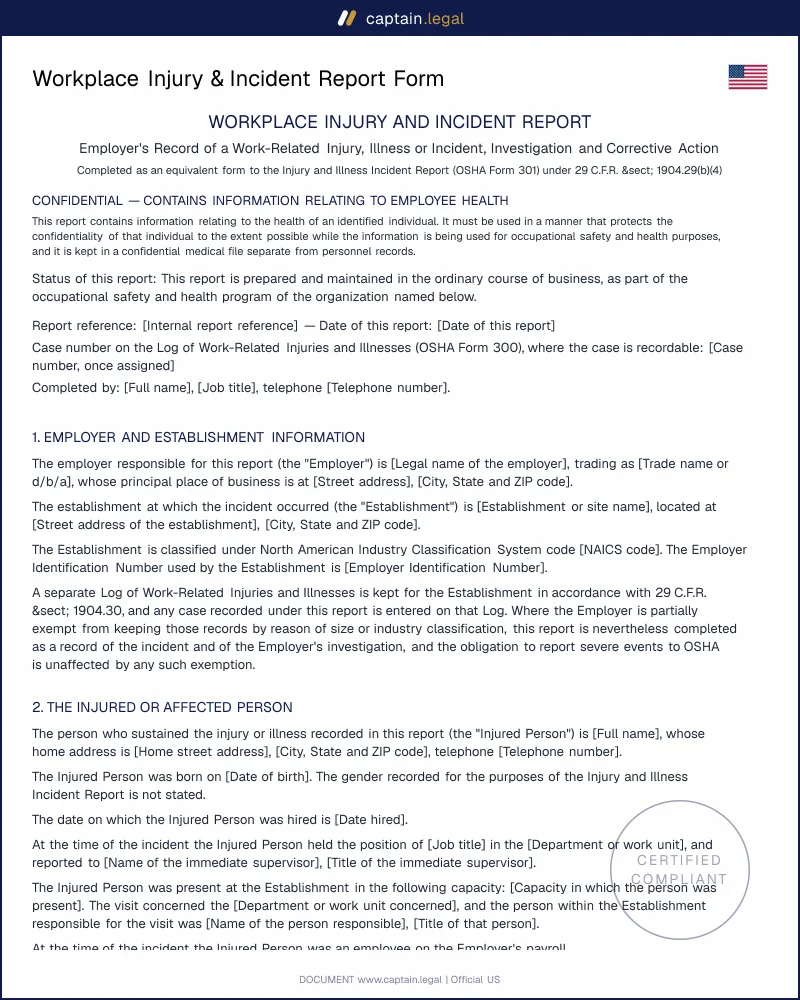
The form is a single incident record built around one question: what actually happened, in enough detail that a claims adjuster, a compliance officer and a defense attorney can rely on it two years later. It names the injured worker, fixes the date and time, describes the task in progress, identifies the object or exposure that caused the harm, and records the treatment given. Witness statements sit next to the narrative, as does the corrective action, the part most employers skip and later regret.

Three names cover overlapping documents here. The OSHA Form 301 Injury and Illness Incident Report is the federal recordkeeping form at 29 CFR 1904.29, and an equivalent is allowed if it carries the same information. The first report of injury is the workers compensation filing your carrier and the state agency require, called DWC Form-001 in Texas, Form 5020 in California, Form C-2F in New York. The internal incident report also captures near misses and property damage that OSHA never asks you to log. This template covers all three, and it is not a disciplinary record: when the event also involves misconduct, that analysis belongs in a separate employee write-up and misconduct form, kept out of the injury file.

2

When do you need this document?

The obvious trigger is the injury everyone watched happen: a fall from a ladder, a laceration on the slicer, a back strain lifting a pallet. Complete the form on the same shift, before the crew disperses and memories quietly align. The harder case is the injury nobody saw. Cumulative trauma, hearing loss, and repetitive strain surface weeks after the exposure that produced them, and the date of injury becomes a judgment call an adjuster will test. Writing the report the day symptoms are reported protects that date.

Near misses deserve the same form even though OSHA never asks you to log them: the pallet that falls into an empty aisle on Tuesday is the pallet that falls onto a picker on Friday. Incidents involving temporary staff need care, because the host employer that supervises an agency worker day to day usually records the case, not the staffing firm that signs the paycheck. Check the indemnity language in your US business and commercial agreement templates before an incident forces the question.

One edge case recurs constantly. An assault between coworkers is physical but rooted in a personnel conflict, so it needs parallel intake through a workplace harassment complaint form that keeps the investigation clear of the medical file.

3

Key clauses included in our template

  • The identification and employment status block captures job title, department, shift, and whether the injured person is a direct employee, an agency worker, or a contractor. That classification drives which employer records the case and which carrier pays.
  • The incident narrative follows the Form 301 fields: what the employee was doing before the event, what happened, what the injury was, and what object or substance harmed the worker. The prompts push toward observable facts, because "employee was careless" is worthless in a hearing. Each witness then signs a dated block of their own rather than a supervisor's paraphrase.
  • The treatment and recordability determination records who provided care, whether treatment went beyond the §1904.7(b)(5)(ii) first aid list, whether medication was prescribed, and how many days away or on restricted duty followed, so the file shows why the case was or was not logged.
  • The root cause analysis section moves past the immediate cause to the conditions that allowed it: missing guarding, a rushed changeover, an untrained substitute operator. Do not leave it blank, because several state plans treat injury investigation as a mandatory part of the written safety program.
  • The corrective action and return to work block assigns each fix to a named person with a target date, then records the restrictions and the modified duty offered. Where restrictions look durable, the file shifts to an ADA reasonable accommodation request form and a documented interactive process.
4

State-specific considerations

California runs its own plan, and Title 8 §14300 tracks the federal log while the deadlines run faster. A serious injury goes to Cal/OSHA immediately and no later than eight hours after the employer learns of it under Labor Code §6409.1(b), and the definition reaches any in-patient hospitalization other than one purely for observation. The employer also hands the worker a DWC-1 claim form within one working day under Labor Code §5401 and files the Form 5020 report within five days of knowledge. The investigation section is not optional here: the Injury and Illness Prevention Program at Title 8 §3203 requires a documented procedure for investigating injuries.

New York requires Form C-2F to reach the Workers' Compensation Board and the carrier within ten days of an accident causing lost time beyond the shift or treatment beyond ordinary first aid, under Workers' Compensation Law §110. The same section keeps the record on file for eighteen years, defeating any destruction schedule built around Part 1904 alone.

Texas is the outlier, because private employers may decline workers compensation coverage entirely. Subscribers file the DWC Form-001 first report with the carrier by the eighth day after the absence passes one day, under Labor Code §409.005. Non-subscribers file an annual DWC Form-005 and report injuries on DWC Form-007, and since they surrender the defenses of contributory negligence and assumption of risk, the incident report is often their only evidence when a negligence suit lands.

Florida gives the employer seven days from actual knowledge to report the injury to its carrier under §440.185(2) of the Florida Statutes, with a death reportable to the Division of Workers' Compensation within twenty four hours, and the late filing fine falls on the employer rather than the carrier. First aid cases treated on site with no medical charges sit outside that duty. The other state plan jurisdictions, from Washington to Virginia, run rules at least as effective as the federal standard and often stricter on timing, so build one form to the tightest deadline you face.

5

How to fill out this workplace injury report form

You start by selecting the state where the incident occurred, which sets the workers compensation deadline and the name of the state first report form on the cover page. The next screen asks whether the injured person is an employee, an agency worker, or a contractor, and the block adjusts. From there the questionnaire walks through the event in the order OSHA expects: the task in progress, the sequence of what happened, the nature of the injury, and the object or exposure responsible. The prompts keep the account factual, with examples of the detail inspectors expect.

Treatment comes next. You indicate the care provided, whether anything was prescribed, and whether the worker lost days or moved to restricted duty, and the tool flags the likely recordability outcome under §1904.7 with the eight and twenty four hour triggers where they apply. You then add one witness block per observer and complete the root cause and corrective action fields with owners and due dates. The finished document downloads in Word and PDF. Keep the completed report for five years at minimum, and eighteen years if you have New York operations.

6

Common mistakes to avoid

The most expensive habit is waiting. Supervisors hold the form open until the clinic sends its report, then discover the seven day window under §1904.29(b)(3) has closed and the call to the agency was never made. Write it the day of the incident with the facts you have and amend later: an amended record dated the day of the event reads very differently from a first draft written three weeks on. The second habit is editorial. Reports saying the worker was careless turn a safety document into evidence in a retaliation case. Describe what happened, not who is to blame.

Confusing recordable with reportable ranks third: a case can belong on the 300 log and never require a call, while a fatality at a company exempt from routine recordkeeping still triggers the eight hour report. Fourth, medical detail from the report often ends up in the personnel folder, which breaches the confidentiality rule at 29 CFR 1630.14. Keep the medical pages in a separate secured file. The last failure is leaving corrective action open. An investigation that finds a missing machine guard and never records who installed it, or when, tells an inspector the employer knew about the hazard and did nothing, the fact pattern behind willful classifications.

Key takeaways

Deadlines

You have 7, 24, and 8 hours

OSHA recordkeeping runs on hard clocks. Once you learn a case is recordable, you have seven calendar days to complete the Form 301 and enter it on the Form 300 log (29 CFR 1904.29(b)(3)). Separately, you must notify OSHA within eight hours of a fatality and within 24 hours of an in-patient hospitalization, amputation, or loss of an eye (29 CFR 1904.39).

Recordability

First aid is narrower than you think

Whether an incident goes on the OSHA log turns on recordability under 29 CFR 1904.7: death, days away, restricted work or transfer, medical treatment beyond first aid, loss of consciousness, or a significant diagnosed injury. Supervisors often overestimate what counts as first aid; OSHA uses a closed list at 1904.7(b)(5)(ii). A single prescription is medical treatment even if the employee never fills it.

Retention

Keep records five years and post 300A

These forms are not one-and-done paperwork. You must keep OSHA 300/301/300A records for five years beyond the covered year (29 CFR 1904.33). Each year, a company executive must certify the 300A summary and you must post it from February 1 through April 30 (29 CFR 1904.32). Treat the incident report as the master file feeding OSHA logs and workers compensation reporting.

Frequently Asked Questions

Yes, provided you complete every field. 29 CFR 1904.29(b)(4) permits an equivalent form in place of the official 301 as long as it holds the same information and is as readable. Many employers use their carrier's first report of injury instead, which the rule allows on the same condition. This template follows the 301 fields, then adds witness statements, root cause analysis and corrective action tracking.

Complete it the day the incident happens, or the day the employee reports symptoms for a condition that built up over time. The federal deadline is seven calendar days from the moment you receive information that a recordable case occurred, under §1904.29(b)(3), but the state workers compensation clock usually runs shorter: seven days to notify the carrier in Florida, ten for the New York C-2F, five for the California Form 5020.

Both formats come with every download. The Word version is the working file, editable so you can add your logo, change the number of witness blocks, or match the incident number field to your safety database. The PDF is what you print for signature and archive once the investigation closes. Most employers keep the Word file as their standard blank and store each closed report as a signed PDF.

No. A case belongs on the log only when it is work-related, is a new case, and meets one of the criteria at §1904.7: death, days away, restricted work or job transfer, medical treatment beyond first aid, loss of consciousness, or a significant diagnosis from a physician. Anything inside the closed first aid list stays off. Complete the report either way, because first aid cases that later worsen become recordable retroactively and only a contemporaneous record fixes the date.

§1904.39 sets two hard triggers. A work-related fatality is reported within eight hours of the employer learning of it. An in-patient hospitalization, an amputation, or the loss of an eye is reported within twenty four hours. Reports go to the area office by phone or through the agency's online form, and the duty binds even employers with ten or fewer workers who are partially exempt from routine recordkeeping under §1904.1.

Yes. Under §1904.35(b)(2), an employee, a former employee, or a personal representative who asks for the Form 301 covering that individual receives a copy by the end of the next business day, and authorized employee representatives may request the incident report portion for every case in the establishment. Because those access rights attach to the record, keep opinion and disciplinary assessment out of it and document that material on separate forms from the catalog of US legal document templates.

4.8/5

12 verified reviews · 50 000+ downloads

OSHA 300/301 Injury Report Form | 29 CFR 1904 Ready
  • Immediate access to the document
  • PDF + Word download
  • Compliant with 2026 legislation
  • Reviewed by lawyers
Fill in the template
Secure payment
Updated on September 6, 2026

You might also like

Employee Onboarding Checklist
At-Will Employment Contract