Create my document
Login

Choose country

FranceBelgiqueEspañaUnited StatesUnited KingdomالمغربDeutschlandItalia
Employment

New Hire Onboarding Checklist — All 50 States | Word & PDF

Streamline hiring with a complete employee onboarding checklist: HR forms, payroll, I-9 compliance and IT provisioning. Customize and download online.
4.7/518 reviews50 000+ downloadsInstant download
Share

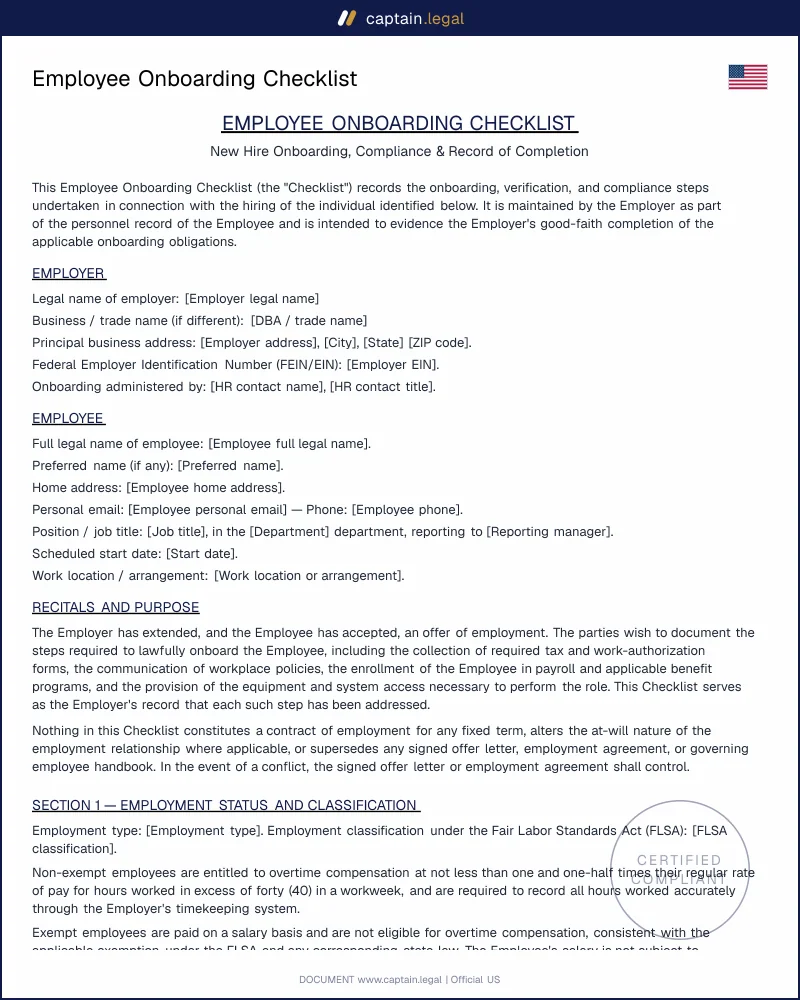
An Employee Onboarding Checklist is the operational backbone of every hire, the single document that tracks each legal, payroll, and IT step from the signed offer letter to the new employee's first full week on the job. HR managers, founders, and office administrators use it to make sure nothing falls through the cracks during onboarding, because the federal paperwork tied to a new hire carries real deadlines and real penalties. A clean new hire checklist turns a chaotic first day into a documented, repeatable process that protects the company and gives the employee a professional welcome.

Most onboarding mistakes are not dramatic. They are quiet omissions: a missing Form I-9, a state tax form nobody collected, a laptop that shows up two weeks late. This template closes those gaps. It maps the compliance obligations, the payroll setup, and the equipment provisioning into one running record that any manager can follow without guessing.

Compliant

2026 Legislation

50,000+ clients

trust us

Affordable

From $4.90 / doc

Secure payment

Instant download

New Hire Onboarding Checklist — All 50 States | Word & PDF

Secure payment · No subscription

Fill in the template

What is an employee onboarding checklist?

An employee onboarding checklist is a structured record that lists every task an employer must complete to bring a new hire into the organization legally and operationally. It is not a contract and it does not create rights on its own. Think of it as a compliance and logistics map: it confirms that the required federal and state forms were collected, that payroll and benefits enrollment happened on time, that workplace policies were acknowledged, and that the employee received the access and equipment needed to do the job.

People sometimes confuse the onboarding checklist with the offer letter or the employment agreement, but they serve different functions. The offer letter sets the terms of the job. The onboarding checklist verifies that the back-office work behind those terms actually got done. A well-built at-will employment agreement template establishes the legal relationship; the checklist makes sure the I-9, the W-4, the direct deposit form, and the policy acknowledgments that follow that agreement are signed, dated, and filed. The two documents work together. One defines the deal, the other proves you executed it correctly, which is exactly what you want on record if a wage claim or an audit ever lands on your desk.

2

When do you need this document?

The obvious trigger is a brand-new permanent hire, the moment a candidate accepts and you need to move them from offer to first day without dropping a single compliance step. This is where the checklist earns its keep, because the I-9 clock starts on day one and the state new-hire report has its own deadline running in parallel. The next most common scenario is scaling, when you go from onboarding one person a quarter to onboarding five people on the same Monday. Memory stops working at that volume. A standardized new hire onboarding checklist is what keeps the fifth hire from getting the same attention as the first.

Remote and distributed hires are a category of their own. When the employee never sets foot in your office, document verification, equipment shipping, and system access all have to be coordinated at a distance, often before the start date. A formal remote work agreement template and a matching onboarding sequence prevent the laptop-arrives-late problem that quietly burns a new hire's first week. You also need the checklist for rehires and internal transfers, where people assume "they already work here" and skip steps that legally still apply, like I-9 reverification in some cases. One edge case worth flagging: seasonal and short-term staff. If someone is hired for fewer than three business days, the entire I-9 must be completed on their first day of work, not within the usual three-day window, a detail that catches employers running short event or harvest crews. Even unpaid roles need attention, which is why a clean internship agreement template belongs alongside the onboarding flow for interns.

3

Key clauses included in our template

  • The pre-boarding and offer confirmation block captures the signed offer letter, the accepted start date, and the background-check authorization before day one. It exists so that nobody starts work without a documented, accepted offer, which is the foundation for everything that follows and the first thing an auditor or attorney will ask to see.
  • The employment eligibility and tax section tracks the Form I-9 with its Section 1 and Section 2 deadlines flagged separately, the federal W-4, and any state withholding certificate. Because the I-9 Section 2 deadline is only three business days, this part of the checklist carries date fields rather than simple checkboxes, so you can prove timeliness if the file is ever inspected.
  • The payroll and benefits enrollment block records direct deposit setup, benefits elections, and the FLSA exempt or non-exempt classification you assigned. Recording the classification here, in writing, is what protects you if the employee later disputes overtime eligibility.
  • The policy acknowledgment section logs receipt of the handbook, the anti-harassment policy, and any confidentiality or invention-assignment terms. A signature here converts "we told them the rules" into evidence that the employee actually received and acknowledged them.
  • The IT and access provisioning block covers equipment issuance, account and email creation, software licenses, and physical access cards or keys. It doubles as the master list you reverse on the separation side, so nothing stays in the field after an employee leaves.
  • The first-week orientation block schedules the manager introduction, role expectations, and training sessions, turning a vague "get them settled" into dated, assignable tasks with an owner.
4

State-specific considerations

Onboarding obligations shift the moment you cross a state line, and the checklist should adapt to where the employee actually works, not where the company is headquartered.

California adds the heaviest layer. Beyond the federal forms, employers must provide the Wage Theft Prevention Act notice under Labor Code §2810.5 to most non-exempt hires at the time of hiring, along with state-specific pamphlets on disability insurance, paid family leave, sexual harassment, and workers' compensation rights. California also reimburses business expenses under Labor Code §2802, so the onboarding step that issues a personal-device stipend or home-office reimbursement is a legal requirement, not a perk, for many remote roles.

New York requires a written wage notice under the Wage Theft Prevention Act, Labor Law §195, given at hiring and stating the rate of pay, the regular payday, and the overtime rate where applicable. The employee signs and the employer keeps the acknowledgment for six years. Sexual harassment prevention training is mandatory and should be scheduled during the onboarding window rather than deferred.

Texas is comparatively light on state-level onboarding mandates, with no state income tax withholding form to collect, which simplifies the payroll block. The federal I-9 and new-hire reporting to the Texas Office of the Attorney General still apply on their normal timelines, and at-will status should be confirmed in writing during orientation.

Florida likewise has no state income tax form, but new-hire reporting to the Florida New Hire Reporting Center is required within 20 days of the start date. Employers should confirm workers' compensation coverage details during onboarding, since Florida's thresholds for mandatory coverage vary by industry and headcount.

5

How to fill out this employee onboarding checklist

You start by entering the new hire's basic details and the work state, because the work state determines which forms appear in the rest of the checklist. From there you move through the pre-boarding block, confirming the signed offer letter and the accepted start date before anyone touches a federal form. The template then walks you into the eligibility and tax section, where you log the I-9 Section 1 on or before day one and set a hard reminder for the Section 2 three-business-day deadline, alongside the W-4 and any state certificate. Next comes payroll and benefits, where you record direct deposit, benefits elections, and the all-important FLSA classification. You then capture policy acknowledgments, marking each signed receipt as it comes in, and hand the IT block to whoever provisions equipment and accounts so the new hire has working access on arrival. The final block schedules the first-week orientation tasks and assigns an owner to each one. When every field is dated and initialed, you download the completed checklist in Word or PDF and file it with the employee's other records. If you also need the underlying agreements, the independent contractor agreement template covers anyone you are onboarding as 1099 rather than W-2.

6

Common mistakes to avoid

The single most expensive onboarding error is treating the I-9 like routine paperwork that can wait. Employers complete Section 1 on the start date, then let Section 2 drift past the three-business-day deadline because the manager who examines documents is traveling or the hire is remote. Under current federal enforcement that late completion is a substantive violation with per-form penalties, so the date discipline on the eligibility block is not optional. A related mistake is asking for I-9 documents during the interview or before the offer is accepted, which crosses into discrimination territory; eligibility verification belongs after acceptance, never as a screening tool.

The other recurring failure is classification by convenience. A new hire gets labeled "salaried exempt" because it is simpler for payroll, even though the duties do not satisfy the FLSA exemption test, and the unpaid overtime bill arrives months later. Skipping the state-specific layer is just as costly: an employer onboards a California or New York worker on a generic federal checklist and never delivers the mandatory wage notice, which itself can trigger statutory penalties. Finally, many companies build a careful onboarding process and no matching offboarding one, leaving equipment, account access, and confidential data in the field after someone leaves. A clean separation process starts with the same equipment list you build during onboarding, which is why a documented employee termination letter template pairs naturally with this checklist.

Key takeaways

I-9 deadline

Form I-9 has hard timing rules

Form I-9 is not optional, and the clock starts immediately. The employee must complete Section 1 no later than the first day of work for pay. The employer must review original identity and work-authorization documents and complete Section 2 within three business days of the hire date. Late completion can trigger per-form penalties, and you must retain the I-9 for three years after hire or one year after separation, whichever is later.

Not a contract

The checklist proves the back-office work

An onboarding checklist does not set job terms and does not create rights by itself. Its value is operational proof: it shows that the forms and acknowledgments tied to the hire were actually collected, signed, dated, and filed after the offer letter or employment agreement. If a wage claim or an audit shows up later, a completed checklist helps you demonstrate that payroll setup, policy acknowledgments, and access provisioning were handled in an organized, repeatable way.

Payroll setup

W-4 and FLSA classification must match reality

Onboarding is where payroll errors get baked in. The W-4 drives federal income tax withholding, and the classification you record for pay purposes has to align with how the person will actually work. Under the Fair Labor Standards Act, overtime exemptions depend on duties and salary basis, not a job title. If you mark someone exempt but their real day-to-day work is non-exempt, you invite overtime and wage disputes that are harder to fix after the first pay cycles.

Frequently Asked Questions

The checklist itself is an internal compliance and tracking tool, not a binding contract, so it does not create obligations between you and the employee the way an offer letter or agreement does. Its legal value is evidentiary. A completed, dated checklist proves you met federal and state onboarding deadlines, collected the Form I-9 on time, and delivered required notices. That documentation is exactly what protects an employer during an ICE I-9 audit, a wage-and-hour investigation, or a discrimination claim. To make the binding parts binding, you pair the checklist with the actual signed forms and agreements it tracks, since those signatures are what carry legal weight.

The Form I-9 has two separate deadlines. The employee must complete and sign Section 1 no later than their first day of work for pay, and you, as the employer, must physically examine their identity and work-authorization documents and complete Section 2 within three business days of the hire date. If you hire someone for fewer than three business days, the entire form must be done on the first day. These deadlines are strict, and as of early 2026 a late Section 2 is treated as a substantive violation rather than a correctable paperwork slip, so build a date-based reminder into the checklist rather than relying on memory.

You can download the completed onboarding checklist in both Word and PDF formats. The Word version is editable, which matters because most companies tailor the checklist to their own equipment list, software stack, and internal training schedule, and because state-specific items differ depending on where the employee works. The PDF version is the clean, fixed copy you store in the employee's file once every step is signed and dated. Keeping both is good practice: edit in Word as your process evolves, archive the PDF as the record of what you actually completed for each individual hire.

You can use the same template, but the remote sequence has its own timing pressure. Document verification for the I-9 has to be arranged through an authorized representative or an approved alternative procedure, and equipment plus system access need to ship and be configured before the start date rather than handed over in person. Practically, that means starting the remote onboarding earlier than you would for an in-office hire. The compliance steps are identical; what changes is the logistics, which is why the IT and provisioning block deserves extra lead time for distributed teams.

At the federal level, every W-2 employee completes a Form I-9 for employment eligibility and a Form W-4 for federal tax withholding, and most states add their own withholding certificate. You also report the hire to your state's new-hire directory, usually within 20 days of the start date. On top of that, the employee should sign acknowledgments for the handbook, anti-harassment policy, and any confidentiality terms. The exact stack depends on the work state, so the checklist adapts the list once you enter where the employee is based, which keeps you from collecting forms a particular state does not require or missing ones it does.

It is meaningfully different, and conflating the two creates risk. A genuine 1099 contractor does not complete a Form I-9 or a W-4; instead you collect a Form W-9 and issue a 1099-NEC at year end if payments cross the reporting threshold. Contractors are also outside most policy acknowledgments and benefits enrollment. The danger is treating a contractor like an employee during onboarding, which is one of the facts regulators weigh when deciding whether a worker was misclassified. If the relationship really has the control, integration, and permanence of employment, the onboarding checklist for employees is the honest tool to use.

4.7/5

18 verified reviews · 50 000+ downloads

New Hire Onboarding Checklist — All 50 States | Word & PDF
  • Immediate access to the document
  • PDF + Word download
  • Compliant with 2026 legislation
  • Reviewed by lawyers
Fill in the template
Secure payment · No subscription
Updated on May 29, 2026

You might also like

Sales Commission Agreement
Employee Reimbursement Policy Template