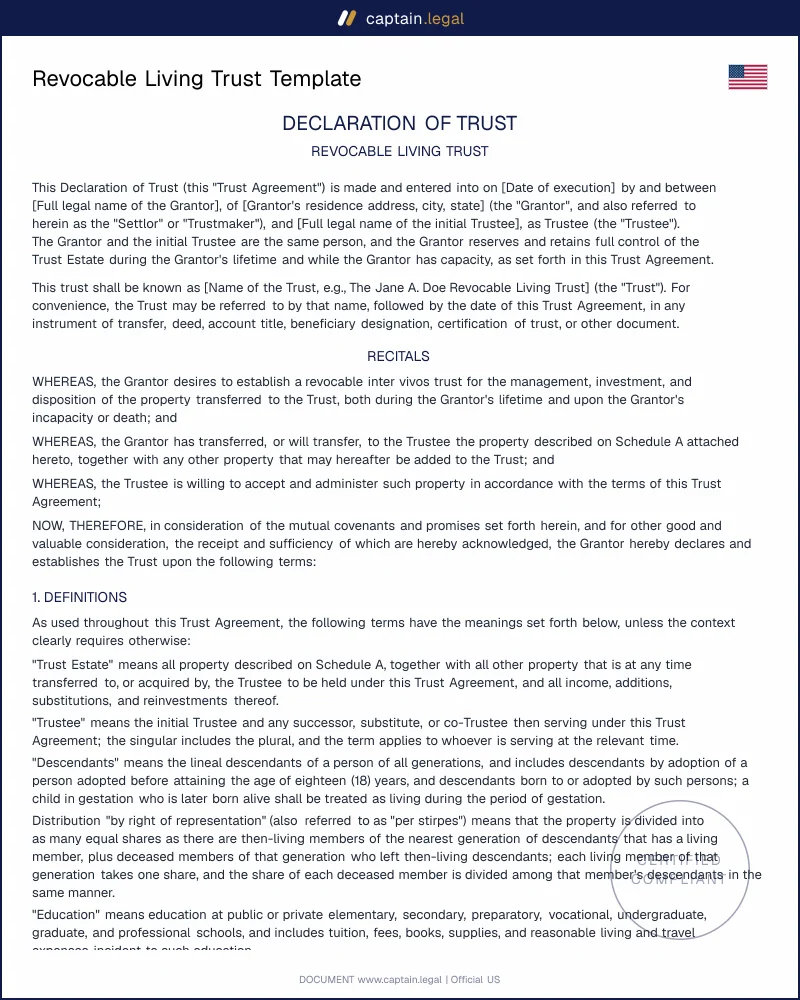
Trust law in the United States is almost entirely state law, not federal. There is no national statute that governs how you create, revoke, or administer a living trust, which is why the "same" document can carry different signing formalities depending on where you sign it. To reduce that patchwork, the Uniform Law Commission approved the Uniform Trust Code in 2000, and 36 states and the District of Columbia have enacted some version of it, including Florida, North Carolina, South Carolina, Ohio, Pennsylvania, and Virginia. Large jurisdictions such as California, Texas, and New York have not adopted the UTC and instead run their own trust statutes, so citations differ: Florida sits in Chapter 736, Florida Statutes, North Carolina in N.C.G.S. Chapter 36C, and Texas in the Texas Trust Code under the Property Code.
The revocation rule is remarkably consistent across UTC states. Under UTC §602, unless the instrument expressly says it is irrevocable, the settlor may revoke or amend it, and the settlor may do so by any method the trust describes or by any other clear expression of intent. That default matters, because a poorly drafted trust that is silent on revocability still lands you in the revocable column in these states. You can read the Uniform Law Commission's own enactment status and article-by-article summary in the Uniform Trust Code enactment map and drafting history, which tracks which states have adopted which provisions.
Two points every settlor should absorb. First, UTC §505 is blunt: while you are alive, the assets in a revocable trust remain fully reachable by your creditors, and after death they answer for your debts if the probate estate runs short. A living trust is a probate-avoidance and privacy tool, not an asset-protection shield. Second, most states require a notary for the trust itself and a recorded deed whenever real estate goes in, and a handful demand witnesses. Get the execution formalities wrong and you inherit the exact probate you were trying to sidestep.