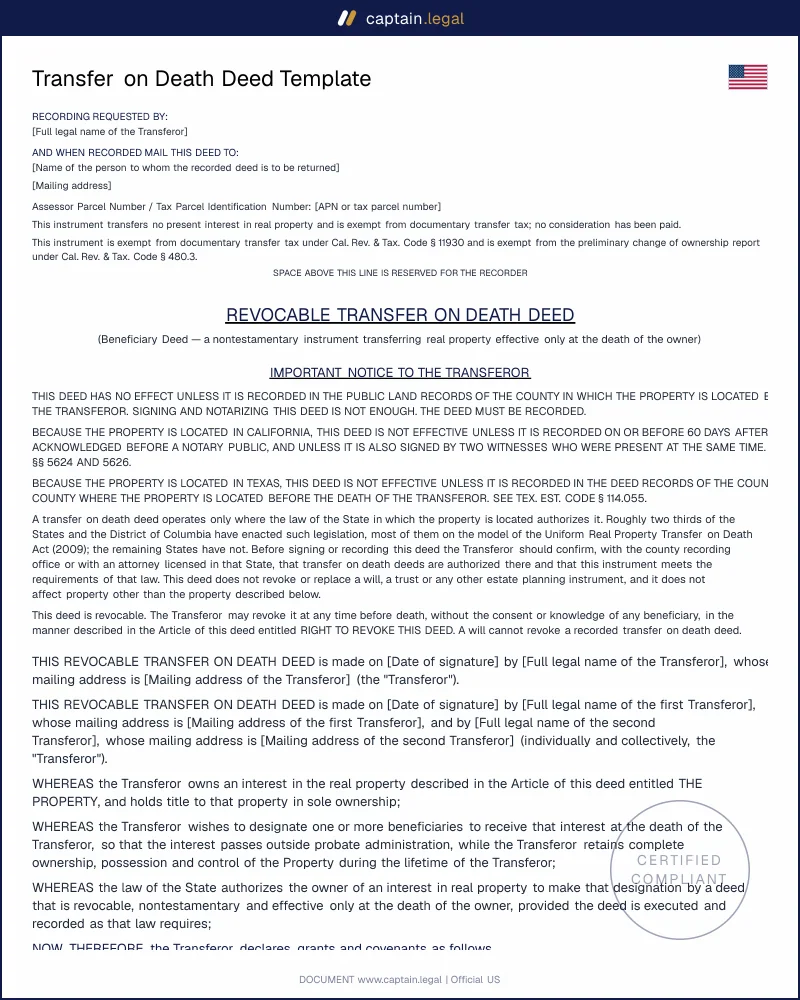
California is the most procedural of the large states. The deed must be signed, dated, witnessed by two people present at the same time, and acknowledged before a notary under Cal. Prob. Code §5624, then recorded within sixty days of notarization under §5626. After death the beneficiary serves a statutory notice on the transferor's heirs under §5681, and those heirs have 120 days from that notice to challenge the transfer. A contest filed with a lis pendens within 120 days of the recorded affidavit of death under §5694 can unwind the transfer against everyone but a good faith purchaser. California limits Medi-Cal estate recovery to the probate estate, so a house passing by TOD deed sits outside a recovery claim for deaths on or after January 1, 2017.
Texas is permissive on execution and unforgiving on timing. No witnesses, no waiting period, but Tex. Est. Code §114.055(3) voids the deed unless it reaches the county deed records before the transferor dies. A deed found in a drawer after the funeral is worthless. Revocation happens by recording a revocation instrument or a later deed, and a divorce decree recorded before death cuts out an ex-spouse under §114.057. Beneficiaries should also watch §114.106(e), which exposes the property to estate claims for two years after death.
New York is the newest entrant. N.Y. Real Property Law §424 took effect on July 19, 2024 and requires two witnesses plus a notarial acknowledgment, with the same capacity standard used for wills. Recording must happen before death in the county where the property lies, and the beneficiary is neither notified nor asked to consent.
Florida has no TOD deed. The Legislature never adopted the uniform act, and a document bearing that title accomplishes nothing on Florida land while the house still goes through probate. Florida practitioners use the enhanced life estate deed, known as a lady bird deed. Michigan sits in the same position.
Illinois works through the Real Property Transfer on Death Instrument Act, at 755 ILCS 27, rewritten to cover all real property rather than residential property alone, and executed with the formalities Illinois requires for a will. Naming conventions matter elsewhere too: Arizona and Missouri call it a beneficiary deed, and Ohio uses a transfer on death designation affidavit under Ohio Rev. Code §5302.22.