Real Estate

Assignment of Contract | Tex. Prop. Code 5.086 Ready

Real estate assignment of contract drafted to Tex. Prop. Code 5.086 equitable interest disclosure and Illinois 225 ILCS 454 wholesaling limits. Word, PDF.
4.5/516 reviews50 000+ downloadsInstant download
Share

A real estate assignment of contract transfers a buyer's rights under an existing purchase agreement to a third party, who then closes in the original buyer's place. The assignor never takes title and never records a deed. What changes hands is the equitable interest created by the purchase contract, and the payment for that interest is the assignment fee. Wholesalers rely on it daily, but so do investors whose financing collapsed and buyers moving a deal into a newly formed entity. The paperwork matters more than people expect, because a growing number of states regulate wholesaling by statute and a missing disclosure can hand the seller a cancellation right.

Compliant

2026 Legislation

50,000+ clients

trust us

Affordable

From $4.90 / doc

Secure payment

Instant download

Assignment of Contract | Tex. Prop. Code 5.086 Ready

Secure payment

Fill in the template

What is a real estate assignment of contract?

An assignment of contract is a separate written agreement between the original buyer, the assignor, and a substitute buyer, the assignee. It does not convey the property. It conveys the assignor's position in a purchase agreement already signed with the owner: the right to buy at the stated price, on the stated terms, by the stated closing date. Under the doctrine of equitable conversion, an enforceable contract gives the buyer an equitable interest in the land, and that interest is what the assignor sells. The seller stays the seller.

Two neighboring structures get confused with it. A double closing means two full transactions, A to B and B to C, with the middle party taking title briefly and paying two sets of settlement costs. An assignment means one closing and one deed, straight from owner to assignee. The other structure is novation, which extinguishes the assignor's obligations entirely. A plain assignment does not. Absent an express release signed by the seller, the assignor stays liable on the purchase contract if the assignee fails to close.

2

When do you need this document?

The classic scenario is a wholesaler who locks up a distressed property below market, then places the contract with a cash buyer from a private list before the closing date arrives. Just as common is the investor whose lender pulls out at underwriting. Assigning salvages the earnest money and avoids a default claim. Buyers who signed personally and later formed an entity use the same instrument to move the deal into the company that will hold title, since lenders rarely fund a borrower whose name does not match the contract.

Land deals produce a steady stream of assignments too. An investor who ties up acreage under a vacant land purchase agreement while zoning is confirmed will often assign to a builder once entitlements clear. Two edge cases deserve a flag. In a delayed exchange, the taxpayer assigns the purchase contract to the qualified intermediary so the replacement property acquisition satisfies 26 C.F.R. §1.1031(k)-1(g)(4). And in probate or divorce sales, court approval of the original buyer is sometimes personal to that buyer, which kills assignability whatever the contract says.

3

Key clauses included in our template

  • The recital and incorporation of the underlying contract identifies the seller, the property, the effective date, the price and the scheduled closing, then attaches the purchase agreement as an exhibit. References to a contract dated "on or about" have been fatal where the parties signed several versions.
  • The assignment and assumption language transfers the assignor's rights and expressly delegates the duties, with the assignee accepting them in writing. Rights transfer automatically; obligations move only when the assignee assumes them, which is why one-sided wording leaves the assignor exposed.
  • The assignment fee mechanics set the amount, the trigger and the route: payment through settlement on the closing statement, a nonrefundable deposit released on execution, or a split.
  • The equitable interest disclosure sits in bold statutory wording at the top of the instrument, confirming that the assignor is assigning a contract and holds no legal title. States that require it accept nothing less than plain language.
  • The earnest money treatment directs whether the deposit is reimbursed, credited at closing, or left in escrow under joint instructions, and fixes entitlement if the assignee defaults.
  • The assignor representations confirm the contract is in full force, no default has occurred, no prior assignment exists and no consent has been withheld. Paired with a mutual indemnity, this clause decides who pays when a deal breaks.
4

State-specific considerations

Texas regulates this more precisely than any other state. Tex. Prop. Code §5.086 requires anyone assigning an interest in a contract to purchase real property to tell a potential buyer, before contracting, that only a contract interest is being assigned and that the assignor holds no legal title. Section 5.0205 demands that disclosure in writing to both the buyer and the property owner. Miss the owner side and the safe harbor at Occ. Code §1101.0045 stops protecting you, which turns the deal into unlicensed brokerage.

Illinois takes the counting approach. The Real Estate License Act of 2000, at 225 ILCS 454/1-10 as amended by Public Act 101-0357, folds anyone engaged in a pattern of business of dealing in assignable contracts or equitable interests into the broker definition, and fixes that pattern at more than one transaction per twelve month period. A second unlicensed assignment inside twelve months is unlicensed brokerage in Illinois. Unlicensed practice is a Class A misdemeanor under 225 ILCS 454/20-22.

California has no wholesaling statute, so exposure runs through Bus. and Prof. Code §10130, which reaches anyone soliciting buyers for real property for another for compensation. Assignability itself is comfortable ground: Civ. Code §1458 makes contract rights transferable, while §1457 confirms that the burden of an obligation moves only with the consent of the party entitled to its benefit.

Florida treats unlicensed brokerage under Fla. Stat. §475.42(1)(a) as a third degree felony. The practical trap is form-based: the widely used Florida Realtors and Florida Bar residential contract is not assignable unless the parties affirmatively elect assignability in the designated paragraph.

New York adds a tax dimension the others do not. Tax Law §1401 expressly addresses the assignment of a contract to purchase real property and excludes the underlying purchase price from consideration, which leaves the assignment fee itself as the measure. Combined with attorney-conducted closings, New York deals need counsel earlier than most markets.

Oklahoma and South Carolina sit at the restrictive end. Oklahoma's Predatory Real Estate Wholesaler Prohibition Act, tightened by SB 1075, requires a license for public marketing of an equitable interest and captures double closings in the definition of wholesaling. South Carolina's H.4754 treats marketing another person's property for compensation as brokerage.

5

How to fill out this assignment of contract

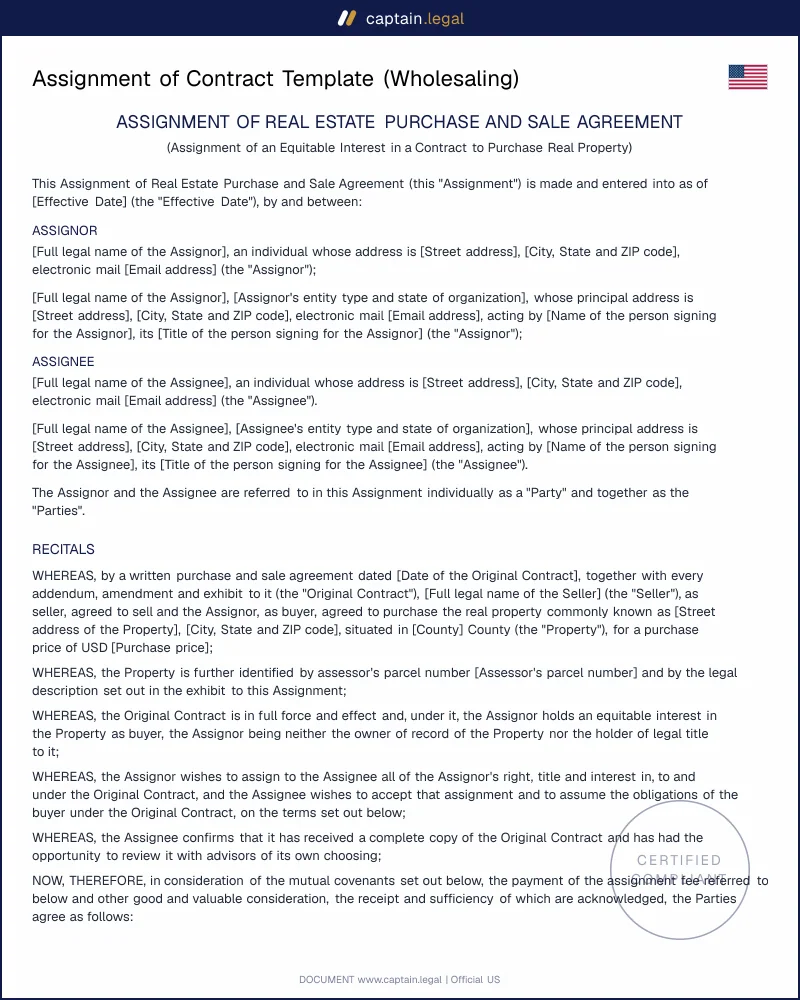
You start by identifying the state where the property sits, because the form pulls the correct disclosure block and cancellation language from there rather than one generic paragraph. Next come the parties. The wizard asks whether the assignor is an individual or an entity and adjusts the signature block and authority recital accordingly. You then enter the underlying agreement details: seller name, property address and legal description, effective date, price and closing date. Those fields populate the recital and the exhibit reference.

The fee section follows, where you set the assignment fee, choose the payment trigger and decide whether any deposit is released before closing. The earnest money screen asks who funded it and who keeps it on a default. A short consent screen handles seller notification and generates a signature line for the owner where the underlying contract requires one. The output arrives in Word and PDF alongside the rest of our real estate document library for US investors.

6

Common mistakes to avoid

The mistake that ends deals is signing an assignment over a contract that prohibits assignment. Bank-owned, HUD, relocation and new-construction forms almost always restrict it, and an assignment made in breach gives the seller a clean cancellation. Close behind is the disclosure failure. In Texas the owner must be told in writing, not only the incoming buyer, and in states with cancellation windows the clock starts when the prescribed language is delivered. A third habit to break is advertising the house rather than the contract. Photographs of a property you do not own, posted publicly with a price, is the fact pattern regulators use to build brokerage cases.

Two more come from sloppy structuring. Assignors forget that the original contract still binds them, then discover after the assignee walks that the seller is looking to them for specific performance. An express release, or a novation, is the only cure. Investors who operate through a company but sign personally create a mismatch that title companies flag late. Sign in the entity name, keep the LLC operating agreement current, and the closing file holds together.

Key takeaways

What it transfers

You sell your contract position, not title

An assignment does not convey the property and it does not record a deed. It transfers the buyer’s rights under an existing purchase agreement: the right to buy at the agreed price, on the agreed terms, by the agreed closing date. What changes hands is the buyer’s equitable interest created by that contract, and the money paid for it is the assignment fee.

Liability

Without a release, you stay on the hook

A plain assignment swaps in a new buyer, but it does not erase the original buyer’s duties. Unless the seller signs an express release, the assignor can still be liable under the purchase contract if the assignee fails to close. If you want to be fully out, you are looking for a novation or a written release, not just an assignment agreement.

Compliance

Disclosures and anti-assignment terms can kill it

Start by reading the underlying purchase agreement: many bank-owned, HUD, relocation, and builder forms bury anti-assignment language that blocks the transfer. Then check wholesaling rules where the property sits. Texas ties its safe harbor to equitable-interest disclosure (Tex. Occ. Code §1101.0045) and Property Code duties, and missing disclosures can give a seller a cancellation right. Because it involves an interest in land, the assignment must be written and signed under Statute of Frauds principles.

Frequently Asked Questions

Yes, when it is written, signed by both parties, supported by consideration and permitted by the underlying purchase agreement. Contract rights transfer by default under Restatement (Second) of Contracts §317, and courts enforce assignments of real property contracts routinely. Two things break enforceability: an anti-assignment clause in the original contract, and a missing statutory disclosure where a state mandates one. Because land is involved, an oral assignment fails under the Statute of Frauds.

It depends on the contract. Where the agreement is silent, the buyer may assign without consent, because assignment is the common law default. Where the contract bars assignment without written approval, or names the buyer "and no assigns", the seller has to sign. Many contracts sit in the middle, allowing assignment to an entity the buyer controls while barring assignment to strangers. Read the buyer definition and the assignment clause together first.

The outer limit is the closing date in the underlying purchase agreement, and you want the assignment executed well before then. Title companies need the assignment, the assignee's entity documents and funding instructions to prepare a settlement statement, and most want that package five to ten business days out. Statutory windows compress it further, since several states give a three business day cancellation right that runs from delivery of a disclosure.

Practice varies by state, and the fee is a separate question from the equitable interest. Texas requires written disclosure to both the owner and the incoming buyer that a contract interest is being assigned, though the statute addresses the nature of the interest and not the amount. Several newer state regimes require the seller to be told the buyer may assign, on penalty of rescission. On the settlement statement, the seller sees it anyway.

In most states yes, provided you assign your own contract and market the contract rather than the property. The line moves quickly though. Illinois limits unlicensed operators to one transaction per twelve month period, Oklahoma requires a license for public marketing of an equitable interest, and South Carolina now treats marketing another person's property for pay as licensed brokerage activity. Check your state licensing act before your second deal, not after it.

The document downloads in both Microsoft Word and PDF. Word is the working copy, so you can adjust the fee mechanics, add an exhibit, insert a seller consent block or change the governing law reference without rebuilding the file. The PDF is signature-ready for printing or electronic execution. Both carry the disclosure wording for the state you selected, as does the rest of the full catalog of US legal documents.

4.5/5

16 verified reviews · 50 000+ downloads

Assignment of Contract | Tex. Prop. Code 5.086 Ready
  • Immediate access to the document
  • PDF + Word download
  • Compliant with 2026 legislation
  • Reviewed by lawyers
Fill in the template
Secure payment
Updated on September 4, 2026

You might also like

Lease Renewal Agreement
Eviction Notice Template