Employment

Relocation Repayment Agreement | AB 692, IRC 1341

Relocation repayment agreement drafted to Cal. AB 692 stay-or-pay rules, Labor Code 221, IRC 1341 claim of right and 29 CFR 531.35. Word & PDF, all 50 states.
4.9/514 reviews50 000+ downloadsInstant download
Share

An employee relocation and repayment agreement is the contract a US employer signs with a new or transferring hire to fund a move and recover that money if the person leaves before an agreed retention period ends. It fixes what the company pays, what triggers repayment, and how the balance shrinks month by month. A funded move rarely stops at the truck: temporary housing, house-hunting trips and the tax gross-up push a mid-level package into five figures. Without a signed relocation repayment clause, all of it walks out the door with the resignation letter. This template gives HR a standalone, state-aware agreement built around federal tax treatment, FLSA deduction limits and the statutes that decide whether a clawback survives.

Compliant

2026 Legislation

50,000+ clients

trust us

Affordable

From $4.90 / doc

Secure payment

Instant download

Relocation Repayment Agreement | AB 692, IRC 1341

Secure payment

Fill in the template

What is an employee relocation and repayment agreement?

An employee relocation and repayment agreement is a conditional benefit contract. The employer advances or reimburses the cost of a move, the worker promises to stay for a defined period, and leaving early converts a prorated portion into a debt. It is signed alongside but separate from the offer letter, and the obligation is contingent: nothing is owed once the retention period runs its course.

The distinction from a relocation policy matters: that document is a unilateral HR statement of what the company funds and creates no repayment obligation. Drafting must also decide what the arrangement legally is: an advance against future service, a reimbursement of business expense, or a discretionary upfront payment. That choice drives payroll treatment and the lawfulness of any deduction. Set the characterisation deliberately in the recitals, because a court reading an ambiguous agreement picks the reading least favourable to the drafter. Most employers pair it with a properly drafted offer letter template for US employers so both documents describe the same start date and conditions.

2

When do you need this document?

The core case is the funded external hire. A company recruits a specialist from another metro area, pays movers and two months of temporary housing, and wants assurance the investment buys more than a few pay cycles. The agreement goes out with the offer, before acceptance, so consideration is clean.

Internal transfers are harder. A worker already employed at will gives no new consideration beyond continued employment, and several states treat that as thin; the fix is to make the relocation benefit itself the consideration and to document that the transfer was voluntary.

Two edge cases justify careful drafting. The first is the employee who sells a home, where the employer covers closing costs or a loss-on-sale guarantee. Some statutes treat that category separately, so it belongs on its own line of the schedule, documented alongside a proper residential purchase agreement for all 50 states. The second is the visa-sponsored hire. Never fold immigration or petition fees into the repayment schedule: several statutes single out immigration cost recovery as unlawful, and federal rules already bar recovery of certain petition fees.

3

Key clauses included in our template

  • The schedule of covered expenses itemises what the company funds, category by category, with a cap on each line. The template forces an annex the employee initials, and separates residential property costs so a state carve-out applies cleanly.
  • The retention period and proration formula state the commitment in months and reduce the repayable balance on a straight-line basis for each completed month of service. Cliff repayment, where the full sum falls due on day 364 of a twelve-month term, reads as a penalty and attracts scrutiny.
  • The trigger events define separation precisely. Resignation and termination for documented cause trigger repayment; layoff, position elimination, death, and disability release it. That asymmetry is the most litigated point in relocation clawbacks, and leaving it implicit invites a good faith and fair dealing argument.
  • The tax and gross-up clause records that the benefit is taxable wages, states whether the employer grosses up, and specifies whether repayment is calculated on gross or net, depending on the tax year.
  • The wage deduction authorisation is drafted to the employee's state, with a stated per-period amount and a floor protecting minimum wage and overtime. It is severable, so an unlawful deduction term does not void the underlying debt.
  • The repayment and collection terms set a deadline running from the separation date, an interest-free instalment option, governing law, and reciprocal attorney fee recovery rather than a one-sided clause.
4

State-specific considerations

California is now the strictest jurisdiction in the country. Assembly Bill 692, codified at Business and Professions Code §16608 and Labor Code §926, treats most employment repayment and exit-fee terms as unlawful restraints on trade, void for contracts entered into on or after January 1, 2026. A narrow exception preserves discretionary upfront payments such as relocation benefits only if the terms sit in a separate agreement, the worker is told of the right to consult an attorney and given five business days to do so, repayment is interest-free and prorated across a retention period of no more than two years, the worker may defer payment instead of repaying, and the early exit was the worker's own choice or a termination for misconduct. Contracts for the lease, financing, or purchase of residential property fall outside the statute. Collection is separately constrained: Labor Code §221 makes it unlawful to take back wages already paid, and the DLSE position is that no deduction for a debt owed to the employer may be taken from a California final paycheck, even with written authorisation.

New York allows recovery only through the advance route. Labor Law §193 and 12 NYCRR §195-5.2 permit deductions to recover a salary advance, but the money must be a strict advance: any interest or repayment amount exceeding the sum provided disqualifies it. Timing and duration must be agreed in writing before the money is paid, and the employer must run a dispute procedure.

Texas sits at the friendlier end without being a free pass. Labor Code §61.018 allows a deduction only on a court order, statutory authority, or written authorisation for a lawful purpose, and the Texas Workforce Commission rejects authorisations that are vague. Name the specific debt and the maximum amount. Final pay under §61.014 falls due six days after an involuntary separation and on the next regular payday after a resignation.

Illinois demands more than a signature at hire. Under 820 ILCS 115/9, a deduction needs express written consent given freely at the time the deduction is made, so an authorisation signed months earlier will not carry the day. Collect a fresh, dated consent at separation and treat the agreement as a contract debt if refused. Employers standardising paperwork across sites often build this agreement alongside a remote work agreement for all 50 states.

5

How to fill out this relocation and repayment agreement

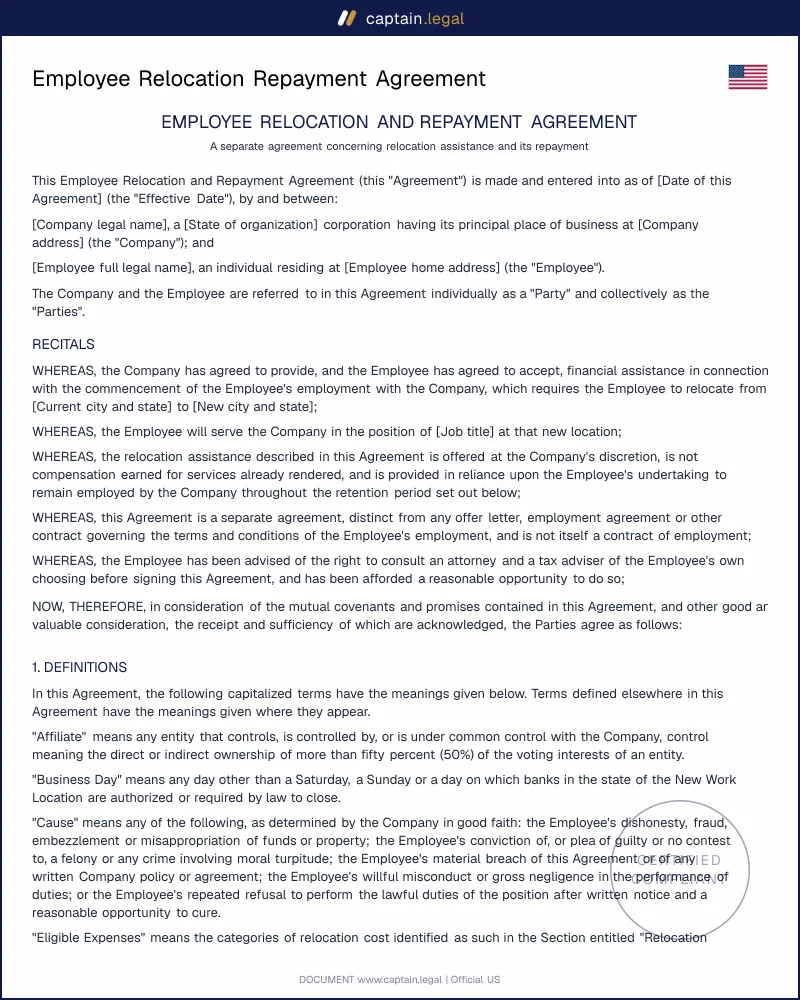
You start with the employer entity and the worker, then select the state where the employee will primarily work after the move. That choice drives the deduction language, the notice wording, and whether California's separate-agreement and five-day review requirements switch on. Next you build the expense schedule, entering each funded category and its cap. The form then asks for the retention period in months and applies straight-line proration to the repayment table.

From there you set the trigger events, confirming which separations create an obligation and which release it, and you choose whether the benefit is grossed up so the tax paragraph adjusts. The final screens cover the repayment deadline, the instalment option, governing law, and signature blocks, including the attorney consultation acknowledgement where a state requires one. The agreement downloads in Word and PDF, and the surrounding hiring paperwork can be assembled from the full catalogue of US legal document templates.

6

Common mistakes to avoid

The most expensive mistake is burying the repayment clause inside the employment contract. California now requires a separate instrument for the exception to apply, and elsewhere a buried clause invites the argument that the employee never knowingly agreed to a debt. The second is the cliff: demanding the full amount back with no credit for service given reads as a penalty and gives a judge an easy reason to strike it. Third is silence on involuntary separation. An agreement that makes a laid-off worker repay a move the employer requested turns a reduction in force into a wage claim.

The fourth mistake is procedural: deducting from the final paycheck because the agreement says you can. In several states that authorisation is worth nothing at separation, and the deduction converts a collectable contract debt into a wage violation with penalties attached. Run the numbers through a final paycheck and offboarding checklist before payroll processes anything. The last is tax silence: with no gross versus net wording, the employer demands gross, the former employee refuses, and the argument costs more than the balance.

Key takeaways

Tax treatment

Relocation benefits are taxable wages now

Under current federal tax rules, relocation payments are generally treated as taxable wages for civilians, reported on Form W-2 and subject to FICA and withholding. That includes common add-ons like temporary housing, house-hunting trips, and any tax gross-up. If you budget a move as a tax-free perk, you will be off by a lot, and payroll reporting can be wrong from day one.

Repayment mechanics

Same-year vs later-year repayment changes everything

If the employee repays in the same tax year, payroll can usually reverse wages and correct withholding cleanly. Repayment in a later year is messier: agreements often require the employee to repay the gross amount because prior-year withholding was already credited on the employee’s return, and the employee typically looks to IRC 1341 (claim of right) for tax relief. FICA corrections may require Form 941-X and a W-2c.

Wage deductions

You cannot claw back by violating wage rules

Even with a signed repayment clause, collection is limited by wage-and-hour law. The FLSA “free and clear” rule (29 CFR 531.35) is breached if a deduction that benefits the employer pulls the worker below minimum wage or cuts into overtime for that workweek. For exempt employees, an improper deduction can also threaten the salary-basis requirement under 29 CFR 541.602, putting the exemption at risk.

Frequently Asked Questions

Yes, when it is properly signed and the state permits repayment terms at all. Enforceability rests on consideration, which the relocation benefit supplies, on clarity about the amount and the proration, and on compliance with the state wage payment statute. The template is a standalone contract with recitals establishing the benefit, so it stands even where employment is at will. Where a statute voids the obligation, no drafting saves it, and the US employment document library points to the alternatives.

Usually not, and this is where employers create liability. California bars deductions for debts owed to the employer from final pay even with written authorisation. New York permits recovery only as a true salary advance agreed beforehand, Texas requires specific written authorisation, and Illinois requires consent given freely at the moment of deduction. Federal law adds a floor: under 29 CFR §531.35 no deduction may push pay below minimum wage.

It depends on the tax year. Repay inside the calendar year the benefit was paid and payroll reverses the wages, so you return the net figure. Repay in a later year and employers normally demand the gross, because the tax withheld was already credited on your earlier return. You recover it through the claim of right rules at IRC §1341, while your former employer recovers the Social Security and Medicare portion through Form 941-X and a corrected Form W-2c.

Only if the agreement says so, and drafting it that way is a mistake. The market standard releases the obligation on layoff, position elimination, death, disability and termination without cause, keeping it for resignation and dismissal for misconduct. California's exception requires that the early exit was the worker's own election or a termination for misconduct. Pursuing a laid-off worker usually produces a wage claim worth more than the balance.

The template sets the deadline as a fixed number of days from the separation date, with thirty days as the default and an interest-free instalment option for larger balances. That window gives payroll time to calculate the prorated figure and the employee time to pay. Making the debt due on the last working day is common in older templates and rarely helps: it collides with final pay deadlines.

The agreement downloads in both Word and PDF. The Word file lets HR or counsel edit the expense schedule and adjust the retention period before circulation. The PDF is the clean version for electronic signature and the personnel file. Both include the expense annex and the repayment table, so the employee signs one complete instrument.

4.9/5

14 verified reviews · 50 000+ downloads

Relocation Repayment Agreement | AB 692, IRC 1341
  • Immediate access to the document
  • PDF + Word download
  • Compliant with 2026 legislation
  • Reviewed by lawyers
Fill in the template
Secure payment
Updated on September 5, 2026

You might also like

Offer Letter Template
Workplace Harassment Complaint Form