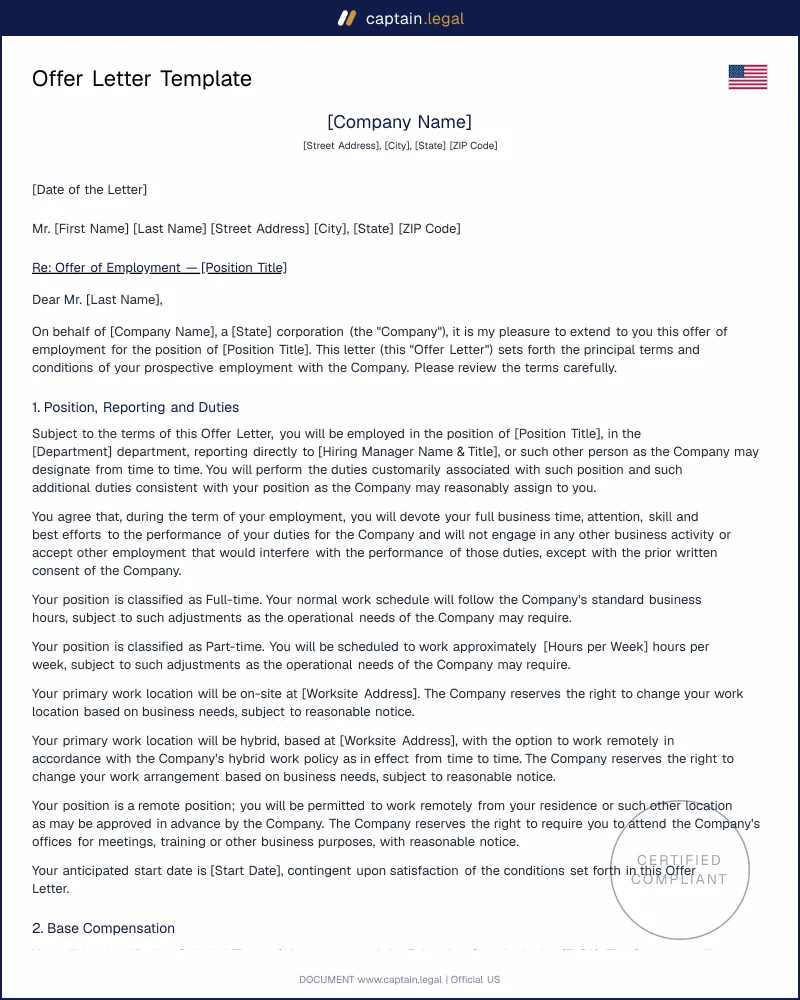
An offer letter is the first formal document an employer hands to a candidate after a verbal "yes." It captures the job title, compensation, start date, and the at-will nature of the relationship in a single page or two, before any full employment contract is signed. Used correctly, it sets clean expectations and prevents the kind of disputes that surface six months in : someone remembers a bonus differently, or believes the role came with a guaranteed term. Used carelessly, it becomes Exhibit A in a wrongful-termination lawsuit. This template is built for US employers, HR managers, and founders who hire across one or several states and want a document that reads professionally without inadvertently destroying at-will employment or triggering wage-and-hour issues.
Compliant
2026 Legislation
50,000+ clients
trust us
Affordable
From $4.90 / doc
Secure payment
Instant download
Offer Letter Template | At-Will, FLSA-Compliant
Secure payment
What is an offer letter?
An offer letter is a written communication, addressed to a specific candidate, that formalizes the company's intention to hire under defined terms. It is not the same as an employment agreement. The distinction matters in US practice : the offer letter is short, transactional, and almost always preserves at-will employment, while an employment agreement is a longer contract that may include fixed terms, severance triggers, restrictive covenants, and dispute-resolution clauses. Most US private-sector hires are documented with an offer letter alone, because adding a full contract creates obligations that employers often do not want to carry, particularly the inference of a definite term of employment.
Practitioners draw a sharper line still : the offer letter is an invitation to accept under specified conditions, not a binding promise of indefinite employment. The conditional nature is what protects the employer. Once the candidate signs and returns the letter, the document becomes evidence of the agreed terms, but it does not convert the relationship into a fixed-term arrangement unless the language explicitly does so. A well-drafted letter says what the role is, what it pays, when it starts, what conditions must still be satisfied (background check, I-9 verification, drug screen where lawful), and confirms that either party may end the relationship at any time, with or without cause, except as prohibited by law. Everything beyond that should live in a separate handbook, plan document, or full agreement to avoid clutter and accidental promises.
Legal framework
US employment law operates on two layers : federal floor and state ceiling. At the federal level, the Fair Labor Standards Act (FLSA) governs minimum wage, overtime, and the exempt/non-exempt classification that the offer letter must signal correctly. Calling a position salaried in the letter does not, by itself, make the employee exempt from overtime ; only the salary basis and duties tests in 29 C.F.R. Part 541 control that outcome. An offer letter that promises a flat annual figure for a role that fails the duties test creates back-wage exposure the moment the employee works over forty hours. The Immigration Reform and Control Act of 1986 layers on top, requiring Form I-9 completion within three business days of the start date — the letter typically conditions the offer on that verification, along with any required E-Verify check for federal contractors and employers in mandatory states.
Anti-discrimination statutes shape what the letter can and cannot ask. Title VII of the Civil Rights Act of 1964, the Americans with Disabilities Act, the Age Discrimination in Employment Act, and the Genetic Information Nondiscrimination Act prohibit conditioning an offer on protected characteristics, and many states now restrict salary-history inquiries and require pay-range disclosure either at the job-posting stage or upon request. California, Colorado, Washington, New York, and Illinois have all moved in that direction over the past few years, and an offer letter that withholds a posted range from a candidate who asks can be the document a plaintiff uses to anchor a claim. The Cornell Legal Information Institute maintains a practitioner-grade reference on at-will employment and statutory exceptions that should be the first stop before drafting state-specific language.
State law decides everything else. The at-will doctrine, while the default in 49 states, is not absolute : Montana requires good cause after the probationary period under Mont. Code Ann. §39-2-904, and most states recognize public-policy, implied-contract, or covenant-of-good-faith exceptions. The offer letter's at-will clause is what defends against the implied-contract exception, so its wording is non-negotiable. Restrictive covenants (non-compete, non-solicit) typically belong in a separate agreement signed concurrently, not buried inside the letter, because their enforceability depends on consideration timing and state-specific statutes that the letter format cannot adequately address. Our employment document library keeps these instruments aligned.
When do you need this document?
The most common scenario is the standard new-hire onboarding for any salaried or hourly position. After verbal acceptance, the offer letter goes out the same day or the next morning ; delaying it past forty-eight hours is where candidates start fielding counteroffers and renegotiating. The second scenario is the internal promotion with materially different terms : new title, new pay band, new reporting line, new exemption status. HR teams sometimes skip a fresh letter for internal moves, which is a mistake. If the promotion shifts the employee from non-exempt to exempt, the documented effective date matters for overtime calculations during the transition pay period.
Contingent offers form a third category : positions that depend on a background check, drug screen, professional license verification, security clearance, or successful completion of a probationary period at a related entity. The letter must state each contingency in clear conditional language, because revoking an offer for a failed background check requires compliance with the Fair Credit Reporting Act (FCRA) pre-adverse and adverse action notice process. A vague "subject to standard checks" line is not enough to protect the rescission. A fourth scenario covers relocation and sign-on bonus arrangements, which need explicit clawback language and repayment schedules ; these can sit in the letter for smaller amounts or in a separate agreement for larger packages.
One edge case worth flagging : rehired former employees. Companies often reuse an old offer letter template without recalculating service credit for benefits, PTO accrual, or vesting. The letter should state expressly whether prior service counts, because plan documents and tax treatment hinge on that determination. Another edge case is the deferred-start hire, where a candidate accepts in March but does not start until September. The letter should specify what happens if the candidate accepts a competing offer in the interim, since at-will rules typically allow either party to walk away before the start date with no remedy beyond returned sign-on amounts.
Key clauses included in our template
- Position title and reporting line identify the role with precision and name the immediate supervisor. Vague titles like team member or associate create classification headaches later. The clause also confirms whether the role is exempt or non-exempt under the FLSA, which determines overtime eligibility and recordkeeping obligations from day one.
- Compensation and pay frequency state the base salary or hourly rate, the pay period, and the method of payment. For exempt roles, the figure is expressed as an annualized salary with the bi-weekly or semi-monthly installment ; for non-exempt roles, the hourly rate is stated alongside the standard workweek and the overtime treatment under 29 U.S.C. §207. Any commission, tip credit, or piece rate is referenced here and detailed in an attached plan rather than improvised in the body.
- Start date and work location anchor the relationship in time and space. The work location drives state-law applicability for wage, leave, and tax purposes, which matters for remote hires. The letter names the primary work address or designates the role as remote, with the employee's state of residence governing the employment relationship.
- At-will employment statement is the single most important paragraph in the document. It declares that either party may end the relationship at any time, with or without cause and with or without notice, subject only to applicable law. The clause is set off in its own paragraph, repeated near the signature block, and never softened with phrases like we expect a long career that courts have used to find implied contracts.
- Benefits summary and contingencies describe eligibility for health, retirement, and PTO plans by reference to the official plan documents, with a clear statement that plans are subject to change. Conditional offers list the background check, I-9 verification, drug screen, and any license or credential requirements, with the deadline by which each must be completed.
- Confidentiality, IP assignment, and restrictive covenants are typically incorporated by reference to a separate agreement that the employee signs on or before the start date. Including these as obligations to sign — not as substantive terms in the letter itself — keeps the offer letter clean and preserves the consideration argument needed to enforce restrictive covenants in states that scrutinize them.
State-specific considerations
California is the most aggressive jurisdiction on offer letter content. California Labor Code §432.3 prohibits asking for salary history and requires disclosure of the pay scale upon reasonable request. The state also restricts noncompetes almost entirely under Business and Professions Code §16600, so any reference to post-employment restrictions must be limited to trade-secret protection and customer non-solicitation in narrow forms. The at-will language survives, but California courts read it strictly : the offer letter should avoid any phrasing about job security, long-term commitment, or termination only for cause, since the Foley v. Interactive Data Corp. line of cases will use such language to find an implied contract.
Texas follows a more employer-friendly framework, but offer letters still need to address the Texas Payday Law by stating the pay schedule clearly. The state's pay frequency requirements under Tex. Lab. Code §61.011 depend on whether the employee is exempt or non-exempt, and the letter should match that classification with the corresponding pay period (monthly for exempt, semi-monthly for non-exempt at minimum). Restrictive covenants are enforceable under Tex. Bus. & Com. Code §15.50 if ancillary to an otherwise enforceable agreement, which makes the offer letter's reference to a separate restrictive-covenant agreement legally meaningful.
Florida permits at-will employment with few exceptions, but Fla. Stat. §448.110 and Article X §24 of the Florida Constitution set state minimum wage above the federal floor and require annual indexing. Offer letters for hourly positions should state that wages comply with Florida's adjusted minimum and reference the annual recalculation. Noncompetes under Fla. Stat. §542.335 are among the most enforceable in the country, but they still require a legitimate business interest and reasonable scope, which the offer letter signals by incorporating the separate covenant by reference.
New York has moved decisively on pay transparency. New York Labor Law §194-b requires employers with four or more employees to disclose the compensation range in job postings and, on request, throughout the hiring process. The offer letter must state a specific figure, not a range that floats above what was posted, or the letter itself becomes evidence of a Labor Law §198 violation. New York City layers additional requirements through the NYC Human Rights Law, and the city's salary-history ban under NYC Admin. Code §8-107 is broader than the state's. New York courts have also been receptive to implied-contract claims, so the at-will clause needs explicit and prominent placement.
How to fill out this offer letter
You begin by selecting the state where the employee will primarily work, because that single choice drives the rest of the form. The generator adjusts the at-will language, references the correct state pay-frequency statute, inserts the right minimum-wage floor, and flags any pay-transparency requirement before the document is generated. From there, the questionnaire walks through the candidate's full legal name and address, the company's legal entity name (not a doing business as, which often creates contract enforceability problems), and the position title with reporting line. Exempt versus non-exempt classification is set explicitly, with a brief duties description that supports the chosen classification under FLSA rules.
The compensation section captures base pay in the format that matches the classification : annualized salary with pay-period installment for exempt roles, hourly rate with anticipated weekly hours for non-exempt. Sign-on bonuses, relocation allowances, and equity grants each have their own field, with clawback schedules and vesting parameters set in plain language. The benefits summary references the company's plan documents by name rather than restating eligibility, which keeps the letter short and the plan documents controlling. Contingencies — background check, drug screen, I-9 verification, license confirmation — are toggled individually, with a deadline calculated from the start date. The final step generates the document in Word and PDF, with a signature block formatted for either physical or e-signature execution under the E-SIGN Act. The full US legal document catalog keeps every related instrument one click away.
Common mistakes to avoid
The most damaging error is using language that undermines at-will status. Phrases like we look forward to a long and successful career with you, this position is permanent, or your annual salary (without the qualifier current or initial) have all been cited in implied-contract cases. Courts read the entire document, not just the at-will paragraph, so the rest of the letter must avoid promises that contradict the at-will declaration. A second common mistake is the unsupported exempt classification : marking a position as salaried-exempt to avoid overtime obligations, when the duties fail the FLSA tests. The misclassification creates back-pay liability that compounds for every workweek over forty hours, plus liquidated damages under 29 U.S.C. §216(b) equal to the unpaid overtime.
A third recurring mistake involves conditional offers and the FCRA. Employers sometimes rescind offers after a background check without sending the pre-adverse action notice with a copy of the consumer report and a summary of FCRA rights, then waiting a reasonable period before issuing the adverse action notice. The rescission becomes actionable not because the underlying conduct was lawful or unlawful, but because the procedure was skipped. A fourth mistake is failing to localize : a single template used across all fifty states will mis-state the minimum wage in California, miss the pay-transparency requirement in New York, ignore Colorado's Equal Pay for Equal Work Act, and overstate noncompete enforceability in Washington. A fifth mistake, more procedural than substantive, is sending the offer letter without the supporting documents (handbook acknowledgment, restrictive-covenant agreement, IP assignment) attached or referenced with a clear deadline ; pieces signed weeks apart create consideration timing problems that surface later in litigation.
Frequently Asked Questions
19 verified reviews · 50 000+ downloads
- Immediate access to the document
- PDF + Word download
- Compliant with 2026 legislation
- Reviewed by lawyers
You might also like