A Nonprofit Employment Agreement is the written contract a 501(c)(3) or other tax-exempt organization uses to hire a paid staff member, whether that person is an executive director, a program officer, a development manager, or a part-time coordinator. It does the same job as a for-profit employment contract, but it also has to answer questions the IRS, state attorneys general, and grant-makers will eventually ask: was the compensation reasonable, was the role properly authorized by the board, and does the arrangement protect the organization's charitable mission and donor-restricted funds? Charity employment paperwork that ignores those questions tends to come back as a Form 990 disclosure problem or, worse, an excess benefit transaction finding.
This template is built for US nonprofits that want a single, clean document covering at-will employment, confidentiality, intellectual property assignment, conflict of interest, and the mission-specific clauses that distinguish charitable employers from commercial ones. It works for newly incorporated organizations issuing their first paid offer and for established charities tightening governance ahead of an audit or major grant.
Compliant
2026 Legislation
50,000+ clients
trust us
Affordable
From $4.90 / doc
Secure payment
Instant download
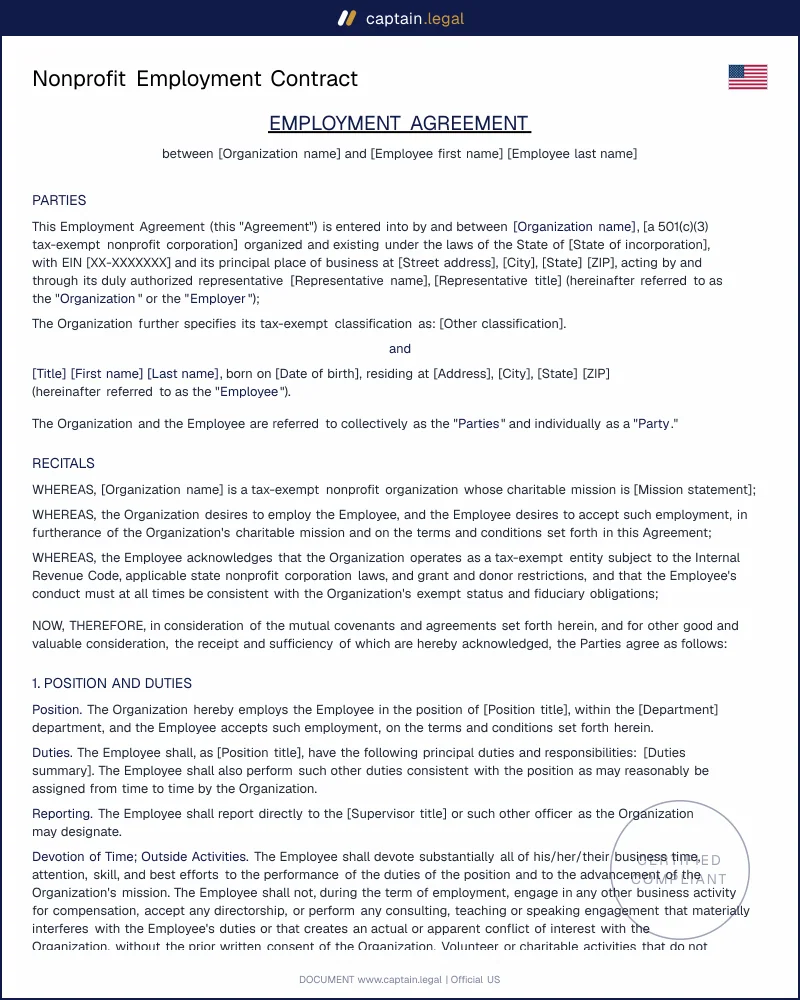
Nonprofit Employment Contract Template — Word & PDF (US)
Secure payment
What is a nonprofit employment agreement?
A nonprofit employment agreement is a binding contract between a tax-exempt organization, almost always a nonprofit corporation organized under state law, and an individual hired to perform services in exchange for W-2 wages and benefits. The structure mirrors a standard private-sector employment contract: identification of the parties, position and duties, compensation, benefits, term, termination rights, and post-employment restrictions. What makes it a nonprofit agreement is the layer of clauses that tie the employee's work to a charitable mission, restrict the use of donor funds, document board approval of compensation, and assign to the organization any work product created in the course of employment.
It is worth distinguishing this document from three close cousins. A volunteer agreement covers unpaid service and avoids creating an employment relationship that would trigger wage-and-hour rules under the Fair Labor Standards Act. An independent contractor agreement is used for grant writers, fundraising consultants, or program specialists engaged on a 1099 basis, where the worker controls the means of performing the work. An offer letter is the short, pre-hire document that summarizes key terms before the full agreement is signed. The nonprofit employment agreement sits at the center : it is the operative contract that governs the relationship once the person starts work. Confusing the four is one of the most common drafting mistakes we see, and it has real consequences for employment compliance and at-will status across the 50 states.
Legal framework
US nonprofit employment sits at the intersection of three bodies of law, and the agreement has to respect all three at once. The first layer is federal tax law applicable to Internal Revenue Code section 501(c)(3) organizations. Charities must avoid private inurement (no part of the net earnings may flow to insiders) and improper private benefit, which means every employment contract with an officer, director, key employee, or family member has to clear the Section 4958 intermediate sanctions test. The IRS defines reasonable compensation as the amount that would ordinarily be paid for like services by like enterprises under like circumstances, and a deliberate process documented in board minutes creates a rebuttable presumption of reasonableness that protects both the organization and the individual. The official guidance on this point sits at the IRS page on reasonable compensation for exempt organizations, and the underlying rules are in 26 CFR §53.4958-6.
The second layer is federal employment law. The Fair Labor Standards Act governs minimum wage, overtime, and the exempt/non-exempt classification. Title VII of the Civil Rights Act of 1964, the Americans with Disabilities Act, the Age Discrimination in Employment Act, and the Family and Medical Leave Act apply to nonprofits the same way they apply to for-profit employers once the size thresholds are met. Religious nonprofits enjoy narrow exemptions from some discrimination rules, but those carve-outs are statute-specific and should never be assumed without counsel review.
The third layer is state law, which controls at-will employment, final-pay timing, paid sick leave, non-compete enforceability, and the wording of mandatory new-hire notices. California Labor Code §2870 limits what an employer can claim as assigned IP. New York's WARN Act and wage theft notices add further requirements. Texas treats non-competes under the Covenants Not to Compete Act (Bus. & Com. Code §15.50). The agreement has to be drafted to the state where the employee actually works, not where the nonprofit is incorporated, and a finalized agreement should also be coordinated with board-approved governance and compensation policies recorded in the corporate minutes.
When do you need this document?
The most frequent trigger is the hiring of a first paid executive, usually an executive director or development director, after a founding board has run the organization on volunteer effort for the first year or two. At that moment, the board needs a written contract that records the authorized compensation, the scope of authority, and the limits on what the new hire can sign or commit on behalf of the organization. Skipping this step is how nonprofits end up with a founder-employee who signs a five-year lease without board approval, or who hires their spouse as bookkeeper without a conflict-of-interest review.
A second common scenario is the formalization of long-tenured staff who were never given a real contract. Many small charities operate for years on offer letters and good faith. When the organization grows past the Form 990 filing threshold or applies for a major institutional grant, the funder will ask for employment agreements, compensation review documentation, and a conflict-of-interest policy. Trying to retrofit those documents under deadline pressure is painful ; doing it before the first grant cycle is straightforward.
A third trigger is hiring for a role that handles restricted donor funds, protected health information, or proprietary research. Universities, healthcare nonprofits, and policy think tanks all face this problem. The employment agreement is the vehicle for confidentiality obligations, FERPA or HIPAA acknowledgments, and assignment of inventions or copyrightable work product to the organization. Without those clauses, ownership of a grant-funded research paper, a copyrighted curriculum, or a fundraising database can become genuinely ambiguous.
One edge case worth flagging : religious nonprofits hiring for ministerial roles trigger the ministerial exception recognized by the Supreme Court in Hosanna-Tabor v. EEOC (2012) and Our Lady of Guadalupe v. Morrissey-Berru (2020). The employment agreement for those positions should be drafted with that doctrine in mind, because it removes most discrimination claims from federal court jurisdiction.
Key clauses included in our template
The identification of the parties names the nonprofit corporation by its exact legal name as it appears on the Articles of Incorporation and IRS determination letter, lists its state of incorporation, and references its EIN. The employee is identified by full legal name and home address. Vague drafting at this step (the trade name instead of the legal name, for instance) creates problems when the agreement is later enforced in state court.
The position, duties, and reporting line define the role with enough specificity to support an FLSA exempt/non-exempt classification. The clause states who the employee reports to, who has authority to discipline or terminate, and whether the employee is authorized to sign contracts, bind the organization, or speak to the press. For executive directors, the reporting line points to the board of directors or an executive committee, not to a single chair acting alone.
The compensation clause sets the base salary or hourly rate, the pay schedule, and the benefits package, then attaches the supporting documentation : a record of the comparable-compensation data the board reviewed, the date of board approval, and the names of the board members who voted (with any conflicted members recused). This paper trail is what creates the Section 4958 rebuttable presumption of reasonableness and protects the organization in a Form 990 audit.
The confidentiality clause covers donor lists, grant proposals, beneficiary records, board deliberations, and the internal financial reports that nonprofits rarely think of as trade secrets but absolutely are. It carries beyond termination and applies during and after employment, with narrowly drafted exceptions for whistleblower disclosures protected under Sarbanes-Oxley §806 and analogous state laws.
The intellectual property assignment transfers to the organization any copyrightable work, curriculum, software, database, research output, or invention created within the scope of employment. The clause must be drafted to respect state IP carve-outs like California Labor Code §2870, Delaware §805, Illinois 765 ILCS 1060/2, and Washington RCW 49.44.140, which protect inventions made entirely on the employee's own time without using employer resources.
The conflict of interest acknowledgment ties the employment agreement to the organization's board-adopted Conflict of Interest Policy (the one disclosed on Form 990, Part VI, Line 12). The employee agrees to disclose financial interests, related-party transactions, and outside business activities that could compete with or compromise the nonprofit's mission.
The at-will provision and termination clause preserves at-will employment in every state that allows it, while spelling out grounds for termination for cause, the calculation of any severance, and the COBRA and final-wage timing required by state law. This is the operative clause when a separation goes sideways, and the language should be coordinated with the organization's standard at-will employment terms used across roles.
State-specific considerations
California is the most restrictive jurisdiction for nonprofit employment in the country, and the agreement has to be adapted accordingly. Business and Professions Code §16600 makes almost all non-compete covenants void, even for executive roles, so the template substitutes a narrowly drafted non-solicitation clause focused on donors, employees, and major-gift prospects. Labor Code §2870 limits IP assignment to inventions created using employer time, facilities, or trade secrets. The agreement must also include the Labor Code §2810.5 wage notice for non-exempt employees, the AB 51 protections on arbitration agreements (which the Ninth Circuit has partially preempted), and references to the California Family Rights Act alongside FMLA. Final pay is due immediately on involuntary termination under Labor Code §201, which the termination clause has to acknowledge.
New York requires a written wage notice under the Wage Theft Prevention Act (Labor Law §195) at the time of hire, with rate of pay, regular payday, and employer contact information. The state's Stop Sexual Harassment in NYC Act and statewide harassment training rules apply to nonprofits with even a single employee. Non-competes are evaluated under the BDO Seidman v. Hirshberg reasonableness test : duration, geography, and protected interest must each be defensible. Recent legislation has further narrowed the use of non-competes for lower-wage workers, and the agreement defaults to a non-solicitation clause for fundraising and program staff below an executive threshold.
Texas is more employer-friendly. The Covenants Not to Compete Act (Bus. & Com. Code §15.50) allows reasonable non-competes when supported by adequate consideration, typically confidential information or specialized training. Texas has no state-level overtime law beyond FLSA, no mandatory paid sick leave at the state level (local ordinances are preempted), and follows employment-at-will strictly. Final pay is due within six calendar days of involuntary termination under Labor Code §61.014. The agreement can include a stronger restrictive covenant than would be enforceable in California or New York, but it still has to be tied to a legitimate protectable interest.
Florida is also generally employer-friendly, with Florida Statutes §542.335 authorizing non-competes supported by a legitimate business interest, including substantial relationships with specific donors and confidential business information. Florida nonprofits should pay particular attention to the Florida Civil Rights Act (which extends to organizations with 15 or more employees) and the state's Sunbiz annual reporting obligations for nonprofit corporations. The agreement should also reference the Florida Solicitation of Contributions Act if the role involves fundraising, since that statute imposes registration and disclosure requirements that some employees will be expected to administer.
How to fill out this nonprofit employment agreement
The form starts by asking for the state where the employee will physically perform the work, which is the determinative factor for wage-and-hour law, IP carve-outs, and non-compete enforceability. From there the template adjusts the at-will language, the final-pay timing, the IP assignment, and any state-specific notices that have to be attached as exhibits.
Next you enter the nonprofit's exact legal name, EIN, state of incorporation, principal office address, and the name and title of the officer signing on behalf of the organization (typically the board chair or, for a subordinate hire, the executive director acting under board authority). For the employee, you provide full legal name, address, and the position title. The template then walks you through compensation : base salary or hourly rate, pay frequency, eligible benefits, vacation and sick leave accrual, and any signing bonus or relocation assistance.
The IP and confidentiality clauses are pre-drafted but allow for organization-specific definitions of confidential information, particularly around donor data and grant work product. You then attach the Conflict of Interest Policy (or reference it by date of board adoption) and confirm the date the board approved the compensation package, including the names of the directors who voted. The agreement closes with the at-will and termination language, signature blocks for both parties, and an effective date. Most organizations complete the entire flow in under 30 minutes, and the output downloads in both editable Microsoft Word and signature-ready PDF formats.
Common mistakes to avoid
The most damaging mistake is failing to document board approval of the executive's compensation before the agreement is signed. Without contemporaneous minutes recording the comparability data reviewed, the directors who voted, and the recusal of any conflicted member, the organization loses the Section 4958 rebuttable presumption of reasonableness. We have seen nonprofits scramble to reconstruct this paper trail two years after the fact under audit pressure, and reconstruction is never as defensible as real-time documentation. The compensation has to be approved before the offer goes out, not retroactively ratified at the next quarterly board meeting. A close second is using a generic for-profit employment template and adding the word "nonprofit" in the recitals. That approach misses the mission alignment language, the conflict-of-interest cross-reference, the donor-data confidentiality scope, and the IP assignment tailored to grant-funded work.
A third recurring problem is over-reaching on restrictive covenants. Nonprofits sometimes import broad non-compete clauses from corporate templates and try to enforce them against program staff in California, Oregon, or Minnesota, where such clauses are partially or wholly void. The result is a clause that is unenforceable in court and creates friction with talented hires who read it correctly as overreach. A narrower non-solicitation clause focused on donors, beneficiaries, and key employees is almost always more defensible and more enforceable. The fourth mistake is leaving classification ambiguous between employee and independent contractor. The IRS common-law control test and the Department of Labor's economic realities test both look at how the work is actually performed, not at what the parties wrote in the contract. Mislabeling a controlled, integrated, full-time worker as a 1099 contractor exposes the nonprofit to back taxes, penalties, and worker-side claims. Coordinating with a properly drafted non-compete and non-solicitation agreement framework and keeping classifications honest from day one prevents most of this.
Frequently Asked Questions
22 verified reviews · 50 000+ downloads
- Immediate access to the document
- PDF + Word download
- Compliant with 2026 legislation
- Reviewed by lawyers
You might also like