A Conflict of Interest Policy is the internal rule book that tells your directors, officers, and key employees what to do when a personal interest collides with the interests of the nonprofit. The IRS expects every applicant for 501(c)(3) tax-exempt status to adopt one before filing Form 1023, and to attach a copy to the application. Beyond the box-checking, this is the document that protects your board from self-dealing claims, keeps your intermediate sanctions exposure under control, and tells donors, grantmakers, and state regulators that you take governance seriously. Drafted properly, it is short, operational, and signed every year. Drafted poorly, it sits in a binder and offers zero protection when a transaction is challenged.
This template is built for US nonprofit corporations seeking or holding 501(c)(3) recognition, including public charities, private foundations, and supporting organizations. It tracks the IRS sample appendix to Form 1023 line by line while leaving room for state-specific overlays.
Compliant
2026 Legislation
50,000+ clients
trust us
Affordable
From $4.90 / doc
Secure payment
Instant download
Nonprofit Conflict of Interest Policy Template | Board-Ready
Secure payment
What is a conflict of interest policy?
A conflict of interest policy is a written set of governance rules that requires directors, officers, and key employees to disclose financial or personal relationships that could compromise their loyalty to the organization, and that defines how the board handles those disclosures. The policy is internal: it does not need to be filed with the state, but the IRS treats its existence and use as evidence that the nonprofit operates exclusively for exempt purposes rather than for the benefit of insiders.
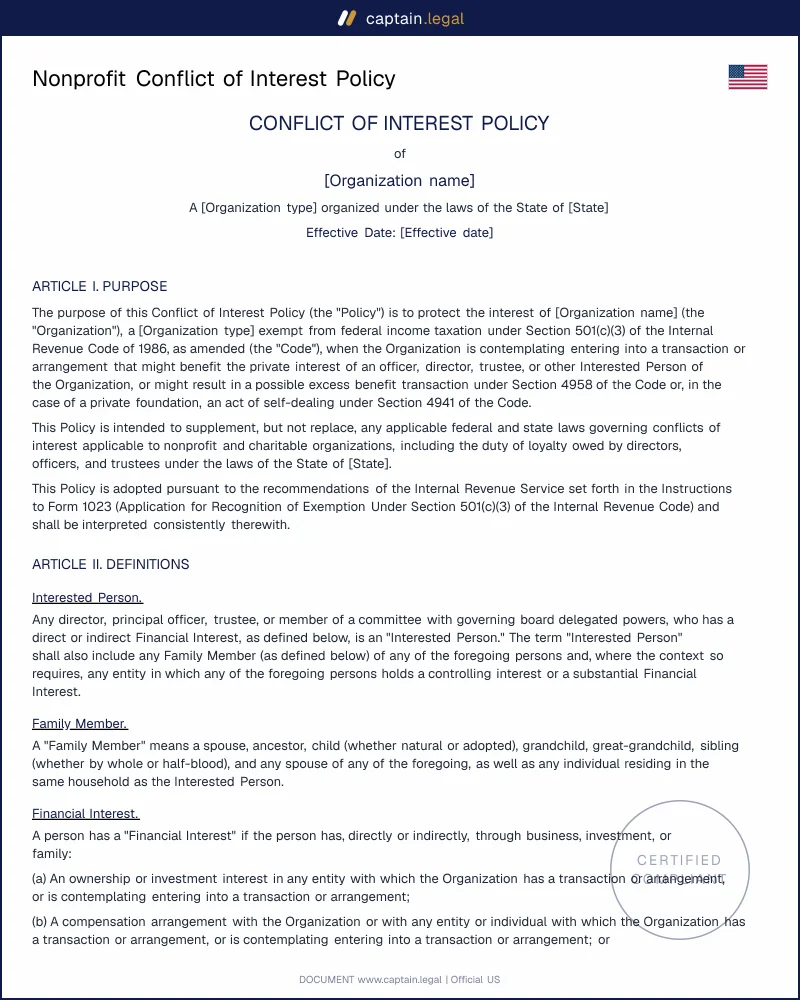
The structure is consistent across well-drafted versions. The policy defines who is an interested person, what counts as a financial interest, how disclosures are made, who decides whether a conflict exists, and what procedure governs the decision once a conflict is identified. It also imposes an annual signed statement from every covered person and requires the board to document its determinations in the minutes.
People sometimes confuse this with a code of ethics or a whistleblower policy. They are related governance documents, but distinct. A code of ethics covers broad standards of conduct ; a whistleblower policy protects people who report violations ; a conflict of interest policy specifically governs transactions and decisions where an insider's personal stake could distort the outcome. The IRS treats all three as best-practice indicators on Form 990, but only the conflict policy is referenced directly on Form 1023, Part V, Line 5a.
Legal framework
The federal anchor is Internal Revenue Code section 501(c)(3), which prohibits any part of a charity's net earnings from inuring to the benefit of a private shareholder or individual. This is the private inurement doctrine, and a documented conflict of interest policy is the IRS's preferred evidence that your organization complies. The IRS has published a sample policy as Appendix A to the Form 1023 instructions ; this template follows that appendix structure while adapting the language to modern board practice. You can read the official guidance in the IRS instructions for Form 1023 including the sample conflict policy, which remains the authoritative reference for tax-exempt applicants.
Beyond inurement, the intermediate sanctions regime under IRC section 4958 imposes excise taxes on excess benefit transactions between a public charity and a disqualified person, typically a director, officer, or substantial contributor. The penalty falls on the individual, not the organization, and can reach 25 % of the excess benefit on first tier and 200 % if not corrected. The conflict policy is what activates the rebuttable presumption of reasonableness under Treasury Regulation §53.4958-6, which shifts the burden of proof to the IRS if the board followed three steps: independent approval, reliance on comparability data, and contemporaneous documentation. Without the policy and the paper trail, the presumption does not attach.
State law adds a second layer. Most jurisdictions follow some version of the Revised Model Nonprofit Corporation Act or the Uniform Prudent Management of Institutional Funds Act (UPMIFA), both of which impose fiduciary duties of loyalty and care on directors. New York's Non-Profit Revitalization Act of 2013 goes further and requires a written conflict of interest policy by statute under N.Y. Not-for-Profit Corporation Law §715-a. California, Illinois, and several other attorneys general examine policies during routine charitable trust reviews. State requirements supplement, but never replace, the IRS standard. Your policy should satisfy the strictest of the regimes that apply to you.
When do you need this document?
The most common trigger is filing IRS Form 1023 or 1023-EZ. Part V of the long form asks whether the organization has adopted a conflict of interest policy, and the IRS expects a "yes" answer with the policy attached as an exhibit. Filing without one is technically permitted but invites follow-up questions and slows down the determination letter. A board that adopts the policy at the organizational meeting, before the application is filed, gets a clean record from day one. This is the standard sequence we recommend pairing with the nonprofit articles of incorporation and the bylaws.
Existing 501(c)(3) organizations need the policy in force for Form 990 reporting. Part VI, Section B, Line 12 asks whether you have a written policy, whether officers and directors disclose annually, and whether you regularly monitor and enforce compliance. A blank or "no" answer becomes a flag the next time you apply for a grant. Most institutional funders, including national foundations and federated giving programs, will not move a proposal past the screening stage without a current policy on file.
You also reach for the policy when a specific transaction is on the agenda : a vendor contract with a board member's company, a compensation decision for the executive director who sits on the board, a real estate deal with a related party, or a grant to an organization run by a director's spouse. Adopt the policy before the transaction is discussed, not after. Courts and the IRS treat retroactive policies as cosmetic. One recurring edge case worth flagging is the founder-led nonprofit where the same person drafts the bylaws, signs the lease, and approves their own salary : the policy is essential there, but it works only if a genuinely independent quorum can be assembled to vote on the founder's transactions.
Key clauses included in our template
- The definition of an interested person covers every director, principal officer, and member of any committee with board-delegated powers. The template explicitly extends the definition to immediate family members and to entities in which the insider holds a controlling or material financial interest. A narrow definition is the most common reason policies fail in practice : if the spouse or LLC of a director is not captured, the loophole eats the rule.
- The scope of a financial interest mirrors the IRS sample appendix and reaches any actual or potential ownership, compensation arrangement, or beneficiary relationship with a party to a proposed transaction. The clause makes clear that the existence of a financial interest is not, by itself, a conflict ; the determination belongs to the disinterested directors after disclosure.
- The disclosure procedure requires the interested person to make full disclosure of the material facts to the board or committee considering the transaction, and then to leave the meeting during the deliberation and vote. The interested person may answer questions before withdrawing. The clause is precise on this point because §4958 compliance turns on the quality of the deliberation outside the interested person's presence.
- The procedure for addressing the conflict locks in the rebuttable presumption protocol from Treasury Regulation §53.4958-6 : the remaining board members investigate alternatives, determine by majority vote whether the proposed transaction is in the organization's best interest and at fair market value, and approve it on those grounds. The vote must be majority of the disinterested directors, not majority of those present.
- The violations and disciplinary procedure gives the board authority to investigate suspected failures to disclose, to take corrective action up to and including removal, and to void unauthorized transactions. The clause is rarely invoked but its presence changes behavior at the disclosure stage.
- The records of proceedings clause requires the board to document, in the minutes, the names of persons who disclosed an interest, the nature of the interest, the decision on whether a conflict existed, the alternatives considered, and the content of the discussion and vote. Contemporaneous documentation is one of the three pillars of the rebuttable presumption.
- The annual statements clause requires every director, principal officer, and member of a committee with board-delegated powers to sign, on becoming an interested person and annually thereafter, an affirmation that they have read the policy, understand it, and agree to comply. The signed statements are kept with the corporate records.
- The periodic reviews clause requires the organization to review compensation arrangements and partnerships, joint ventures, and asset-sharing arrangements annually to confirm consistency with the charitable purpose and the absence of inurement or excess benefit.
- The use of outside experts clause permits the board to retain attorneys, accountants, or appraisers to support periodic reviews, while preserving the board's ultimate responsibility for the determination.
State-specific considerations
California. California charities are supervised by the Attorney General's Registry of Charitable Trusts under the Supervision of Trustees and Fundraisers for Charitable Purposes Act (Cal. Gov. Code §12580 et seq.). The Attorney General's office routinely requests conflict of interest policies during audits and registration reviews. California Corporations Code §5233 defines self-dealing transactions for nonprofit public benefit corporations and imposes a specific approval procedure for self-dealing : prior approval by the Attorney General or a court is required unless the transaction qualifies under one of the statutory exceptions. The template's procedure satisfies the standard board approval requirement, but California boards should layer the §5233 analysis on top whenever an interested-director transaction is on the table.
Texas. The Texas Business Organizations Code §22.230 governs interested party transactions for nonprofit corporations and validates them when the material facts are disclosed and the transaction is approved by a majority of disinterested directors, or is fair to the corporation at the time. The Texas framework is more permissive than California's but still requires the disclosure-and-vote sequence the template institutes. Texas charities that solicit donations should also confirm registration status with the Office of the Secretary of State under the Charitable Raffle Enabling Act and any applicable solicitation statutes.
Florida. Florida nonprofit corporations operate under Chapter 617 of the Florida Statutes, with §617.0832 governing director conflicts of interest. The statute uses the fair to the corporation standard combined with disclosure-and-approval requirements that the template mirrors. The Florida Department of Agriculture and Consumer Services administers the Solicitation of Contributions Act (Chapter 496, Florida Statutes), which does not mandate a conflict policy but examines governance practices during compliance reviews.
New York. New York imposes the highest statutory floor of any state. N.Y. Not-for-Profit Corporation Law §715-a requires every nonprofit corporation to adopt a written conflict of interest policy and prescribes the minimum content : definition of interested persons and conflicts, disclosure procedures, prohibition on the interested person being present during deliberations, documentation requirements, and an annual signed statement. §715-b separately requires a whistleblower policy for organizations with twenty or more employees and annual revenue over one million. The template is drafted to satisfy §715-a in full, and we recommend pairing it with the nonprofit bylaws template to align governance documents under New York law.
How to fill out this conflict of interest policy
You begin by entering the legal name of the corporation exactly as it appears on the articles of incorporation, then the state of incorporation, which drives the supplementary statutory references the template inserts automatically. From there, the form asks you to confirm the categories of interested persons you want covered : the default tracks the IRS sample appendix, but boards with delegated committees often extend the definition to committee members with binding authority. The compensation committee and executive committee are the usual additions.
The next step is the procedural detail. You specify whether disclosures are made to the full board, to a designated committee, or to the chair, and you set the cadence of the annual signed statement. Most boards align the signature date with the fiscal year close or the annual meeting, which keeps the paper trail consistent with the minutes and the Form 990 preparation cycle. You then choose whether to include the optional clauses for use of outside experts and periodic reviews of compensation and partnership arrangements ; both are recommended for organizations with paid staff or material contracts.
The final pass is signatures. The template generates a clean policy document for board adoption by resolution, plus a separate annual statement for each covered person to sign and return. You download both in editable Word format for board counsel review and in PDF for archival and Form 1023 attachment. The signed statements live in the corporate records alongside the bylaws and the minutes from the adoption meeting.
Common mistakes to avoid
The most expensive mistake is adopting the policy and then never using it. A binder version that no one signs annually and that the minutes never reference offers almost no protection : the IRS and state regulators look for evidence of operation, not paper. Boards that quietly let the annual statements lapse for three years discover the gap when a Form 990 triggers a state audit, and at that point the cure is awkward. The second recurring failure is letting the interested director stay in the room. The statute and the IRS sample are explicit on withdrawal during deliberation and vote, yet small boards routinely treat the requirement as informal because "everyone is family." The minutes then show no separate disinterested vote, the rebuttable presumption never attaches, and the transaction is exposed to §4958 scrutiny.
A third mistake is defining the interested-person universe too narrowly. A policy that covers only the named directors and officers, but not their immediate family members or the entities they control, misses the most common conflict scenario : the spouse's consulting firm hired as a vendor, or the director's wholly owned LLC leasing space to the nonprofit. A fourth failure is skipping the comparability data requirement on compensation decisions for the executive director or other disqualified persons : without independent salary surveys or comparable contracts in the record, the board's approval is vulnerable even when the amount is reasonable. Finally, boards forget that the policy interacts with broader governance hygiene. Treating the conflict policy as a standalone document, rather than as one piece of a coherent board package that includes corporate bylaws and a documented compensation review process, leaves predictable gaps that surface during a Form 990 preparation or a state Attorney General inquiry.
Frequently Asked Questions
31 verified reviews · 50 000+ downloads
- Immediate access to the document
- PDF + Word download
- Compliant with 2026 legislation
- Reviewed by lawyers
You might also like