A commercial lease agreement is the binding contract that lets a business occupy office, retail, or industrial space owned by someone else, in exchange for rent and a defined set of operating obligations. Unlike a residential lease, it operates in a world where courts treat both parties as sophisticated and will enforce nearly every clause as drafted, however lopsided it reads after the fact. That single fact shapes everything: the use clause that boxes in your business model, the CAM reconciliation that lands on your desk every January, the holdover penalty that triples your rent the day after expiration. Whether you are leasing 1,200 square feet of retail at a strip center or 80,000 square feet of warehouse, the document you sign on day one governs the next five to fifteen years of cash flow.
This template covers the three structures actually used in the US market — full-service gross, modified gross, and triple net — and adapts to every state through built-in selectors for governing law, notice periods, statutory remedies, and recording requirements where applicable.
Compliant
2026 Legislation
50,000+ clients
trust us
Affordable
From $4.90 / doc
Secure payment
Instant download
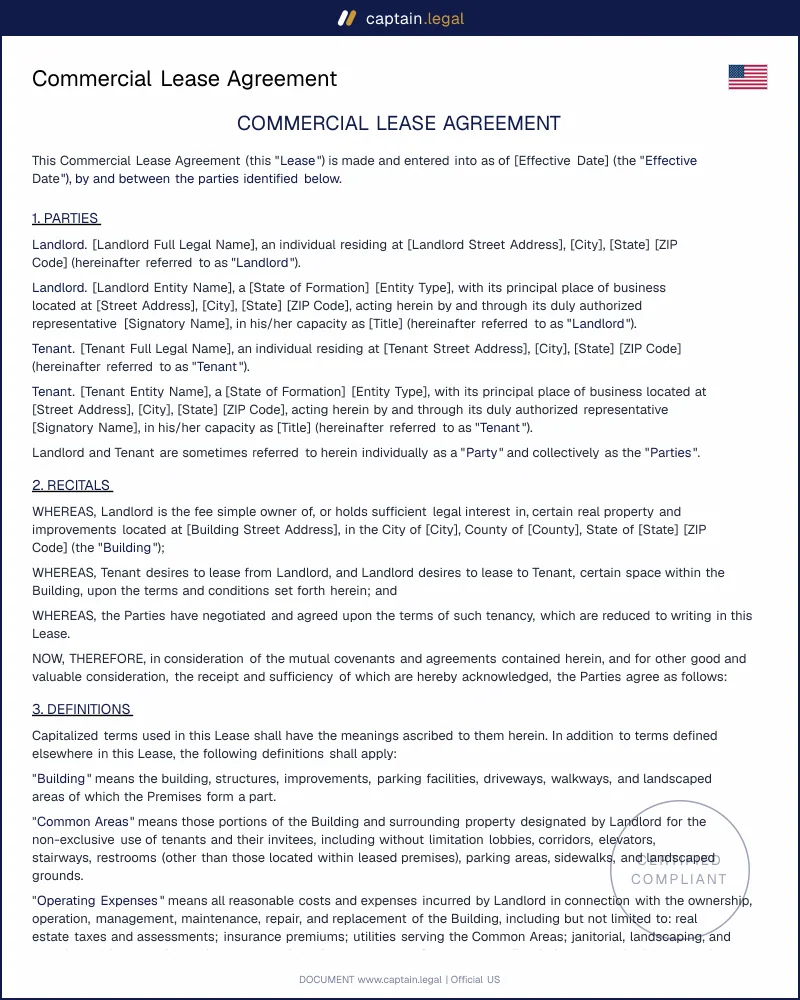
Commercial Lease Agreement Template — Office, Retail, Industrial
Secure payment
What is a commercial lease agreement?
A commercial lease agreement is a written contract under which a landlord conveys exclusive possession of non-residential real estate to a tenant for a stated term, in return for rent and the performance of specified covenants. The space is leased for business purposes — general office, retail, restaurant, industrial, warehouse, medical, flex — and the lease structure determines who pays what beyond base rent. The federal landlord-tenant protections that blanket residential rentals largely do not apply here; the relationship is governed almost entirely by the four corners of the document and the underlying state contract and property law.
The confusion most tenants carry into the negotiation is the assumption that a commercial lease and a residential lease sit on a spectrum. They do not. A residential lease is heavily regulated, with mandatory disclosures, statutory eviction procedures, security-deposit caps, and implied warranty of habitability baked in by case law. A commercial lease has almost none of those guardrails. Late fees are limited only by unconscionability doctrine, not by a statutory ceiling. The implied warranty of suitability recognized in Davidow v. Inwood North Professional Group (Texas, 1988) and a minority of states is the rare exception, not the rule. Most states treat a commercial tenant as a merchant who negotiated at arm's length, even when the tenant is a first-time entrepreneur signing a 90-page document handed to them on a take-it-or-leave-it basis. That asymmetry is precisely why the drafting of the lease matters more than any operational decision the business will make over the next decade.
Legal framework
Commercial real estate leases sit at the intersection of state common law, state statutes, and a thin layer of federal law for narrow issues like ADA accessibility and bankruptcy treatment of unexpired leases under 11 U.S.C. §365. There is no national landlord-tenant act for commercial property. UCC Article 2A governs leases of goods — equipment, vehicles, fixtures sold separately — and explicitly does not reach leases of real estate. The body of law you are actually working with is your state's contract and property statutes, supplemented by decades of appellate decisions interpreting standard lease language. For an introductory map of how courts treat the triple net structure that dominates this market, the Cornell Legal Information Institute entry on triple net leases lays out the allocation of taxes, insurance, and maintenance that most commercial leases adopt as their default skeleton.
Every state imposes a statute of frauds that requires a lease for a term longer than one year to be in writing and signed by the party against whom enforcement is sought (see e.g. New York General Obligations Law §5-703, California Civil Code §1624, Texas Business and Commerce Code §26.01). An oral lease for sixty months is not just risky; it is unenforceable on its face. Many states layer on recording statutes for leases over a defined length — typically seven years in Texas, three years in California under Civil Code §1214, ten years in Florida — and a lease that is not recorded against the property risks subordination to any subsequent lender or purchaser without actual notice.
A handful of jurisdictions have enacted commercial-specific statutory protections that override the contract on narrow points: New York City's Commercial Tenant Harassment Law (Local Law 77 of 2017), Washington D.C.'s commercial lockout prohibition under D.C. Code §16-1505, and California's notice requirements for common area maintenance reconciliations under recent retail-tenant amendments. None of these displace the lease wholesale; they trim its sharpest edges. The default rule remains contractual freedom, and the foundational documents on Captain.Legal real estate reflect that — drafting the lease tightly is the only durable protection either side has.
When do you need this document?
The clearest trigger is the signing of a new tenancy for any business space, from a single-suite professional office to a multi-tenant retail center. Anything beyond a true month-to-month occupancy demands a written instrument that satisfies the statute of frauds and locks in the economic terms before the tenant builds out the space. Going to lease without a signed document, even when both parties are operating in good faith on a letter of intent, exposes the landlord to a tenant who walks before completing the buildout and exposes the tenant to a landlord who decides three months in that the agreed tenant improvement allowance was actually a verbal courtesy.
The second common trigger is the renewal or extension of an existing lease. Most well-drafted leases include an option to renew at a fair market rent or at a stated percentage escalation, but the option is conditioned on written exercise within a precise window — often 180 to 270 days before expiration. A tenant who lets that window close has effectively given up the option; the landlord can then propose a market rent that, in tightening submarkets, may run thirty to fifty percent above the expiring rate. The renewal lease document captures the new term, the new rent schedule, and any updated operating expense base year.
The third scenario is assignment or sublease, where the original tenant transfers part or all of its leasehold to another business. The standard lease prohibits this without landlord consent not to be unreasonably withheld, and a clean assignment requires a separate written instrument incorporating the original lease by reference. Skip the written assignment and the original tenant remains primarily liable for the new occupant's rent and conduct, often for the entire remaining term. A franchisor buying back a unit from a struggling franchisee, a tenant being acquired in an M&A transaction, a coworking operator subletting individual suites — each of these calls for the document to be drawn up, signed, and recorded where applicable.
One edge case worth flagging: a sale-leaseback, in which an owner-operator sells the building to an investor and immediately leases it back. The economics work like financing, but the structure is a commercial lease and the documents must read as one, or the IRS may recharacterize the transaction as a disguised loan with severe tax consequences.
Key clauses included in our template
The template is built around the clauses that, in our experience drafting and litigating commercial tenancies across all fifty states, account for the overwhelming majority of disputes. Each clause is parameterized so the form adapts to your state, your lease structure (gross, modified gross, NNN), and your property type (office, retail, industrial).
- The rent and additional rent clause separates the base rent from the additional rent representing the tenant's share of taxes, insurance, and common area charges. Base rent is fixed or escalates on a defined schedule (a 3% annual bump is common; CPI-indexed escalation with a 2% floor and 5% cap is the negotiated alternative). Additional rent is reconciled annually under an estimate-and-true-up mechanism the lease must spell out, including the tenant's audit right and the landlord's record-retention duty.
- The use clause defines the permitted use of the premises in narrow, specific language. Vague phrasing like "general office and related uses" invites disputes the moment the tenant pivots its business model; the better practice is to list the planned activities expressly, then add a reasonableness savings provision covering ancillary uses customary in the industry. Exclusive use protection, where applicable, blocks the landlord from leasing nearby space to a direct competitor.
- The CAM and operating expense clause is where landlords win or lose net operating income, and where tenants accept or refuse to pay for capital improvements dressed up as maintenance. The clause inventories includable expenses (landscaping, parking-lot resurfacing, common-area utilities, property management fees capped at a percentage of gross revenues) and explicitly excludes capital expenditures, leasing commissions, tenant-improvement work for other tenants, roof replacement, and structural repairs.
- The assignment and sublet clause sets the standard for landlord consent. The default "sole and absolute discretion" standard is a near-total veto; the negotiated alternative is "consent not unreasonably withheld, conditioned, or delayed," with a defined response period (15 to 30 business days) and an objective test for reasonableness. The clause also covers recapture rights, profit-sharing on subrent above base rent, and change-of-control triggers in entity tenants.
- The default and remedies clause aligns with the state's commercial eviction procedure (forcible entry and detainer, unlawful detainer, summary process) and lists the specific events of default with the cure periods that match local law. The remedies tier from acceleration of rent, to lease termination with damages measured under §1951.2 California Civil Code or its state analogue, to self-help re-entry where the state permits it.
- The renewal, holdover, and surrender clauses fix the option terms, the holdover rent multiplier (typically 150% to 200% of last-month base rent, sometimes plus consequential damages), and the surrender condition standard, including whether the tenant must remove buildout or leave it in place. You can compare the renewal mechanics across product types on the Captain.Legal US documents catalog.
State-specific considerations
Commercial lease enforcement is governed by state law in every meaningful respect, and the variations matter on dollar-level and timeline-level questions that tenants and landlords confront within the first year of any tenancy.
California. California treats commercial tenants with somewhat more scrutiny than most states, particularly in retail. Civil Code §1950.7 limits the use of commercial security deposits and imposes a 30-day post-vacancy accounting requirement that mirrors the residential rule. Eviction proceeds by unlawful detainer under Code of Civil Procedure §1161, and the three-day notice to pay or quit is the threshold to a commercial lockout; self-help re-entry is prohibited even when the lease purports to authorize it. Local rent-control ordinances generally do not reach commercial space, but San Francisco's Proposition I and similar municipal measures have started extending limited protections to small-business tenants, which makes the legal description of the premises and the use clause more consequential than ever.
Texas. Texas is the friendlier jurisdiction for landlord enforcement. Property Code §93 governs commercial tenancies, allowing self-help lockout and commercial landlord's liens on tenant property left at the premises after default, subject to specific notice requirements. The Davidow implied warranty of suitability survives but can be waived by clear lease language, and Texas courts routinely enforce waiver-of-subrogation and exculpatory clauses that other jurisdictions narrow. Lease terms over seven years should be recorded under Property Code §13.001 to bind subsequent purchasers and lenders.
Florida. Florida's Chapter 83 Part I covers nonresidential tenancies. The state permits commercial distress for rent under §83.08, a creditor's remedy obsolete in most states but still alive in Florida, allowing the landlord to seize and sell tenant property to satisfy unpaid rent. Florida also applies a strict fifteen-day default notice baseline unless the lease specifies otherwise, and the lease's attorney-fee-shifting provision is enforceable for the prevailing party in any rent or possession dispute. The state's hurricane exposure makes the casualty and force majeure clauses particularly load-bearing.
New York. New York commercial leases are litigated in Civil Court Commercial Landlord-Tenant Part and proceed under Real Property Actions and Proceedings Law §711. Yellowstone injunctions, named after the First National Stores v. Yellowstone Shopping Center decision (1968), are a uniquely New York remedy allowing a tenant to pause a notice to cure while litigating the underlying default — a major tenant-side protection that the lease cannot waive in most boroughs. New York City's Commercial Tenant Harassment Law (Local Law 77 of 2017) imposes statutory damages on landlords engaging in coercive conduct against small-business tenants, layered on top of the general lease framework. Recording over three years is governed by Real Property Law §291-c.
A handful of additional jurisdictions — D.C., Massachusetts, Illinois — overlay their own commercial-specific procedures, and the template adapts the notice, cure, and remedies sections to whichever governing law you select. The same care applies on the Captain.Legal employment documents for any business that will employ staff at the leased premises.
How to fill out this commercial lease agreement
The form opens by asking you to identify the state of the property and the lease structure you have negotiated. From there, the template adapts every downstream provision: governing law, statutory citations, notice periods, default cure timelines, and holdover formulas. You will then enter the legal name and entity type of the landlord and tenant exactly as registered with the secretary of state, because a lease signed in a trade name rather than the legal entity name has been challenged successfully in multiple states. The premises description follows, with the legal address, suite or unit number, rentable square footage, and usable square footage if the building applies a load factor.
The economic section walks you through base rent with any scheduled escalations, the commencement and expiration dates, any rent abatement during fit-out, and the security deposit. If you are signing a triple-net or modified-gross structure, the template prompts you for the operating expense base year, the included and excluded CAM categories, and the audit right window. You will be asked whether the tenant is contributing capital through a tenant improvement allowance and, if so, how it disburses against contractor invoices.
The last section covers the operational covenants: insurance limits with the landlord named as additional insured, the use clause language, signage rights, parking allocation, and any exclusive use protection. The document then generates with the correct statutory citations for the chosen state and is downloadable in both Word and PDF for signature, with execution blocks formatted for notarization in the states that recommend it. Pages with similar parameterization logic for individuals are available on the Captain.Legal personal documents page.
Common mistakes to avoid
The most expensive mistake we see is signing the lease without negotiating the CAM exclusions list, then receiving a true-up invoice twelve months in that includes the new roof, the parking-lot repaving, and a property management fee calculated on gross rents rather than net. Tenants assume "operating expenses" means routine upkeep; landlords draft it to capture every dollar not expressly excluded. The fix is to redline the inclusion language to add an exclusions schedule covering capital improvements, structural work, leasing commissions, depreciation, financing costs, and the cost of services provided to other tenants but not the signing tenant. A second mistake closely related is failing to negotiate an audit right with a usable timeline; a 90-day audit window from receipt of the reconciliation statement is the workable minimum.
The other recurring failure sits in the renewal option. Tenants negotiate hard for a five-year option at signing, then forget the exercise window and miss the deadline by a week. Many leases require the option to be exercised in writing, by certified mail to a specific notice address, no earlier than 270 and no later than 180 days before expiration. Calendar the deadline the day you sign, in two systems, and exercise even if you are not yet certain you want to renew — most options can be unwound for a fee. The third common error is signing a personal guaranty without negotiating a good guy clause, which caps personal liability at the rent that accrues until the tenant peaceably surrenders. Without a good guy carve-out, the guaranty runs for the full remaining term, which on a ten-year lease can mean seven-figure personal exposure for the founder. Finally, tenants in triple net deals routinely overlook the insurance certificate compliance review: the lease specifies coverages and the landlord as additional insured, but the tenant's broker issues a certificate listing the landlord only as a certificate holder, leaving the landlord with no direct claim against the policy and the tenant in technical default from day one.
Frequently Asked Questions
39 verified reviews · 50 000+ downloads
- Immediate access to the document
- PDF + Word download
- Compliant with 2026 legislation
- Reviewed by lawyers
You might also like