A roommate agreement is the private written contract that governs how cotenants share a rental unit between themselves, covering rent split, utilities, security deposit allocation, quiet hours, guest policies, and the exit procedure when someone leaves before the lease ends. It does not replace the master lease signed with the landlord ; it sits underneath it, binding only the roommates to each other. Tens of thousands of US renters sign one every month, and the ones who skip it are exactly the ones who end up in small claims court arguing over a missing deposit eighteen months later.
This page walks you through what a roommate agreement must contain to be enforceable, the state rules that quietly shape it, the clauses our template includes, and the common mistakes that turn a friendly cohabitation into a billing dispute. Whether you are splitting a two-bedroom in Brooklyn, a four-bedroom student house in Austin, or a high-rise in San Francisco, the same architecture applies, with a few statutory adjustments depending on where the keys turn.
Compliant
2026 Legislation
50,000+ clients
trust us
Affordable
From $4.90 / doc
Secure payment
Instant download
Roommate Agreement: Split Rent, Deposit & Utilities Legally
Secure payment
What is a roommate agreement?
A roommate agreement is a written contract between two or more people who occupy the same rental unit and want to define their mutual obligations in writing. It is a separate document from the lease the landlord signs with the tenants. The lease creates the landlord-tenant relationship and is governed by your state's landlord-tenant act ; the roommate agreement governs the intra-tenant relationship, and US courts treat it as an ordinary private contract under state contract law.
The distinction matters more than people realize. A roommate who fails to pay their share of rent is not breaching the lease (the landlord can still come after every cotenant jointly), but they are breaching the roommate agreement. That breach gives the other roommates a contractual claim, typically in small claims court, for unpaid rent, utilities, or damages caused. Without a signed roommate agreement, the only available remedy is a quantum meruit or unjust enrichment argument, which is slower, harder to prove, and almost never recovers the full amount owed.
A roommate agreement is also distinct from a sublease. In a sublease, one tenant on the lease rents space to a new occupant who is not on the lease, with the original tenant acting as a quasi-landlord. In a roommate agreement, all parties are usually cotenants on the same lease, sharing the unit on equal footing. Mixing the two structures, or assuming they are interchangeable, is one of the fastest ways to create liability for the master tenant. For shared housing covered by a lease the whole household signs, our residential lease agreement for cotenants in all 50 states is the natural companion document.
Legal framework
Roommate agreements live at the intersection of three layers of US law. The first is state contract law, which determines whether the agreement is enforceable at all. Every US state recognizes a written, signed contract between adults for lawful purposes as binding, provided there is offer, acceptance, and consideration. The shared rent obligation supplies the consideration, so a properly drafted roommate agreement is enforceable under the same general rules as any other contract, including the Restatement (Second) of Contracts principles followed by most state courts.
The second layer is the state landlord-tenant act, which governs the master lease and indirectly constrains what roommates can agree to. Cotenants are jointly and severally liable for rent in nearly every state, meaning the landlord can collect the entire rent from any single tenant regardless of internal arrangements. California Civil Code §1951.2, New York Real Property Law §226-b, Texas Property Code §92.019, and Florida Statutes §83.43 all reflect this rule. A roommate agreement cannot waive joint and several liability toward the landlord, but it can, and should, allocate the burden internally so the roommate who paid more than their share can recover from the others. The cure-or-quit and pay-or-quit machinery is laid out in our state-specific eviction notice templates with 3-day and 30-day formats for the moments where one cotenant's default puts the whole household at risk.
The third layer is federal fair housing law, primarily the Fair Housing Act (42 U.S.C. §§3601 et seq.). It restricts how cotenants can select replacement roommates : you cannot post an ad excluding tenants by race, color, religion, sex, national origin, familial status, or disability. The single-family roommate exemption under §3603(b) is narrow and rarely applies to typical urban shared rentals. The Cornell Legal Information Institute publishes a Cornell Legal Information Institute overview of the Fair Housing Act roommate exemption that is the authoritative starting point. Discriminatory roommate ads have triggered HUD complaints and statutory damages in dozens of reported cases, so the screening clause in any roommate agreement must be drafted carefully.
When do you need this document?
The clearest trigger is two or more adults moving into the same rental on the same lease. The moment the keys are handed over, every cotenant is on the hook for the full rent, and the only thing standing between a friendly arrangement and a courtroom dispute is whatever was written down before move-in. New cotenants almost never want to think about exit clauses on day one, which is exactly why the agreement has to be signed on day one.
The second scenario is adding a new roommate mid-lease, with the landlord's written consent. The incoming roommate signs an addendum to the master lease and a separate roommate agreement with the existing cotenants. In rent-controlled jurisdictions, this is the moment when vacancy decontrol rules can be triggered, particularly in cities like New York and San Francisco, so the timing and paperwork around a new arrival is not purely administrative.
A third common situation is family or romantic cohabitation outside marriage. Unmarried couples who pool rent, an adult child living with a parent and paying rent, or two siblings sharing an inherited rental all benefit from a written roommate agreement. Without it, the IRS and family courts have nothing to anchor the financial reality of the household, which becomes painful during a separation or an estate proceeding.
Two edge cases deserve attention. The first is mid-term replacement after one roommate moves out before the lease ends : the departing roommate often wants a release, and the remaining roommates want a successor who can actually pay. The second is student housing, where parents sometimes co-sign the master lease but the students themselves want to define how chores, food, and visitors are handled. In both edge cases, skipping the written agreement is the single most reliable way to end up in small claims court.
Key clauses included in our template
- The identification of the parties lists every adult cotenant by full legal name, current address, and date of birth, plus the address of the rental unit and the start date of the cotenancy. Naming "Sarah and the others" is not enough ; a small claims judge needs to know exactly who is bound, especially when one roommate denies ever agreeing to a specific rule.
- The rent allocation clause specifies the exact dollar share each roommate owes and the payment method, whether to a primary tenant who consolidates payments or directly to the landlord. It distinguishes between equal split and pro rata by bedroom size, which is the fairer formula when one bedroom is materially larger or has a private bathroom.
- The security deposit allocation matches each roommate's contribution to the master deposit and defines how deductions will be apportioned at move-out. §1950.5 of the California Civil Code and equivalents in Texas, Florida, and New York treat the deposit as a single fund held against the lease, so the internal split has to be contractual.
- The utilities and shared expenses clause covers electricity, gas, water, internet, streaming services, and household supplies. It names the account holder for each utility and the reimbursement mechanism, which prevents the "I'll Venmo you next week" spiral that ends most cotenancies badly.
- The house rules section addresses overnight guests, quiet hours, cleaning rotations, common-area use, pets, smoking, and parking. These are not legal requirements but they are the items that generate 80 percent of the friction in shared housing, so writing them down is what keeps the cotenancy intact.
- The exit and replacement clause governs what happens when a roommate wants to leave before the lease ends. It defines the notice period, the right of the remaining roommates to approve a replacement, and the financial settlement for the departing party, including security deposit refund timing.
- The dispute resolution clause typically requires the cotenants to attempt informal mediation before filing in small claims court, with the prevailing party entitled to reasonable attorneys' fees. In most states this clause is enforceable as long as it does not waive the underlying right to sue.
State-specific considerations
California treats roommate agreements as ordinary contracts under the California Civil Code, but the Tenant Protection Act of 2019 (Civil Code §1946.2) overlays just-cause eviction protections on most multi-tenant units after twelve months of occupancy. A roommate agreement cannot strip a cotenant of those statutory protections, even with consent. San Francisco and Los Angeles both have rent stabilization ordinances that further regulate how a replacement roommate can be added without triggering vacancy decontrol. The master tenant model, where one cotenant signs the lease and the others are subtenants, is common in San Francisco and is governed by San Francisco Rent Ordinance §37.3. Drafting the agreement without checking the local rent ordinance is the single most expensive mistake we see in California cotenancies.
Texas has no statewide rent control, which makes the roommate agreement the primary instrument for allocating cost between cotenants. Texas Property Code §92.019 limits late fees but says nothing about internal rent allocation, leaving the door wide open for contractual flexibility. Austin and Houston have their own short-term rental ordinances that can disqualify a sublease structure, so cotenants planning to host paying guests through Airbnb-style platforms need to draft around those local rules. Joint and several liability is the default, and Texas courts enforce it strictly.
Florida applies Florida Statutes Chapter 83 to the master lease, with a 15-day notice period for terminating a month-to-month tenancy under §83.57. Roommate agreements in Florida frequently address hurricane preparedness and insurance allocation, which most generic templates ignore entirely. The state recognizes oral contracts for tenancies under one year, but a written roommate agreement is still strongly recommended because oral agreements between cotenants are essentially unprovable in court.
New York is the most regulated of the four. Real Property Law §235-f (the so-called Roommate Law) gives a tenant the right to share their apartment with one additional occupant and that occupant's dependent children, regardless of what the lease says, provided the named tenant continues to occupy the unit as their primary residence. Rent-stabilized units in New York City add an entire layer under the Rent Stabilization Code governing how rent can be allocated and how successors are recognized. A roommate agreement in New York must be drafted with §235-f in mind, because any clause that purports to override the statute is void as against public policy. Cotenants in stabilized units should also consult our rental application form for FCRA-compliant tenant screening before approving any replacement, because the Fair Credit Reporting Act applies even between cotenants once a formal screening process is in place.
How to fill out this roommate agreement
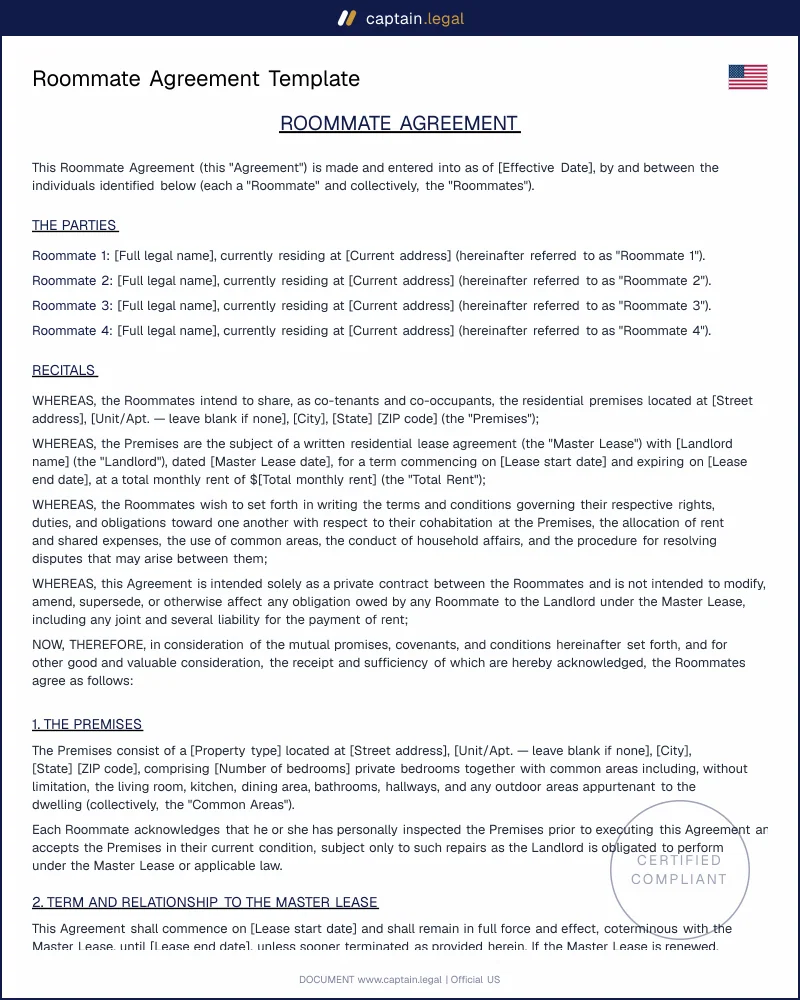
You start by selecting the state where the rental unit is located, because the form then adapts the joint and several liability language, the security deposit allocation defaults, and the references to local rent control ordinances. From there, you enter the master lease start date and end date, the full legal names of every cotenant, and the address of the unit. The form distinguishes between an equal split and a pro rata by bedroom allocation, and recalculates each roommate's monthly share automatically once you enter the total rent.
Next, you allocate the security deposit and define the utility setup, naming the account holder for each utility and the reimbursement cycle. The house rules section is presented as a series of toggles for overnight guests, quiet hours, pet policies, smoking, and common-area assignments, with a free-text field for anything the standard options do not capture. The exit clause is configured with a default 30-day notice period, which you can shorten or extend depending on the cotenancy. The dispute resolution clause defaults to informal mediation followed by small claims court in the county where the unit is located.
The final step is to review the generated agreement, add electronic signatures for every cotenant, and download the file in editable Word and ready-to-sign PDF formats. Every cotenant should keep a signed copy, and the original should be stored alongside the master lease. If your household uses our month-to-month rental agreement template valid in every state as the master lease, the roommate agreement attaches as an internal addendum that the landlord does not need to countersign.
Common mistakes to avoid
The first and most damaging mistake is treating the roommate agreement as a substitute for the master lease. It is not. The landlord is not a party to the roommate agreement and is not bound by anything it says. If you allocate 30 percent of the rent to one cotenant in the agreement but the lease names all four cotenants jointly, the landlord can still pursue any single one of you for the entire amount, leaving the underpaying roommate to be chased internally. The second is failing to address what happens when a roommate leaves, which transforms a routine departure into a months-long argument over the deposit, the last month's rent, and who is allowed to choose the replacement.
The third recurring error is vague utility allocation, especially the "we'll just split everything equally" approach that ignores the cotenant who works from home and triples the electricity bill. The fourth is skipping the dispute resolution clause entirely, which means the only path to recovery is a contested small claims filing, often in a county where the defendant no longer lives. The fifth, and the one that lands cotenants on the wrong end of a HUD complaint, is drafting a screening clause that names protected characteristics, even informally : a clause requiring a replacement to be "a woman, non-smoker, vegetarian, no kids" runs straight into the Fair Housing Act, and the fact that it is between roommates rather than between landlord and tenant does not always provide a defense.
Frequently Asked Questions
34 verified reviews · 50 000+ downloads
- Immediate access to the document
- PDF + Word download
- Compliant with 2026 legislation
- Reviewed by lawyers
You might also like