A Sublease Agreement lets the original tenant (the sublessor) hand the apartment to a third party (the sublessee) for some or all of the remaining lease term, without erasing the sublessor's own obligations to the landlord. It is the document that turns a casual "my friend is taking my place for the summer" into a defensible legal arrangement, with rent, duration, deposit, and house rules written down and signed. In US practice, this is the standard tool for a tenant who needs to be away temporarily, who has taken a remote job in another city, or who wants to share a unit with a roommate added mid-lease. A clean sublet protects three people at once: the master tenant who stays on the hook with the landlord, the subtenant who needs proof of a legal right to occupy, and the owner whose property remains under a single chain of responsibility.
Compliant
2026 Legislation
50,000+ clients
trust us
Affordable
From $4.90 / doc
Secure payment
Instant download
Sublease Agreement Template for US Tenants | PDF + Word
Secure payment
What is a sublease agreement?
A sublease agreement is a written contract under which a tenant who already holds a lease (the master lease) rents out the property, or part of it, to a third person. The original lease between the landlord and the tenant remains fully in force. The subtenant has no direct contractual relationship with the property owner ; their counterparty is the original tenant, who collects the rent and remains primarily liable for everything the landlord can demand under the master lease.
This distinction matters in court. If the subtenant stops paying, the landlord still chases the sublessor, not the sublessee. If the subtenant damages the unit, the landlord can deduct from the original tenant's security deposit and sue them for the balance. That structure is what separates a sublease from an assignment: in an assignment, the new occupant steps fully into the original tenant's shoes and the original tenant walks away. In a sublease, the original tenant stays in the picture, which is usually what landlords prefer and what state law assumes when the lease is silent. Captain.Legal's residential lease agreement template is built on the same logic and shares the deposit and notice mechanics used here.
Legal framework
Subleasing in the United States is governed by a layered set of rules. The starting point is the Uniform Residential Landlord and Tenant Act (URLTA), adopted in some form by roughly 21 states, which presumes that a tenant may sublet only with the landlord's consent and that the landlord cannot refuse that consent unreasonably when the lease so provides. Outside URLTA jurisdictions, the rule is generally that subletting requires the landlord's written consent whenever the lease contains an anti-assignment or no-sublet clause, and that the absence of such a clause leaves the tenant free to sublet, subject to the master lease term.
State-level statutes refine the picture. New York's Real Property Law §226-b gives tenants of buildings with four or more units a statutory right to sublet with the landlord's consent, which cannot be unreasonably withheld, and lays out a precise 30-day notice procedure the tenant must follow by certified mail. California's Civil Code §1995.260 applies a similar standard of reasonableness to commercial subleases, while residential subleases are governed by the master lease and general contract principles. Florida's Statutes §83.20 recognize that an unauthorized sublet is a ground for eviction under a 7-day notice to cure. Texas, under Property Code §91.005, takes the opposite default: the tenant may not sublet unless the landlord expressly agrees in writing, which makes the consent letter a non-negotiable companion to the sublease itself.
Federal rules also bite. Tenants receiving HUD Section 8 assistance must obtain prior approval from the public housing authority before any sublet, and an unauthorized arrangement can terminate the voucher. A sublease that violates the master lease is voidable at the landlord's option, and most state courts will not let the subtenant raise the original lease as a defense against eviction. The authoritative starting point for the underlying contract doctrine is the Cornell Legal Information Institute overview of landlord-tenant law, which collects the federal and state sources cited above.
When do you need this document?
The most common trigger is a temporary relocation: a tenant takes a six-month contract in another city, a student leaves campus for an internship, a couple decides to spend the winter abroad. Walking away without a sublease means paying rent for an empty unit ; walking away with only a verbal arrangement means hoping the friend, the cousin, or the Craigslist stranger will pay on time and leave the place intact. A signed sublease converts that hope into a contract, and it gives the master tenant a document to wave at the landlord when consent is requested.
The second scenario is the added roommate. A tenant who originally signed alone now wants to share rent and space with another adult. If the landlord refuses to add the newcomer to the master lease, a sublease for one bedroom and shared common areas is the standard workaround. The same logic applies when an existing roommate moves out mid-term and a replacement steps in: rather than reopening the master lease, the remaining tenant subleases the vacated room. Both situations are covered by our month-to-month rental agreement template when the underlying tenancy is itself month-to-month.
A third use case is the commercial sublet: a small business shedding excess square footage, a co-working host renting desks, a retailer subletting a portion of its storefront. The mechanics are similar but the stakes are higher, because commercial leases routinely contain recapture clauses that let the landlord terminate rather than approve. One edge case worth flagging : subletting in a rent-stabilized New York City apartment can never exceed the legal regulated rent plus a 10 % furnished surcharge, and overcharging the subtenant exposes the master tenant to treble damages under NYC Rent Stabilization Code §2525.6.
Key clauses included in our template
The template was drafted to track the obligations a US landlord actually expects to see and the protections a subtenant should never sign away. Each clause is configurable to the state and to the master lease attached as an exhibit.
- The identification of the parties and the master lease names the original tenant as sublessor, the new occupant as sublessee, and incorporates the master lease by reference as Exhibit A. This is the clause that lets a court read both documents together and apply the original landlord's protections to the sublet relationship.
- The scope of the sublet specifies whether the subtenant takes the entire premises or a defined portion (a named bedroom, a desk in a shared office, a basement unit). For partial sublets, the clause sets out shared-use rules for kitchens, bathrooms, parking, and storage, which is where most roommate disputes start.
- The term and renewal mechanics fix a start date, an end date, and a clear statement that the sublease cannot outlive the master lease by a single day. The template also addresses holdover : if the subtenant stays past the end date, rent converts to month-to-month at 150 % of the agreed amount, a figure that tracks common state holdover statutes.
- The rent and security deposit clause sets the monthly rent, the due date, the accepted payment methods, and a separate deposit held by the sublessor (never by the subtenant directly to the landlord). It also lays out the itemized return procedure within the statutory window, which is 21 days in California under Civil Code §1950.5, 30 days in Florida under Statutes §83.49, and 14 days in New York under General Obligations Law §7-108.
- The landlord's written consent is attached as Exhibit B and signed before the sublease takes effect. The template includes a fallback acknowledgment that, if the master lease is silent, the sublessor warrants their right to sublet and indemnifies the sublessee against eviction triggered by a missing consent.
- The assignment of utilities, insurance, and access allocates who pays electricity, gas, water, internet, and renter's insurance, and how keys are exchanged at move-in and move-out. A signed move-in inspection checklist is incorporated by reference to anchor any later deposit dispute.
State-specific considerations
California. The default rule under Civil Code §1995.210 allows subletting unless the lease prohibits it, but the practical reality is that nearly every California residential lease contains a no-sublet without consent clause. Where the lease conditions consent on the landlord's reasonable approval, the Kendall v. Ernest Pestana, Inc. line of cases requires the landlord to articulate a commercial reason for refusal. San Francisco, Oakland, and Los Angeles layer rent control on top : a master tenant subletting in a rent-controlled unit cannot charge more than the regulated rent plus a small surcharge for furniture and utilities. Charging a subtenant a premium in a rent-controlled California unit is a misdemeanor under most local ordinances and triggers civil penalties.
Texas. Under Property Code §91.005, no subletting is permitted unless the landlord consents in writing, full stop. Texas does not impose a reasonableness standard on the landlord's refusal, which means a Texas sublease without an explicit consent letter is fragile. Our template includes a Texas-specific consent rider that the sublessor must obtain before the sublessee signs. The eviction process for an unauthorized sublet runs through Property Code §24.005 and starts with a 3-day notice to vacate.
Florida. Statutes §83.20(2) makes unauthorized subletting a 7-day curable breach, which means the master tenant has seven days to either remove the subtenant or obtain retroactive consent. Florida is generous on form (no notarization, no witnesses required for residential sublets under one year) but unforgiving on procedure : the Florida Bar Real Property Section regularly reminds practitioners that retroactive consent must be in writing to be enforceable.
New York. The strictest jurisdiction in the country. Real Property Law §226-b requires the tenant to send a certified-mail notice to the landlord at least 30 days before the proposed sublet, containing the term, the subtenant's name, the rent, and the reason for subletting. The landlord then has 10 days to request additional information and 30 days to consent or refuse with reasons. Silence equals consent. In rent-stabilized units, the rent ceiling and the 10 % furnished surcharge cap apply, and the master tenant must maintain the apartment as their primary residence during the sublet, intending to return at the end of the term.
How to fill out this sublease agreement
You start by selecting the state where the property is located. From there, the form adjusts the statutory notice periods, the deposit return deadlines, and the consent language to match the local rules described above. The next screen asks for the master lease : you upload it or enter its date, the landlord's name, and the term, so the sublease can reference it accurately as Exhibit A. The interview then collects the identities of the sublessor and sublessee, the description of the sublet portion (entire unit, a named bedroom, a defined commercial area), and the dates of occupancy, with a built-in check that the sublease end date does not exceed the master lease end date.
The rent and deposit step lets you set the monthly amount, the due date, the late-fee mechanics consistent with state caps, and the security deposit held by the sublessor. You then attach the landlord's written consent, either by uploading a signed letter or by generating one through our companion consent template. The final step produces a clean PDF and an editable Word file, ready for signature in person or through any compliant e-signature platform. For broader contract drafting outside the rental context, our business contract templates follow the same configurator logic.
Common mistakes to avoid
The mistake we see most often is subletting without written consent when the master lease requires it. A friendly text from the landlord ("yeah that's fine, no worries") is not consent under the laws of any state that requires writing, and the master tenant discovers this only when the landlord files for eviction six weeks later. The cure is simple : insist on a signed consent letter before the subtenant moves in, and attach it to the sublease. The second mistake is failing to incorporate the master lease by reference, which leaves the subtenant unaware of the rules they are bound by (pet restrictions, quiet hours, smoking bans) and gives them a defense against any deduction tied to those rules.
A third recurring error is the security deposit shortcut: the sublessor asks the subtenant to pay the deposit directly to the landlord. This breaks the chain of liability, because the landlord now holds money on behalf of someone who is not their tenant, and the sublessor loses the ability to deduct from the deposit at the end of the sublet. The fourth mistake is overcharging in a regulated jurisdiction such as New York City, where the rent ceiling is non-negotiable. The fifth, and the most expensive, is holdover by the subtenant past the master lease expiration. If the subtenant remains in the unit after the master lease ends, the master tenant is the one the landlord sues, even if they left the country two months earlier. The template's holdover clause and the consent letter together close this gap by giving the landlord direct standing against the subtenant from day one.
Frequently Asked Questions
50 verified reviews · 50 000+ downloads
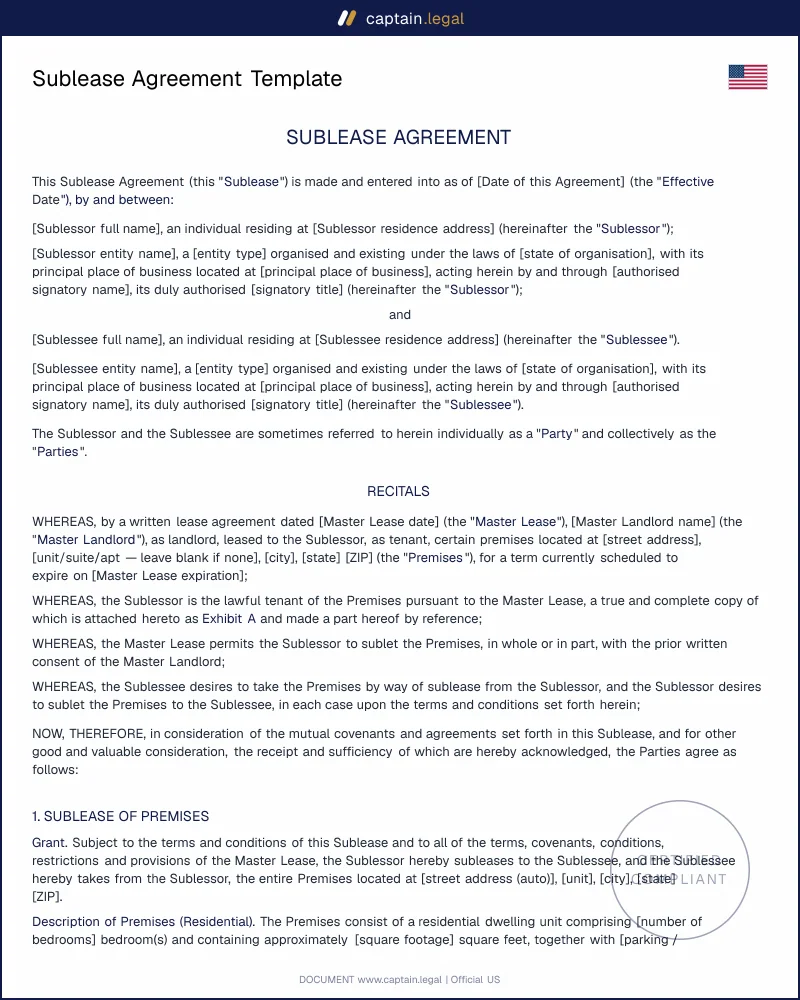
- Immediate access to the document
- PDF + Word download
- Compliant with 2026 legislation
- Reviewed by lawyers
You might also like