A security deposit demand letter is the written request a former tenant sends a landlord to recover the deposit, or the portion of it, that should have been returned at the end of the tenancy. It is the document a small claims judge will look for before deciding whether the landlord acted in good faith. In every state, the statute that governs deposit returns imposes a hard deadline and a duty to provide an itemized accounting of any deductions ; once that window closes, a properly drafted demand letter is what turns a private grievance into a documented legal claim, often as a precondition to filing suit. This template is built for tenants who have already moved out, surrendered the keys, and are still waiting for the deposit, the itemized statement, or both. It is equally useful when the deposit came back short and the deductions look invented, padded, or aimed at normal wear and tear.
A clean letter does three things at once : it puts the landlord on formal notice that the statutory clock has run, it preserves the tenant's right to treble, double, or bad-faith damages depending on the jurisdiction, and it sets up the forwarding address requirement that several state codes treat as a trigger for the refund deadline.
Compliant
2026 Legislation
50,000+ clients
trust us
Affordable
From $4.90 / doc
Secure payment
Instant download
Security Deposit Demand Letter | Get Your Deposit Back (CA, TX, FL, NY)
Secure payment
What is a security deposit demand letter?
A security deposit demand letter is a formal written demand, signed by the tenant, that asks the landlord to refund all or part of the deposit and threatens specific legal action if payment does not arrive within a stated period. It is not a complaint filed in court ; it is the last step before that complaint. Many state landlord-tenant statutes either require a written demand or treat the absence of one as evidence that the tenant never gave the landlord a chance to cure. Even where no statute requires it, a demand letter is the document a judge expects to see attached to a small claims petition.
The letter differs from a move-out notice or a rent receipt. A move-out notice ends the tenancy ; a rent receipt acknowledges a payment. A demand letter operates after the relationship is already over and the deposit clock has expired. Sending it by certified mail with return receipt requested is non-negotiable : without proof of delivery, the landlord can later claim never to have received it, and the bad-faith presumption that most states attach to non-response collapses. The letter should also be sent to the address the lease designates for legal notices, not merely to the landlord's leasing agent or property manager, unless that person is named as the statutory agent for service.
A well-written letter pairs cold legal references with a concrete calculation, leaving the landlord no honest way to respond except by paying. It is intentionally short, factual, and dated, because anything emotional, accusatory, or vague weakens it as evidence.
Legal framework
Security deposit recovery is governed almost entirely by state statute, with each jurisdiction setting its own return deadline, itemization rule, and penalty for non-compliance. The structure is consistent across most codes : the landlord must return the deposit within a defined window after the tenant surrenders the premises, must provide a written itemized statement of any deductions within the same window, and forfeits the right to retain any portion of the deposit if either obligation is missed. Federal law does not directly regulate security deposits in private residential tenancies, although tenants under HUD-assisted housing benefit from a parallel set of return obligations codified at 24 C.F.R. §880.608. For the rest, the relevant statute lives in the state property code or general obligations law and varies in three dimensions : the length of the return period, the penalty for bad-faith retention, and whether the deadline starts running from move-out or from receipt of the tenant's forwarding address.
The return windows cluster between 14 and 60 days. California's Civil Code §1950.5(g) gives the landlord 21 calendar days from move-out to either return the deposit in full or send an itemized statement with the balance ; the same statute, amended by AB 12 effective July 1, 2024, also caps the deposit itself at one month's rent for most rentals. New York's General Obligations Law §7-108(1-a)(e), strengthened by the Housing Stability and Tenant Protection Act of 2019, runs to 14 days after the premises are vacated and forfeits the entire deposit if the itemized statement is even a day late, a rule the Second Department confirmed in Cohen v. Abruzzo (2024) by penalizing a landlord whose statement arrived six days past deadline. Texas allows the longest standard window at 30 days under Texas Property Code §92.103, but conditions the start of that period on the tenant providing a written forwarding address under §92.107. Florida's Statute §83.49(3) sets a split timeline : 15 days when no deductions are claimed, 30 days when the landlord notifies the tenant of an intent to deduct by certified mail. The Cornell Legal Information Institute summary of Texas Property Code §92.109 landlord liability lays out the bad-faith penalty structure that most states have copied in some form.
The penalty side is where the statutes get teeth. Texas imposes three times the wrongfully withheld amount, plus $100 and reasonable attorney's fees under §92.109(a). New York mirrors that with treble damages under the HSTPA. California permits up to twice the deposit as statutory damages for bad-faith retention under Civil Code §1950.5(l), on top of the actual amount owed. The shape of any demand letter must track these citations precisely : a letter that cites the wrong statute, or invokes treble damages in a state that allows only double, undermines its own credibility.
When do you need this document?
The most common trigger is the simplest one : the statutory return window has expired and the deposit has not arrived. A tenant who moved out on the first of the month and has heard nothing by day 22 in California, day 15 in New York, or day 31 in Texas has a statutory case the moment that deadline passes, regardless of what the landlord later claims. The same applies when the deposit arrives short and the accompanying itemized statement is missing, vague, or padded with charges for ordinary wear and tear that the statute explicitly excludes. A faded carpet, a few small nail holes, sun-bleached blinds, a slightly worn appliance gasket : none of these are legally deductible in any state, even when the lease says otherwise.
A second scenario covers landlords who send a statement listing real deductions but inflate the amounts. A $1,200 charge for "repainting" the whole unit after a one-year tenancy is the textbook example : courts in California, New York, and Texas have repeatedly held that interior paint has a useful life of two to three years and that the landlord can deduct only the portion attributable to actual tenant damage, prorated. The eviction notice template guide discusses the mirror-image situation, where a landlord serves notice for unpaid rent ; the deposit demand letter is the tenant-side equivalent when the landlord becomes the debtor.
A third trigger is the successor landlord problem. When a building changes hands mid-tenancy, the deposit is supposed to follow the lease into the new owner's escrow under most state statutes, and the predecessor remains jointly liable until written notice of transfer is given to the tenant. A demand letter sent only to the original landlord, when the building has changed hands, often comes back marked "no longer responsible." Sending the letter to both the seller and the buyer, by certified mail, eliminates that defense. If the building was sold and you have not received written notice of who holds your deposit, send the letter to both parties at once.
One edge case worth flagging concerns tenants who left without providing a forwarding address. In Texas, §92.107 explicitly suspends the landlord's refund obligation until that address is provided in writing. In those situations, the letter doubles as the forwarding-address notice and the deposit demand, and the 30-day clock starts running from the date of receipt.
Key clauses included in our template
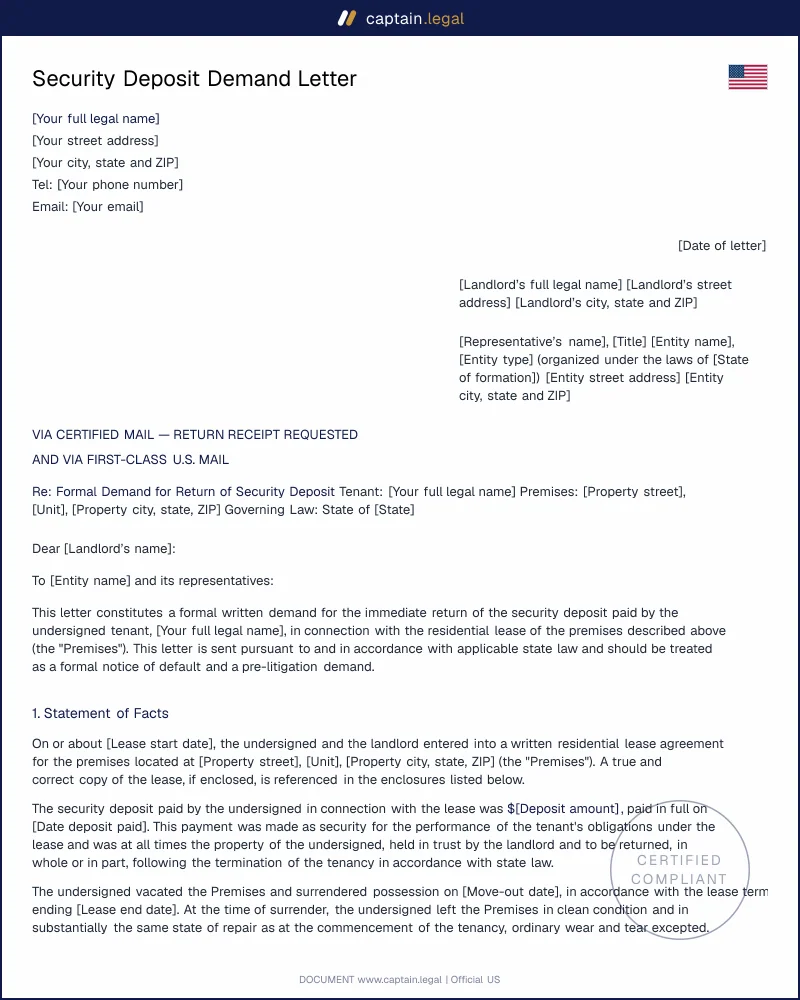
The template walks through every element a US court expects in a deposit demand, and lets you toggle the state-specific citations on the fly. The clauses are drafted to the bad-faith threshold each state applies, so the letter reads like an attorney drafted it and not a form download.
- The identification block and tenancy summary opens the letter with the parties' full legal names, the rental property address, the lease dates, the move-out date, and the deposit amount paid at signing. Courts dismiss demand letters that lack any of these elements as evidentiary support, because the landlord can later claim the document is too vague to identify a specific tenancy.
- The statutory citation paragraph quotes the controlling state statute by section number and inserts the exact return deadline that applies to your jurisdiction, whether 14 days under N.Y. Gen. Oblig. Law §7-108, 21 days under Cal. Civ. Code §1950.5, 30 days under Tex. Prop. Code §92.103, or the 15/30-day split under Fla. Stat. §83.49. Mis-citing the deadline is the single most common defect in tenant-drafted demand letters.
- The factual recital establishes that the tenant surrendered possession on a specific date, returned the keys, provided the forwarding address (with date and method), and either received nothing or received an incomplete deposit. The recital should also note whether a move-in inspection report and a move-out walk-through were performed, because both create rebuttable presumptions in the tenant's favor.
- The itemization challenge addresses any deductions the landlord did claim, item by item, and rejects each one with either a statutory ground (ordinary wear and tear, preexisting condition, no receipts provided) or an evidentiary one (photos taken on move-out, attached as Exhibit A). A demand letter that ignores the landlord's stated deductions reads as a fishing expedition ; one that engages each line reads as litigation-ready.
- The demand and damages calculation sets out the precise amount sought, broken down into the base deposit, any unpaid interest required by states like New York or Massachusetts, and the statutory penalty the relevant code allows. The calculation should reference the bad-faith multiplier explicitly so the landlord understands what a small claims judgment would look like.
- The deadline and consequence paragraph gives the landlord a final response window, typically 7 to 14 days, and states that failure to pay or respond will result in a small claims filing for the full statutory amount plus attorney's fees where the state allows them. The paragraph closes with the tenant's signature, date, and forwarding address restated in full.
State-specific considerations
California. The deposit demand letter must be drafted to Civil Code §1950.5(g), which gives the landlord 21 calendar days from the date the tenant surrenders the premises to return the deposit and provide an itemized statement of any deductions. AB 12, effective July 1, 2024, capped most new deposits at one month's rent regardless of furnishing, so any deposit collected on or after that date in excess of one month's rent on a new lease is itself unlawful and recoverable. The bad-faith penalty under §1950.5(l) is up to twice the deposit amount in statutory damages, plus actual damages and attorney's fees. AB 2801, effective April 1, 2025, now requires landlords to provide photos before and after any deductible repair, and the absence of those photos in the itemized statement is a strong negotiating point in the demand letter.
Texas. Texas Property Code §92.103 sets a 30-day return deadline that begins running only after the tenant provides a written forwarding address under §92.107. The penalty under §92.109(a) is three times the portion wrongfully withheld, plus $100, plus reasonable attorney's fees when the landlord acts in bad faith. A landlord who fails to provide the itemized statement of damages by the 30-day mark is presumed to have acted in bad faith under §92.109(d), which shifts the entire burden of proof. The demand letter should cite this presumption directly. Texas is also the state where the lease itself can require advance written move-out notice as a precondition to the refund, but only if that requirement is underlined or in conspicuous bold print per §92.103(b) ; an unmarked clause is unenforceable.
Florida. Florida Statute §83.49(3) uses a split timeline that surprises most tenants : 15 days to return the deposit when no deductions are claimed, 30 days to send a written notice of intent to deduct by certified mail to the tenant's last known address. If the 30-day certified notice is missed, the landlord forfeits the right to claim any deduction whatsoever under §83.49(3)(a). The notice must use the specific statutory language reproduced in the code, including the sentence beginning "This is a notice of my intention to impose a claim for damages…" ; substitutes have been rejected. A Florida demand letter should test compliance with each of these procedural traps before discussing the merits of any deduction.
New York. General Obligations Law §7-108(1-a)(e), as amended by the Housing Stability and Tenant Protection Act of 2019, requires the landlord to return the deposit and provide an itemized statement within 14 days of the tenant vacating the premises. The forfeiture is absolute : a landlord whose statement is even six days late, as in Cohen v. Abruzzo (2nd Dept. 2024), loses the right to retain any portion of the deposit. New York also caps residential deposits at one month's rent statewide and requires interest payments on deposits held in buildings of six or more units. The demand letter should cite §7-108(1-a)(e) by full subsection, request treble damages for any willful violation, and request statutory interest if applicable.
How to fill out this security deposit demand letter
The interview begins by asking which state your rental was located in, because that single answer rewrites the statutory citations, the return deadline, and the penalty calculation throughout the document. Once the state is fixed, you enter the property address, the lease start and end dates, the original deposit amount, and the date you actually surrendered the premises, which is rarely the same as the date stated in the lease. The form then asks whether you provided a written forwarding address, when, and by what method, because that fact determines the start of the refund clock in several states.
You then describe what the landlord did or failed to do : nothing returned, a partial refund without explanation, a refund with an itemized statement you dispute, or no response at all. If deductions were claimed, the form walks you line by line through the categories the landlord listed (cleaning, painting, carpet replacement, damage to fixtures, unpaid utilities) and lets you challenge each one with a reason the statute or case law recognizes. You can attach photos, the move-in inspection report, and any text messages where the landlord acknowledged the unit's condition. Captain.Legal generates the final letter in Word and PDF, with the certified mail tracking template pre-filled, and includes a parallel copy formatted for the successor landlord if a sale happened mid-tenancy. The whole interview takes around eight minutes for tenants who have their documents at hand. For tenants who also need to revisit lease language before sending, the residential lease agreement template is a useful companion to confirm what the original deposit clause actually allowed.
Common mistakes to avoid
The first and most damaging mistake is sending the letter by ordinary mail or email and assuming receipt. Without a certified mail green card or a tracked equivalent, the landlord can plausibly deny ever having seen the document, which knocks out the bad-faith claim that drives most statutory penalties. The second is failing to provide a written forwarding address before sending the letter, particularly in Texas, Florida, and several other states where the refund clock does not start until that address is on file. A demand letter that arrives before the statutory deadline has even begun running gives the landlord a clean defense and looks amateurish to a judge. The third is sending the letter to the property manager or leasing agent rather than the named landlord ; agents are rarely authorized to receive legal notice on the owner's behalf, and the service defect is fatal at the courthouse. A month-to-month rental agreement typically names the owner clearly in the parties block, which is the address that should appear on the envelope.
The fourth mistake, and the one that most often loses tenants their case on the merits, is overreaching on what counts as a recoverable deduction. Ordinary wear and tear is statutorily excluded in every state, but tenants who try to recover for genuine damage they caused, framing it as wear and tear, lose credibility on the items where they were actually right. Drafting the letter line by line, conceding the legitimate deductions and contesting the inflated ones, almost always produces a faster settlement than a maximalist demand. The fifth, finally, is delay : in most states the statute of limitations on deposit recovery is between two and four years under the general written-contract limitation, but the bad-faith presumption fades as months pass. A letter sent within 60 days of the missed deadline carries far more force than one sent eighteen months later, even though both remain technically timely.
Frequently Asked Questions
24 verified reviews · 50 000+ downloads
- Immediate access to the document
- PDF + Word download
- Compliant with 2026 legislation
- Reviewed by lawyers
You might also like