Create my document
Login

Choose country

FranceBelgiqueEspañaUnited StatesUnited KingdomMarocDeutschlandItaliaSchweiz
Family & Divorce

Name Change Notification Letter — SS-5 Ready Template

Attorney-structured name change letter aligned with Form SS-5 and state DMV rules. Certified-proof checklist, correct notification order, Word and PDF.
4.7/537 reviews50 000+ downloadsInstant download
Share

A Name Change Notification Letter is the written notice you send to banks, your employer, the Social Security Administration, your state DMV, lenders, insurers, and other record-holders to confirm that your legal name has changed and to request that they update their files. It is not the document that changes your name. The court order, marriage certificate, or divorce decree does that. This letter is the standardized cover notice that travels with your proof, tells each institution exactly which old name maps to which new name, and asks for a specific action on a specific account. People who skip it end up making the same explanation by phone forty times and watching half their accounts stay stuck under the old name.

Most adults need a name change notification letter after marriage, after divorce, or after a court-ordered change, and the typical mistake is treating it as optional. It is the difference between a clean paper trail and a year of mismatched records.

Compliant

2026 Legislation

50,000+ clients

trust us

Affordable

From $4.90 / doc

Secure payment

Instant download

Name Change Notification Letter — SS-5 Ready Template

Secure payment · No subscription

Fill in the template

What is a name change notification letter?

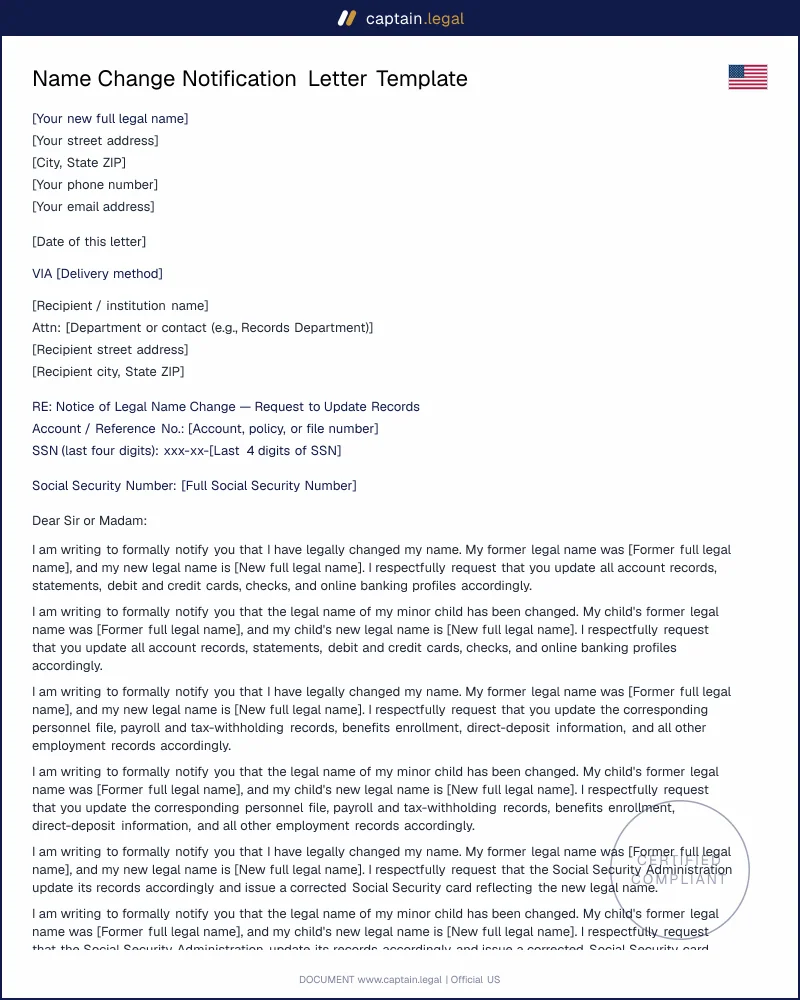
A name change notification letter is a formal written request directing a record-holder to update your name on file and attaching certified proof of the change. It does three things in one page: it identifies you by your former legal name and your new legal name, it references the account, policy, or employee number so the recipient can find your file, and it states the document you are relying on as authority for the change.

People confuse this letter with the underlying name change document, and the distinction matters. The authority for your new name comes from one of three sources: a marriage certificate, a divorce decree that restores a former name, or a court order of name change issued under your state's name change statute. The letter does not create any rights. It transmits those rights to a third party and asks them to act. That is why a strong letter always travels with a certified copy of the proof, never a plain photocopy, because most agencies and banks reject uncertified copies outright.

The format also differs by recipient. A bank wants an account number and a signature that matches the one on file. An employer wants your employee ID so payroll and IRS wage reporting stay aligned. The DMV will not act on the letter alone at all, but a cover letter still helps you organize what you bring in person. Our template gives you a master version plus tailored variants for each category of recipient, so you are not rewriting the same paragraph for every institution. If you are coordinating this alongside a divorce, you may also want a marital settlement agreement template in the same file set so the name restoration and the financial terms are documented together.

2

When do you need this document?

The most common trigger is marriage. After the ceremony, the certified marriage certificate becomes the authority for adopting a spouse's surname, hyphenating, or restructuring a middle name, and a wave of notifications has to follow: SSA, DMV, bank, employer, credit cards, insurance, and the passport agency. The second trigger is divorce, where a decree restores a former name and the same wave runs in reverse. A divorce-driven letter has to be precise, because the decree must clearly reference the former name before it can be used as proof, and a vague decree forces a separate court trip. If you are still finalizing terms, our family and divorce document templates cover the decree-adjacent paperwork that often gets filed alongside the restoration request.

A court-ordered change driven by personal preference, gender transition, or correcting a long-standing error is the third scenario, and here the certified court order is the universal key that every institution will accept. Beyond the big three, the letter earns its keep in the quieter cases. Someone who married years ago but never updated a dormant brokerage account suddenly needs the letter when they try to roll that account over. A new hire whose offer letter and I-9 carry a maiden name needs to notify the employer before the first payroll run posts wages under a mismatched name. Wages reported under a name the SSA does not recognize can fail to credit to your earnings record, which quietly shrinks future benefits. An executor settling an estate may need to prove that the deceased's married name and birth name belong to the same person. Each of these is a situation where a clear, signed letter with attached proof closes the question in one exchange instead of ten.

3

Key clauses included in our template

  • The former-name-to-new-name identification block is the spine of the letter. It states your full prior legal name, your full new legal name, and your date of birth so the recipient can tie the two identities together. DMVs and the SSA both insist on this linkage, and a letter that omits the date of birth or buries the old name forces the recipient to come back with questions.
  • The account or reference identifier points the institution straight to your file: a bank account number, a policy number, an employee ID, or a customer reference. Banks process these letters in volume, and a letter without an identifier lands in a queue where it stalls. Naming the specific account turns a vague request into an actionable one.
  • The statement of authority names the document you rely on, whether a marriage certificate, a divorce decree restoring your name, or a court order of name change, and confirms that a certified copy is enclosed. This is the clause that satisfies the recipient's compliance team, because it shows the change is legally grounded rather than self-declared.
  • The specific requested action tells the recipient exactly what to do: update the name on the account, reissue a card or credential, correct payroll and tax records, or amend a beneficiary designation. Generic phrasing like "please update my information" invites partial action; a precise request gets a complete one.
  • The signature and contact block carries a signature the bank can match against its records and a callback number for verification. For accounts opened under the old name, your signature is often the bridge the institution uses to confirm identity before it acts.
4

State-specific considerations

California processes name changes through the DMV only after the Social Security Administration updates its record, and the department electronically verifies your name and number with the SSA before issuing a new license. An updated Social Security card by itself is not sufficient at the counter; you must bring the original legal document that authorized the change. Because the SSA-to-DMV sync can take two or more business days, a Californian should send the SSA notification, wait for the new card, and only then notify the DMV, building that delay into the sequence the letter follows.

Texas imposes a firm timeline. The Department of Public Safety expects you to apply for a replacement driver license or ID within 30 days of the legal name change, and the Texas State Law Library guidance pairs that with the advice to update the SSA card as soon as possible. A Texas notification letter to the DMV is most useful as a personal checklist, since the counter requires the certified court paper or marriage certificate in person, but the financial and employer letters can go out by mail in parallel once the SSA record is set.

New York prints only your exact legal name on a REAL ID or Enhanced credential and rejects nicknames or abbreviations. If any proof document shows a shortened or alternate name, the DMV demands additional proof of full legal name or a court-ordered name change. For standard documents, New York allows a mail-in name update once your SSN is on file and the SSA change is complete, provided the requested name matches the Social Security card exactly. A New York letter should therefore mirror the SSA spelling character for character.

Florida and most other states follow the same federal-first logic: the SSA record changes first, then the state credential, then private institutions. Across every state, the constant is that the DMV ties the old and new names together through a certified document, and divorce decrees must spell out the former name to work as proof. Your letter adapts to the recipient, but the certified attachment and the exact-match spelling are non-negotiable everywhere.

5

How to fill out this name change notification letter

You begin by selecting the type of change, marriage, divorce, or court order, because that choice determines which proof the letter references and how the authority clause reads. From there, the template asks for your former full legal name, your new full legal name, and your date of birth, then assembles the identification block that every recipient needs to link the two identities. Next you choose the recipient category, and the letter adjusts its tone and the requested action: a bank version asks for account and card reissuance, an employer version asks for payroll and tax-record correction, an SSA version frames the request around Form SS-5 and the new card.

You then add the account, policy, or employee reference for that specific recipient, which is the detail that moves the request out of a holding queue. The template generates a clean, signed letter in Word for last-minute edits and PDF for printing and mailing, along with a short checklist reminding you to enclose a certified copy and to send in the recommended order, SSA first. If you are managing a broader life-event paperwork bundle, you can pull related forms from our all U.S. legal document templates library and keep everything consistent in one place.

6

Common mistakes to avoid

The first and costliest mistake is sequencing the notifications wrong. People send the bank and DMV letters before the Social Security Administration record updates, and because nearly every institution verifies against SSA data, those early requests bounce back. The fix is discipline: SSA first, wait for the new card, then DMV, then everyone else. The second frequent error is attaching a plain photocopy instead of a certified copy. The SSA and most DMVs reject uncertified and even notarized copies, so a letter with the wrong attachment is a letter that does nothing, and you lose the days it spent in the mail.

A third mistake is a name mismatch between the letter and the proof. If your court order or marriage certificate spells your new name one way and your letter spells it another, the recipient stops and asks for clarification, especially at REAL ID counters that print only the exact legal name. Match the spelling character for character. A fourth problem is forgetting to notify the employer promptly, which lets payroll report wages under a name the SSA cannot match, quietly damaging your earnings record. The last common slip is missing state deadlines. Several states give you only 30 days to update your license after a legal name change, and letting that window lapse can mean fees or a lapsed credential. Treat the DMV step as time-sensitive even when the rest of the cascade feels optional.

Key takeaways

Purpose

The letter notifies, it does not rename

This notice letter is a cover request you send after your name has already changed by marriage certificate, divorce decree, or a court order. Its job is to map your old legal name to your new legal name and tell each institution what to update on a specific account, policy, or employee record. Without it, you end up repeating the story and still living with mismatched files.

SSA First

Start with SSA using Form SS-5

Treat the Social Security Administration as the first stop in the update chain because other systems check your data against the SSA record. You update your name by filing Form SS-5 and supporting it with an original or agency-certified document showing both the old and new names. The SSA does not accept notarized photocopies, and the replacement card is free while keeping the same number.

Proof Rules

Use certified proof and tailor each request

Send the letter with certified proof of the name change, not a plain copy, because many banks and agencies reject uncertified documents. Customize the details to the recipient so they can locate your file fast: banks typically need an account number and a signature that matches their records, employers need an employee ID for payroll and IRS reporting, and the DMV generally will not act on the letter alone even if it helps you organize an in-person visit.

Frequently Asked Questions

The letter itself is a notice, not a binding contract, so it does not by itself force an institution to act. Its legal weight comes entirely from the certified document it transmits: a marriage certificate, a divorce decree, or a court order of name change issued under your state's name change statute. When you enclose that certified proof, the recipient is acting on a legally valid change, and the letter simply directs them to the correct account and the specific action. Used correctly, with the right attachment and an exact-match name, it is fully effective at getting your records updated. Without the certified proof, even a perfectly drafted letter carries no authority.

Yes, and the order is not optional in practice. The Social Security Administration record is the master file that banks, employers, the IRS, and state DMVs verify against, so you file Form SS-5 and obtain your new card before sending other notifications. Many DMVs will not process a name change until the SSA update propagates, which can take two or more business days. Sending bank and DMV letters first usually produces rejections and forces you to start over. Build the sequence into your plan: SSA first, then DMV, then financial and private institutions.

Both. The template generates an editable Word version so you can adjust account numbers, recipient addresses, and last-minute wording for each institution, and a print-ready PDF for mailing and for your own records. Most banks and employers accept a mailed signed letter with a certified attachment, while the DMV and SSA generally require an in-person or mailed submission of originals. Having both formats lets you tailor each copy quickly without rebuilding the letter, which matters when you are sending the same notice to a dozen different record-holders at once.

Timelines vary by recipient. The SSA typically issues a new card within 10 to 14 business days of accepting your documents, and its electronic record updates shortly after. Banks and credit card issuers usually process a name change within a few days of receiving a valid letter and certified proof. Credit bureaus update automatically once your creditors report under the new name, but that can lag a full billing cycle, so check your credit reports a few months later. DMV processing depends on the SSA sync finishing first. Plan for the full cascade to take several weeks end to end.

You can start from one master letter, but you should tailor a version for each category. A bank needs your account number and a matching signature, an employer needs your employee ID for payroll and IRS wage reporting, and an insurer needs your policy number. The core identification block, former name, new name, date of birth, stays constant, but the requested action and the reference number change. Our template builds these variants for you, so you keep one consistent identity statement while sending each recipient the specific instruction it needs to act without follow-up questions.

You attach a certified copy of the divorce decree, and the decree must clearly reference your former name so the recipient can connect the two identities. This is the detail that trips people up: a decree that grants the divorce but does not expressly restore or state the former name may be rejected by the DMV and the SSA, forcing a separate court trip to obtain a corrected order. Before you send anything, read your decree to confirm the former name appears. If it does not, request an amended order first, then send your notification letters with the corrected certified copy enclosed. You can pair this with the related separation and divorce templates when assembling the full file.

Yes, though these sit later in the cascade. After your SSA and DMV records reflect the new name, you update your U.S. passport through the State Department using its own application and your certified proof, and many states let you update voter registration at the same time you apply for a replacement driver license. The notification letter is most directly aimed at banks, employers, the SSA, the DMV, and creditors, but keeping a running checklist that includes the passport, voter rolls, insurers, and retirement accounts ensures no record stays stranded under your old name. A single missed account can resurface years later when you try to access it.

4.7/5

37 verified reviews · 50 000+ downloads

Name Change Notification Letter — SS-5 Ready Template
  • Immediate access to the document
  • PDF + Word download
  • Compliant with 2026 legislation
  • Reviewed by lawyers
Fill in the template
Secure payment · No subscription
Updated on June 13, 2026

You might also like

Legal Separation Agreement Template
Divorce Financial Affidavit Template