A Nonprofit Dissolution Plan is the formal written instrument by which a tax-exempt corporation winds down its operations, settles its obligations, and transfers any remaining assets to another 501(c)(3) organization or a governmental body for a public purpose. It is the document the IRS, the state attorney general, and your secretary of state will all read when deciding whether your charity ended cleanly or left a mess behind.
Closing a nonprofit is not a quiet administrative task. You are dealing with three audiences at once: a federal regulator that wants to confirm assets stayed inside the charitable system, a state regulator that supervises charitable trusts, and donors whose restricted gifts may dictate where specific funds must go. A well-drafted nonprofit dissolution plan answers all three before they ask. Used correctly, it converts a stressful shutdown into a documented sequence of board votes, notices, and asset transfers that survive any later audit.
Compliant
2026 Legislation
50,000+ clients
trust us
Affordable
From $4.90 / doc
Secure payment
Instant download
Nonprofit Dissolution Plan — All 50 States Template (PDF & Word)
Secure payment
What is a nonprofit dissolution plan?
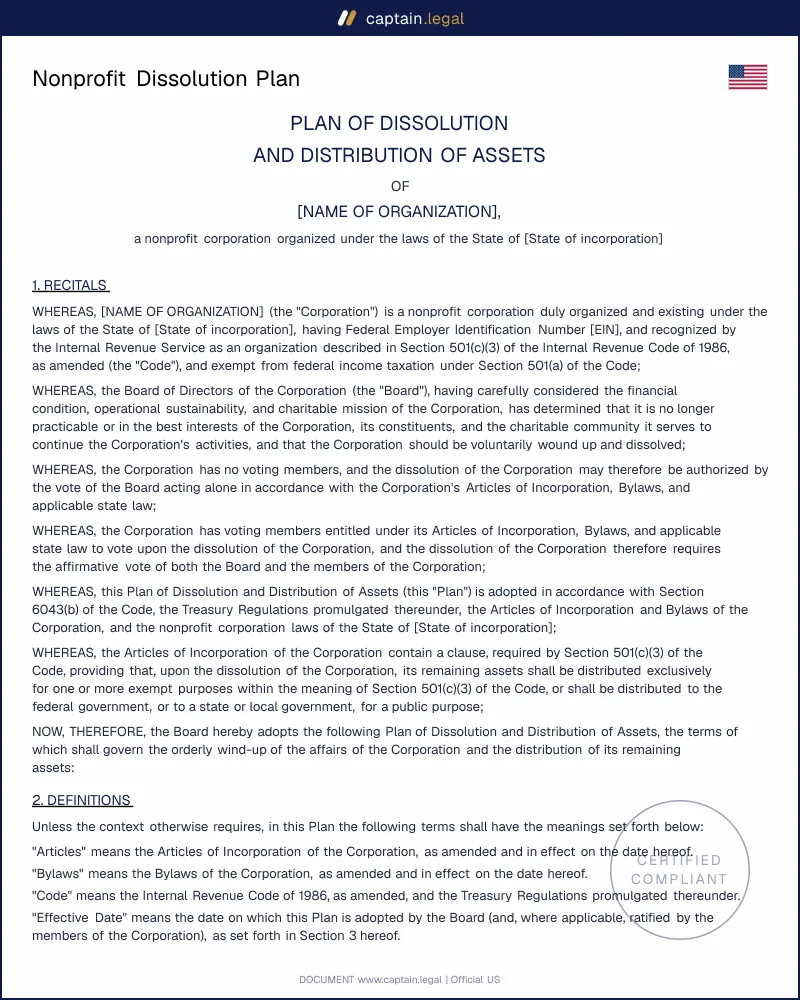
A nonprofit dissolution plan is a board-adopted document that authorizes the voluntary termination of a tax-exempt corporation and lays out, in operative detail, how the entity will wind up its affairs. It is required in substance, and in many states in form, before a charity can file Articles of Dissolution with the secretary of state and submit a final Form 990 with Schedule N to the IRS. The plan typically includes the resolution to dissolve, the effective date, the appointment of officers responsible for the wind-up, the procedure for paying creditors, and the designated recipient organizations that will receive any residual assets.
It is sometimes confused with Articles of Dissolution, which are the short public filing made with the state, or with the plan of liquidation required by Treasury for federal tax reporting. The dissolution plan is the underlying governance document that makes those filings possible. Without it, the board has no documented authority to transfer assets, sign final returns, or settle pending claims. Courts and state charity regulators routinely look back at the written plan when a former director, donor, or creditor disputes a post-dissolution decision. A board that decides to wind up by informal consensus, without a written plan, exposes its directors to personal liability for breach of fiduciary duty under the relevant state nonprofit corporation statute. The plan is, in practical terms, the bridge between a board vote and a clean legal death of the entity.
Legal framework
The dissolution of a 501(c)(3) organization sits at the intersection of federal tax law, state nonprofit corporation law, and state charitable trust supervision. At the federal level, Internal Revenue Code Section 501(c)(3) and Treasury Regulation §1.501(c)(3)-1(b)(4) impose what the IRS calls the organizational test: a charity's governing documents must permanently dedicate its assets to exempt purposes, and that dedication is tested at the moment of dissolution. The acceptable dissolution language, reproduced in IRS Publication 557 and the Form 1023 instructions, requires that residual assets be distributed for one or more exempt purposes under Section 501(c)(3), or to a federal, state, or local government for a public purpose. Distributions to 501(c)(6) trade associations, 501(c)(7) social clubs, individual members, or insiders are categorically prohibited and trigger retroactive revocation of exempt status.
Federal reporting closes the loop. Within four months and fifteen days after the end of the final short tax year, the dissolving organization must file a terminal Form 990, 990-EZ, or 990-PF with Schedule N attached. Schedule N demands a description of each transferred asset, its fair market value, the recipient's name and EIN, and copies of the state dissolution documents and final board minutes. The Internal Revenue Service guidance on charity dissolution provisions sets the baseline language every plan must respect.
State law adds the second layer. Most jurisdictions follow the Model Nonprofit Corporation Act or a close variant, which conditions voluntary dissolution on a board resolution, a member vote where members exist, the filing of Articles of Dissolution, and in many states prior notice to or approval by the state attorney general acting as parens patriae for charitable assets. Several cy pres states (including California, New York, and Massachusetts) treat charitable assets as a quasi-trust, requiring judicial or attorney-general consent before a transfer is final. Failing to notify the attorney general where required can void the entire dissolution and reopen director liability years after the corporation is supposedly closed. State law also governs creditor notice periods, dissenters' rights for members, and the order in which obligations must be paid before any charitable distribution can occur.
When do you need this document?
The most common trigger is a mission completion or strategic merger with another charity that absorbs the program. In a merger, the surviving entity inherits assets and liabilities under a separate plan of merger, but the disappearing nonprofit still needs a dissolution plan to document the transfer and authorize the final filings. Skipping that step leaves the disappearing entity legally alive on the state register, which generates annual filing penalties and confuses donors who think they are giving to the merged organization.
The second scenario is financial insolvency or chronic underfunding that the board concludes is irreversible. Here the dissolution plan operates alongside, and sometimes inside, a state-supervised receivership. Boards facing insolvency should understand that fiduciary duties shift toward creditors once equity is gone, and that distributing remaining assets to another 501(c)(3) before paying known creditors is a personal-liability event. The plan must sequence creditor satisfaction first, then charitable distribution of any surplus, and document both with paid invoices and signed receipts. A founder-led organization losing its key donor or grant is the textbook fact pattern; the plan converts an emotional decision into a defensible record. You can also consult the broader catalog of board-ready nonprofit governance and compliance templates when structuring the wind-up.
Three less obvious triggers deserve attention. First, the loss of tax-exempt status through revocation forces a choice between reapplying, converting to a taxable entity, or dissolving; the plan formalizes that decision. Second, a founder transition in a small charity often exposes the absence of any real governance, and a clean dissolution can be more responsible than a forced reinvention. Third, a donor-restricted gift that the organization can no longer use for its stated purpose may require a court-approved cy pres modification and a dissolution if the rest of the mission has also lapsed. In each of these edge cases, a documented plan protects the directors from later second-guessing by regulators or aggrieved donors.
Key clauses included in our template
- The resolution to dissolve and effective date records the formal board action, the supermajority vote required by the bylaws or applicable state statute, and the exact date the wind-up phase begins. Without a fixed effective date, federal and state filing deadlines float, and the organization risks missing its terminal Form 990 due date.
- The identification of authorized officers designates the directors or officers empowered to sign filings, transfer titles, close bank accounts, and execute asset transfers during the wind-up. We include a successor-officer mechanism so that a single resignation or unavailability does not stall the process.
- The creditor notice and claims procedure establishes the published notice, the statutory claims deadline (typically 90 to 120 days depending on state), and the rejection-and-contest procedure for disputed claims. This clause is what gives directors the barred-claim defense against later creditor suits.
- The plan for payment of liabilities prioritizes obligations in the order required by state law: secured creditors, employee wages and benefits, taxes, unsecured trade debt, and finally any obligations to members. Restricted grant returns are flagged separately because they often must be returned to the original grantor rather than treated as ordinary debt.
- The designated recipient organization clause names one or more 501(c)(3) organizations (or governmental bodies) to receive residual unrestricted assets, with a fallback recipient if the primary refuses. The recipient's exempt status must be verified through the IRS Tax Exempt Organization Search at the time of distribution, not merely at the time of drafting.
- The handling of restricted assets addresses donor-restricted funds, endowments, and grant-funded property separately. Restricted assets generally cannot be redirected to the chosen recipient without donor consent, attorney-general approval, or a cy pres order, and the clause documents how each restriction will be resolved.
- The final tax filings and record retention clause assigns responsibility for the terminal Form 990 with Schedule N, state final returns, payroll closeouts, and the seven-year retention of corporate records after dissolution, including board minutes, financial statements, and donor correspondence.
State-specific considerations
California treats charitable assets as held in quasi-trust and requires advance notice to the Attorney General's Registry of Charitable Trusts under California Corporations Code §6716 before any disposition of assets. The Registry typically issues a no-objection letter or a waiver of objections, and asset transfers completed before that letter issues are voidable. Plans drafted for California charities must allocate a realistic 30 to 90-day window between board approval and final asset transfer, build in a contingency for AG questions about valuations, and route any sale of real property through the Registry's separate disposition procedures. Skipping the AG notice is the single most common cause of reopened dissolutions in California.
New York layers the Not-for-Profit Corporation Law §1001 through §1008 on top of attorney-general supervision through the Charities Bureau. Type B and Type C charities, and any nonprofit holding assets subject to a charitable trust, must obtain either AG approval or court approval before dissolving. The Verified Petition for Dissolution and supporting affidavits must demonstrate that no assets will be diverted from charitable purposes. New York also requires final tax clearance from the Department of Taxation and Finance before the secretary of state will accept the Certificate of Dissolution, which extends the timeline beyond what most board members expect.
Texas operates under the Texas Business Organizations Code Chapter 11 and is comparatively streamlined: a board resolution and a Certificate of Termination filed with the secretary of state generally suffice, with no AG approval requirement for routine charitable dissolutions. The catch is the Texas Tax Code §171.255 franchise tax forfeiture rule, which can hold directors personally liable for entity debts if the franchise tax account is not properly closed before dissolution. Texas plans should include a tax-clearance step keyed to the Comptroller's confirmation letter. The state also requires a notarized officer's certificate confirming asset distribution complied with the dissolution clause.
Florida follows Florida Statutes Chapter 617 for not-for-profit corporations and requires Articles of Dissolution filed with the Division of Corporations. Florida does not impose an AG approval requirement for most 501(c)(3) dissolutions, but the Solicitation of Contributions Act under Chapter 496 requires that solicitation registration be formally closed with the Department of Agriculture and Consumer Services. Charities that ran multistate online fundraising campaigns from a Florida base often discover unresolved registrations in other states during this step. The dissolution plan should include a checklist of every state where the organization filed a charitable solicitation registration, with closure confirmed before the federal Schedule N is submitted.
New York practitioners should additionally verify whether the organization received any state or city grant funding, since recapture clauses in those grant agreements often survive dissolution. We routinely link dissolution plans to a prior conflict-of-interest review to confirm that no insider receives any benefit during the wind-up, a pattern that also informs the related US corporate governance and entity templates used during the founding phase.
How to fill out this nonprofit dissolution plan
You begin by selecting the state of incorporation, because the template automatically loads the correct statutory citations, notice period for creditors, and any attorney-general involvement step. From there, you provide the organization's legal name, EIN, date of incorporation, and the date the board adopted the resolution to dissolve. The form prompts you for the names of the directors who voted in favor, the bylaws section that authorizes dissolution, and the supermajority threshold actually met.
You then designate the wind-up officers and their signing authority. The interface lets you nominate one primary and one alternate, and it generates the corresponding signature blocks for state filings and bank closure letters. The next section captures the recipient 501(c)(3) organization or governmental body, with a field for its name, EIN, address, and a fallback recipient. You can attach a board resolution from the recipient confirming its acceptance, which the IRS reviews on Schedule N. Restricted gifts are handled in a separate workflow that asks, for each restriction, whether donor consent has been obtained, whether cy pres relief is being sought, or whether the asset will be returned. Once the operative clauses are complete, you review a draft, sign electronically or print for board signatures, and download the final document in both editable Word and signature-ready PDF formats. The platform also generates a separate checklist of state and federal filings keyed to your jurisdiction, drawing on the same drafting logic used in US employment and termination document templates.
Common mistakes to avoid
The first mistake is distributing assets before paying creditors. Directors who rush the charitable distribution to a sympathetic recipient before settling vendor invoices or payroll taxes can be held personally liable for the unpaid debt under most state nonprofit statutes, and the IRS can treat the premature distribution as private inurement that retroactively voids exempt status. A board that wants to feel good about the transfer ends up funding the very lawsuit that finishes the directors' service. The second mistake is transferring to an organization that has since lost its exempt status. The IRS Tax Exempt Organization Search must be checked at the date of transfer, not at the date of drafting, because revocation can occur between board vote and execution. Listing a single recipient without a fallback is what turns this surprise into a crisis.
The third mistake is ignoring donor restrictions on legacy gifts. Endowment funds, named scholarships, and grant-funded equipment often carry restrictions that survive dissolution and require either donor consent, AG approval, or a cy pres petition. Sweeping restricted funds into the general distribution is a fiduciary breach that the state attorney general will pursue years after the entity is gone. The fourth, often overlooked, is failing to file the terminal Form 990 with Schedule N. The IRS continues to flag the organization as a non-filer, accrues penalties, and refuses to acknowledge dissolution in its database, which means future grant applications by the directors for new entities can be denied for unresolved compliance history. The fifth is closing the organization's bank account before all final checks clear, which forces the board to reopen the account, restart the resolution chain, and amend the Schedule N already filed. Each of these errors is preventable with a written plan that sequences the steps correctly. For founders also closing personal estate matters in parallel, the personal estate planning and end-of-life document templates cover the individual side of the wind-up.
Frequently Asked Questions
37 verified reviews · 50 000+ downloads
- Immediate access to the document
- PDF + Word download
- Compliant with 2026 legislation
- Reviewed by lawyers
You might also like