A volunteer agreement and waiver is the single document that turns goodwill into a structured, defensible relationship between a US nonprofit and the people who give it their time. It sets out the volunteer's role, the organization's expectations, the boundaries of the engagement, and the assumption of risk and release of liability language that protects the charity if something goes wrong on shift. Boards, executive directors, and volunteer coordinators rely on it whenever an unpaid worker steps onto premises, into a vehicle, or onto a service site, especially for youth programs, food distribution, construction projects, festivals, or anything involving minors or physical labor. Done properly, it is the difference between a recoverable incident and a lawsuit.
This page walks through what a US volunteer agreement should contain, the federal and state law that shapes it, the clauses that actually hold up in court, and the practical mistakes that turn a one-page form into a useless piece of paper.
Compliant
2026 Legislation
50,000+ clients
trust us
Affordable
From $4.90 / doc
Secure payment
Instant download
US Volunteer Waiver Template | Liability Release for 501(c)(3)
Secure payment
What is a volunteer agreement and waiver?
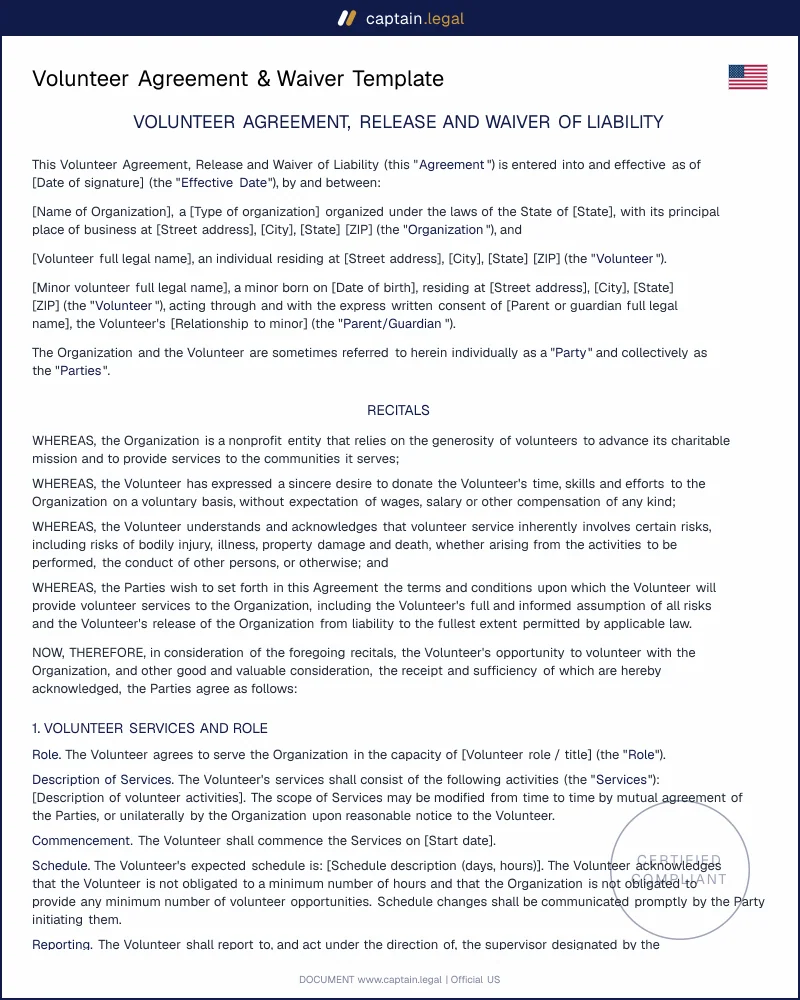
A volunteer agreement and waiver is a hybrid contract. The agreement half spells out the volunteer's role, schedule, supervision, code of conduct, and confidentiality obligations. The waiver half, sometimes labeled a release of liability and assumption of risk, is the volunteer's signed acknowledgment that they understand the inherent risks of the activity and release the nonprofit from claims arising from those risks, to the extent allowed by state law. Both pieces live in one document because they protect different problems: the agreement prevents misclassification and operational drift, while the waiver limits civil exposure if an accident occurs.
It is worth being precise about what this document is not. It is not an employment contract, and language treating the volunteer like a W-2 employee (set hours, performance evaluations, mandatory training tied to discipline) can be used against the organization to argue the volunteer was actually a worker entitled to minimum wage under the Fair Labor Standards Act (29 U.S.C. §§201 et seq.). It is also not a release for gross negligence or willful misconduct, since no state enforces a waiver that purports to cover those. A well-drafted template walks the line: enough structure to manage the volunteer, enough distance to keep the relationship clearly charitable. Captain.Legal's nonprofit and charity document templates are drafted with that boundary in mind.
Legal framework
Three layers of law shape this document in the United States. At the federal level, the Volunteer Protection Act of 1997 (42 U.S.C. §§14501 et seq.) provides limited immunity to individual volunteers of nonprofit organizations and governmental entities for ordinary negligence committed while acting within the scope of their duties, provided the volunteer was properly authorized and not operating a motor vehicle without a license or insurance. The Act protects the volunteer, not the organization. The nonprofit itself remains exposed under standard respondeat superior and negligent supervision doctrines, which is exactly why the waiver portion of this document exists.
The second layer is state tort law, and it varies sharply. Every state recognizes liability waivers in principle, but courts in Virginia, Montana, and Louisiana refuse to enforce pre-injury releases for personal injury as a matter of public policy, while California, Texas, Florida, New York, and most others uphold them when the language is conspicuous, unambiguous, and signed voluntarily by a competent adult. State Good Samaritan statutes and charitable immunity doctrines (still alive in New Jersey and Massachusetts, abolished or narrowed elsewhere) add another layer that the agreement should reference without overpromising. For minors, the picture tightens further: parents in roughly thirty states cannot prospectively waive a child's tort claim, so the parental signature operates only as informed consent to participation, not as a defense to the child's own future suit. The Cornell Legal Information Institute summary of the Volunteer Protection Act is the cleanest public starting point for understanding what federal immunity actually covers.
The third layer is worker classification. The FLSA and IRS Publication 15-A draw a bright line between bona fide volunteers and unpaid workers. A volunteer who receives anything beyond reimbursement of expenses, modest stipends, or nominal recognition risks being recharacterized as an employee, with retroactive minimum wage, overtime, and FICA exposure. The agreement should state, plainly, that the engagement is uncompensated, that no benefits or wages are owed, and that any reimbursement is limited to documented out-of-pocket expenses. Nonprofits that also run hiring pipelines should keep their at-will employment contract template clearly separate from this document, both physically and in the volunteer's onboarding flow.
When do you need this document?
The most common trigger is onboarding a new volunteer for a recurring role — weekly food bank shifts, after-school tutoring, animal shelter care, hospice companionship. Any role with regular presence on premises or near vulnerable populations should not start without a signed agreement on file. The second trigger is event-based volunteering, where a 5K race, gala, festival, or disaster relief deployment brings in dozens or hundreds of one-time helpers. Here the agreement and waiver are usually combined into a single short form distributed at check-in, with separate parental signature blocks for any volunteer under eighteen.
A third scenario involves specialized or higher-risk activities: construction with Habitat for Humanity-style builds, animal handling, water rescues, transportation of clients in a volunteer's personal vehicle, or any role involving heavy equipment. These engagements demand a more detailed assumption of risk recital, naming the specific hazards rather than relying on generic language. Courts in California and Texas have repeatedly thrown out waivers for activities the plaintiff could not reasonably have anticipated from the form itself; specificity is what holds up.
Two edge cases deserve flagging. Volunteers handling donor data, child records, or medical information should sign a confidentiality addendum that survives the engagement and references HIPAA or state privacy law where applicable. And volunteers serving on a board of directors or board-adjacent committee should sign a separate director acknowledgment covering fiduciary duty, conflict of interest, and D&O insurance coverage, because the standard volunteer waiver does not address governance risk. For organizations bringing on paid contractors alongside volunteers, the freelance contractor agreement template handles the IRS side of the relationship.
Key clauses included in our template
The identification of the parties names the nonprofit by its full legal corporate name, state of incorporation, and EIN where appropriate, then identifies the volunteer with full legal name, date of birth, and emergency contact. For minors, a separate parent or guardian signature block appears with parental name and relationship. Vague identification ("the Volunteer") without identifying details is a frequent reason waivers are struck down on enforceability grounds.
The scope of the volunteer role describes the position, supervisor, schedule expectations, location, and the activities the volunteer is authorized to perform. It also lists what the volunteer is not authorized to do, such as operate organizational vehicles, handle cash, or work unsupervised with minors absent specific clearance. This section doubles as evidence of "scope of duties" under the Volunteer Protection Act if federal immunity ever needs to be invoked.
The assumption of risk and release of liability is the heart of the waiver. It identifies inherent risks specific to the activity (physical injury, exposure to weather, contact with animals or clients, transportation hazards, infectious disease) and states that the volunteer accepts those risks knowingly. The release covers claims for ordinary negligence but expressly carves out gross negligence and intentional misconduct, since no state will enforce a waiver of those.
The background check and clearance authorization is required for any role involving minors, the elderly, or vulnerable populations. The clause authorizes the nonprofit to run criminal background checks and, where applicable, fingerprint-based screening under state child protection statutes such as California Penal Code §11105.3 or Florida Statutes §943.0542.
The confidentiality and intellectual property clause protects donor lists, beneficiary information, internal financials, and any creative work product produced during the engagement. Captain.Legal's nonprofit and charity legal templates catalog includes a standalone NDA if the role warrants stronger protection.
The termination and code of conduct clause makes clear the engagement is at-will on both sides, with no notice required, and lists conduct that results in immediate removal (harassment, theft, breach of confidentiality, intoxication on shift). Pairing termination language with a no-rehire clause for cause-based removals helps the organization document a paper trail if the same individual reapplies later.
State-specific considerations
California treats liability waivers strictly. Under Tunkl v. Regents of the University of California (1963) 60 Cal.2d 92 and its progeny, a release is enforceable only when the activity is non-essential, the waiver language is clear, explicit, and comprehensible, and the release does not affect the public interest. For volunteer agreements, this means Civil Code §1668 prohibits waiver of gross negligence without exception, and the release must be a separate, clearly captioned section, not buried in fine print. California nonprofits should also note Labor Code §3363.6, which extends workers' compensation coverage to volunteers only when the board has formally adopted a resolution electing such coverage. Without that resolution, an injured volunteer must pursue tort remedies, which is exactly when the waiver matters.
Texas is more permissive but has its own quirks. The Charitable Immunity and Liability Act (Tex. Civ. Prac. & Rem. Code Chapter 84) caps damages against qualifying nonprofits and immunizes volunteers for ordinary negligence committed in good faith within the scope of their duties. To qualify, the nonprofit must carry liability insurance of at least $500,000 per person and $1,000,000 per occurrence. The waiver should reference Chapter 84 explicitly and include the express negligence doctrine language required by Texas courts under Dresser Industries, Inc. v. Page Petroleum, Inc. (1993) 853 S.W.2d 505, meaning the word negligence must appear in the release clause itself.
Florida enforces volunteer waivers under Florida Statutes §768.1355 (the Florida Volunteer Protection Act) and §768.13 (Good Samaritan Act), but requires that the release be clear and unequivocal and that risks be specifically identified. Generic catch-all language alone will not survive a Florida challenge. For programs serving minors, Kirton v. Fields (2008) 997 So.2d 349 limits parental pre-injury waivers in commercial settings but leaves room for noncommercial, community-based nonprofit activities, a distinction worth documenting in the recitals.
New York does not recognize charitable immunity and enforces waivers narrowly under General Obligations Law §5-326, which voids releases for places of "amusement or recreation." Volunteer activities outside that scope (food distribution, tutoring, advocacy) are generally enforceable if clearly drafted, but waivers tied to fitness classes, sports leagues, or recreational events run by the nonprofit may be unenforceable as to the participants and require careful drafting as to volunteers. New York also has detailed youth volunteer rules under Labor Law §130 for anyone under eighteen.
How to fill out this volunteer agreement and waiver
The Captain.Legal builder starts by asking for the state where the nonprofit is incorporated and where the volunteer activity will physically occur, because those two states drive the governing law clause and the waiver language. From there, the form requests the nonprofit's full legal name, EIN, principal address, and the name of the volunteer coordinator who will sign on the organization's behalf. The volunteer's information comes next, with a dedicated branch for minors that automatically inserts the parent or guardian signature block and tailors the release language to comply with state limits on parental waivers.
The next step asks you to describe the volunteer role in plain language: title, supervisor, weekly hour expectation, location, duration of the engagement (open-ended or fixed-term), and whether the volunteer will use a personal vehicle for organizational business. That last question is important because vehicle use triggers additional language about primary insurance, MVR checks, and the Volunteer Protection Act requirement that the volunteer be properly licensed and insured.
You then select the inherent risks specific to the activity, picking from a curated list (physical labor, animal contact, client contact, infectious disease, weather exposure, food handling, water-based activities). The form drafts the assumption of risk recital from that selection rather than relying on a catch-all. Background check authorization, confidentiality language, and photo release are toggled based on the role. The final screen previews the document and lets you download in editable Word or signature-ready PDF, both formats appearing in the same delivery. Once signed, the agreement should be filed in the volunteer's personnel record alongside any related forms from the full catalog of US legal templates.
Common mistakes to avoid
The first mistake is treating the waiver as boilerplate. A release that simply says "Volunteer releases Nonprofit from all claims" without identifying specific risks, without conspicuous formatting, and without the word negligence in the operative sentence will fail in Texas, Florida, and most jurisdictions that have addressed the issue. Specificity is not optional. The second is using the same form for adults and minors. Parental signatures do not function as broad pre-injury releases of a child's claims in most states; courts in Florida, Utah, New Jersey, and Washington have repeatedly held that a parent cannot waive a minor's tort right prospectively. The minor's version of the form should focus on informed consent, medical authorization, and indemnification by the parent, not on extinguishing the child's future claims.
The third mistake is letting the agreement drift toward an employment contract. Mandatory shifts, progressive discipline, performance reviews, productivity quotas, and benefits-like perks all push the volunteer relationship across the FLSA line, with retroactive wage liability waiting on the other side. The fourth is failing to update the document when the role changes. A volunteer who signed a generic agreement two years ago and now drives clients in a personal vehicle is operating without coverage for the higher-risk activity, and the original waiver will not stretch to fit. Refresh the agreement whenever the role materially changes. The fifth, and most expensive, is collecting signatures and then losing the paper. A waiver that cannot be produced when a claim is filed is functionally a waiver that never existed; signed copies belong in a permanent personnel file, ideally backed up digitally.
Frequently Asked Questions
18 verified reviews · 50 000+ downloads
- Immediate access to the document
- PDF + Word download
- Compliant with 2026 legislation
- Reviewed by lawyers
You might also like