A pet custody agreement is a private contract between two co-owners of a companion animal who no longer share a household, setting out who keeps the pet, when the other party gets visitation, how veterinary bills and food costs are split, and who makes the medical decisions when the animal is sick. Most people draft one after a divorce, a separation between unmarried partners, or the end of a roommate situation where the dog or cat was acquired jointly. Demand for this document has grown sharply since 2024: Millennials and Gen Z treat their pets as family members, and courts in most states still treat them as personal property, which is precisely the gap a written agreement fills.
This page explains what a pet custody agreement covers under U.S. law, which states have moved beyond the property model, what clauses our template includes, and the practical mistakes that turn a well-intentioned arrangement into a small claims dispute six months later. It is written for unmarried co-owners, separating spouses, and roommates who want a document that holds up the next time the dog tries to chew through a leash.
Compliant
2026 Legislation
50,000+ clients
trust us
Affordable
From $4.90 / doc
Secure payment
Instant download
Pet Custody Agreement Template | Word & PDF — All 50 States
Secure payment
What is a pet custody agreement?
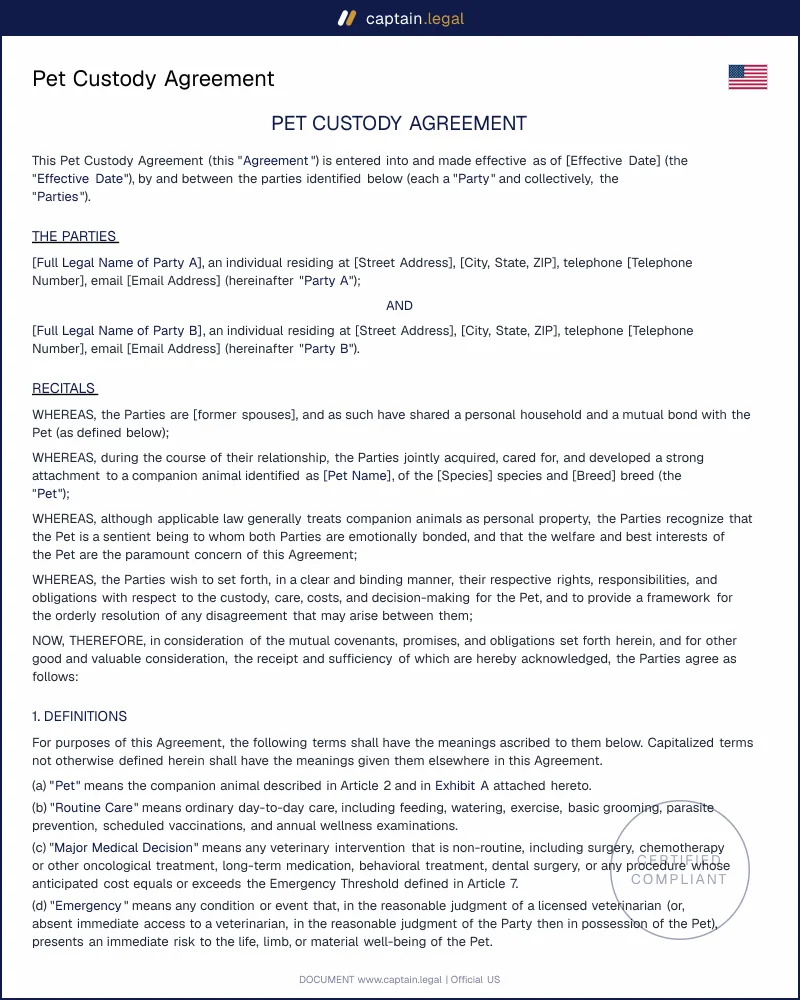
A pet custody agreement is a written contract that allocates possession, decision-making authority, and financial responsibility for a companion animal between two co-owners. The agreement names a primary custodian (the party with whom the pet lives most of the time), defines a visitation schedule for the non-custodial party, and sets the rules for shared expenses, emergency care, and what happens if either party moves or dies. It is sometimes called a pet sharing agreement, a pet co-ownership agreement, or, after a divorce, a companion animal parenting plan.
The legal nature of the document depends on the state. In 46 states, pets remain classified as chattel, which means a court asked to enforce the agreement will treat it the same way it treats a contract about a piece of furniture. The contract is fully enforceable, but the judge will not impose visitation by analogy to child custody rules; the remedy will be possession of the animal as property, plus damages. In California, Illinois, New York, Alaska, Maine, Rhode Island, and a handful of other states, statutory reforms now allow family court judges to consider the best interest of the pet in divorce proceedings, which lifts the document closer to a true custodial framework. The distinction matters when you draft: an agreement signed in Texas needs to lean heavily on contract remedies, while one signed in California can reference the statutory factors a judge would already weigh.
Legal framework
In most of the country, ownership of a companion animal is governed by state property law, generally falling under the residual chattel category of the Uniform Commercial Code as adopted by each state. A court resolving a dispute will ask who paid for the animal, whose name appears on the adoption contract or the American Kennel Club registration, whose veterinary records list the primary owner, and whose homeowners or renters insurance lists the dog on the liability rider. Once ownership is established, the historical rule was that the animal went to the legal owner, full stop. A private pet custody agreement changes that default by creating contractual rights that override the bare property analysis, provided the document is signed by both parties and supported by adequate consideration (typically the mutual promises to share expenses and access).
A growing minority of states has rewritten the divorce rules. California led the shift with Family Code §2605, effective January 1, 2019, which allows the court to assign sole or joint ownership of a pet animal "taking into consideration the care of the pet animal" and defines care to include the prevention of cruelty and the provision of food, water, veterinary care, and shelter. Illinois followed under 750 ILCS 5/503(n), requiring family courts to consider the well-being of a companion animal when allocating it as a marital asset, while excluding service animals from the analysis. New York amended Domestic Relations Law §236 in 2021 to apply a similar best interest standard. Alaska's AS §25.24.160(a)(5) was the first statute of its kind, dating from 2017. You can read the full statutory text of the California rule in the Cornell Legal Information Institute summary of California pet custody statutes. Outside these states, a written agreement is not just useful, it is the only practical mechanism for shared custody, because the court will not invent one for you.
Form requirements are light. No notarization is required at the federal level, and most states accept a signed writing with two adult signatures and a date. Notarization is recommended whenever the agreement involves significant ongoing payments or transfers of registered animals, because it strengthens evidentiary weight if the document ends up in front of a judge. For more context on private contracts that govern post-separation life, see our collection of personal legal documents for life transitions.
When do you need this document?
The most frequent trigger is a separation between unmarried partners who jointly adopted or purchased a pet during the relationship. In that scenario there is no divorce court to allocate the animal, and one party walking out with the dog under their arm is, in legal terms, simply taking possession of joint property, with all the disputes that produces. A written agreement signed before the breakup is resolved fixes the question before it becomes adversarial.
Divorcing spouses are the second large category, and the reason is procedural: family courts in property-only states will not draft a visitation schedule for a dog, no matter how attached the parties are. The judge will award the animal to one spouse and offset its value against other community property. Couples who want a real sharing arrangement need to sign their own document, often as a side agreement to the marital settlement agreement. Roommates who jointly adopted a cat are the third recurring scenario, and they are particularly exposed because there is no marital framework to fall back on at all. Same-sex couples who adopted before they had the option to marry, blended families where a stepchild and a parent both bonded with the same animal, and elderly co-owners planning for the death of either party all benefit from the same document.
One edge case worth flagging: tenants in no-pets buildings whose landlords issued a one-time waiver tied to a specific occupant face a real risk that the lease will not follow the animal when the relationship ends. The agreement should anticipate that contingency rather than assume the dog can move freely between two units. A related issue arises when one party plans to relocate out of state, which can collapse a 50-50 schedule into something unworkable; the agreement should set a notice period and a default rule for that situation.
Key clauses included in our template
- The identification of the parties and the animal lists each co-owner by full legal name and address, then identifies the pet by name, species, breed, date of birth, color, microchip number, and American Kennel Club or rescue registration number when applicable. Vague descriptions like "our golden retriever" have failed in court when both parties owned multiple dogs of the same breed.
- The allocation of ownership and primary residence designates one party as the primary custodian and the other as the secondary custodian, with a clear statement of where the pet lives by default. The clause is drafted to survive even if one party later argues that day-to-day care should override the written designation, by referencing the parties' intent at signing.
- The visitation schedule sets out the recurring access pattern (alternating weeks, every other weekend, a specific monthly cadence), the exchange location, and the rules for holidays, vacations, and the pet's birthday. Our template includes optional language for a transition period when the schedule changes for school holidays or work travel.
- The financial responsibility clause splits routine costs (food, grooming, monthly preventatives), preventative veterinary care, and extraordinary medical expenses, typically with a dollar threshold that triggers joint approval before treatment. The threshold is the single most litigated provision in pet agreements, because emergency veterinary bills routinely exceed what either party expected when they signed.
- The medical decision-making clause identifies who is authorized to consent to surgery, euthanasia, or experimental treatment in an emergency when the other party cannot be reached within a stated window (usually two to four hours). This clause is what veterinary hospitals actually ask for when one party arrives with a sick animal.
- The relocation and right of first refusal clause requires advance written notice if either party intends to move beyond a defined radius, gives the other party a right of first refusal to take the pet rather than have it transported, and addresses what happens if one party can no longer keep the animal due to housing, illness, or financial hardship.
- The dispute resolution and modification clause sends disagreements to mediation before litigation, sets the governing state law, and provides a written-amendment requirement so verbal modifications cannot be invoked later. For couples coordinating multiple post-relationship contracts, our overview of separation and personal agreements explains how these documents fit together.
State-specific considerations
California is the jurisdiction with the most developed framework. Family Code §2605 gives divorce courts explicit authority to assign sole or joint ownership "taking into consideration the care of the pet animal," and judges weigh factors including who provided primary care, who has the financial ability to maintain veterinary treatment, and whose living situation is suitable for the animal. A private agreement signed in California should track the statutory language, because a judge reviewing it will already be looking for those factors. Note that §2605 applies only to marital community-property pets, not to animals owned before marriage or adopted by unmarried partners; for the latter, the contract is the entire framework.
Illinois courts apply 750 ILCS 5/503(n), which directs the court to consider the well-being of the companion animal when allocating it as a marital asset. The statute explicitly excludes service animals from its scope, since they remain the property of the handler under the Humane Care for Animals Act. Agreements drafted in Illinois should include a recital confirming the animal is a companion animal under the statute, which preempts later disputes about classification.
New York added a best interest standard to Domestic Relations Law §236 in 2021, making it the third state to abandon the pure property model in divorce proceedings. New York judges look at the animal's bonding patterns, the daily caregiver, and the suitability of each post-divorce home. The agreement should document caregiving history with specifics (who walked the dog, who scheduled vet appointments), because that evidence carries direct statutory weight.
Texas remains a strict community property and separate property state for pets, with no special statute. Texas Family Code §3.001 et seq. governs the analysis, and judges award the animal as chattel. A written pet custody agreement is therefore essential rather than supplementary in Texas: without one, the court will not impose shared access regardless of how attached either spouse is. The same property-only approach applies in Florida under Bennett v. Bennett, 655 So.2d 109 (Fla. 1st DCA 1995), which remains the controlling appellate authority and explicitly rejected pet visitation orders.
How to fill out this pet custody agreement
You start by selecting whether the agreement covers a divorce, a separation between unmarried partners, or a roommate situation, because each path changes the recitals and the dispute resolution defaults. From there, the form asks for the state where both parties live, which determines whether the document references a statutory framework like Family Code §2605 or relies purely on contract law. If the parties live in different states after the separation, you select the governing law clause that will apply to disputes.
The form then walks through the identification of the animal (microchip number, registration, photographs that can be attached as an exhibit), the allocation of primary residence, and the visitation schedule. Our template offers preset rotations (alternating weeks, every other weekend, custom calendar) and a free-text field for holidays. The financial section asks for a monthly contribution amount or percentage split, a veterinary expense threshold above which both parties must consent, and the bank account or payment platform used for reimbursements.
The last section covers contingencies: what happens if one party relocates, what happens if either party dies, and how the agreement can be modified. Once you have entered all fields, the full personal documents library on Captain.Legal generates the document in Word and PDF formats, ready for both signatures. We recommend signing in front of a notary even when not legally required, particularly if the agreement involves recurring payments.
Common mistakes to avoid
The most damaging mistake is leaving the medical decision threshold blank or setting it absurdly low. A clause that requires joint consent for any expense above fifty dollars looks reasonable on signing day, but it paralyzes emergency care the first time the dog swallows a sock at 2 a.m. and the other party does not pick up the phone. The threshold should be set high enough to allow real-time decisions in routine emergencies, with mandatory consultation reserved for elective procedures and end-of-life decisions. A second frequent mistake is failing to address what happens when one party loses pet-friendly housing, which is increasingly common in tight rental markets. Without a right of first refusal, the party who finds a no-pets apartment can effectively force the animal into surrender or rehoming without consulting the co-owner.
A third recurring failure involves microchip registration. Many agreements name a primary custodian but never update the chip database, so the secondary custodian shows up at an emergency clinic with no legal standing to authorize treatment. The fix is a single sentence requiring updated chip records within thirty days of signing. The fourth mistake is using verbal modifications: parties agree by text to swap weeks, the swap becomes routine, and within a year the actual schedule looks nothing like the written document. Insist on written amendments, even brief ones, because a judge enforcing the agreement will follow the writing, not the messaging history. The final common error is forgetting to address the death of either party, which leaves the surviving co-owner negotiating with an estate executor who has no obligation to honor an oral promise about the dog.
Frequently Asked Questions
48 verified reviews · 50 000+ downloads
- Immediate access to the document
- PDF + Word download
- Compliant with 2026 legislation
- Reviewed by lawyers
You might also like