A nonprofit hiring a consultant, trainer, or designer cannot just hand over a check and call it a day. The Independent Contractor Agreement for nonprofits is the written contract that defines the scope of work, the fee, the IP ownership, and — most importantly for a 501(c)(3) — proves to the IRS, the state, and your auditor that the worker is genuinely outside the payroll. Without it, a $5,000 design engagement can morph into back wages, FICA, and unemployment penalties that wipe out a quarter's fundraising. This template is built for executive directors, board treasurers, and program managers who need a contractor agreement that respects tight budgets, charitable purpose, and the common law classification test the IRS applies to exempt organizations.
A solid contractor agreement also protects the mission itself. Restricted grant money carries strings, donor-funded deliverables must belong to the nonprofit, and a freelance trainer cannot quietly walk away with a curriculum the board paid to develop. The clauses below are drafted to handle exactly these scenarios.
Compliant
2026 Legislation
50,000+ clients
trust us
Affordable
From $4.90 / doc
Secure payment
Instant download
501(c)(3) Independent Contractor Agreement Template | Word, PDF
Secure payment
What is a nonprofit independent contractor agreement?
A nonprofit independent contractor agreement is a written services contract between a tax-exempt organization and a non-employee worker — typically a 1099 contractor paid for a defined project or specialized expertise. The contract documents that the worker controls how the work is performed, supplies their own tools, bears their own profit-and-loss risk, and is not entitled to employee benefits, payroll tax withholding, or workers' compensation coverage. For a charity, this last point is decisive: misclassification triggers federal employment tax liability under IRC §3401 and parallel state unemployment exposure under the State Unemployment Tax Act (SUTA).
A common confusion is the difference between this agreement and a master services agreement used by agencies and consultants. An MSA is an umbrella document that anticipates repeated engagements documented through individual statements of work. The standalone Independent Contractor Agreement is a single project contract: one scope, one fee schedule, one term. Nonprofits with a recurring need (a fractional CFO, a quarterly grant writer) often start with this agreement and graduate to an MSA later.
The other point of confusion is the line between contractor and volunteer. A volunteer receives no compensation beyond reimbursement of actual out-of-pocket expenses. The moment a stipend, honorarium, or in-kind benefit crosses a threshold of consideration, the IRS treats the relationship as compensated, and the worker is either an employee or a contractor. If you pay anything beyond receipted expenses, you need this agreement, not a volunteer waiver.
Legal framework
Three legal layers govern a nonprofit's use of independent contractors, and the agreement must satisfy all three simultaneously. The first is the federal common law test, codified in IRS guidance and applied through three categories of evidence: behavioral control (does the nonprofit direct how the work is done), financial control (who supplies tools, who carries profit-or-loss risk, is the worker free to offer services to the public), and type of relationship (written contract, permanence, whether the services are integral to the nonprofit's exempt purpose). The IRS published its definitive guidance for exempt organizations at the IRS page on independent contractors versus employees for exempt organizations, and that test is the one every clause of this template is designed to satisfy.
The second layer is federal tax reporting. Any contractor paid $600 or more in a calendar year must receive a Form 1099-NEC by January 31 of the following year, with the corresponding copy filed with the IRS. The nonprofit must collect a Form W-9 before issuing the first payment, retain it for four years, and report annual totals. Failing to collect a W-9 before the first check goes out is the single most common compliance miss in small nonprofits, because the contractor's tax ID is the data point that flows through the entire reporting chain.
The third layer is state law, which has tightened significantly in recent years. Several states now apply a stricter ABC test under their wage-and-hour or unemployment statutes (California's Labor Code §2775, codifying the Dynamex decision, is the leading example, with Massachusetts and New Jersey close behind). Under the ABC test, the burden is on the nonprofit to prove the worker is free from control, performs work outside the nonprofit's usual course of business, and is engaged in an independently established trade. A grant writer producing grant applications for a fundraising organization may fail prong B even if every other element points to contractor status. The agreement must therefore document not just intent, but the operational facts that support classification under whichever state test applies.
When do you need this document?
The most common trigger is hiring a consultant for a defined project: a strategic plan, a board retreat facilitation, a salary benchmarking study, a feasibility analysis before a capital campaign. These engagements have a clear deliverable, a fixed budget, and a predictable end date, which is exactly the contractor profile the IRS recognizes. The second frequent scenario is contracting a trainer or workshop leader for a one-off program — a financial literacy series funded by a specific grant, a board governance training, a volunteer onboarding session. Because the engagement is bounded by the grant period, the contractor relationship maps cleanly onto the funding cycle.
Design and creative work form the third bucket. A graphic designer producing the annual report, a web developer rebuilding the donation portal, a videographer documenting a program for an upcoming gala : each justifies a contractor agreement with strong work made for hire language. Without that language, the freelancer keeps the copyright by default under 17 U.S.C. §201, and the nonprofit licenses the work rather than owns it. That is a real problem when a future board wants to repurpose the materials or when a funder demands ownership of grant-funded deliverables.
Two edge cases deserve attention. A former board member taking on paid consulting work creates a built-in conflict-of-interest issue that the agreement must surface and that the board must approve under the organization's conflict-of-interest policy before any check is signed. And a fiscal sponsor relationship, where a contractor is paid through a fiscal sponsor on behalf of an unincorporated project, requires the agreement to name the sponsor as the contracting party, not the project leader personally. Getting either of these wrong has cost charities their exempt status. For comparable agreements outside the nonprofit space, our freelance contractor agreement template designed for IRS 1099 compliance handles the for-profit case.
Key clauses included in our template
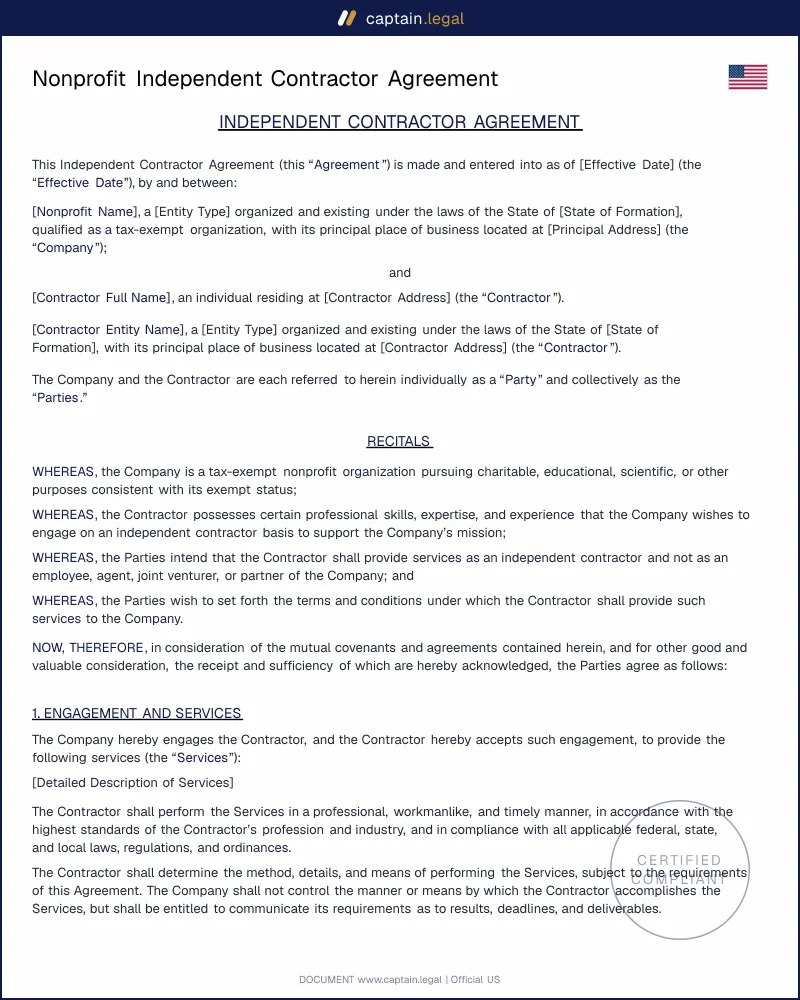
- The scope of work and deliverables are drafted as a separate exhibit incorporated by reference, so the underlying agreement remains stable across multiple projects with the same contractor. The exhibit names the deliverables, the acceptance criteria, the milestones, and the deadlines. Vague language like "strategic advisory services as needed" is replaced with concrete outputs, because that is exactly the kind of phrasing the IRS reads as evidence of an employment relationship.
- The fee schedule and payment terms specify a fixed project fee or a per-deliverable rate rather than an hourly wage tied to a fixed weekly schedule. The contractor invoices the nonprofit, the nonprofit pays on net-15 or net-30 terms, and there is no automatic recurring payroll run. This structural detail is one of the strongest indicators of financial control sitting with the contractor.
- The independent contractor status clause affirms in writing that the contractor is not an employee, is not entitled to benefits, will not be on payroll, and is responsible for their own self-employment taxes under IRC §1401. The clause does not by itself defeat a misclassification claim — the IRS looks at facts — but it eliminates the contractor's later argument that they reasonably believed they were an employee.
- The intellectual property clause assigns all deliverables to the nonprofit as work made for hire, with a backup assignment of any rights that do not qualify as work-for-hire under copyright law. For grant-funded deliverables, the clause also confirms compliance with any funder requirements regarding ownership and licensing.
- The confidentiality and donor data clause binds the contractor to protect donor lists, beneficiary records, and program data, with specific reference to any HIPAA or state privacy obligations the nonprofit itself carries. This clause survives termination and runs for a defined period after the project ends.
- The termination clause allows either party to end the engagement on written notice, with pro-rated payment for accepted work. The clause expressly avoids language about "cause" or progressive discipline, which would suggest an employment relationship subject to wrongful-termination claims.
State-specific considerations
California applies the ABC test under Labor Code §2775 to most worker classification questions, and the test is unforgiving. The nonprofit must prove the contractor is free from control, performs work outside the organization's usual course, and is engaged in an independent trade. A bookkeeper working full-time for a charity will fail prong B under the Dynamex framework. The state's Business and Professions Code §16600 also voids most non-compete restrictions in contractor agreements, so the template removes those provisions automatically when California is selected.
Texas applies the older 20-factor common law test administered by the Texas Workforce Commission, which is closer to the federal IRS standard and somewhat friendlier to nonprofit contractor arrangements. Texas does not impose state income tax withholding, simplifying the agreement's tax language, but the Texas Unemployment Compensation Act still requires accurate classification for unemployment tax purposes. A 501(c)(3) that elects the reimbursement method for state unemployment must still document why each contractor is genuinely outside payroll.
Florida uses the common law right-to-control test under Florida Statutes §443.1216 and is generally permissive on contractor classification, but the state aggressively audits nonprofits that file Form 1099-NEC for workers who look like employees on closer inspection. The template includes a Florida-specific recital confirming the contractor's right to subcontract and to maintain other clients. A contractor who works exclusively for the nonprofit and accepts no other engagements is at high risk under Florida audit standards.
New York applies different tests for different agencies. The New York Department of Labor uses a control-based test for unemployment, while the New York State Tax Department applies a slightly different standard for withholding. The New York Nonprofit Revitalization Act also imposes conflict-of-interest review requirements when the contractor has any relationship to a board member or officer, and the template generates the disclosure paperwork the board needs to approve such engagements before payment is authorized.
How to fill out this independent contractor agreement
You begin by selecting your nonprofit's state of incorporation, which determines the worker-classification test the template applies and the jurisdiction clause at the bottom of the contract. From there, the form asks for the legal name of the nonprofit (matching the IRS determination letter), the EIN, and the authorized signatory's title — usually the executive director or the board secretary, depending on the bylaws and any board-adopted signing authority resolution. Pulling the right person here matters, because a contract signed by someone outside their authority can be challenged later by the board itself.
The next screen captures the contractor's details: legal name, business name if a sole proprietorship or LLC, tax ID number from the Form W-9, and address. The form then guides you through the scope of work, the fee structure, the payment schedule, and the deliverable acceptance criteria. If the engagement is funded by a restricted grant, you check a box that adds a grant-compliance recital and a deliverable ownership clause specific to that funder's terms. The final step generates the signature page with optional notarization for high-value engagements and produces both the Word and PDF versions for execution. The full agreement and any other charity-specific document is accessible from our nonprofit and charity legal templates collection.
Common mistakes to avoid
The first and costliest mistake is paying before the W-9 is on file. The contractor's tax ID drives the year-end 1099 reporting chain, and without it the nonprofit faces backup withholding obligations at 24% of every payment plus penalties for late reporting. Treasurers in small charities often skip this step for a trusted vendor, then scramble in January to chase the form down. A second related mistake is using the same template the for-profit world uses, which omits the nonprofit-specific recitals : exempt purpose, charitable mission alignment, grant compliance, conflict-of-interest acknowledgment, and the specific tax language that protects 501(c)(3) status under IRC §501(c)(3). The template looks fine on the surface and fails the first time a state auditor reads it.
The third mistake is describing hours and supervision in employment terms. A clause that says the contractor "will work Tuesdays and Thursdays from 9 to 5 under the supervision of the Executive Director" is a confession of employee status, regardless of what the title at the top of the document says. The fourth is silence on intellectual property, which leaves the nonprofit licensing rather than owning grant-funded work product. The fifth and most damaging is failing to update agreements when scope expands. A contractor hired for a three-month strategic plan who continues working for eighteen months on operational tasks has functionally become an employee, and a court or auditor will read the relationship that way regardless of the original agreement. For nonprofits that hire repeat workers who later need restrictive covenants, our non-compete and non-solicitation agreement template enforceable across the 50 states addresses the employee-side scenario.
Frequently Asked Questions
32 verified reviews · 50 000+ downloads
- Immediate access to the document
- PDF + Word download
- Compliant with 2026 legislation
- Reviewed by lawyers
You might also like