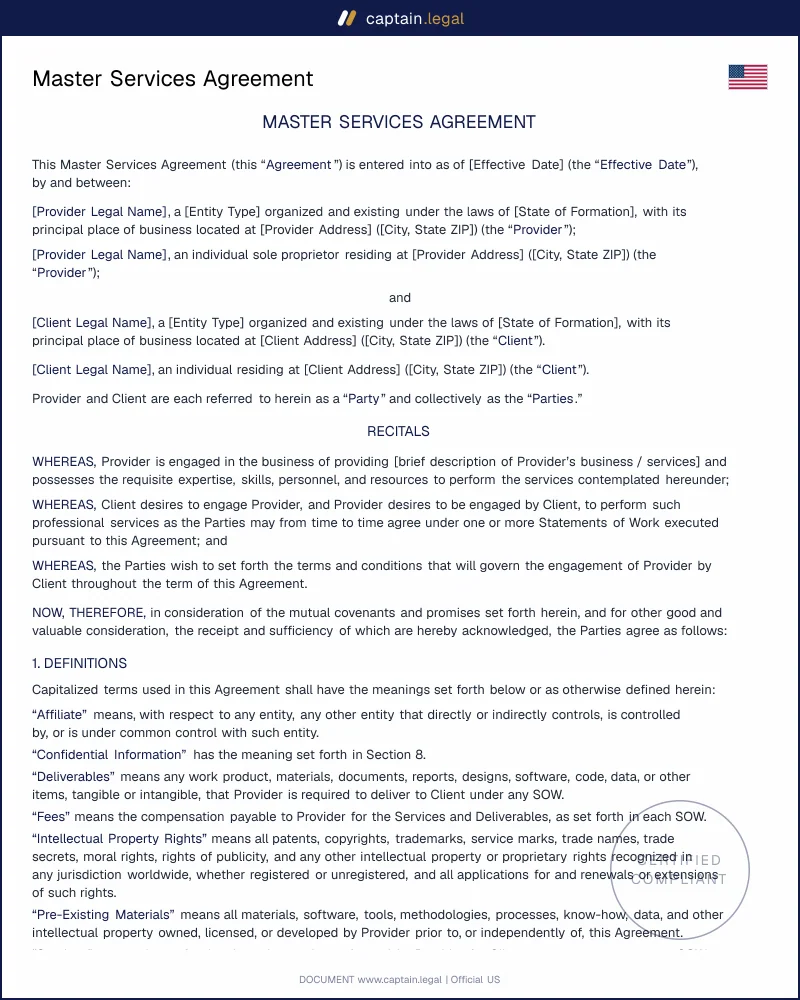
A Master Services Agreement is the contract you sign once so you stop renegotiating the same boilerplate every time a new project lands. It sits at the top of a two-layer structure: the MSA itself locks in the legal terms that govern every engagement between a service provider and a client, while each individual project gets its own Statement of Work (SOW) that defines deliverables, timeline, and fees. Agencies, consulting firms, software development shops, marketing studios and independent contractors use this framework because it cuts the contracting cycle from weeks to hours once the master is in place. The template on this page is built for U.S. service providers operating under common-law contract principles, with governing-law options for California, New York, Texas, Delaware, and Florida, and ready to sign in Word or PDF.
Compliant
2026 Legislation
50,000+ clients
trust us
Affordable
From $4.90 / doc
Secure payment
Instant download
MSA Template for Agencies & Consultants — Word, PDF, SOW Ready
Secure payment
What is a Master Services Agreement?
A Master Services Agreement, often shortened to MSA and sometimes called a Service Agreement when no SOW layer is contemplated, is a B2B contract that establishes the legal terms governing an ongoing service relationship between two businesses. It is a framework agreement: it sets the rules of engagement, but does not commit either party to a specific scope of work or a specific dollar amount on day one. Each piece of actual work gets added later through a Statement of Work, a Change Order, or a purchase order that incorporates the MSA by reference. The result is a clean separation between commercial terms (what we are doing and for how much) and legal terms (what happens if something goes wrong).
People sometimes confuse an MSA with a one-off Service Agreement or a Consulting Agreement. The practical difference comes down to repetition. If you expect a single discrete project with a clear end date, a standalone service agreement is enough. If you expect a continuing relationship with multiple phases, change requests, or new workstreams added over twelve to thirty-six months, the MSA-plus-SOW structure is the market standard. Captain.Legal also offers a freelance contractor agreement for 1099 engagements for situations where worker classification is the dominant concern rather than scope flexibility.
Legal framework
Service contracts in the United States sit squarely under state common law of contracts, not Article 2 of the Uniform Commercial Code. That distinction matters more than people realize. The UCC governs the sale of goods, defined under §2-105 as movable tangible things, while pure service arrangements are governed by the common law of the chosen forum state. When a single deal mixes goods and services, courts apply the predominant purpose test established in Bonebrake v. Cox, 499 F.2d 951 (8th Cir. 1974), to decide which body of law controls. A well-drafted MSA addresses this head-on by stating the agreement is for services, and by including a clause that disclaims Article 2 for the avoidance of doubt, which is now standard in software, SaaS, and creative-services contracts. The Cornell Legal Information Institute overview of UCC Article 2 sales contracts is the cleanest public reference for the goods-versus-services line.
Beyond the goods/services threshold, four state-law dimensions shape every U.S. MSA. Governing law selects whose common law applies and decides everything from interpretation rules to default damages. Statute of frauds in most states requires contracts that cannot be performed within one year to be in writing and signed. Limitation-of-liability enforceability varies: a cap excluding consequential damages is enforceable in commercial settings under most state laws, but unenforceable for gross negligence in New York, California, and several others, and never enforceable for fraud. Indemnification triggers strict-construction rules in California under Civil Code §2782, in New York under General Obligations Law §5-322.1 for construction work, and in Texas under Chapter 151 of the Business & Commerce Code. Plain English does not cut it on indemnity. Captain.Legal's non-disclosure agreement template is built to dovetail with the confidentiality language used in this MSA, which is why most clients pair the two.
Watch the auto-renewal trap. California Business and Professions Code §17600 et seq., New York General Obligations Law §5-903, and similar statutes in Florida, Illinois, and Oregon require specific notice and disclosure language before an auto-renewal clause can bind a B2B counterparty. A boilerplate "this agreement renews for successive one-year terms unless terminated" clause has been struck down repeatedly in California Superior Court over the last decade.
When do you need this document?
The cleanest signal is recurring work with a single client. When a marketing agency wins a retainer, when a software shop signs a Fortune 500 enterprise, when a consulting firm starts a multi-phase transformation, the MSA goes first and the SOWs follow. Negotiating limitation of liability, indemnification, and IP ownership once at the master level is dramatically faster than relitigating them every six weeks for each new SOW. In practice, the typical agency closes its first MSA inside ninety days of landing an enterprise account, then issues SOWs in two to three business days for the rest of the engagement.
The second trigger is enterprise procurement requirements. Any client with a procurement department of meaningful size will refuse to sign a one-page invoice or a quote and ask for a master agreement before issuing a purchase order. Companies on the Fortune 1000, public-sector buyers, and most healthcare and financial institutions will not pay against anything less. If you want access to those budgets, you need a defensible MSA in your sales packet. A senior partner at a New York consulting boutique once told me his close rate doubled the quarter he replaced his three-page service letter with a proper MSA: not because of the content, but because procurement stopped flagging the deal.
The third use case is multi-deliverable engagements with evolving scope. Software development is the textbook example: discovery, design, build, integration, post-launch support, each phase priced and scoped separately but governed by the same legal terms. An MSA with SOW exhibits lets you ship change orders without reopening the underlying contract. Without an MSA, every scope change becomes a contract amendment, which is how seven-figure relationships die from administrative friction.
Two edge cases are worth flagging. International work where the client is non-U.S. but the work is performed in the U.S. needs an export controls representation and an anti-bribery clause referencing the FCPA. And public-sector work, even as a subcontractor, triggers flow-down obligations from the prime that an off-the-shelf MSA will not absorb without amendment.
Key clauses included in our template
- The identification of the parties and recitals captures the legal name and state of formation of both signatories, identifies the authorized signatory, and frames the commercial purpose of the relationship. We use the precise corporate form (LLC, Inc., LP) because a signature against the wrong entity is one of the most common defenses to enforcement we see in commercial litigation. The recitals are kept short and factual, not aspirational, because some states treat overstated recitals as admissions.
- The services and Statement of Work structure establishes that the MSA itself imposes no scope obligation until a signed SOW is in place, and that each SOW incorporates the MSA by reference while remaining severable. This is the legal mechanism that lets you sign once and bill monthly without renegotiating the master. The template includes a sample SOW exhibit calibrated for fixed-fee, time-and-materials, and retainer billing models.
- The fees, invoicing, and late-payment terms specify Net 30 by default with a switch for Net 15 or Net 45, and they include a finance charge on overdue amounts at the lesser of 1.5% per month or the maximum permitted by law. This last formulation matters because New York General Obligations Law §5-501 and similar usury statutes elsewhere can void an above-statutory rate retroactively.
- The intellectual property allocation distinguishes pre-existing IP (retained by each party), deliverables (assigned to the client upon full payment), and tools and methodologies (perpetual non-exclusive license back to the provider). The assignment is conditioned on payment because pre-payment assignment leaves you with no leverage if the client refuses to pay. The clause cites the 17 U.S.C. §201 work-for-hire framework correctly, including the limited categories where work-for-hire actually applies.
- The confidentiality clause runs three years post-termination for general information and indefinite for trade secrets, tracking 18 U.S.C. §1839 under the Defend Trade Secrets Act. It carves out information independently developed, publicly available, or required by law to be disclosed, with a notice-and-cooperation obligation for compelled disclosures.
- The limitation of liability caps direct damages at the fees paid in the twelve months preceding the claim, excludes consequential, incidental, special, and lost-profits damages, and carves out gross negligence, willful misconduct, IP infringement indemnification, and breach of confidentiality. This carve-out structure is the market standard for software and professional services and survives challenge in most jurisdictions.
- The mutual indemnification covers third-party claims for IP infringement caused by the provider's deliverables and third-party claims caused by client-supplied content or instructions. Procedural requirements (prompt notice, sole control of defense, cooperation) are spelled out because California Civil Code §2778 imposes specific defaults if you do not.
- The termination for convenience and for cause gives either party a thirty-day convenience-termination right (with payment for work performed) and a fifteen-day cure-then-terminate right for material breach. Survival clauses identify which sections live past termination: confidentiality, IP, indemnification, limitation of liability, and dispute resolution.
State-specific considerations
California: Civil Code §1668 voids any clause attempting to exempt a party from fraud, willful injury, or violation of law, which means a limitation-of-liability provision drafted as an absolute cap will be partially unenforceable. The template carves out fraud and willful misconduct by default. Section 16600 also voids most non-compete restrictions on services providers, so the template uses a narrow non-solicitation of employees rather than a general non-compete. For consumer-facing services, the CCPA/CPRA triggers data-processing-addendum obligations that the Captain.Legal privacy policy template addresses in parallel.
New York: General Obligations Law §5-1401 lets parties choose New York law for contracts over $250,000 even without a New York nexus, which is why so many tech MSAs designate New York as the governing law. §5-1402 extends the same logic to forum selection. The state's Faithless Servant Doctrine and Wood v. Lucy, Lady Duff-Gordon, 222 N.Y. 88 (1917), inform the implied duty of good-faith performance that courts read into every MSA. The template includes an express good-faith covenant rather than relying on the implied one.
Texas: the Business & Commerce Code §15.50 permits non-competes only with reasonable scope and consideration, but the doctrine of blue-penciling is unusually broad here, so overreaching restrictions get rewritten rather than struck. Section 35.51 enforces forum-selection clauses without a Texas nexus, and Chapter 41 of the Civil Practice and Remedies Code caps exemplary damages, which interacts with the indemnification clause for IP claims.
Delaware: most enterprise clients want Delaware governing law because §2708 of Title 6 enforces the parties' choice of Delaware law for contracts over $100,000 without further nexus, and the Court of Chancery offers fast equitable relief for confidentiality and IP disputes. The template's Delaware variant routes disputes to the Superior Court for non-equitable claims and the Court of Chancery for injunctive relief. Many founders use the template to govern services rendered to entities formed under the Articles of Incorporation template.
Florida: Florida Statutes §542.335 governs restrictive covenants in service relationships and is one of the most provider-friendly regimes in the country, with statutory presumptions on reasonable scope for non-solicits up to two years. Section 685.101 validates Florida choice-of-law for contracts over $250,000.
How to fill out this Master Services Agreement
You start by entering the legal names and states of formation of both contracting entities, with the same precision you would use on a signature block: full corporate name, suffix (LLC, Inc., LP), and registered office. The generator pulls the correct entity-type clauses automatically once you select the form. From there, you pick the governing-law state, and the limitation-of-liability, indemnification, and termination clauses adjust to that state's enforceability rules. The five available variants are California, New York, Texas, Delaware, and Florida, which together cover the governing law of roughly eighty percent of U.S. enterprise MSAs.
Next, you configure the commercial defaults that flow into every future SOW: payment terms (Net 15, Net 30, or Net 45), late-payment finance charge, currency, and expense-reimbursement policy. You select the IP model that fits your business, assignment on payment for agencies and dev shops, or broad license-back for consultancies that reuse methodologies. The template then offers optional modules: a data processing addendum if you handle client personal data, an insurance requirements exhibit if your client requires E&O or cyber coverage, and a non-solicitation of employees for the term plus twelve months. You finish by drafting your first SOW directly inside the wizard or skipping it and producing a clean master to send to procurement. The output is a fully editable Word file and a clean PDF, ready to redline or sign.
Common mistakes to avoid
The most expensive mistake we see is using a sales contract template (UCC Article 2) for a services engagement. The implied warranties of merchantability and fitness for a particular purpose under §§2-314 and 2-315 do not exist in pure services contracts at common law, but they can be inadvertently imported by sloppy drafting that references "products" or "deliverables as goods." The template explicitly disclaims UCC Article 2 and uses services-appropriate warranties. Closely related is the omission of an IP assignment trigger tied to payment: assigning IP at delivery instead of at full payment is how providers end up watching a non-paying client use their work product anyway. The fix is one sentence, and it is in the template by default.
The second cluster of mistakes lives in the limitation of liability and indemnification interaction. A cap that swallows the indemnification obligation makes the indemnity worthless to the protected party, and a carve-out that swallows the cap makes the cap worthless to the indemnifying party. The market-standard solution is a cap that excludes IP infringement indemnification, confidentiality breach, and gross negligence, while everything else stays under the twelve-month-fees cap. Drafting this in plain English without testing the math against a real claim scenario is how seven-figure indemnity exposures appear in contracts that nobody intended. The auto-renewal clause without statutory notice language is a third recurring failure: in California, New York, and several other states, the renewal is unenforceable, but most providers do not learn this until a client refuses to pay the renewed year. Finally, misclassifying the engagement as a services contract when the substance is employment is a category-level mistake that no MSA can fix; if the relationship looks like employment under the IRS common-law factors or California's ABC test (AB 5), the non-compete agreement template and the contractor agreement linked above address the underlying classification problem before the MSA layer ever applies.
Frequently Asked Questions
25 verified reviews · 50 000+ downloads
- Immediate access to the document
- PDF + Word download
- Compliant with 2026 legislation
- Reviewed by lawyers
You might also like