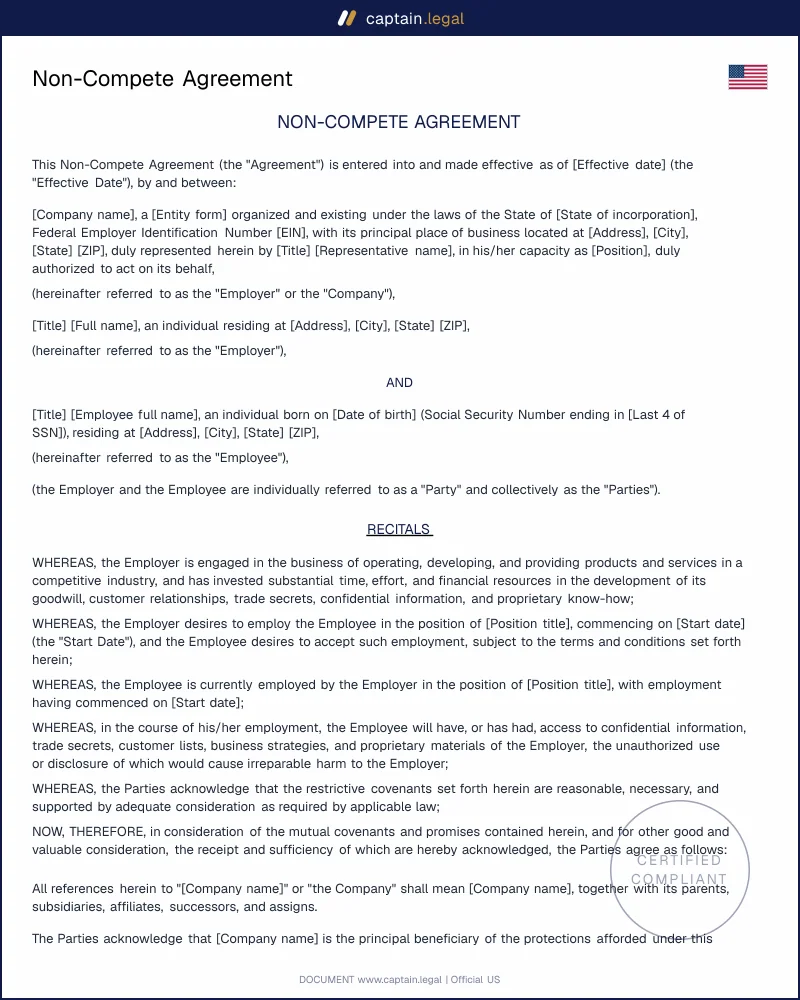
A non-compete agreement is the contractual instrument an American employer uses to keep a departing employee, contractor, or seller of a business from working for a direct competitor for a defined period after the relationship ends. The instrument has been at the center of US labor law debate for two years : the Federal Trade Commission tried to ban most of them in 2024, a federal court vacated that ban, and the FTC has now switched to case-by-case enforcement. The result on the ground is a state-by-state patchwork that decides whether your non-compete agreement is enforceable, modifiable, or void on its face. This template generates a state-correct restrictive covenant in Word and PDF, with the Defend Trade Secrets Act whistleblower notice embedded, garden-leave language for Florida CHOICE Act enforcement, and a severability architecture drafted to survive blue-pencil review in jurisdictions that allow it.
The template covers the four scenarios where a non-compete still works in 2026 : senior-executive departures, sale-of-business covenants, partner buyouts, and sophisticated-employee arrangements above a state-defined wage floor. It does not cover physician practice covenants, which are governed by separate statutes the form will route you away from where applicable.
Compliant
2026 Legislation
50,000+ clients
trust us
Affordable
From $4.90 / doc
Secure payment
Instant download
Non-Compete Agreement Template 2026 | Word & PDF Download
Secure payment
What is a non-compete agreement?
A non-compete agreement, also called a covenant not to compete or restrictive covenant, is a contract under which one party promises not to engage in a competing trade, profession, or business within a defined time period and geographic area following the end of an employment, partnership, or sale-of-business relationship. The agreement is enforceable only when it protects a legitimate business interest recognized by the governing state's law, typically trade secrets, confidential information, customer goodwill, or specialized training paid for by the promisee.
The non-compete sits inside a broader family of restrictive covenants and is often confused with its siblings. A non-solicitation agreement prohibits soliciting customers or employees but does not stop the worker from competing generally. A non-disclosure agreement protects information without restricting employment. A garden-leave clause keeps an employee on payroll during a notice period in exchange for sitting out the market. The three are routinely combined in a single instrument, but courts apply different enforceability tests to each, and Washington's RCW 49.62 now sweeps several of them into the non-compete framework explicitly. The template separates the clauses cleanly so that a court striking the non-compete does not collapse the entire restrictive package, a drafting choice that has saved confidentiality and non-solicitation protections in dozens of reported decisions.
Legal framework
US law on covenants not to compete operates on three layers, and the top layer changed materially between 2024 and 2026. The federal layer opens with the FTC Non-Compete Clause Rule of April 23, 2024, which would have voided most existing non-competes nationwide. On August 20, 2024, the Northern District of Texas in Ryan, LLC v. FTC set the rule aside with nationwide effect ; the FTC initially appealed, then voted 3-1 on September 5, 2025 to abandon the appeal and accede to the vacatur. The official record sits on the FTC's news release confirming the vacatur of the Non-Compete Clause Rule, and the agency formally removed 16 CFR Part 910 from the Code of Federal Regulations after its January 2026 workshop. The federal ban is dead, but federal scrutiny is not : the FTC has shifted to case-by-case enforcement under Section 5 of the FTC Act, with Gateway Services (Sept. 2025) and Rollins, Inc. (April 2026) the leading consent-order precedents.
The state layer is now where every non-compete lives or dies. California, Minnesota, North Dakota, Oklahoma, and Wyoming prohibit virtually all employee non-competes. Washington moved a near-total ban through ESHB 1155, signed March 23, 2026, with effect June 30, 2027 ; the existing RCW 49.62 salary thresholds remain in force until then, set by the Department of Labor and Industries at $126,858.83 for employees and $317,147.09 for independent contractors for 2026. Florida moved the opposite direction with the CHOICE Act (Fla. Stat. §§542.41-542.45), effective July 1, 2025, allowing covered non-competes up to four years with mandatory preliminary injunctions. Texas enforces under Tex. Bus. & Com. Code §15.50, which requires the covenant to be ancillary to an otherwise enforceable agreement and reasonable in time, geography, and scope. New York has no statutory ban, applies the BDO Seidman common-law reasonableness test, and is monitoring Senate Bill S4641A, which targets non-competes for individuals earning under $500,000. Delaware enforces under common law, blue-pencils overbroad clauses, and its Court of Chancery remains the favored forum.
The third layer is the Defend Trade Secrets Act (18 U.S.C. §1836 et seq.) and state trade-secret statutes. A non-compete drafted alongside a confidentiality covenant inherits the DTSA's exemplary-damages and attorney-fees regime under §1836(b)(3), but only if the federal whistleblower-immunity notice of §1833(b)(3) is included verbatim. The full catalog of US business legal templates routes overbroad or facially void clauses to the appropriate alternative instrument before the document is generated.
When do you need this document?
The strongest case for a non-compete is the sale of a business, where the seller's covenant protects the goodwill the buyer just paid for. Every state that voids employee non-competes carves out the sale-of-business context, and Cal. Bus. & Prof. Code §16601 preserves the covenant against a former owner who sells the goodwill of a business or a substantial ownership interest. Courts treat these covenants generously : five-year terms and statewide geographic scope are routinely enforced where the consideration is a meaningful purchase price.
The second scenario is the senior-executive separation, where the departing officer leaves with detailed knowledge of pricing models, M&A targets, and unannounced product strategy. Florida's CHOICE Act covered employees, New York's proposed highly-compensated-individual threshold, and Massachusetts' §24L exemptions all converge on the same idea : the higher the salary, the more enforceable the restraint. Pair the non-compete with a garden-leave clause when the executive sits in a true competitive-intelligence role, because most state courts now expect continued compensation during the restricted period.
The third scenario is the specialized employee with employer-funded training, the classic Marsh USA v. Cook fact pattern in Texas where the consideration is something more than at-will employment. The fourth is the partner or member buyout, where the departing equity holder's covenant protects the firm's continuing client relationships. The fifth and edge case is the independent contractor with deep client access, which works in Florida and Texas but fails in Washington unless the contractor's annual earnings exceed $317,147.09, the 2026 RCW 49.62 threshold. The companion employment law document templates for offer letters and severance include the forms that pair with a properly drafted non-compete.
Key clauses included in our template
The template tracks the structure used in restrictive-covenant practice at major US firms, with smart fields that adapt scope, term, and remedies to the governing state and the underlying transaction.
- The definition of competing activity is drafted narrowly to a specific line of business, list of products or services, or named competitors, never to "any business similar to the company". Vague competitive-activity definitions are the single most common reason courts strike non-competes, and Washington's interpretive rule under RCW 49.62.020(4) construes ambiguities against the employer by statute.
- The geographic scope is calibrated to where the employee actually worked and where the employer actually competes. A nationwide restriction is enforceable for a senior executive at a national firm, Calhoun v. WHA Medical Clinic and similar Texas decisions confirm, but a 50-mile radius around the employee's office is the safer default for everyone else. Florida's CHOICE Act requires the geographic area to be specified explicitly, with no exception.
- The temporal restriction runs the spectrum allowed by the governing state. The template defaults to one year, the figure most courts treat as presumptively reasonable, and offers up to eighteen months for executives in non-statutory states. Florida covered employees can extend to four years under Fla. Stat. §542.412. Washington presumes anything longer than eighteen months unreasonable under RCW 49.62.020(2). New York's pending S4641A would cap any future enforceable covenant at one year with mandatory paid leave during the restricted period.
- The consideration clause identifies what the promisee is giving in exchange for the restraint. Continued at-will employment is sufficient consideration in Texas after Marsh USA v. Cook, in Florida, and in most southern jurisdictions, but fails in Massachusetts, Illinois, and Oregon, where the template inserts a sign-on bonus, additional severance, or restricted stock as substitute consideration. Get this wrong and the covenant fails before reasonableness review even begins.
- The DTSA whistleblower notice under 18 U.S.C. §1833(b)(3), the garden-leave option for Florida CHOICE Act enforcement, and the severability and blue-pencil language sit in dedicated paragraphs. The blue-pencil clause expressly authorizes the court to reform an overbroad provision, which Texas courts must do under §15.51(c) and which Delaware courts will do at their discretion. Some states, notably Wisconsin under Wis. Stat. §103.465, refuse to blue-pencil and void the entire covenant on overbreadth, the template flags this and adjusts drafting accordingly.
State-specific considerations
California is the most aggressive non-compete jurisdiction in the country. Cal. Bus. & Prof. Code §16600 voids any contract restraining a person from engaging in a lawful profession, trade, or business of any kind, with carve-outs only for the sale of a business under §16601 and the dissolution of a partnership or LLC under §§16602-16602.5. AB 1076 and SB 699 of 2024 extended the prohibition extraterritorially : a California-resident employee can void a non-compete signed in another state under another state's law, and a California employer that includes a non-compete in any contract is subject to §16600.1 notice obligations and a private right of action. The template refuses to generate an employee non-compete for a California worker and routes the user to a non-solicitation-and-confidentiality alternative.
Florida is now the most permissive jurisdiction after the CHOICE Act. The Act, codified at Fla. Stat. §§542.41-542.45 and effective July 1, 2025, applies to any covered employee earning more than twice the annual mean wage of the relevant Florida county. For these workers, the courts must issue a preliminary injunction on a showing of breach, the burden of proving unenforceability shifts to the employee, and the maximum term extends to four years. The template includes the seven-day pre-execution review, the right-to-counsel notice, and the written acknowledgment of confidential-information access required by §542.412. Healthcare practitioners licensed under §456.001 are excluded from CHOICE Act enforcement and remain governed by §542.336.
Texas anchors enforcement in Tex. Bus. & Com. Code §15.50, which requires the covenant to be ancillary to an otherwise enforceable agreement and reasonable in time, geography, and scope. The Texas Supreme Court relaxed the consideration analysis in Alex Sheshunoff Mgmt. Servs. v. Johnson and Marsh USA Inc. v. Cook, allowing stock options and access to confidential information to satisfy the ancillary requirement. §15.51(c) obligates the court to reform an overbroad covenant rather than strike it, but it shifts attorney fees to the employer that drafted unreasonably broad limitations. Physician covenants are governed by the separate requirements of §15.50(b).
New York applies the common-law BDO Seidman v. Hirshberg reasonableness test, which weighs employer interest, employee hardship, and public interest. New York courts have grown increasingly skeptical of broad covenants over the past decade and routinely blue-pencil duration and geography. Senate Bill S4641A, which passed the Senate in June 2025 and remains in the Assembly, would prohibit employee non-competes except for individuals averaging $500,000 or more in compensation, cap any enforceable covenant at one year, and require continued salary payment during the restricted period. The template assumes current law and flags the legislative risk for high-stakes drafting.
Delaware is the chosen governing-law and forum for most entity-level non-competes signed alongside equity grants and partnership interests, because of Court of Chancery expertise on equitable remedies and its willingness to blue-pencil. Delaware will respect a reasonable choice-of-law clause selecting Delaware law and a forum-selection clause designating the Court of Chancery in Wilmington. Delaware's permissiveness has limits : the Chancery Court has voided overbroad covenants outright in Kodiak Building Partners and Ainslie v. Cantor Fitzgerald, and a poorly drafted non-compete will not be saved by the choice of Delaware law alone. Member-level covenants in LLC operating agreements receive the same Chancery scrutiny, and the LLC operating agreement template with member buyout and restrictive covenants carries the partnership-dissolution carve-outs that survive even in California.
How to fill out this non-compete agreement
You start by selecting the governing state, which sets enforceability tier, duration cap, geographic-scope rules, and required notices. The template then asks for the relationship type, employment, independent contractor, partnership, or sale of business, because the available consideration and the applicable legal standard differ for each. Sale-of-business covenants unlock longer terms and broader geography, employee covenants pull California out of the menu altogether, and contractor covenants trigger Washington's higher salary threshold automatically.
You then identify the parties by exact legal name and provide the employee's annualized compensation, which the form uses to test enforceability against state-specific wage floors : the 2026 Washington thresholds, the Florida CHOICE Act mean-wage multiplier, and the proposed New York S4641A highly-compensated-individual line. The next step defines the competing activity in operational terms, the geographic area by counties or radius, and the temporal restriction in months. The form rejects combinations the governing state will not enforce and offers the closest enforceable alternative. Final steps add the optional garden-leave clause, the DTSA whistleblower notice, the severability and blue-pencil language, and the dispute-resolution clause. The agreement exports as an editable Word file and a PDF with every state-specific compliance item already drafted in. Sign before the relationship starts wherever possible, because mid-employment non-competes require fresh consideration in most jurisdictions and post-termination covenants are simply unenforceable.
Common mistakes to avoid
The first failure is using the same template across all fifty states. A clause that is bulletproof in Florida is void on its face in California, presumed unreasonable beyond eighteen months in Washington, and reformed downward by Texas courts under §15.51(c). The second failure is drafting an unreasonable scope to give the court something to blue-pencil. The strategy worked in the 1990s and now triggers fee-shifting in Texas under §15.51(c)(2) and complete voidness in Wisconsin under Wis. Stat. §103.465, and even Delaware's Chancery Court has refused to rewrite covenants it considers shockingly overbroad.
The third failure is forgetting consideration. At-will employment alone supports a non-compete in Texas and Florida but fails in Massachusetts, Illinois, and Oregon, where the form must include independent consideration paid at signing. The fourth is omitting the DTSA whistleblower-immunity notice under 18 U.S.C. §1833(b)(3), which forfeits exemplary damages and attorney fees the moment the employer pursues the trade-secret remedies that pair with the non-compete. The fifth, and the most expensive in 2026, is ignoring the FTC's case-by-case enforcement track. The agency has put pet-cremation, pest-control, and building-services employers on consent orders for overbroad covenants applied to low-wage workers, and the employee disciplinary documentation toolkit is the appropriate paper trail for performance issues that a restrictive covenant was never designed to solve.
Frequently Asked Questions
34 verified reviews · 50 000+ downloads
- Immediate access to the document
- PDF + Word download
- Compliant with 2026 legislation
- Reviewed by lawyers
You might also like