A gift acceptance policy is the written rulebook a US nonprofit uses to decide which donations it will take, which it will refuse, and on what terms. It tells board members, staff, and donors exactly how the organization handles cash, publicly traded securities, real estate, closely held business interests, cryptocurrency, in-kind goods, planned gifts, and anything weird that lands in the inbox at 4 p.m. on a Friday. Every 501(c)(3) charity that files a full Form 990 and accepts noncash contributions effectively needs one, because Schedule M, line 31 asks whether the organization has such a policy and "no" is the answer that triggers questions.
This template is built for US public charities and private foundations that want a board-ready document, drafted to match the way the IRS and state regulators read these policies. It assumes you actually fundraise, not that you operate in theory.
Compliant
2026 Legislation
50,000+ clients
trust us
Affordable
From $4.90 / doc
Secure payment
Instant download
Nonprofit Gift Acceptance Policy Template | Word & PDF (US)
Secure payment
What is a gift acceptance policy?
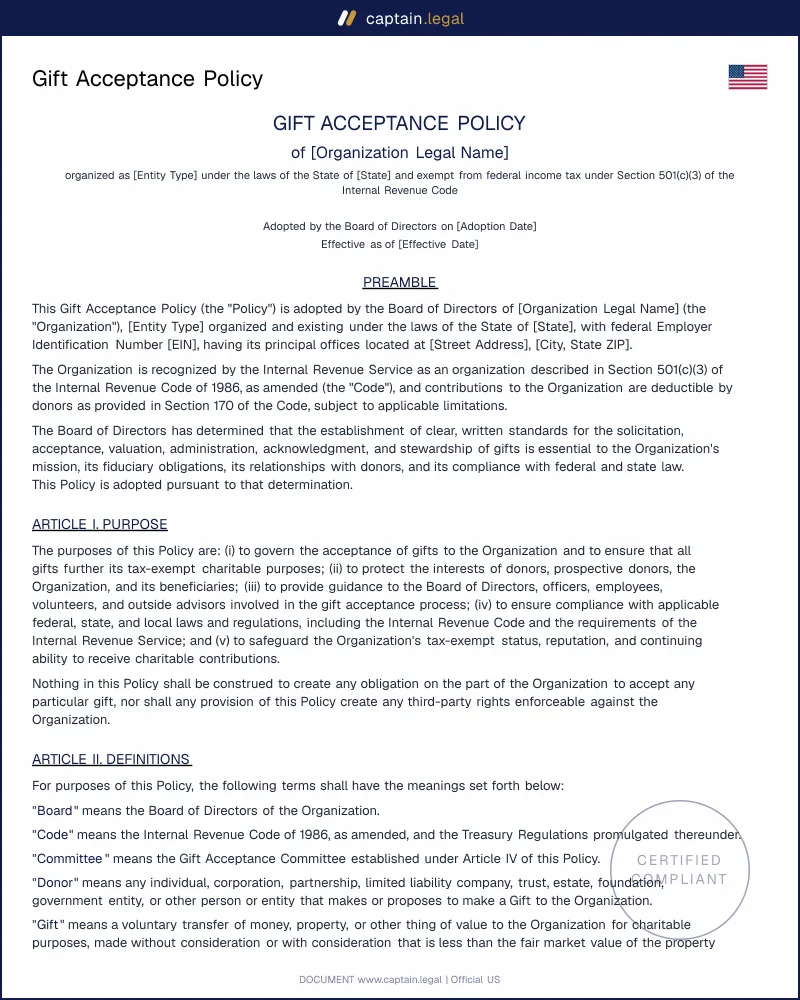
A gift acceptance policy is a governance document adopted by the board of a tax-exempt organization that sets the criteria, approval process, and documentation requirements for incoming donations. It is not a fundraising script and it is not a donor agreement. It binds the organization, not the donor. Once adopted, it tells the development team what they can accept on their own signature, what has to go to a gift acceptance committee, and what must be escalated to the board or to outside counsel before the gift is recorded.
In practice, the policy does three things at once. It protects the charitable mission by screening out gifts that come with strings the organization cannot live with, such as restrictions inconsistent with IRC §501(c)(3) purposes. It protects the balance sheet by refusing assets that carry hidden liabilities, environmental risk, or carrying costs the nonprofit cannot absorb. And it protects the board by creating a documented, neutral standard that lets fundraisers decline a problematic gift without insulting the donor.
People sometimes confuse a gift acceptance policy with a donor restricted gift acknowledgment or a donation receipt template. Those are donor-facing documents issued after a gift is accepted. The policy sits upstream of them. It is also distinct from an investment policy statement, which governs what the organization does with assets after they have been received and converted to endowment or operating funds.
Legal framework
US gift acceptance policies sit at the intersection of three bodies of law, and a serious template has to respect all three. The first is federal tax law. Internal Revenue Code section 501(c)(3) prohibits private inurement and improper private benefit, which means a charity cannot accept a "gift" structured so that the donor or an insider receives more value than the organization. IRC §170 governs the donor's charitable deduction and dictates how the nonprofit's acknowledgment must read: written substantiation for any single gift of $250 or more, contemporaneous and including the magic language about goods or services. For noncash gifts above $5,000, the donor's Form 8283 requires the organization's signature in Part V, and the nonprofit's Form 8282 must be filed if it sells, exchanges, or otherwise disposes of the property within three years of receipt. Get this paperwork wrong and the donor loses the deduction.
The second layer is the Form 990 governance framework. Schedule M, line 31, asks point-blank whether the organization has a gift acceptance policy that requires review of nonstandard contributions. Schedule M is triggered when the charity receives more than $25,000 in noncash contributions during the year or accepts art, historical treasures, or qualified conservation contributions. The IRS uses Schedule M and Part VI governance questions to identify organizations whose internal controls do not match their stated policies, and a missing or hollow gift acceptance policy is a documented red flag. You can see the current Schedule M questions in the Council of Nonprofits overview of gift acceptance policy requirements.
The third layer is state law. State nonprofit corporation statutes impose fiduciary duties on directors, and the Uniform Prudent Management of Institutional Funds Act (UPMIFA), adopted in most jurisdictions, governs how restricted gifts and endowment funds must be administered. Several states also require charitable solicitation registration through the office of the attorney general or secretary of state before a nonprofit may solicit donations from residents. None of these regimes are optional, and a gift acceptance policy that ignores UPMIFA's rules on donor restrictions will create real exposure the first time a board considers modifying or releasing one.
When do you need this document?
The most common trigger is the first time a donor offers something other than cash. A long-time supporter calls and says she would like to transfer 200 shares of Apple Inc. before year-end, or a board member proposes deeding a vacant lot in his name to the organization. Without a written policy, the executive director is forced to improvise, and improvisation is exactly what Schedule M, line 31 is designed to expose. The second trigger is the start of a capital campaign or planned giving program. Once you market charitable bequests, charitable remainder trusts, gift annuities, or beneficiary designations, you are committing in advance to accept categories of gifts whose mechanics most boards have never seen. The policy is what keeps those commitments from becoming traps.
A third trigger is the arrival of cryptocurrency and digital-asset donations. The IRS treats crypto as property rather than currency, which means a Bitcoin gift looks more like a stock transfer than a check, with Form 8283 requirements above $5,000 and qualified appraisal rules above $5,000 of value claimed by the donor. Charities that began accepting crypto in 2021 and 2022 often did so without a corresponding policy update; many are now retrofitting one under audit pressure.
A fourth trigger is real estate, closely held business interests, and gifts with environmental or carrying-cost risk. These rarely go wrong on paper. They go wrong because nobody read the easement, the partnership agreement, or the Phase I environmental site assessment before the deed was signed. The policy forces that diligence to happen before acceptance. One edge case worth flagging: gifts from donor-advised funds and private foundations sometimes carry quid-pro-quo elements (recognition benefits, naming rights, scholarships for the donor's family) that can disqualify the underlying distribution under IRS rules. A clean acceptance policy catches these before money moves, not after.
Key clauses included in our template
- The scope and purpose clause opens the document by stating that the policy applies to all gifts proposed to the organization regardless of source, value, or solicitation channel, and that no employee, officer, or volunteer is authorized to accept a gift outside this policy. This language is what gives the gift acceptance committee real authority and what lets a fundraiser politely refuse a problematic offer.
- The categories of acceptable gifts clause enumerates each asset type the organization is prepared to receive: cash, checks and electronic transfers, publicly traded securities, mutual fund shares, closely held business interests, real property, tangible personal property, life insurance, retirement plan beneficiary designations, charitable remainder trusts, charitable lead trusts, charitable gift annuities, cryptocurrency, and noncash in-kind contributions. Each category points to a separate review threshold and signature authority.
- The restricted and conditional gifts clause sets the boundary on donor restrictions. It requires that any restriction be consistent with the charity's 501(c)(3) purposes, reduced to writing in a gift agreement, and reviewed against UPMIFA standards before the funds are deposited into a restricted account. Restrictions that would force the organization to violate its bylaws or its tax-exempt purpose are declined as drafted.
- The prohibited gifts clause names what the organization will not accept under any circumstance, typically including weapons, hazardous materials, gifts contingent on a specific vote of the board, gifts that violate anti-terrorism financing rules under OFAC, and quid-pro-quo arrangements that would compromise the private benefit doctrine.
- The valuation and substantiation clause assigns responsibility for Form 8283 signatures, qualified appraisals for noncash gifts above $5,000, Form 8282 filings on disposition within three years, and the timing of donor acknowledgment letters required under IRC §170(f)(8) for any single gift of $250 or more.
- The review and amendment clause requires the board to review the policy at least annually, document the review in the minutes, and approve any amendment by a recorded vote. This is the language Form 990 governance questions are looking for.
Common mistakes to avoid
The most expensive mistake is treating the policy as a formality the board signs once and never opens again. A policy adopted in 2018 that does not address cryptocurrency, donor-advised fund grants, or qualified charitable distributions from IRAs is functionally obsolete, and a Form 990 preparer asked under Schedule M, line 31 whether the organization "has" a policy can technically answer yes while signaling weak controls. The second mistake is delegating acceptance authority too broadly. When a development director can sign for a real estate gift without committee review, the organization has effectively waived the diligence the policy is supposed to create. Authority levels should escalate with risk: cash under any amount goes through standard processing, securities require finance sign-off, real estate and closely held interests require the committee, and anything above a board-set threshold or with unusual restrictions goes to the full board.
A third mistake is silent acceptance of restricted gifts. A donor mails a check with a memo line reading "for the youth literacy program" and the bookkeeper deposits it without flagging the restriction. Under UPMIFA that note can create a binding restriction enforceable by the state attorney general, and releasing it later requires either donor consent, a court order, or compliance with the small-fund release procedure. The fourth mistake is forgetting Form 8282. Selling a donated painting, vehicle, or block of stock within three years of receipt requires filing within 125 days and notifying the donor, and missed filings carry per-failure penalties. The fifth is using a generic template that ignores state charitable solicitation rules. A policy that does not reference your state's registration regime is a policy your attorney general's office will not respect.
How to fill out this gift acceptance policy
Captain.Legal's guided form walks you through the policy section by section, in the order a board would actually adopt it. You start by entering the legal name of the organization exactly as it appears on the IRS determination letter, then confirm the federal tax classification, typically 501(c)(3) public charity or private foundation, because several clauses change depending on classification. From there, the form asks which asset categories you currently accept or anticipate accepting, and it generates the corresponding review and valuation language automatically.
You then set the authority thresholds. Most US nonprofits use a three-tier structure: staff approval up to a defined dollar amount, gift acceptance committee approval between that amount and a higher ceiling, and full board approval above the ceiling or for any nonstandard asset. The form lets you set those amounts and the assets that trigger committee review regardless of value (real estate, closely held interests, cryptocurrency, conservation easements).
The final steps capture the names of officers authorized to sign Form 8283 Part V, the gift acknowledgment language compliant with IRC §170(f)(8), and the policy review cadence. Once you finish, you can download the document in editable Word or signature-ready PDF and pair it with a nonprofit governance template suite for boards and officers. If your bylaws need updating to reference the new policy, the same workflow can route you to a corporate bylaws template for incorporated entities.
State-specific considerations
California charities operate under the Supervision of Trustees and Fundraisers for Charitable Purposes Act and California Government Code §12580 et seq., administered by the Attorney General's Registry of Charitable Trusts. The state has been particularly active on donor restrictions and on conflict-of-interest transactions involving board members, so a gift acceptance policy for a California nonprofit should reference the Nonprofit Integrity Act of 2004 and align acceptance authority with the audit committee structure required for organizations with gross revenues above the statutory threshold. UPMIFA in California also imposes specific notification rules before releasing or modifying donor restrictions on funds under $100,000 held for more than 20 years.
Texas charities are governed by the Texas Business Organizations Code, Chapter 22, with UPMIFA codified at Texas Property Code §163.001 et seq. Texas does not require general charitable solicitation registration, which removes one compliance layer but raises the importance of internal controls because the state relies more heavily on attorney general enforcement after the fact. Real estate gifts deserve particular attention in Texas given the prevalence of mineral interests; a policy should explicitly address oil, gas, and mineral rights and require independent valuation before acceptance.
New York imposes one of the strictest charitable registration regimes in the country under Executive Law Article 7-A and the Estates, Powers and Trusts Law, administered jointly by the Attorney General's Charities Bureau and the Department of State. The Nonprofit Revitalization Act of 2013 requires written conflict-of-interest and whistleblower policies and shapes how boards must approve related-party transactions, which often surface in gift acceptance contexts (a board member proposing to donate stock in a company he controls, for example). New York's UPMIFA implementation also requires court approval or attorney general consent before releasing certain donor restrictions, and the policy should flag this.
Florida charities register under the Solicitation of Contributions Act, Chapter 496 of the Florida Statutes, enforced by the Department of Agriculture and Consumer Services. The state has a robust disclosure regime for paid solicitors and commercial co-venturers, and gift acceptance policies for Florida nonprofits should include explicit language on how the organization handles cause-marketing arrangements and how it documents the charitable sales promotion registration filings required before commercial partnerships go live.
Frequently Asked Questions
31 verified reviews · 50 000+ downloads
- Immediate access to the document
- PDF + Word download
- Compliant with 2026 legislation
- Reviewed by lawyers
You might also like