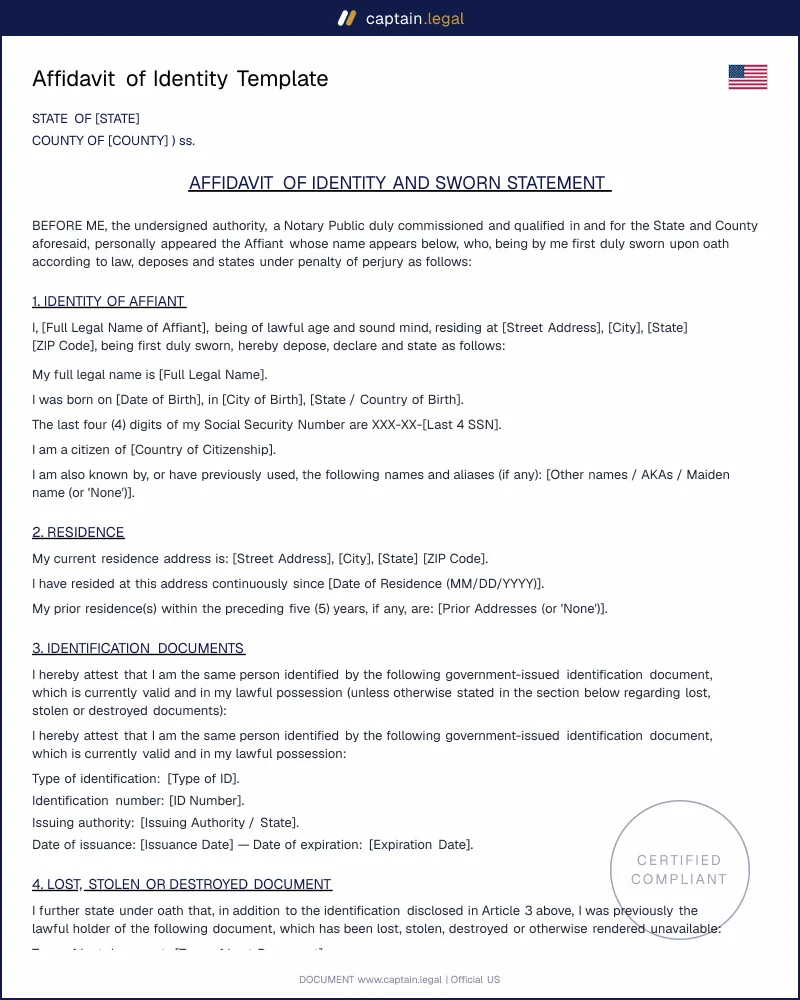
An affidavit of identity is a sworn written statement in which an individual confirms, under penalty of perjury, who they are, where they live, and the truth of facts within their personal knowledge. American banks, courts, motor vehicle agencies, schools, and consulates routinely demand one when a passport is lost, when a name on a deed does not match a driver's license, or when an heir must prove they are the person named in a will. It is also the workhorse document behind countless administrative filings: lost-title applications at the DMV, identity verification for USCIS petitions, and one-and-the-same affidavits for property records. This template produces a notary-ready sworn statement you can sign before any commissioned notary public in the United States, with the optional unsworn-declaration language authorized by 28 U.S.C. §1746 for filings where notarization is not strictly required.
Compliant
2026 Legislation
50,000+ clients
trust us
Affordable
From $4.90 / doc
Secure payment
Instant download
Sworn Statement of Identity | Lost ID, Name Discrepancy, Probate
Secure payment
What is an affidavit of identity?
An affidavit of identity is a written declaration sworn to before a notary public, in which the affiant (the person making the statement) asserts personal facts: full legal name, any prior or alternate names, date of birth, current and prior addresses, and the specific facts the receiving institution needs to verify. The signature is paired with a notarial jurat, meaning the notary witnessed the affiant raise their right hand, take an oath, and sign in their physical presence after presenting government identification. The jurat is what distinguishes a sworn affidavit from an ordinary acknowledged signature, and it is what gives the document evidentiary weight in court.
The label can be misleading. Practitioners use affidavit of identity, identity affidavit, sworn statement of identity, affidavit of one and the same person, and affidavit of name almost interchangeably, depending on the receiving agency. The substance is the same: a jurat-style sworn statement attesting to who you are and, where relevant, to a specific fact such as the loss of a document, the consistency of two name variants on different records, or your relationship to another individual. Unlike an identity-related document like a Power of Attorney, an affidavit does not grant authority to anyone ; it merely puts facts on the record under oath, with criminal exposure if those facts are false.
Legal framework
Affidavits in the United States sit at the intersection of state notarial law and federal evidentiary rules. There is no single national statute defining an affidavit of identity, but its enforceability rests on three pillars. The first is the state notary code where the document is executed: California's Government Code §8202, Texas's Government Code Chapter 121, Florida's Statutes Chapter 117, and New York's Executive Law §135 all require personal appearance, satisfactory evidence of identity (typically a current government photo ID), and the administration of an oath or affirmation. A jurat signed without these elements is voidable, and a defective notarial certificate has been treated as fatal by appellate courts in property and probate matters.
The second pillar is the federal substitute created by 28 U.S.C. §1746, which allows an unsworn declaration under penalty of perjury to stand in for a notarized affidavit in most federal proceedings. The statutory wording must be substantially this: "I declare under penalty of perjury that the foregoing is true and correct", with the additional phrase "under the laws of the United States of America" when the declaration is signed abroad. The IRS, USCIS, and federal courts accept §1746 declarations in lieu of notarized affidavits for routine filings, but you can find a full reference in the Cornell Legal Information Institute summary of 28 U.S.C. §1746 unsworn declarations. State-level filings, by contrast, almost always require formal notarization ; DMVs, county recorders, and probate clerks will reject a §1746 declaration where a notarized affidavit is mandated.
The third pillar is 18 U.S.C. §1621 (federal perjury) and its state counterparts. A knowingly false statement in an affidavit of identity is a felony in every American jurisdiction, with sentences ranging from one year to five years in federal court. This criminal exposure is what gives the affidavit its persuasive force ; it is also what makes our personal legal document templates collection more than a simple form-fill exercise. The wording matters, and so does the signing ceremony.
When do you need this document?
The most common trigger is a mismatch between two official records: a passport spelled one way, a Social Security card spelled another, and a closing agent who refuses to record a deed until the discrepancy is cured. An affidavit of one and the same person solves this in an afternoon, where reissuing the underlying document would take months. The second frequent scenario is loss or theft of a primary identification document, particularly when applying for a replacement passport at a State Department acceptance facility or a duplicate vehicle title at the DMV. The affidavit replaces the missing record by establishing, under oath, that the affiant is the person originally identified on it.
Probate and estate administration generate a third category. Heirs and executors are routinely asked to swear to their identity and to their relationship to the decedent before a bank will release accounts or a registrar will transfer shares. The affidavit dovetails with the Last Will and Testament template covering all 50 states, forming the evidentiary chain that moves an estate from petition to distribution. Immigration filings are a fourth driver : USCIS petitioners frequently submit identity affidavits to corroborate a primary record that is missing, defective, or issued in a foreign script.
The remaining cases are scattered but real. Voter-registration challenges, school enrollment without a birth certificate, change-of-name confirmations after marriage or divorce, lost-stock-certificate replacement, and consular registration abroad all routinely require a sworn identity statement. One edge case worth flagging : if the affidavit is destined for use in a foreign country, the notary's seal will usually need an apostille from the Secretary of State of the state of execution, and in non-Hague countries a full chain of consular legalization.
Key clauses included in our template
- The caption and venue open the affidavit with the full state and county of execution, formatted to match the local notary statute. Several states (notably New York and Illinois) treat a missing or incorrect venue line as a fatal defect, even where the rest of the document is properly notarized. Our template populates the venue automatically based on the state you select.
- The affiant identification block lists the full legal name as it appears on the primary government photo ID, the date of birth, the current residential address, and a recital that the affiant is over eighteen and competent to make the declaration. Where the affidavit is a one-and-the-same statement, this block also lists every prior or alternate name being reconciled, with the document on which each appears.
- The statement of personal knowledge is the substantive heart of the document. Each fact is stated in the first person, in short numbered paragraphs, with a recital that the affiant has direct personal knowledge of the matter sworn to. This phrasing tracks Federal Rule of Evidence 602 and the parallel state rules on competence to testify.
- The purpose recital identifies the agency or transaction for which the affidavit is being prepared. A passport replacement affidavit, a DMV title affidavit, and a probate affidavit are not interchangeable, and naming the purpose closes off later challenges that the document was drafted for a different proceeding.
- The penalty-of-perjury clause is drafted in two flavors. For notarized execution, the language tracks the jurat required by the relevant state notary code. For unsworn execution under 28 U.S.C. §1746, the template inserts the exact federal wording, with the "under the laws of the United States of America" phrase activated when the affidavit is signed outside the United States.
- The signature, notarial certificate, and seal block is laid out so the notary has clear space for the certificate, commission number, expiration date, and seal impression. Our template uses the Uniform Acts on Notarial Acts short-form jurat as default, with state-specific overrides for California, Texas, Florida, and New York where the form language is statutorily prescribed.
State-specific considerations
California. California requires the jurat prescribed by Civil Code §1189 and Government Code §8202, with the specific "subscribed and sworn to (or affirmed)" language and the thumbprint requirement for any affidavit affecting real property recorded in the county. The notary must also enter the act in a sequential journal under Government Code §8206, and you should expect to present a current driver's license, passport, or military ID ; a credit card photo is not satisfactory evidence. Where the affidavit replaces a lost vehicle title, the DMV's REG 227 and REG 5 forms layer their own identity declarations on top of the general affidavit.
Texas. Texas affidavits are governed by Government Code Chapter 121 and the Texas Notary Public Manual issued by the Secretary of State. The jurat must include the venue, the date, the signer's printed name, the notary's signature, the seal, and the commission expiration date. Texas also recognizes the unsworn declaration under Civil Practice and Remedies Code §132.001, which mirrors the federal §1746 mechanism and is now accepted in most state-court filings. Texas DMV title transfers require the wet-ink notarized version ; a §132.001 declaration will be rejected.
Florida. Florida's Statutes §117.05 sets the form of the jurat and requires the notary to verify identity by personal knowledge or by a satisfactory ID listed in §117.05(5). Florida is one of the states that permits remote online notarization under §117.201, which is useful when the affiant is out of state at the time of signing. Probate affidavits routed to a Florida circuit court must include the date of birth and the last four digits of the Social Security number under Probate Rule 5.030, a quirk that catches many out-of-state practitioners.
New York. New York affidavits are notarized under Executive Law §135 and Real Property Law §309-a. The venue line must state the county in which the oath was administered, not the county in which the affiant resides, and the notary's stamp must include the commission's expiration date and the county of qualification. New York courts strictly enforce the requirement that the affiant appear in person before the notary ; recent appellate decisions have voided affidavits where remote notarization rules were not precisely followed during the COVID-era temporary authorizations, and the standard rule has now returned to in-person appearance for most filings.
How to fill out this affidavit of identity
You begin by selecting the state where the affidavit will be signed, which sets the venue line, the jurat wording, and the notary block format to the local statutory requirements. The template then asks for the affiant's full legal name exactly as printed on the primary government identification, followed by date of birth, current residential address, and any prior addresses the receiving agency has asked you to disclose. If the affidavit is a one-and-the-same statement, the next screen lets you list each name variant alongside the document on which it appears, generating the cross-reference paragraph automatically.
You then choose the purpose of the affidavit from a short list of common scenarios: lost identification, name discrepancy, probate verification, USCIS submission, or a free-text "other" field that lets you draft the substantive recitals yourself. The template offers suggested wording for each scenario, drawn from accepted agency practice, which you can edit before generating the final document. The last screen handles execution: you select between a standard notarized jurat and a 28 U.S.C. §1746 unsworn declaration, and the template adjusts the closing block accordingly. You download the affidavit as a Word file for last-minute edits and as a print-ready PDF for the notary appointment, which you can find alongside other individual sworn declaration and consent templates in the personal category.
Common mistakes to avoid
The most frequent error is signing the affidavit before arriving at the notary's office. A jurat is a sworn act, which means the signature must be witnessed live ; a pre-signed affidavit must be re-signed in the notary's presence, and many notaries will simply refuse the work rather than print a fresh page. The second recurring mistake is presenting an expired or non-photo identification document. Most state notary codes require an unexpired government-issued photo ID, and expired passports, expired driver's licenses, or non-photo Social Security cards are rejected as a matter of course. The third pitfall is venue confusion : the affidavit must state the county where the notarization occurs, not where the affiant lives or where the affidavit will ultimately be filed.
A fourth, subtler error is conflating notarization formats. Substituting an acknowledgment for a jurat (or vice versa) is a fatal defect that title companies, probate clerks, and DMVs all catch. An acknowledgment certifies that the signer voluntarily executed the document ; a jurat certifies that the signer swore to the truth of its contents under oath. Affidavits require the jurat, full stop. The fifth mistake is overreach in the substantive recitals : an affidavit of identity should swear only to facts within the affiant's personal knowledge. Throwing in legal conclusions, hearsay statements about third parties, or speculation about future events weakens the document and exposes the affiant to perjury charges on statements they could not actually verify. Our business and corporate document templates collection treats this distinction the same way for corporate verifications.
Frequently Asked Questions
28 verified reviews · 50 000+ downloads
- Immediate access to the document
- PDF + Word download
- Compliant with 2026 legislation
- Reviewed by lawyers
You might also like