A bill of sale is the short, signed record that makes a private transfer of property real in the eyes of a court, a state DMV, or a tax assessor. It names the seller and the buyer, identifies what changed hands, fixes the price and the date, and locks in the "as-is" condition that protects the seller after the keys, the title, or the deed of gift leave the driveway. American practice uses the same instrument for three very different transactions: the vehicle bill of sale that a DMV will demand at registration, the boat bill of sale that pairs with a Coast Guard or state title, and the general bill of sale for furniture, equipment, livestock, firearms, or any tangible item sold between private parties. Buyers want it for proof of ownership ; sellers want it because "sold as-is, where-is" in writing is the line that ends most post-sale arguments.
Compliant
2026 Legislation
50,000+ clients
trust us
Affordable
From $4.90 / doc
Secure payment
Instant download
Bill of Sale Template (DMV-Ready) | Vehicle, Boat, Personal Property
Secure payment
What is a bill of sale?
A bill of sale is a written instrument that documents the transfer of personal property from one private party to another in exchange for consideration, typically money. It is not a title and it does not replace one : for any titled asset (cars, motorcycles, RVs, trailers over a certain weight, boats, outboard motors above a state-set horsepower), the certificate of title is still the document that conveys legal ownership, and the bill of sale is the proof of the transaction that supports the title transfer at the DMV or the Department of Natural Resources. For untitled property, the bill of sale is often the only paper trail that exists, which makes it the primary evidence of ownership if the item is later lost, stolen, repossessed, or claimed in a dispute.
Practitioners distinguish three flavors. A general bill of sale handles tangible personal property without a title scheme: a couch, a tractor, a pair of horses, a used laptop, a private-party firearm transfer where state law allows it. A vehicle bill of sale adds the Vehicle Identification Number, the odometer reading, and the federal odometer disclosure language required for any car under ten years old. A boat bill of sale lists the Hull Identification Number, the year and make of the hull, and (where applicable) the engine serial numbers for trailered outboards. The structure is the same ; the data fields and the warranty language differ, and so do the filing requirements at the receiving agency.
Legal framework
The bill of sale has no single federal statute behind it for most transactions. It is governed primarily by Article 2 of the Uniform Commercial Code, adopted in some form by every state, which sets the default rules for the sale of goods between private parties : the passage of title at delivery (UCC §2-401), the implied warranties of merchantability and fitness (UCC §§2-314, 2-315) and the seller's right to disclaim them in writing through clear "as-is" or "with all faults" language (UCC §2-316). Most disputes between private buyers and sellers turn on those provisions, not on a special state statute. Once a bill of sale is signed and the goods are delivered, the buyer carries the risk of latent defects unless the seller actively concealed them or made a written promise that survives the closing.
For motor vehicles, federal law overlays the contract. The Truth in Mileage Act and its implementing regulations at 49 CFR Part 580 require the seller of any vehicle under ten years old to provide a written odometer disclosure to the buyer at the time of transfer, signed by both parties, stating the actual mileage and whether it is accurate, exceeds mechanical limits, or is not the actual mileage. The same regulation allows the disclosure to be incorporated directly into the bill of sale rather than issued as a stand-alone form, which is the format most DMVs now prefer. Failure to comply with §580.5 exposes the seller to civil penalties and, in cases of intentional rollback, criminal liability under 49 U.S.C. §32705. The federal text and the underlying authority are summarized on the Cornell Legal Information Institute page on the federal odometer disclosure rule.
State law fills in the rest. Some states require the bill of sale to be notarized for vehicle transfers (Louisiana, West Virginia, Nebraska, Montana, and a handful of others). Most states require the odometer disclosure on the back of the title itself in addition to the bill of sale, and a growing number now run electronic odometer disclosures through their DMV portals under 49 CFR §580.6. Boats follow a parallel track : the Federal Boat Safety Act and Coast Guard documentation rules govern federally documented vessels, while smaller hulls follow state titling statutes.
When do you need this document?
The most common trigger is a private-party vehicle sale. Whenever a car, truck, motorcycle, RV, or trailer changes hands outside a dealership, the buyer needs a bill of sale to register the vehicle, the seller needs it to release liability to the state DMV, and both parties need it to handle the sales tax question. A handshake and a signed-over title work in theory ; in practice, the DMV clerk will ask for the bill of sale at the counter and the state tax department will assess use tax based on the price written on it. Skipping the document means the buyer has no protection if the seller's check to pay off the lien bounces, and the seller stays exposed to parking tickets, toll violations, and accident liability accrued by the new owner before the title clears.
The second scenario is boat and trailer transfers, where states like Florida, Texas, and Michigan run separate titling systems for hulls and outboards and will reject a registration application that does not include a dated bill of sale with the Hull Identification Number. The third is gifts of titled property between family members, where a "gift bill of sale" showing zero consideration is what most DMVs accept to waive sales tax. Be careful here : a zero-dollar bill of sale for a vehicle that obviously has market value will trigger a state-assessed book value tax in many jurisdictions unless the transfer qualifies as a family exemption.
Beyond vehicles, the document is used for estate liquidations and probate sales (an executor selling decedent's tangible property to a buyer outside the family), for business asset sales where a buyer purchases equipment, inventory, or a tool collection without an entire-business deal, and for private firearm transfers in states that recognize them. One edge case worth flagging : sales of livestock in states with brand inspection laws (Colorado, Wyoming, Montana, Idaho) require a bill of sale that meets the brand board's format, and a generic template can be rejected at the inspection station.
Key clauses included in our template
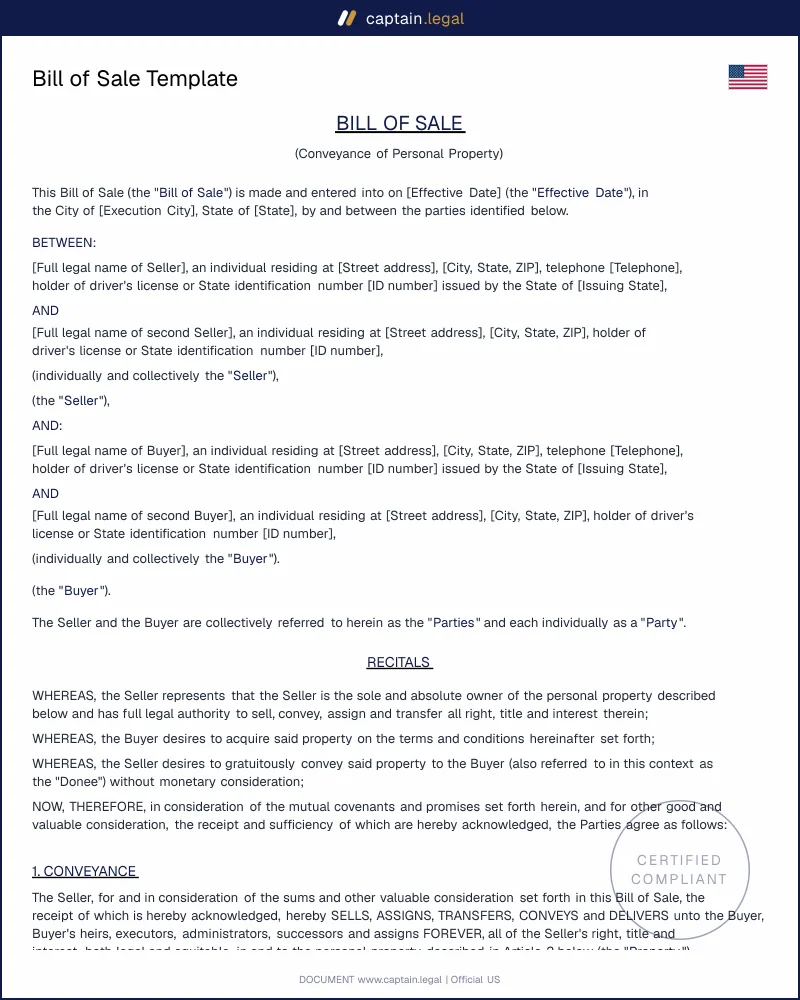
- The identification of the parties lists the full legal name, current physical address, and government-issued ID number of both seller and buyer. The DMV will not accept a bill of sale that uses initials or a business "d/b/a" without the underlying legal entity name, and a missing buyer address is the single most common reason title applications are kicked back at the counter.
- The description of the property is built to the asset type. For vehicles, the template captures the year, make, model, body style, color, Vehicle Identification Number, and current mileage. For boats, it adds the Hull Identification Number, length, hull material, and propulsion type, with a separate block for the outboard motor serial number when the engine is sold with the hull.
- The federal odometer disclosure block is reproduced verbatim from 49 CFR §580.5, including the warning that federal law requires the disclosure and that false statements may result in fines or imprisonment. The template auto-includes this block for any vehicle under ten years old and offers an exempt checkbox for vehicles over the federal threshold, in line with current NHTSA guidance.
- The purchase price and payment terms record the consideration in U.S. dollars, the form of payment (cash, certified check, wire), the date funds were received, and whether the sale is final or contingent on a bank draft clearing. A space for a deposit and the balance due at delivery is included for higher-value items where the buyer needs a few days to arrange financing.
- The "as-is, where-is" warranty disclaimer is the seller's protection. The clause is drafted to the UCC §2-316 safe-harbor language so that the implied warranties of merchantability and fitness are clearly waived. A separate optional clause carves out an express limited warranty if the parties want one (rare in private sales, common in equipment auctions).
- The delivery, title transfer, and signature block records when and where possession changed hands, who is responsible for transport, and a notary acknowledgment block for the states that require it. The template's signature page includes a witness line for jurisdictions where two adult witnesses are accepted in lieu of a notary.
State-specific considerations
California. California treats the bill of sale as a supporting document for the REG 135 and REG 262 forms issued by the DMV. The state's odometer disclosure must be made on the DMV Vehicle/Vessel Transfer and Reassignment Form (REG 262), a controlled secure document, rather than on the bill of sale itself, in compliance with California Vehicle Code §5751. Sales tax is collected by the DMV at registration based on the price written on the bill of sale, and the Board of Equalization may reassess if the declared price is well below Kelley Blue Book. Sales between family members qualify for an exemption only with the REG 256 statement of facts and the matching family relationship code. Boats sold in California fall under the Department of Motor Vehicles Vessel Division and require the BOAT 110 form alongside the bill of sale.
Texas. Texas requires a bill of sale for any vehicle transfer between private parties to support the Form 130-U application for title, with a standard presumptive value assessment by the Texas Department of Motor Vehicles if the declared sale price falls more than thirty percent below SPV. The state recognizes the federal odometer disclosure on the back of the title as sufficient under Texas Transportation Code §501.072, but the bill of sale is still requested for the tax calculation. Texas does not require notarization for the vehicle bill of sale itself, though the title assignment must be signed in front of a notary if the seller is out of state. For trailers under 4,000 pounds gross, the bill of sale alone is enough and no title is issued.
Florida. Florida uses Form HSMV 82050 as its official bill of sale for motor vehicles and vessels, and many county tax collectors will accept either the state form or a properly drafted private bill of sale that contains the same fields. Florida Statute §319.22 governs the title transfer and §328.46 governs vessel transfers ; both require the Hull Identification Number or Vehicle Identification Number, the odometer reading, and the purchase price. Florida assesses a six percent sales tax at the time of registration, plus discretionary county surtax up to one and a half percent. Florida does not require notarization of the bill of sale, but the title signature must be witnessed by two adults or a notary.
New York. New York requires Form DTF-802 (statement of transaction) in addition to the bill of sale when the buyer is registering a used vehicle, with the bill of sale serving as the price evidence for New York Vehicle and Traffic Law §2103. Sales tax is collected at the DMV at the combined state and local rate of the buyer's residence. For boats over fourteen feet, a Form MV-82B and a bill of sale that lists the Hull Identification Number are both required, and outboards above forty horsepower must be titled separately under Navigation Law §2251.
How to fill out this bill of sale
The flow on Captain.Legal starts with the property type. You select vehicle, boat, or general personal property ; the template then loads the right fields and the right federal blocks. For a vehicle, you enter the state where the buyer will register, which conditions the odometer language, the exempt checkboxes, the notarization requirement, and the references to the state-specific DMV form (REG 262 for California, Form 130-U for Texas, Form HSMV 82050 for Florida, DTF-802 for New York). The next screen captures the parties: full legal names, addresses, dates of birth, and ID numbers, with separate blocks for individual sellers, married couples selling jointly titled property, and estates selling decedent's property. From there, the form takes the Vehicle Identification Number or Hull Identification Number, the year, make, model, mileage, and any liens that are being paid off at closing. The payment screen records the consideration, the form of payment, and whether the sale is a gift, which auto-zeros the price field and inserts the family-relationship language where the state recognizes a tax exemption. The final screen handles the warranty: as-is by default with the UCC-compliant disclaimer, or an optional limited warranty clause for buyers who negotiated one. The generated document downloads as both an editable Microsoft Word file and a print-ready PDF, with the signature block, the notary acknowledgment, and the witness lines all formatted for the state you selected. You can find related transfer documents through our catalog of US personal legal templates or pair the bill of sale with a notarized power of attorney for vehicle and property transfers when the seller cannot appear at the DMV in person.
Common mistakes to avoid
The most common mistake is leaving the odometer block blank or rounded. Federal law under 49 CFR §580.5 requires the exact reading, not "approximately 85,000", and a buyer who later sues for fraud will use that imprecision as evidence of a rollback. The second mistake is the "as-is" clause that says only "as-is". Plain words are not enough under UCC §2-316: the disclaimer must clearly mention merchantability and be conspicuous, which usually means bold or all caps in a visible position. The third is the handwritten amendment after signing, which voids the document in most jurisdictions unless both parties initial the change with the date next to each correction. The fourth is failing to keep a signed copy for the seller, leaving the seller with no proof of the as-is disclaimer if the buyer files a small-claims action three months later.
The fifth and most expensive mistake is the gift bill of sale that misstates the consideration. Writing "$1" or "$100" for a vehicle clearly worth ten thousand triggers a use-tax recalculation by the state at book value in California, Texas, Florida, and New York, and may constitute tax fraud if the auditor finds the underlying transfer was actually for full price. If the transaction is genuinely a gift, the template writes "$0.00 — bona fide gift between family members" and pairs it with the state-specific exemption form. If money actually changed hands, declare it accurately ; the audit risk on an underdeclared private-party vehicle is rising in every state with an SPV system. Captain.Legal users handling more complex transfers between family members often pair the bill of sale with a last will and testament template valid in all 50 states to ensure the larger estate plan is consistent. For ongoing business sales of inventory or equipment, the non-disclosure agreement template for confidential business transactions is a useful companion when buyer and seller exchange financial details before closing.
Frequently Asked Questions
32 verified reviews · 50 000+ downloads
- Immediate access to the document
- PDF + Word download
- Compliant with 2026 legislation
- Reviewed by lawyers
You might also like