Create my document
Login

Choose country

FranceBelgiqueEspañaUnited StatesUnited KingdomMarocDeutschlandItaliaSchweiz
Family & Divorce

Marital Settlement Agreement: State-Compliant MSA

Lawyer-structured marital settlement agreement built to the UMDA standard and your state family code, incorporated into the divorce decree. Word and PDF.
4.8/551 reviews50 000+ downloadsInstant download
Share

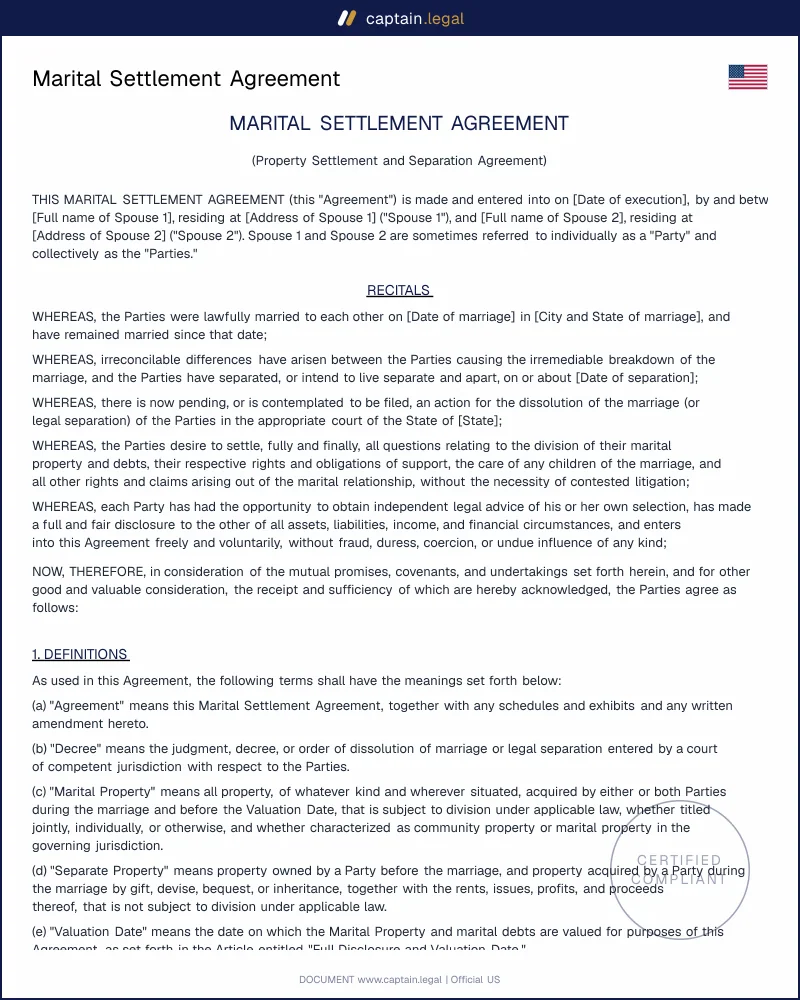
A marital settlement agreement (often called a divorce settlement agreement or MSA) is the written contract two spouses sign to resolve every financial and parenting question their divorce raises, in a single document a court can approve and enforce. It is the backbone of an uncontested or settled divorce: property division, debt allocation, spousal support, and child-related terms all live in one place, drafted to the language your state court expects. Couples who agree on the substance still need the paperwork done right, because the judge does not simply rubber-stamp a handshake. This template gives you a court-ready core agreement you can tailor to your state and your county's filing rules, then download as Word for editing and PDF for signing.

Compliant

2026 Legislation

50,000+ clients

trust us

Affordable

From $4.90 / doc

Secure payment

Instant download

Marital Settlement Agreement: State-Compliant MSA

Secure payment · No subscription

Fill in the template

What is a marital settlement agreement?

A marital settlement agreement is a binding contract between divorcing spouses that memorializes how they will divide their marital estate, handle joint debts, address spousal and child support, and arrange custody and parenting time. It is the instrument that converts a negotiated understanding into terms a court can incorporate into the final judgment of dissolution or divorce decree. Once incorporated, the agreement carries the force of a court order, which means a breach can be enforced through contempt and other post-judgment remedies rather than an ordinary breach-of-contract suit.

People use several names for the same instrument, and the label depends on where you file. California and many other states call it a marital settlement agreement; some jurisdictions speak of a stipulated judgment, a property settlement agreement, or simply a separation agreement when the couple is not yet filing for divorce. The distinction that actually matters is timing and integration. A separation agreement governs life while spouses live apart and may or may not survive into the divorce. An MSA is built to be merged into the dissolution judgment itself. Drafting one as if it were the other is a frequent and costly error, because an agreement meant to be incorporated must speak in the operative language a judge can adopt verbatim. Our template is structured for incorporation, with defined terms, recital clauses, and signature blocks that read like real court-ready paperwork rather than an informal letter between spouses. If your situation is pre-filing, the related separation agreement and cohabitation documents cover that earlier stage.

2

When do you need this document?

The clearest trigger is an uncontested or settled divorce, where both spouses have reached agreement and need that agreement in a form the court will adopt. Here the MSA is the centerpiece of the filing, sparing you a contested trial and the legal fees that come with it. The second common scenario is a divorce that started adversarial and settled along the way, often after mediation. The mediated terms get reduced to a formal MSA so the judge can incorporate them into the decree.

A third situation is the high-asset or business-owner divorce, where the substance is agreed but the drafting carries real risk. Dividing a closely held business, allocating stock options and deferred compensation, or tracing separate property mixed with marital funds all demand precise language, and a generic template fixed without thought invites later litigation. Retirement accounts are the single most common place couples get hurt by sloppy drafting, because moving a 401(k) or pension share requires a separate QDRO and the MSA must set that up correctly. A fourth scenario involves spouses who want privacy. In states like Texas, an agreement incident to divorce lets a couple keep the financial details out of the public decree while still binding the court.

One edge case worth flagging: where one spouse is active-duty military, the Servicemembers Civil Relief Act and the Uniformed Services Former Spouses' Protection Act add layers that a standard MSA does not address on its own. Another is when minor children receive federal benefits, which can change how support and the dependency exemption should be written. For the contractual mechanics that underpin any settlement, our general contract and agreement templates show how enforceable terms are structured.

3

Key clauses included in our template

  • The recitals and identification of the parties open the agreement by naming both spouses, the date and place of marriage, the date of separation, and each minor child by initials and birth year. Courts read this section first to confirm jurisdiction, and a missing separation date can complicate the characterization of property acquired during the breakup.
  • The division of property and assets allocates the marital home, vehicles, bank and investment accounts, and personal property with enough specificity that no later dispute can arise over who got what. In community property states the clause should confirm the 50/50 starting frame or document the parties' agreed departure from it; in equitable distribution states it records a division the court can find fair.
  • The debt allocation assigns mortgages, credit cards, auto loans, and tax liabilities, and includes a hold-harmless and indemnification provision so that if one spouse fails to pay a debt assigned to them, the other has a contractual remedy. An assignment of debt does not bind the original creditor, so the clause is drafted to protect the non-paying spouse's ex from third-party collection.
  • The spousal support (alimony) clause sets amount, duration, and termination events such as remarriage, cohabitation where state law recognizes it, or death, and addresses whether support is modifiable or non-modifiable.
  • The child custody, parenting time, and child support provisions track the best interests standard and the applicable state guideline formula, covering legal versus physical custody, a holiday and vacation schedule, health insurance, uncovered medical costs, and the QDRO mechanics for any retirement division.
4

State-specific considerations

California is a community property state, so the agreement starts from a presumption that property and debt acquired during the marriage are divided equally. California Family Code sections 3580 through 3593 authorize the settlement and confirm the court may incorporate it into the judgment. California also imposes mandatory financial disclosures through the preliminary and final declarations of disclosure, and an MSA signed without them is vulnerable to being set aside. Spousal support in marriages of long duration carries no automatic cutoff, so the duration clause deserves close attention. The state's just-cause and guideline child support rules mean a clause purporting to waive support for a child will not survive review.

Texas is also a community property state, but it routes settlement through the agreement incident to divorce under Texas Family Code section 7.006. The terms become binding once the court finds them just and right, and a couple may keep the agreement out of the public decree by incorporating it by reference. Texas does not favor long-term alimony; court-ordered spousal maintenance is capped by statute in both amount and duration, so most support in Texas settlements is contractual rather than court-ordered, which changes how the clause should be drafted and enforced.

New York is an equitable distribution state, meaning marital property is divided fairly rather than automatically in half. New York requires a Statement of Net Worth and treats the MSA, called an opting-out agreement under Domestic Relations Law section 236(B)(3), as enforceable only if it is in writing, subscribed, and acknowledged in the form required for a recordable deed. That acknowledgment requirement is strict, and New York courts have voided agreements that skipped it. Maintenance in New York follows a statutory advisory formula that the agreement can depart from with clear language.

Florida is an equitable distribution state with no permanent alimony following recent reform, so duration clauses must reflect the current durational framework. Florida requires financial affidavits and applies its own child support guidelines under Florida Statutes chapter 61, and the parenting plan must conform to the state's specific statutory elements or the court will not approve it.

5

How to fill out this marital settlement agreement

You begin by selecting the state where the divorce will be filed, because that single choice drives the property regime, the support framework, and the statutory language the document uses. From there the form walks you through identifying both spouses, the marriage and separation dates, and any minor children, then moves into the financial sections. You enter the assets to be divided and indicate who receives each, and the template adjusts its property language to the community property or equitable distribution rules of your state. The debt section mirrors this, letting you assign each obligation and attach the hold-harmless protection automatically.

For couples with children, the form opens the custody and support modules, where you set legal and physical custody, build the parenting time schedule, and enter the figures your state's guideline calculation requires. The spousal support section lets you choose amount, duration, and termination triggers, and flag whether the support is modifiable. When you reach retirement accounts, the template prompts you to note that a separate QDRO will follow. You then review the full draft, confirm the recitals and signature blocks match your county's filing expectations, and download in Word to make final edits or PDF to sign before a notary where your state requires acknowledgment.

6

Common mistakes to avoid

The most damaging mistake is treating an MSA as a private memo rather than an instrument written for a judge. Vague phrasing such as "the parties will divide the accounts fairly" or timelines like "as soon as possible" invite exactly the conflict the agreement was meant to prevent, and a court may decline to enforce terms it cannot read with precision. A close second is the assumption that two consenting adults can write anything they like. Parents in most states cannot waive child support in a way that harms the child, and a clause that does so will be struck even when both spouses signed it willingly and amicably.

Couples also stumble on the difference between dividing an asset and actually transferring it. Naming who keeps the 401(k) does nothing until a QDRO is drafted and accepted by the plan administrator, and the same gap appears with real estate where a quitclaim deed and refinance are needed to match the paper division. People forget that assigning a joint debt to one spouse does not release the other in the eyes of the lender, which is why the hold-harmless clause matters. Finally, many filers skip their state's mandatory financial disclosures, the single fastest way to have an otherwise sound agreement set aside months after the divorce is final. Reviewing the full library of family and personal legal templates helps confirm you have every companion document the filing requires.

Key takeaways

Role

Your MSA becomes the court’s playbook

A marital settlement agreement is the written contract that captures every deal point in a divorce: property division, debt allocation, spousal support, and child-related terms. When the judge incorporates it into the final divorce decree, it carries the force of a court order. That changes enforcement: a breach can trigger contempt and other post-judgment remedies, not just a standard contract dispute.

Drafting

Do not confuse an MSA with separation terms

A frequent and expensive mistake is drafting a separation agreement as if it were an MSA. A separation agreement may govern the period while you live apart and may or may not carry into the divorce. An MSA is designed to be merged into the dissolution judgment, so it must use court-adoptable language, clear defined terms, and proper signature blocks that a judge can incorporate verbatim.

State law

Compliance is state-specific and reviewed for fairness

Divorce settlements are governed by state family law, not federal rules, so “compliant” means matched to the state where you file. Many states follow the UMDA approach, where a court generally upholds the parties’ agreement unless it is unconscionable. Some states also spell out the authority to incorporate settlements, such as California Family Code sections 3580 through 3593 and Texas Family Code section 7.006.

Frequently Asked Questions

Yes, once it is properly executed and the court incorporates it into the final divorce judgment, a marital settlement agreement carries the force of a court order. Before incorporation it is an enforceable contract between the spouses, but the real power comes from the decree, which lets you enforce a breach through contempt rather than a separate lawsuit. A judge can still refuse to adopt terms found unconscionable under the Uniform Marriage and Divorce Act standard many states follow, or terms that fail the best interests of the child test. Proper signatures, full financial disclosure, and clear language are what make the agreement stick.

You can download the marital settlement agreement in both Word and PDF. The Word version is meant for editing, so you can adjust clauses, insert county-specific language, or refine the parenting schedule before finalizing. The PDF is the clean, print-ready version you sign, notarize where your state requires it, and file with the court. Most couples keep the Word file as a working draft and use the PDF as the executed copy. Having both formats means you are not locked into one stage of the process, whether you are still negotiating or ready to file.

Timing depends entirely on your state and county, not on the document itself. After you file a signed MSA in an uncontested divorce, many states impose a mandatory waiting period before the judge can enter the final decree, commonly several weeks to a few months from the date the petition was served. California, for example, requires six months from service before a divorce is final, while other states are faster. The court reviews the agreement for fairness and statutory compliance during that window, so a clean, complete document moves through faster than one the judge sends back for revision.

No state requires both spouses to retain attorneys for a settlement agreement to be valid. That said, independent representation makes the agreement far harder to challenge later, because a spouse who had their own counsel cannot easily argue the terms were signed under duress or without understanding them. For high-asset divorces, business interests, or complex QDRO arrangements, having a lawyer review the draft is prudent even when the couple agrees on everything. The template is built so two cooperating spouses can complete the substance themselves and seek targeted review only where the stakes warrant it.

It depends on which terms you mean. Property division is generally final and non-modifiable once the decree is entered, which is why getting it right the first time matters so much. Child custody, parenting time, and child support remain modifiable when circumstances change substantially, such as a job loss, relocation, or a shift in the children's needs, because courts retain ongoing authority over children. Spousal support may or may not be modifiable depending on how the clause was drafted and your state's law. To change a modifiable term you typically file a motion to modify with the same court that issued the decree.

Yes, the template includes full custody and support modules. You can set legal custody, which governs decision-making, and physical custody, which governs where the children live, then build a parenting time schedule covering school days, weekends, holidays, and vacations. Child support is calculated under your state's guideline formula rather than left to negotiation, since most states will not approve a figure that ignores the guideline. The agreement also addresses health insurance, uncovered medical expenses, and childcare allocation, all measured against the best interests of the child standard the court applies.

Because the agreement is incorporated into a court order, a violation is enforceable through the court that issued the decree. For financial breaches, such as failing to pay support or transfer an asset, you can file a motion to enforce and, in many states, seek contempt sanctions, wage garnishment, or interest on unpaid amounts. The hold-harmless and indemnification clauses give you a contractual remedy if your ex fails to pay a debt assigned to them. Child support enforcement also runs through your state's Title IV-D agency, which has tools like license suspension and tax refund interception that private litigants do not.

4.8/5

51 verified reviews · 50 000+ downloads

Marital Settlement Agreement: State-Compliant MSA
  • Immediate access to the document
  • PDF + Word download
  • Compliant with 2026 legislation
  • Reviewed by lawyers
Fill in the template
Secure payment · No subscription
Updated on June 13, 2026

You might also like

Parenting Plan & Child Custody Agreement
Legal Separation Agreement Template