Create my document
Login

Choose country

United StatesUnited StatesChoose country
Real Estate

Lease Option Template | Tex. Prop. Code 5.062 Ready

Rent-to-own agreement drafted to statute: Texas Property Code 5.062, California Civil Code 2985, Florida Statutes 697.01. Editable Word and PDF, 50 states.
4.7/518 reviews50 000+ downloadsInstant download
Share

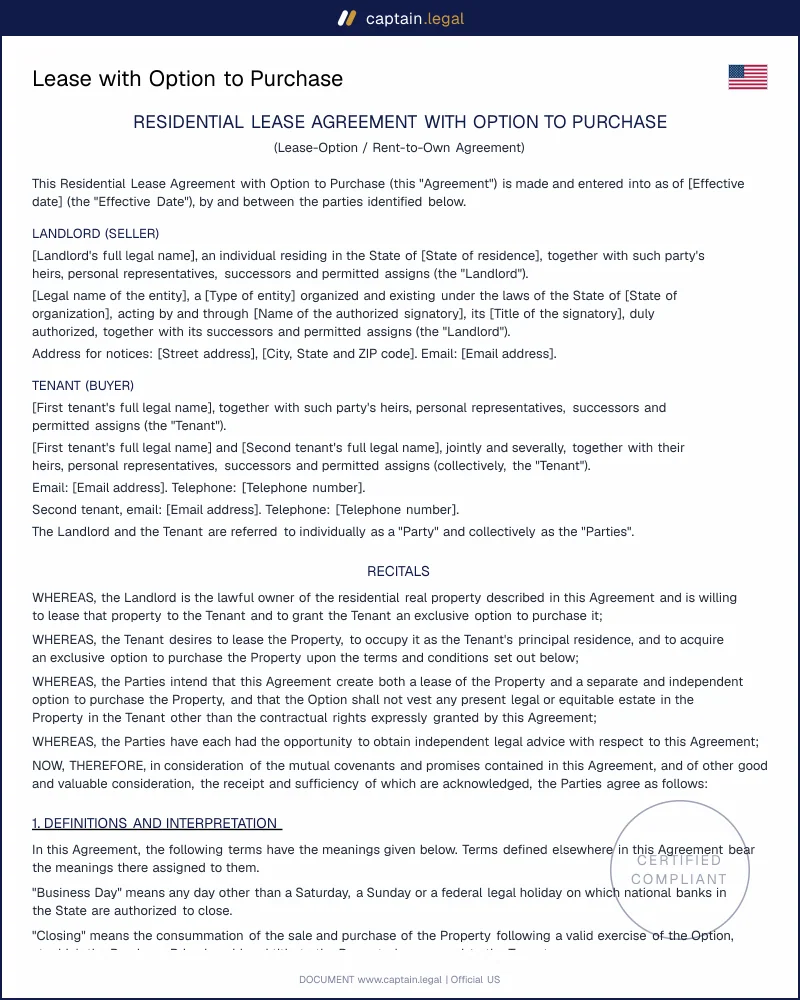
A lease with option to purchase gives a tenant the right to buy the home they are renting, at a price fixed in advance, before a deadline written into the contract. Sellers use it to move a property that has been sitting. Buyers use it to lock a strike price while they season credit, clear a bankruptcy, or finish saving a down payment. The instrument is really two agreements bound together: a residential tenancy governed by state landlord-tenant law, and a unilateral purchase option governed by contract and real property law. This rent-to-own agreement covers both halves, with option fee treatment, rent credit accounting, exercise mechanics and closing terms drafted to the state where the property sits.

Compliant

2026 Legislation

50,000+ clients

trust us

Affordable

From $4.90 / doc

Secure payment

Instant download

Lease Option Template | Tex. Prop. Code 5.062 Ready

Secure payment

Fill in the template

What is a lease with option to purchase?

A lease with option to purchase is a residential lease to which the landlord attaches a standing offer to sell. The option is unilateral: the tenant-buyer may exercise it or walk away when the window closes, while the seller stays bound for the entire term. That asymmetry is why the tenant pays an option fee at signing, separate consideration that keeps the offer irrevocable.

Two neighboring documents get confused with it constantly. A lease-purchase is bilateral: the tenant is obligated to close, and the seller holds a specific performance claim rather than an option. A contract for deed hands over possession and equitable title immediately while the seller keeps legal title as security until the final payment. The remedies diverge sharply. A defaulting optionee loses possession through the landlord-tenant courts; a defaulting installment buyer normally has to be foreclosed. Check the underlying terms against a residential lease agreement template built for all 50 states before layering an option on top, because an option never repairs a defective lease.

2

When do you need this document?

The classic trigger is a buyer who wants the house but cannot get the loan yet. Credit that needs twelve to twenty-four months of clean history, a bankruptcy discharge that has not aged into underwriting guidelines, self-employment income with one year of returns: none of these disqualify a tenant from occupying a home, they only delay the mortgage.

Sellers arrive from the opposite direction. An owner relocating for work who refuses to take a discount, an accidental landlord who inherited a house and dislikes turnover: each gets occupancy, above-market rent and a probable exit without paying a listing commission twice.

Two edge cases deserve attention. Investors sometimes run a sandwich lease-option, taking an option from an owner and granting a sub-option to an occupant, which stacks two sets of statutory duties on one property and usually calls for an entity, so the structure belongs in an LLC operating agreement covering member roles and distributions. The second is the intra-family transfer, where a parent leases to an adult child with an option rather than gifting equity or moving the house into a revocable living trust valid in all 50 states. Texas reads relationships and residency into its executory contract rules, so the family framing simplifies nothing.

3

Key clauses included in our template

  • The option fee clause states the amount, the date it is earned, and whether it credits against the purchase price. It says in terms that the fee is neither a security deposit nor prepaid rent, the most useful sentence in the document when a deposit statute is thrown at the seller.
  • The strike price mechanism offers two paths: a number fixed at signing, or a formula tied to an appraisal ordered before exercise, with a floor. Fixed pricing suits short windows, the formula holds up better across three years.
  • The rent credit schedule sets what portion of each monthly payment accrues toward the price, and what happens to accrued credits when a payment arrives late. Silence here is what turns rent credits into an equity argument in front of a judge.
  • The exercise clause requires written notice, delivered by a named method, before a stated deadline, with time expressly of the essence. It also fixes who orders title work and how long the parties have to close.
  • The closing terms identify the deed, allocate transfer taxes, escrow fees and title insurance, and set the consequences if financing falls through. They sit alongside a full real estate purchase agreement for the sale itself.
  • The maintenance, tax and insurance allocation keeps carrying obligations on the landlord side unless the parties deliberately choose otherwise, with a warning where the shift creates recharacterization risk. A memorandum of option comes with the file, ready to record.
4

State-specific considerations

California treats the option as a real property sales contract under Civil Code section 2985 whenever title will not pass within a year of formation, which covers most rent-to-own deals. Since July 1, 2024, Civil Code section 1950.5 as amended by AB 12 caps the security deposit at one month's rent, with a narrow exception allowing two months for natural-person owners of no more than two residential properties totaling four units. Document the option fee separately or it counts toward that cap. The Tenant Protection Act of 2019 still applies, so just-cause termination under section 1946.2 and the rent cap in section 1947.12 reach a tenant-buyer like anyone else.

Texas is the strictest jurisdiction in the country. An option combined with a residential lease running beyond 180 days becomes an executory contract under Property Code section 5.062(a)(2), triggering Subchapter D: pre-signing disclosures under section 5.069, recording with the county clerk within 30 days under section 5.076, an annual accounting statement under section 5.077, and fee simple title under section 5.085. Violations are actionable under the Deceptive Trade Practices Act, which exposes the seller to treble damages and attorney fees.

Florida applies Part II of Chapter 83 to the tenancy: the deposit procedure of section 83.49 with its 30-day notice of intent to impose a claim and 15-day objection period, and the 30-day termination notice for month-to-month tenancies set by the 2023 amendment to section 83.57. The sale side carries the radon disclosure of section 404.056(5), and the governing risk stays section 697.01, which turns a security-flavored instrument into a mortgage and pushes the seller into foreclosure.

New York layers the Housing Stability and Tenant Protection Act over everything. Deposits are capped at one month's rent by General Obligations Law section 7-108, a rent demand requires 14 days under RPAPL section 711(2), and non-renewal notices under Real Property Law section 226-c run 30, 60 or 90 days by length of occupancy. Where the occupant shows an equitable interest, courts push the landlord out of summary proceedings and into ejectment. Recording a memorandum under Real Property Law section 294 protects the option against intervening liens.

5

How to fill out this lease with option to purchase

You start by selecting the state where the property is located, because that choice reshapes everything after it. The form takes the property description, the parties and the lease term, then sets notice periods and deposit ceilings from the statute rather than a national default. Next comes the option block: option window, option fee and its treatment, strike price or appraisal formula, rent credit rate. In Texas the form flags the 180-day threshold and switches on the Subchapter D disclosure and recording language once the term crosses it. In California it separates the option fee from the deposit line so the AB 12 cap is calculated correctly.

The closing section handles deed type, escrow, prorations and the financing contingency. You then download an editable Word file and a signature-ready PDF, plus a memorandum of option formatted for the county recorder.

6

Common mistakes to avoid

The most expensive mistake is collapsing the option fee, the security deposit and prepaid rent into one payment described loosely in a single sentence. Deposit statutes then swallow the whole amount, and the seller who kept it faces statutory penalties in California and Florida. The second is letting rent credits accrue with no written ledger. When the tenant-buyer eventually claims an equity position, that ledger is the only document that answers them. The third is skipping the recorded memorandum, since an unrecorded option is worth little against a purchaser or lienholder who takes without notice.

Two more come up constantly. Sellers rarely check the due-on-sale clause in their own mortgage, and the safe harbor in 12 U.S.C. 1701j-3 protects only a lease of three years or less that contains no option to purchase. A lease with option to purchase is exactly the transfer that can accelerate the underlying loan. Finally, sellers draft an exercise clause with no delivery method and no hard deadline, then spend two years arguing about whether a text message counted as notice.

Key takeaways

Deal structure

One contract, two legal systems

A lease with option to purchase is not just a rental with a promise. It combines (1) a residential lease governed by state landlord-tenant rules and (2) a unilateral purchase option governed by contract and real property law. If the underlying lease is sloppy, the option will not fix it. Treat rent, maintenance, and default terms like a normal lease, then layer the option on top.

Option terms

The option is unilateral and time-boxed

Only the tenant-buyer gets the choice to buy; the seller stays bound for the full option term. That one-sided commitment is why the tenant typically pays an option fee at signing as separate consideration. The exercise deadline is not flexible in practice. Courts expect a signed writing that clearly identifies the parties, the property, the price, and the exercise date so a judge could order a conveyance if needed.

Recharacterization risk

Too sale-like can trigger mortgage rules

If the economics look like financing, courts may reclassify the deal as an installment sale or equitable mortgage, which can strip the seller of a simple eviction remedy. The excerpt flags three common tripwires: a large option fee, above-market rent, and the tenant paying property taxes and structural repairs. Texas is especially strict: under Texas Property Code 5.062(a)(2), certain lease-options become executory contracts if the deed is not delivered within 180 days.

Frequently Asked Questions

Yes, provided the writing satisfies the Statute of Frauds and the option rests on consideration. Courts want the parties, the property, the purchase price and the exercise deadline identified with enough certainty to be enforced without further negotiation. The option fee supplies the consideration that makes the offer irrevocable for the stated term. A seller who refuses to convey after a valid exercise can be ordered to perform.

Both formats come with every generated document. The Word file stays editable if your closing attorney or title company wants to adjust a clause, and the PDF is formatted for signature with the exhibits and the memorandum of option in the right order. Other tenancy documents in the same formats sit in the US real estate documents and lease agreements catalogue.

Whatever window the contract sets, and courts read that deadline strictly. Most residential options run 12 to 36 months, matched to the lease term so the two do not expire on different dates. Texas is the outlier, because anything beyond 180 days converts the arrangement into an executory contract with its own statutory duties. The exercise clause makes time of the essence and fixes the notice method, which ends the argument about informal notice.

Normally no. The fee buys the right to hold the seller to a fixed price for a defined period, and that right is delivered whether or not the tenant exercises. The template says so expressly and keeps the fee separate from the security deposit, which is refundable under state law and cannot be relabeled. A partial refund can be built in, though it makes the fee look like a deposit on a sale and strengthens a later recharacterization argument.

That depends entirely on the contract, which is why the schedule has to address it directly. A common approach forfeits the credit for any month in which rent arrives after a stated grace period, while leaving previously accrued credits intact. Some sellers prefer full forfeiture after repeated lateness. Either choice is defensible; leaving it blank is not, because untreated credits are the raw material for an equitable interest claim.

Only if the arrangement still reads as a tenancy to the court. Where the tenant-buyer paid a large option fee, accrued significant rent credits, carried the taxes and handled structural repairs, judges in California, Florida and Texas have required foreclosure instead of a summary eviction. Keeping the option fee moderate, the carrying costs on the landlord and the paperwork clean is what preserves the faster remedy.

4.7/5

18 verified reviews · 50 000+ downloads

Lease Option Template | Tex. Prop. Code 5.062 Ready
  • Immediate access to the document
  • PDF + Word download
  • Compliant with 2026 legislation
  • Reviewed by lawyers
Fill in the template
Secure payment
Updated on July 29, 2026

You might also like

Early Lease Termination Agreement
Residential Lease Agreement Template