Personal

Personal Care Agreement | 42 USC 1396p Look-Back Compliant

Caregiver contract drafted to 42 USC 1396p(c): fair market value proof, prospective payment, contemporaneous logs. FL, NY, CA and TX rules. Word and PDF.
4.7/525 reviews50 000+ downloadsInstant download
Share

A personal care agreement is a written contract under which an older or disabled adult pays a family member, friend, or private aide an agreed rate for defined caregiving services. Practitioners also call it a caregiver contract, a personal services contract, or an elder care contract. It exists for one reason above all others. Medicaid treats money moving from a parent to an adult child without paperwork as a gift, and a gift inside the five year look back period buys a penalty period instead of a nursing home bed. Our template is drafted to the transfer of assets rules at 42 U.S.C. section 1396p(c) and to the fair market rate evidence your state agency actually asks for. Word and PDF, all 50 states.

Compliant

2026 Legislation

50,000+ clients

trust us

Affordable

From $4.90 / doc

Secure payment

Instant download

Personal Care Agreement | 42 USC 1396p Look-Back Compliant

Secure payment

Fill in the template

What is a personal care agreement?

Strip away the family context and a personal care agreement is an ordinary services contract: one side promises defined work, the other promises defined pay. What makes it distinctive is who signs it. The caregiver is usually a relative who would have done the same work for free, and the payer is someone whose Medicaid application will one day be read line by line by a state eligibility worker.

Several names circulate for the same instrument. Personal services contract is the phrase Florida caseworkers recognize, caregiver agreement dominates New York practice, and life care contract signals a prepaid version rather than pay as you go. None of them is a power of attorney. A caregiver contract buys labor; a durable power of attorney for finances grants legal authority to act for the principal. Families usually need both, because the person receiving care often cannot sign the contract that pays for their care. Where the agent is also the proposed caregiver, that conflict has to be resolved on the face of the document.

2

When do you need this document?

The classic trigger is a diagnosis. A parent comes home from the hospital needing help with bathing, medication, and transport, one adult child cuts back to part time work, and the family starts moving money informally. That phase is the dangerous one, because those transfers already sit inside the look back window with nothing on paper to explain them. The second trigger is a spend down: an applicant holds savings above the state asset limit, and a properly priced contract converts countable cash into paid for services rather than a penalized gift. Sibling politics drive the third: an hourly rate and a service log settle the inheritance argument before the estate is opened.

Two edge cases are worth flagging. A caregiver already paid through a state consumer directed program cannot bill the same hours twice, so the private contract has to cover services outside the authorized plan of care. And when the recipient lives in a nursing facility, the agreement must be built around advocacy and outside appointments, because paying a relative for services the facility is already licensed to provide is the fastest route to a denial.

3

Key clauses included in our template

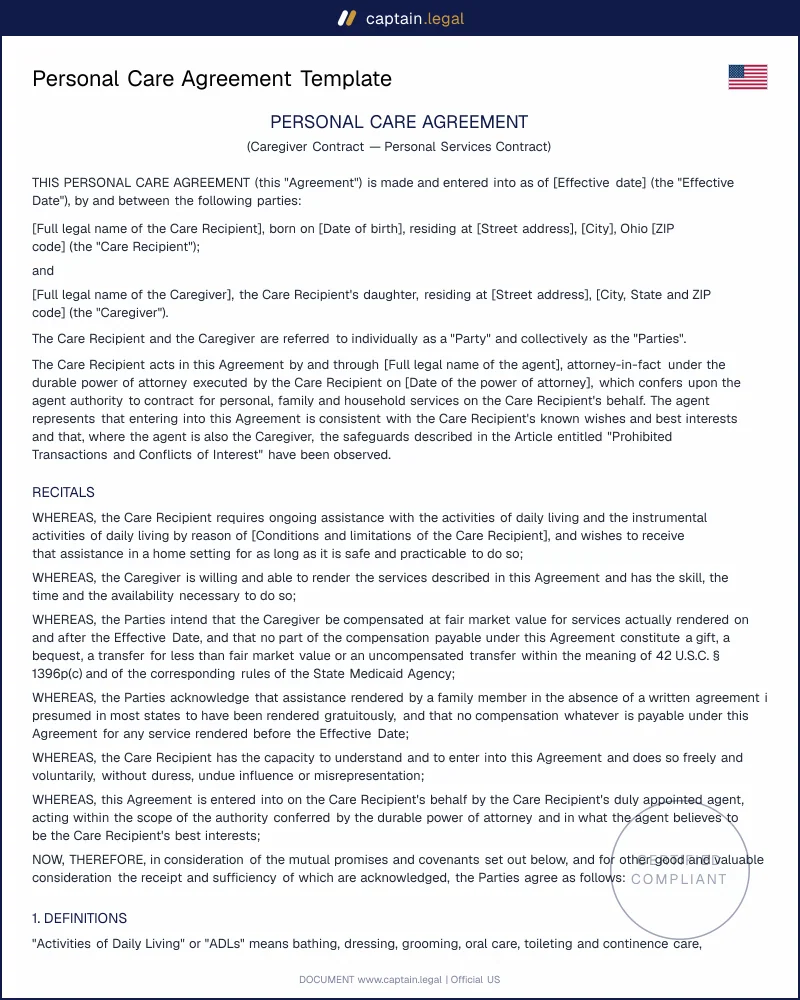
  • The identification and capacity of the parties names the recipient and each caregiver and records how the recipient signs. Where an agent signs under a power of attorney, the template adds the authority recital and, if that agent is also the caregiver, an independent approval mechanism.
  • The scope of services breaks care into activities of daily living, instrumental activities, and advocacy tasks such as attending medical appointments or managing bills. Drafting like "general assistance" is replaced by itemized duties, because a caseworker prices duties.
  • The compensation clause states an hourly figure supported by a named benchmark, usually a local agency quote or county wage data, and records how the rate was set so the file carries its own evidence.
  • The schedule and payment terms fix weekly hours and a payment cycle, and state that no payment covers services rendered before the effective date.
  • The recordkeeping clause obliges both parties to keep a contemporaneous log of dates, hours, and tasks. This single clause decides more Medicaid applications than every other provision combined.
  • The medical information clause authorizes the caregiver to receive protected health information, which normally needs a companion HIPAA authorization for release of medical records before a hospital will cooperate.
4

State-specific considerations

Florida is the friendliest jurisdiction for this planning. The Fourth District Court of Appeal upheld a lifetime caregiver contract in Thomas v. Department of Children and Families, 707 So. 2d 954 (Fla. 4th DCA 1998), and the Department still accepts prepaid lump sum contracts priced against its own life expectancy tables. The ESS Policy Manual sets the look back at 60 months in section 1640.0608 and values support and services in section 1640.0614.04. Get the actuarial math wrong and the excess is recharacterized as a gift, so the term must never exceed the tabled life expectancy.

New York applies the federal 60 month look back to nursing facility coverage through 18 NYCRR section 360-4.4. The separate 30 month look back for community based long term care, authorized by Part DD of Chapter 56 of the Laws of 2020 and codified at Social Services Law section 366(5), reaches transfers made on or after October 1, 2020 but has never been enforced, since the state still lacks the federal waiver and state plan approvals. Treat that delay as temporary. Local districts are strict about contemporaneous logs and reject reconstructed timesheets.

California rewrote its rules twice in quick succession. Medi-Cal removed the asset test for non-MAGI programs effective January 1, 2024, then reinstated an asset limit effective January 1, 2026 under Department of Health Care Services guidance. Transfers made in the two intervening calendar years fall outside review, and penalties resume only for transfers on or after the reinstatement date. California also runs a 30 month look back rather than the federal 60.

Texas takes the strictest documentary line. HHSC applies the full 60 month look back and expects compensation to track hours actually delivered, so prepaid lump sums draw scrutiny that a pay as you go schedule avoids. Texas is a community property state, so a spouse's resources are counted, and an agent acting under Chapter 751 of the Texas Estates Code needs express authority before signing a contract that pays that agent. Elsewhere the same three pillars hold: written before service, priced at market, logged as performed. Families pairing this contract with a revocable living trust drafted to Uniform Trust Code section 602 should have both reviewed together, since they interact at estate recovery.

5

How to fill out this personal care agreement

You begin by selecting the state where the care recipient lives, which sets the look back period, the notarization rule, and whether your agency accepts a prepaid structure. The form then asks who signs for the recipient, and if the answer is an agent under a power of attorney it adds the authority recital and the conflict provisions. From there you build the scope of services from a checklist of daily living tasks, instrumental tasks, and advocacy duties, and the document turns those selections into itemized obligations rather than a generic promise of help.

The rate section asks for your hourly figure and the source you used to justify it, then writes that source into the contract so the evidence travels with the document. The effective date locks forward, since backdating invalidates most of these agreements. Final questions cover weekly hours, payment cycle, tax classification, medical information access, and termination. You then download an editable Word file, a print ready PDF, and a service log. Related documents sit in the personal legal document templates for the United States.

6

Common mistakes to avoid

The most expensive mistake is timing. Families sign the agreement the week they file the Medicaid application, after two years of informal payments, then discover the contract protects nothing that came before it. A close second is a rate pulled from thin air. An hourly figure well above local agency pricing is treated as a partial gift, and the excess gets penalized even though the contract itself is valid. Vague drafting causes the third failure. "Helping mom around the house" cannot be priced, and a caseworker who cannot price the services cannot credit them.

The rest are administrative and just as fatal. Nobody keeps the log, so at review the family produces bank statements showing regular transfers and no proof of what was delivered for them. Nobody reports the income, which hands the state an argument that the payments were always gifts. Notarization gets skipped in states that expect it. In facility cases the contract lists bathing and feeding the nursing home already provides. Sign, log, report, and keep the paperwork in one place from the first day.

Key takeaways

MEDICAID LOOK-BACK

Paperwork prevents payments from being treated as gifts

Medicaid scrutinizes transfers in the 60-month look-back period under 42 U.S.C. 1396p(c)(1). Money paid to an adult child without documentation is often treated as a gift, which can trigger an ineligibility penalty right when the applicant would otherwise qualify. A personal care agreement is used to show the payment was for services at fair market value, not an uncompensated transfer.

CONTRACT BASICS

Sign first, match market rates, track hours

States assume relatives provide care for free, so the applicant must prove fair value under 42 U.S.C. 1396p(c)(2). The key proof points are operational: the agreement must be in writing and signed before the first hour of care, the pay rate should align with what a licensed agency charges locally, and time records should be kept as work happens. Paying for past care is not accepted.

TAX AND PAYROLL

Caregiver pay can create household employer duties

Care payments are taxable income to the caregiver, and many arrangements make the caregiver a household employee rather than an independent contractor. If the care recipient controls what work is done and how, you may need payroll compliance such as a Form W-2 and Schedule H, following IRS Publication 926. The common family exception is narrow, such as a child under 21 working for a parent.

Frequently Asked Questions

Yes. It is an ordinary bilateral contract supported by consideration, and courts enforce it like any other services agreement. Enforceability between the parties is only half the question. The harder test is whether a state Medicaid agency accepts it as proof of fair market value under 42 U.S.C. section 1396p(c)(2), and that turns on execution rather than drafting. A contract signed before services begin, priced at a documented local rate and backed by contemporaneous logs, holds up. The same contract signed after two years of undocumented payments is worthless at review.

No, and this is where most families lose. State manuals treat compensation for past services as an uncompensated transfer, meaning a gift subject to the look back penalty. The presumption is that relatives care for one another gratuitously, and payment after the fact does not rebut it. Sign the agreement and pay prospectively from the effective date. Where informal payments were already made, keep them separate in the file, and have an elder law attorney check whether any exception reaches them.

Anchor the rate to something a caseworker can verify. Written quotes from two or three licensed home care agencies in the same county are the strongest evidence, followed by published wage data for home health and personal care aides in that area. Sitting at or slightly below the prevailing commercial rate is safer than sitting above it, because anything above market is treated as a partial gift. Write the benchmark into the contract, and revisit the rate in writing whenever hours increase.

Usually yes. When the care recipient controls what work is done and how, the caregiver is a household employee, so the employer files Schedule H with the annual return and issues a Form W-2 once wages pass the threshold set out in IRS Publication 926. The exclusion for a child under 21 working for a parent under section 3121(b)(3)(A) does not help an adult son or daughter. Reporting the income also helps strategically: unreported payments are the first thing a state agency points to when arguing the arrangement was a gift.

Yes. The agreement generates as an editable Word file for your own revisions and as a print ready PDF for signature, with a companion service log you can keep on a clipboard or a phone. Word is what most families want, since the scope of services or the weekly hours usually need updating within the first year. Every template in the Captain.Legal catalogue of United States documents arrives in both.

A spouse can sign one, but it does little for Medicaid eligibility. Medicaid treats a married couple's resources as jointly available at application, so moving money between spouses changes nothing about the countable total. A spousal agreement earns its place in a blended family, where it records the caregiving contribution against later claims by adult children from a previous marriage. For eligibility purposes the contract should run between the care recipient and an adult child, sibling, niece, nephew, or unrelated aide.

4.7/5

25 verified reviews · 50 000+ downloads

Personal Care Agreement | 42 USC 1396p Look-Back Compliant
  • Immediate access to the document
  • PDF + Word download
  • Compliant with 2026 legislation
  • Reviewed by lawyers
Fill in the template
Secure payment
Updated on September 2, 2026

You might also like

Roommate Move-Out & Deposit Settlement Letter
Child Travel Consent