Create my document
Login

Choose country

United StatesUnited StatesChoose country
Personal

Roommate Deposit Settlement Letter | 50-State Template

Lawyer-drafted roommate deposit settlement letter. Covers joint and several liability, fault-based deductions and state deadlines (Cal. Civ. Code §1950.5).
4.8/523 reviews50 000+ downloadsInstant download
Share

A roommate move-out and deposit settlement letter is the written record two co-tenants sign when one of them leaves a shared rental before the lease ends or at the end of the term. It states the departure date, the exact split of the security deposit, the settlement of outstanding utilities and shared charges, and the condition of the unit at the moment of handover. Anyone sharing an apartment under a joint lease should have one on file, because the landlord's deposit accounting almost never matches the private arithmetic between roommates. This roommate deposit settlement agreement closes the loop, fixes the numbers, and releases both parties from further claims.

The document is not a lease amendment and it does not bind the landlord. It binds the roommates to each other. That distinction, misunderstood by most people who search for it, is the reason the letter exists at all.

Compliant

2026 Legislation

50,000+ clients

trust us

Affordable

From $4.90 / doc

Secure payment

Instant download

Roommate Deposit Settlement Letter | 50-State Template

Secure payment

Fill in the template

What is a roommate move-out and deposit settlement letter?

Under a standard joint tenancy, every adult who signed the lease is jointly and severally liable for the full rent and for the full damage bill. The landlord holds one deposit for the unit, not one deposit per person. When a roommate leaves, the landlord owes nothing to that individual: the deposit stays with the tenancy until the last tenant vacates, and §1950.5(b) California Civil Code and its state analogues treat the deposit as attached to the premises rather than to a named payer. The departing roommate therefore has no statutory claim against the property owner. His only claim runs against the people he lived with.

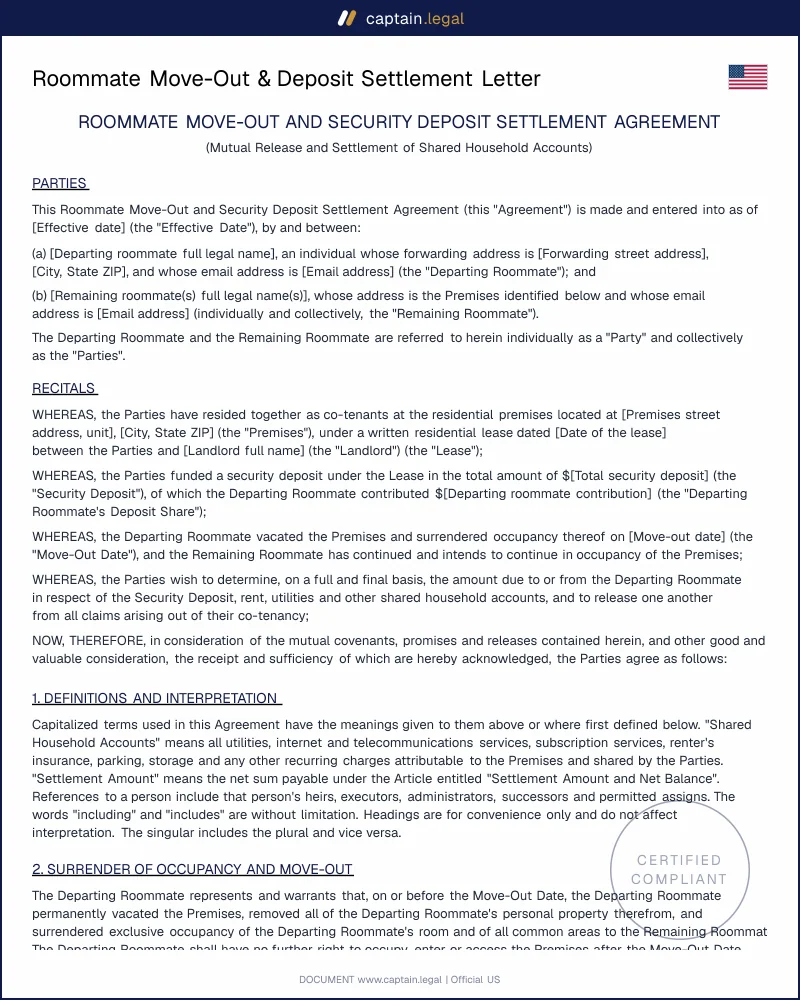
That is what this letter creates. It is a private contract between co-tenants that converts an informal understanding into an enforceable settlement, with a stated buyout figure, a stated allocation of shared charges, and a mutual release of claims arising from the shared occupancy. It sits alongside, not inside, the lease.

People confuse it with three neighbouring documents. A sublease transfers possession to a new occupant and requires landlord consent. A lease assignment removes the outgoing tenant from the lease entirely, again with landlord consent. A roommate agreement governs the ongoing relationship: quiet hours, guests, chore rotation. This letter does none of that. It is the exit instrument, drafted for the moment the relationship ends, and it works whether or not the landlord ever agrees to release the departing roommate from the lease.

2

When do you need this document?

The textbook scenario is a mid-lease departure where the remaining roommates buy out the leaver's share of the deposit immediately rather than waiting for the landlord's final accounting. One person leaves in month seven of a twelve-month term, the deposit stays with the unit, and the people staying reimburse the leaver's contribution now, on the understanding that they inherit the risk of future deductions. That trade needs to be written down, because the leaver is trading certainty for a discount and the stayers are buying an unknown liability.

The second common trigger is a lease ending where all roommates vacate together but the landlord returns a reduced deposit. The kitchen counter was scratched. One person's dog chewed the baseboard. Now four people are dividing an amount smaller than what they paid in, and the deduction was caused by one of them. Allocating that shortfall by fault rather than by headcount is exactly what this letter does, and it is why the itemised deduction schedule matters more than the total.

The third scenario is the replacement roommate. Someone new moves in, pays the departing roommate directly for his deposit share, and the landlord never touches a dollar. That payment needs documentation or the new arrival will claim, eighteen months later, that he was reimbursing back rent instead of buying a deposit position.

Two edge cases justify a careful draft. Domestic violence early termination statutes, now in force in most states, let a victim break the lease on notice with documentation. In practice the remaining roommates often stay on the hook, and the settlement must handle a deposit share that the leaver has a statutory right to walk away from. Second, if the landlord has already sent a deduction notice but the tenancy has not fully ended, the roommates are settling against a moving number. Do not sign a final release before the landlord's statutory accounting period has closed, or fix the figure with an express true-up clause.

3

Key clauses included in our template

  • The identification of the parties and the tenancy names every adult on the lease, not merely the two people arguing. A settlement signed by two of four joint tenants binds only those two, and the unsigned roommates remain free to claim their share later. The clause also fixes the lease commencement date and the total deposit held, because the arithmetic downstream depends on both figures.
  • The deposit contribution ledger records what each roommate actually paid in, which is rarely equal. One person often fronted the whole deposit at move-in and was repaid piecemeal. Reconstructing that history at exit is the single largest source of dispute, and the clause forces it into writing before the numbers are agreed.
  • The buyout figure and payment mechanics state the exact amount, the payee, the method, and the date. Instalment payments carry an acceleration clause so a missed payment makes the balance due immediately. Cash payments require a signed receipt appended to the letter.
  • The allocation of shared charges covers the final utility bills, internet cancellation fees, renters' insurance, and any prorated rent. The clause distinguishes charges already invoiced from charges that will arrive after the leaver has gone, and assigns the latter by a stated formula rather than by later negotiation.
  • The move-out condition statement and photographic annex documents the unit on the departure date. Timestamped photographs of every room, attached as an exhibit and initialled by both parties, defeat the later claim that damage predated or postdated the exit. Tenants who ran a formal walkthrough often attach the same evidence they would use with a move-in and move-out inspection checklist for rental property.
  • The mutual release and indemnity is the operative clause. Each party releases the other from all claims arising from the shared occupancy through the departure date, and the remaining tenants indemnify the leaver against future landlord claims for post-departure damage. Without this, the leaver stays exposed to joint liability for events he had no part in.
4

State-specific considerations

California runs the tightest deposit clock in the country. §1950.5(g) Civil Code gives the landlord 21 days from the end of the tenancy to return the balance with an itemised statement, and deductions above $125 require attached receipts or a good-faith estimate. A co-tenant settlement signed before that 21-day window closes is settling blind. California also treats the deposit as indivisible while any original tenant remains in possession, which means the departing roommate's only realistic route to his money is the buyout this letter documents. Since the 2024 amendment capping residential deposits at one month's rent for most landlords, the sums in dispute have fallen, but the allocation problem is unchanged.

Texas allows landlords 30 days under §92.103 Property Code, and §92.109 exposes a landlord who acts in bad faith to three times the withheld amount plus $100 and attorney's fees. That penalty belongs to the tenancy collectively, so the settlement should say who captures it if the remaining tenants later sue and win. Texas courts enforce co-tenant releases readily; the state has no statutory roommate framework, and ordinary contract principles govern.

Florida is the outlier on procedure. §83.49(3) Florida Statutes requires the landlord to send a written claim on the deposit by certified mail within 30 days, and the tenant has 15 days to object in writing. Miss the objection and the deduction is deemed accepted. The departing roommate must therefore reserve, in writing, the right to object on his own behalf, or the remaining tenants can waive his claim by silence.

New York shortened the return period to 14 days under §7-108 General Obligations Law, and a landlord who fails to provide an itemised statement forfeits the right to retain any portion. New York City adds a further wrinkle for rent-stabilised units, where succession rights can turn a departing roommate's exit into a tenancy question rather than a money question. Anyone in that position should settle the deposit and the occupancy separately.

Illinois, Massachusetts, and Washington each impose statutory damages for deposit violations, and Massachusetts is the harshest: G.L. c. 186 §15B triples the deposit plus interest and fees for several categories of landlord error. Where such penalties are in play, the settlement should treat them as a shared asset rather than a windfall to whoever files first.

5

How to fill out this roommate move-out and deposit settlement letter

You start by selecting the state where the rental sits, and the form loads that state's deposit return deadline and statutory citation into the document automatically. Next you enter the lease details: commencement date, total deposit held by the landlord, and the full name of every adult on the lease. The form then asks how much each roommate contributed to the original deposit, which is where most people pause, so have the move-in receipts or bank transfers open before you begin.

From there you choose the settlement structure. A lump-sum buyout produces a single payment clause with a receipt block. An instalment plan opens fields for the schedule and adds the acceleration language. If you are settling after the landlord's final accounting rather than before it, the form switches to the itemised deduction path and prompts you to allocate each deduction by cause rather than by equal share.

The final section handles evidence. You describe the unit's condition, list the photographs you are attaching, and confirm whether a joint walkthrough took place. The output arrives in Word and PDF, and you can browse the rest of the personal legal documents catalogue for everyday life administration if the move also calls for a pet custody arrangement or a bill of sale for furniture left behind.

6

Common mistakes to avoid

The most expensive error is signing a full mutual release before the landlord's statutory accounting window has expired. A leaver who releases his roommates on day three of a 21-day California window has given up his contribution claim for damage that has not yet been assessed. Almost as common is the assumption that the deposit splits by headcount. It splits by contribution, and in most shared apartments those two numbers differ, sometimes by hundreds of dollars, because one person fronted the money at move-in and the informal repayments were never completed. A close cousin of that error is allocating a landlord deduction equally when a single roommate caused the damage: the clause that saves you is fault-based allocation, and it has to be drafted before anyone knows the amount.

People also forget that this letter does not remove the leaver from the lease. The landlord can still pursue him for rent that goes unpaid in month ten, and the indemnity from his former roommates is only as good as their solvency. If release from the lease itself is the goal, the document you need is an assignment signed by the landlord, and the sublease agreement rules that apply when a new occupant takes over explain why consent is not optional. Finally, verbal settlements collapse. Two roommates who agree over a beer that the deposit is "sorted" will remember that conversation differently in nine months, and neither version will persuade a judge.

Key takeaways

WHO IT BINDS

It binds roommates, not the landlord

This letter is a private contract between co-tenants. It is not a lease amendment, and it does not force the landlord to refund anyone early or change the lease. Under a joint lease, the landlord holds one deposit for the unit, and a departing roommate usually has no direct claim to that money. The departing roommate’s claim is against the remaining roommate(s).

MONEY TERMS

Lock in the deposit split and charges

The whole point is to put the numbers in writing: the move-out date, the buyout amount (if any), how the security deposit will be divided, and who covers utilities or shared bills that are still open. Landlord deposit accounting often won’t match roommates’ private math, so this letter fixes the agreed allocation while memories are fresh and the unit’s condition can be described at handover.

RISK CONTROL

A signed release prevents later claims

Without a signed settlement, disputes turn into after-the-fact arguments about damage and payments, often in small claims court where the judge relies heavily on documents. Because co-tenants on a joint lease are jointly and severally liable, one person can get stuck paying more than their share and then sue for contribution. A mutual release closes the loop by settling those occupancy-related claims upfront.

Frequently Asked Questions

Yes, provided it has the ordinary elements of a contract: identified parties, definite terms, consideration, and signatures. Courts treat it as a private settlement between co-obligors and enforce it like any other written agreement. The statute of frauds does not apply, since performance falls within a year, so no notarisation is legally required in any state. Notarising it anyway is cheap insurance against a signature challenge. What the letter cannot do is bind your landlord: he never signed it, and he remains free to pursue every original tenant for rent or damage under the lease. It settles the roommates' obligations to each other, nothing more.

Not from the landlord, and not until the last original tenant vacates. Every state's deposit statute attaches the money to the tenancy rather than to an individual contributor, so a landlord who returns part of a deposit mid-lease is exposing himself to a claim from the remaining tenants. Your realistic route is a buyout from the roommates who stay, paid on your departure date and documented in this letter. They take on the risk that the landlord later deducts for damage, which is why buyout figures are often slightly below a strict pro-rata share. That discount is the price of certainty.

The deadline is set by state statute and varies widely. New York allows 14 days, Florida 15 for an undisputed refund, California 21, and Texas 30. Several states run 30 to 45 days, and a handful have no fixed period at all, requiring only a reasonable time. Most statutes also require an itemised written statement of deductions, and many penalise a landlord who misses the deadline by forfeiting his right to withhold anything. Check your own state's figure before you write a true-up date into the settlement, because a date that precedes the landlord's deadline makes the true-up unusable.

You download the completed letter in both Word and PDF. The Word file lets you adjust wording, add a clause your situation needs, or correct a figure after a final utility bill arrives. The PDF is the version you sign, since it locks the layout and is what a small claims clerk or a notary expects to see. Photographic exhibits attach cleanly to the PDF as appended pages, which matters because the condition evidence is often the most valuable part of the file. Keep both. The Word file is your working copy and the PDF is your record.

Not under this letter, if it is drafted properly. The fault-based allocation clause assigns each landlord deduction to the person or people responsible, and the mutual release cuts off claims for anything predating your departure. Your exposure to the landlord is a separate question: joint and several liability means he can pursue you for the full amount regardless of fault, and then you would sue your former roommates in contribution. That is exactly the litigation the indemnity clause is designed to prevent, since it obliges the remaining tenants to reimburse you for post-departure claims.

No, and asking him to is usually counterproductive. The letter is a co-tenant instrument and functions without any landlord involvement. Where a landlord's signature does matter is a lease assignment, which is the only way to remove your name from the lease and end your joint liability. Some landlords will sign one, most will not, and many charge a fee. Send your landlord a written notice of your departure date and forwarding address anyway, because most deposit statutes key the accounting deadline and the mailing obligation to the address on file.

Then the payment usually comes from the incoming tenant rather than from the people staying, and the letter should say so explicitly. Record what the new arrival is buying: a position in the existing deposit, not a loan and not back rent. Without that language, incoming roommates routinely claim later that the money was something else entirely. If the landlord agrees to add the new person to the lease, do that separately, since a lease amendment and a private deposit settlement are different instruments serving different purposes. Both can be signed on the same day.

Yes, and photograph everything. A joint walkthrough with the roommates who are staying, on the departure date, with timestamped photographs of every room, is the single most useful thing you can do. Several states also give tenants a statutory right to request a pre-move-out inspection from the landlord, California among them under §1950.5(f), which produces an itemised list of proposed deductions while there is still time to fix them. Attach whatever you gather as an exhibit to the settlement letter and have both parties initial it. Photographs settle arguments that words do not.

4.8/5

23 verified reviews · 50 000+ downloads

Roommate Deposit Settlement Letter | 50-State Template
  • Immediate access to the document
  • PDF + Word download
  • Compliant with 2026 legislation
  • Reviewed by lawyers
Fill in the template
Secure payment
Updated on July 15, 2026

You might also like

Small Estate Affidavit Template
Bill of Sale Template