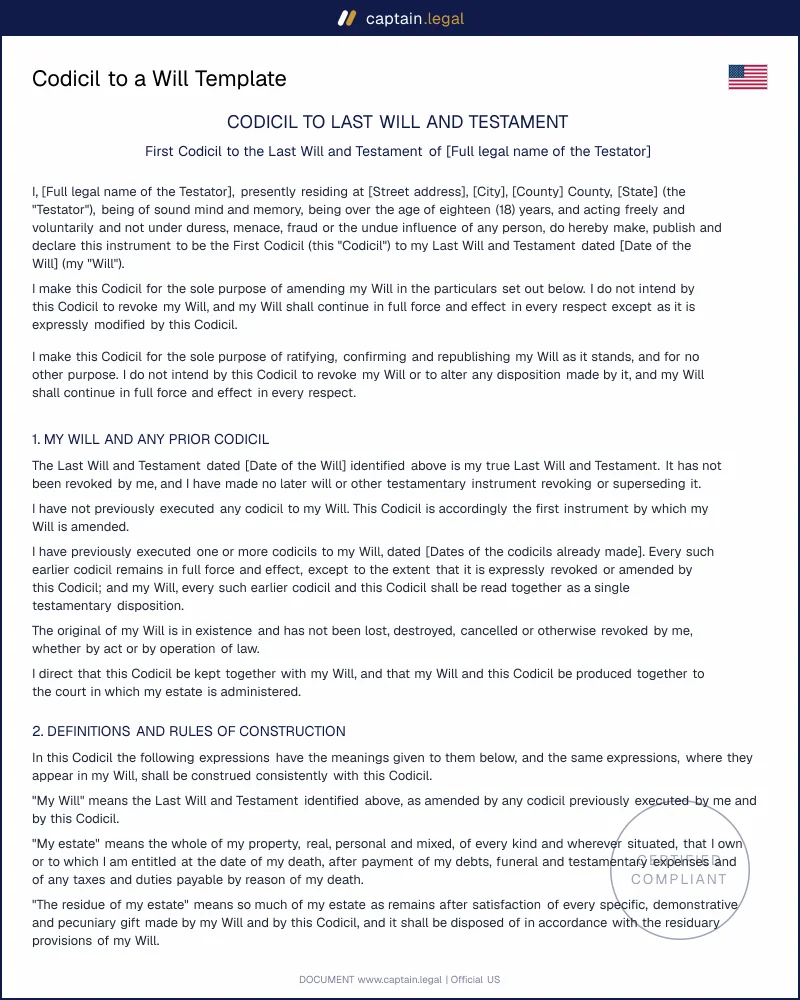
California requires a writing signed by the testator and witnessed by two people present at the same time who understand the instrument is testamentary, under Cal. Prob. Code §6110. The state has no contemporaneous self-proving affidavit. An uncontested codicil is proved later by the affidavit of a subscribing witness under Cal. Prob. Code §8220, which is why the California attestation clause should be signed under penalty of perjury. Using a beneficiary as a witness triggers the presumption of Cal. Prob. Code §6112 that the gift was procured by undue influence unless two disinterested witnesses also signed. Handwritten amendments are valid under Cal. Prob. Code §6111, and a defective one may still be rescued on clear and convincing evidence under Cal. Prob. Code §6110(c)(2).
Texas accepts an instrument signed by the testator and attested by two credible witnesses over fourteen who sign in the testator's presence, under Tex. Est. Code §251.051. Holographic versions remain valid under Tex. Est. Code §251.052. The state offers two self-proving routes: the notarized affidavit of Tex. Est. Code §251.104, annexed to the document, or the combined format of Tex. Est. Code §251.1045, which folds the oath into the signature page.
Florida is the strictest of the four on ceremony. Under Fla. Stat. §732.502, the testator signs at the end and the attesting witnesses must sign in the presence of the testator and of each other, a rule that defeats a codicil signed by witnesses in separate rooms or on separate days. Florida rejects handwritten versions, even one valid where it was signed. Self-proof follows Fla. Stat. §732.503.
New York requires the testator to sign at the end, to publish the document to the witnesses as a testamentary instrument, and to have two attesting witnesses under EPTL §3-2.1. Both witnesses must sign within a thirty day period, a deadline with no equivalent in most states that catches testators who mail the paperwork to a second signer. Handwritten instruments are barred outside military service under EPTL §3-2.2, and the affidavit of attesting witnesses under SCPA §1406 lets a Surrogate admit the codicil without live testimony.