Personal

Affidavit of Heirship | Tex. Est. Code 203.002 Form

Affidavit of heirship drafted to Tex. Est. Code 203.002 and state descent and distribution rules, with the witness and heir blocks county clerks require.
4.7/517 reviews50 000+ downloadsInstant download
Share

When someone dies without a will and leaves behind a house, a mineral interest or a car titled in their name alone, the asset stays frozen until somebody proves who the legal heirs are. An affidavit of heirship is the sworn statement that does that work outside probate court. A person familiar with the family swears to the decedent's marital history, children, parents and siblings, signs before a notary, and the affidavit goes into the county deed records or across the counter at a bank or a title company. Texas writes the instrument into statute at Section 203.002 of the Estates Code. Other states treat it as evidence rather than a conveyance, and that difference decides whether it clears the asset at all.

Compliant

2026 Legislation

50,000+ clients

trust us

Affordable

From $4.90 / doc

Secure payment

Instant download

Affidavit of Heirship | Tex. Est. Code 203.002 Form

Secure payment

Fill in the template

What is an affidavit of heirship?

An affidavit of heirship is a notarized statement of family history, made by a person with personal knowledge of the decedent, identifying who inherits under the state's descent and distribution rules. It does not transfer title by itself. What it does is put a written record of the family tree into the chain of title, so a title underwriter, a bank officer or a county clerk has something to rely on instead of a phone call from a relative. In Texas the document sits in Chapter 203 of the Estates Code, headed nonjudicial evidence of heirship, and the heading tells you what the instrument really is: proof, not a court order.

Two neighboring documents get confused with it constantly. A small estate affidavit for estates under the statutory ceiling is a court filing, reviewed by a judge in most states, and it moves both real and personal property. A judicial determination of heirship sits at the other end of the scale: citation to unknown heirs, an attorney ad litem, a judgment that binds everyone. The affidavit of heirship is the fastest and least formal of the three, and also the weakest. It creates a presumption, never a guarantee.

2

When do you need this document?

The usual trigger is a sale that will not close. A buyer is ready, the title commitment comes back, and the requirements schedule calls for evidence of heirship because the record owner died decades ago and nobody probated anything. The affidavit cures that gap before the real estate purchase agreement reaches funding. Refinancing raises the same problem: no lender takes a deed of trust on a tract owned by three siblings on paper and eleven cousins in reality.

Mineral owners meet the document from a different direction. An operator suspends royalties the moment a royalty or working interest owner dies, and division order analysts routinely accept a recorded affidavit, usually with a death certificate attached, as the step that releases the suspense account. Banks use it for a modest deposit account when no personal representative has qualified.

Two situations deserve care. The first is the decedent who left a will nobody probated in time: the affidavit then recites that a will exists while the family accepts that intestate shares govern. The second is heir property, a tract passed through two or three undocumented generations. Each generation multiplies the signatures a title company will demand, and one unreachable cousin can stall a closing indefinitely.

3

Key clauses included in our template

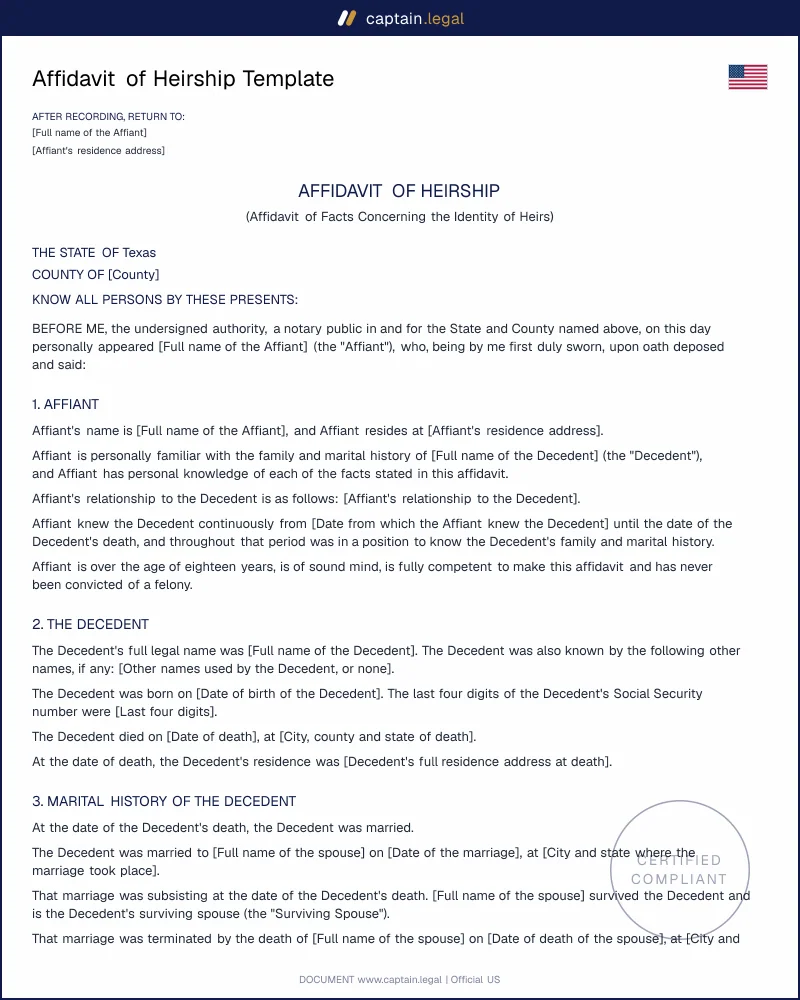
  • The affiant's qualification opens the document, because the affidavit is worthless if the signer cannot show how they know the family. Our template asks for the affiant's address, the years during which they knew the decedent, and an express statement of personal knowledge.
  • The death and residence recitals fix the date of death, the place of death and the decedent's residence at that moment. Residence matters more than people expect: it selects the county whose deed records give the affidavit its evidentiary value under Section 203.001.
  • The complete marital history covers every marriage, every divorce with its decree date, and the death of any predeceased spouse. Community property states divide an estate very differently depending on this history, and the same records support the divorce and marital settlement documents a family may already hold.
  • The children and descendants schedule lists each child with birth date, the other parent and a current address, and carries the express negative statement that the decedent adopted no other children and took no others into the home. That sentence is what protects a title company against a pretermitted or adopted heir.
  • The debts, property and signature blocks close the affidavit, disclosing unpaid debts and taxes, describing each tract by legal description rather than street address, and arranging the disinterested witness and heir acknowledgments so one notary appointment covers every jurat.
4

State-specific considerations

Texas remains the most permissive jurisdiction. A recorded affidavit under Chapter 203 can carry marketable title through a sale once the title company is satisfied, while Chapter 201 splits community and separate property along different lines depending on whether the decedent left descendants from an earlier relationship. For vehicles the Department of Motor Vehicles publishes Form VTR-262.

Oklahoma treats the affidavit as a slow burning cure. Under Title 16, Section 67 of the Oklahoma Statutes, a purchaser of a severed mineral interest takes marketable title through a recorded affidavit of death and heirship only after ten years of record with no inconsistent instrument filed in the county clerk's office.

Michigan records under a much older statute. MCL 565.451a, part of Act 123 of 1915, lets anyone with knowledge of the facts record an affidavit reciting family history, heirship and marital status with the register of deeds. It becomes evidence in the chain of title, while the estate still devolves under the Estates and Protected Individuals Code.

Florida does not recognize the instrument as a transfer device. Heirs are fixed by court order under Section 733.105 of the Florida Statutes and Florida Probate Rule 5.385, applying the intestacy schedule at Section 732.102. The sworn affidavit of heirs supports that petition rather than replacing it.

California has no recorded heirship affidavit. Personal property moves on a declaration under Probate Code Section 13100 once the statutory waiting period has run, and real property below the statutory ceiling moves through Section 13200, filed with the superior court clerk with a probate referee's inventory and appraisal. Recording a Texas style affidavit in a California county clears nothing and may cloud the title further.

New York works through the Surrogate's Court, where kinship is proved by a family tree affidavit and, when relatives are distant, by a kinship hearing. SCPA 1301 covers voluntary administration of small estates, and SCPA 2225 governs the presumption that no other heirs exist after a diligent search.

5

How to fill out this affidavit of heirship

You start by naming the state and the county where the property sits, because that single choice drives the recording rules, the witness requirements and the statutory citations the document will carry. If you select the recording option for Texas real property, the form opens the additional witness and heir blocks required by the Property Code amendment and arranges them in notary ready order.

Next comes the family history, and this part rewards going slowly with documents in front of you: death certificates, marriage licenses, divorce decrees, adoption orders. The form walks through marriages in chronological order, then children, then the negative statements about other children, then parents and siblings if there are no descendants. Assets come last, with a field for the legal description of each tract. Related paperwork sits in our personal estate and life administration templates.

6

Common mistakes to avoid

The most expensive mistake is an interested affiant. Title examiners want the family history sworn by someone who inherits nothing, typically an old neighbor, a family friend or an in law, and many underwriters want two such affidavits from two separate people. A signature from the son who is selling the land invites the exact challenge the affidavit was meant to prevent. Close behind it is the incomplete marital history: a first marriage that ended in another state, quietly omitted, surfaces when a half sibling appears with a birth certificate.

Three procedural failures show up over and over. Affidavits get recorded in the wrong county, so they never sit in the deed records where the property lies and never ripen into evidence. Legal descriptions get replaced by mailing addresses, which makes the instrument useless for indexing. And families lean on an affidavit where the estate carries real debt, forgetting that creditors keep their rights whatever the document recites. If the decedent left a mortgage, a judgment lien or unpaid taxes, talk to a probate lawyer before recording anything.

Key takeaways

When it helps

Use it to unfreeze title without probate

When someone dies without a will and an asset is titled in their name alone, it can be stuck until the heirs are identified. An affidavit of heirship is a sworn, notarized family-history statement that gives a county clerk, bank, or title company something concrete to rely on. It does not transfer title by itself, but it can support clearing a house, mineral interest, or vehicle.

Legal weight

It is evidence, not a court order

Texas treats this as nonjudicial evidence of heirship under Estates Code Chapter 203, not a judicial determination. That means it creates a presumption, not a guarantee, and it can be challenged by contrary proof (including later-discovered facts). If you need a binding result against unknown heirs, the affidavit is the weakest option compared with a court-driven heirship judgment.

Recording rules

Missing signatures can block recording

For Texas real property, the form in Tex. Est. Code 203.002 is only half the battle: recording can be refused if the required acknowledgments are missing. Under the Property Code rule tied to this affidavit, a clerk may reject an affidavit filed by an individual unless it is sworn by two credible subscribing witnesses, notarized for the affiant and each witness, and acknowledged by each living, non-disabled heir named.

Frequently Asked Questions

It is legally effective as evidence, not as a judgment. A properly executed and recorded affidavit creates a rebuttable presumption about who the heirs are, and in Texas Section 203.001 of the Estates Code makes it prima facie evidence once it has been of record for five years. Any interested party can still contest the facts, and omitted heirs and creditors keep their rights whatever it says.

Often, though it depends on the asset and the state. In Texas, Oklahoma and other recording states, an affidavit can carry real property or a mineral interest through a sale with no court involvement. Florida, California and New York do not allow that substitution for real property. The affidavit also assumes agreement: once an heir disputes the family tree or cannot be found, a court proceeding becomes the practical route. Related paperwork sits in our catalog of United States legal document templates.

Recording is immediate: a clerk files the instrument the day it is presented, provided the acknowledgments are complete. Acceptance runs on a different clock. A bank or a mineral operator usually acts on a fresh affidavit within a few weeks. A title underwriter often wants seasoning first, and in Texas the statutory presumption attaches only after five years in the deed records. Oklahoma's marketable title provision for severed minerals requires ten years.

The affidavit downloads in both Word and PDF. The Word file lets you correct a birth date, add a child discovered after the first draft, or adjust a legal description without rebuilding the document, because family history rarely comes out right first time. The PDF is the version to print for signature and notarization, with the jurat, witness and heir blocks in the order a notary and a county clerk expect.

Yes, with one adjustment. The statutory form asks you to modify the paragraph stating the decedent died without a will, so the affidavit recites that a will exists but was never probated. In Texas Section 256.003 of the Estates Code closes the door on probating a will more than four years after death unless the applicant was not in default. The heirs named will then be heirs at law, not the people the will favored.

For a vehicle you generally need the state motor vehicle agency's own form rather than the recording version. Texas uses Form VTR-262, the affidavit of heirship for a motor vehicle, filed with the title and registration application; all heirs sign before a notary and agree on who receives the vehicle. If a court has already found that no administration is necessary, a certified copy of that order goes in the packet.

4.7/5

17 verified reviews · 50 000+ downloads

Affidavit of Heirship | Tex. Est. Code 203.002 Form
  • Immediate access to the document
  • PDF + Word download
  • Compliant with 2026 legislation
  • Reviewed by lawyers
Fill in the template
Secure payment
Updated on September 2, 2026

You might also like

Revocation of Power of Attorney Template
Last Will and Testament