Personal

Revocation of Power of Attorney | UPOAA Section 110

Revocation drafted to Uniform Power of Attorney Act section 110, with state recording rules for CA, TX, FL, NY and IL. Notary-ready Word and PDF template.
4.6/523 reviews50 000+ downloadsInstant download
Share

A revocation of power of attorney is the signed instrument that cancels an existing POA and ends your agent's authority to act in your name. Under the Uniform Power of Attorney Act section 110, a principal who still has capacity may revoke at any time, for any reason, and the agent's consent is irrelevant. The legal side is that simple. The practical side is not: a bank, a brokerage, a title company, or a nursing home keeps honoring the old document until it receives written notice that the authority is gone. This template covers both halves, with a revocation drafted to statutory language and formatted for the county recorder, plus the notice letters that make the cancellation stick.

Compliant

2026 Legislation

50,000+ clients

trust us

Affordable

From $4.90 / doc

Secure payment

Instant download

Revocation of Power of Attorney | UPOAA Section 110

Secure payment

Fill in the template

What is a revocation of power of attorney?

A power of attorney is a delegation of authority, and like any delegation it can be withdrawn. The revocation is that act of withdrawal. It names the principal, identifies the earlier instrument by execution date and agent, terminates all authority granted under it, and is signed with the same formality as the original. Most practitioners have the principal acknowledge it before a notary, because section 105 of the uniform act attaches a presumption of genuineness to an acknowledged signature, and a compliance officer comparing two documents will trust the notarized one.

Three related instruments get confused with it. A successor designation moves authority to the next agent named in the original POA and revokes nothing. An agent's resignation ends that person's role but leaves the power standing for co-agents. And a new power of attorney does not automatically cancel the old one: section 110(f) of the uniform act, and its state analogues, provide that a later POA revokes an earlier one only if it expressly says so. Sign a fresh durable power, leave the old one in a drawer, and two agents may hold competing authority over the same bank account. If you are replacing rather than simply cancelling, pair this form with a fresh power of attorney template drafted for all fifty states.

2

When do you need this document?

Divorce is the most common trigger, and the one people handle worst. A dissolution filing may revoke a spouse-agent's authority by statute, but no clerk telephones the bank, so the branch keeps processing transfers signed by the former spouse. The second scenario is loss of trust: an adult child who has started moving money, a business partner whose interests have diverged. Speed matters here, because every day of delay is another day of good-faith reliance.

Completed transactions account for most routine revocations. A limited POA signed so a relative could close on a house should be shut down once the deal funds, even where the instrument recites its own expiry. Recorded limited powers are the ones that come back to haunt sellers, because the county index outlives the closing by decades. Estate planning refreshes produce the rest: replace a fifteen year old durable power drafted before you set up a revocable living trust built to Uniform Trust Code section 602, and the old instrument still needs express cancellation.

Two edge cases justify a closer look. A principal recovering from a stroke or major surgery can revoke as soon as capacity returns, and documenting that capacity contemporaneously is worth the effort if the agent is likely to argue. Military powers executed before a deployment stay in circulation long after the service member returns, since they were photocopied and handed to several institutions at once. Separation and custody matters raise their own paperwork, covered by our divorce and family law agreements.

3

Key clauses included in our template

  • The identification of the revoked instrument goes well beyond a date. The template captures the agent's full legal name, the execution date, the notary and county of acknowledgment, and, where the POA was recorded, the instrument number with book and page. A revocation reading "any power of attorney I may have signed" invites an institution to call the language too vague to act on.
  • The express revocation and capacity recital states that the principal is of sound mind, acting voluntarily, and terminates all authority previously granted. That recital is your evidence if the former agent later claims you were incapacitated when you signed, which is the standard defense in agent misconduct disputes.
  • The treatment of co-agents and successors is handled explicitly, because terminating one named agent can leave successor authority intact. The form lets you cancel the whole instrument or strip a single agent while keeping the rest of the structure alive.
  • The effective date and non-retroactivity language confirms that acts properly taken before receipt of notice are undisturbed. This mirrors the statutory reliance rules and reassures third parties who would otherwise stall, worried about unwinding past transactions.
  • The demand for return of originals and copies requires the agent to surrender every counterpart and stop holding themselves out as your representative. A written refusal is useful evidence in a conversion or elder abuse claim.
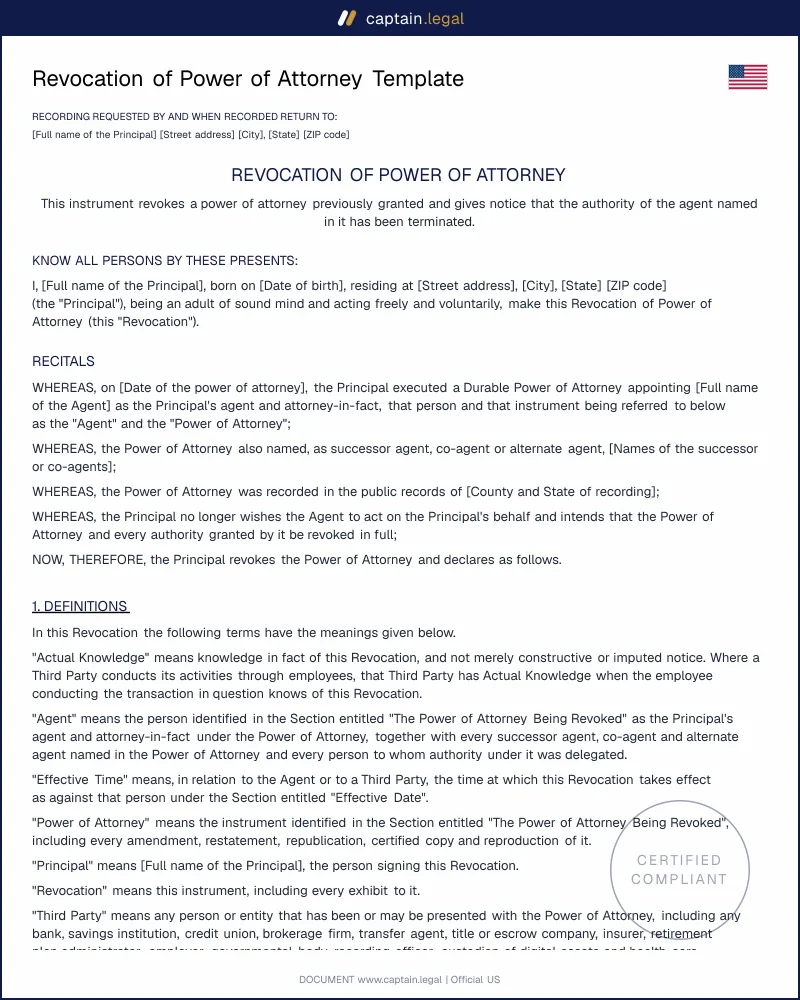
  • The execution block with acknowledgment and recording legend is formatted the way county recorders expect, with the return address panel at the top of the first page and margin space reserved for the recorder's stamp. Documents get rejected over margins more often than over substance.
4

State-specific considerations

California keeps its own statute. Probate Code section 4151 lets a principal revoke according to the terms of the instrument or by a writing, and that right cannot be limited by the power of attorney itself. Under Probate Code section 4154, dissolution or annulment of the marriage to the attorney in fact revokes that designation automatically. For real property, Civil Code section 1216 is the hard rule: a recorded power to convey is not revoked as against third parties unless the revocation is acknowledged, certified, and recorded in the same office.

Texas codifies the uniform framework in chapter 751 of the Estates Code. Section 751.135 says plainly that a previous durable power of attorney continues in effect until revoked, and section 751.132 governs termination of an agent's authority. Sections 751.054 and 751.055 protect a person acting without actual knowledge and let that person demand an agent's affidavit. Where the agent signs a recordable real property instrument, section 751.151 puts the durable power in the county clerk's file within thirty days, so the revocation belongs there too.

Florida addresses revocation directly at section 709.2110 of the Florida Statutes. A principal revokes by expressing the revocation in a later power of attorney or in another writing signed by the principal, and subsection (2) confirms that a new POA does not otherwise cancel an earlier one. Notice to the agent is permitted rather than required by that text, but section 709.2119 makes it decisive, since a third person who knows of the termination loses the right to rely.

New York is the most procedural state in the group. General Obligations Law section 5-1511(3) requires delivery of the revocation to the agent in person, or dispatch of a signed and dated revocation to the agent's last known address by mail, courier, electronic transmission, or facsimile. Subsection (4) requires recording where the power was recorded under Real Property Law section 294, and subsection (5) gives a financial institution actual notice only once it has had a reasonable opportunity to act on written notice received at the office holding the account.

Illinois runs the Illinois Power of Attorney Act, 755 ILCS 45. Section 2-8 lets anyone acting in good faith on a copy of the agency presume it has not been revoked, absent actual knowledge. The counterweight sits in section 2-8(f)(9), which makes actual notice of revocation a reasonable cause to refuse the document.

5

How to fill out this revocation of power of attorney

You begin by choosing the state whose law governed the original instrument, usually the state where you lived when you signed it, and the form adjusts its statutory recitals and notarial wording accordingly. Next you describe the power being cancelled: the agent's name, the signature date, whether the document was durable, and whether it was ever recorded. If it was, you enter the county, instrument number, and recording date so the revocation can be indexed against the same chain of title. You then choose scope, cancelling the whole instrument or the authority of one named agent while preserving a co-agent.

The form then builds your service list. You add every institution that has seen the original: banks, credit unions, brokerage and retirement plan administrators, insurers, the title company, a physician group. Each entry generates a notice letter referencing the revocation by date. You download the package in Word and PDF, sign before a notary, send the letters by a method that produces proof of delivery, and record where the original was recorded. The rest of our personal legal document templates follow the same drafting logic.

6

Common mistakes to avoid

The dominant error is believing that a new power of attorney kills the old one. In almost every state it does not, unless the new document says so in express words, and the two instruments coexist until one is revoked. Close behind is notifying the agent and nobody else. Your former agent may be perfectly cooperative and still leave a signature card sitting at a branch that has no idea anything changed. The third recurring failure is the recorded power that never got a recorded revocation. Title examiners search the grantor index, not your correspondence, and an outstanding recorded POA will hold up a closing years later, which is one reason our library of real estate contract templates exists.

Then come the drafting mistakes. Identifying the original only as "my power of attorney" gives a compliance department an excuse to demand a certified copy. Skipping notarization saves ten minutes and costs a week of arguing. Waiting until capacity is in doubt is the worst of them, because a principal who can no longer understand the document cannot revoke it, and the remedy shifts from a signature to a guardianship petition. Revoke while your capacity is beyond question.

Key takeaways

Authority ends

You can revoke anytime if competent

If you still have capacity, UPOAA Section 110 lets you revoke a power of attorney at any time, for any reason, and the agent does not get a vote. The revocation should clearly identify the prior POA (date and agent) and terminate all authority granted under it. Treat it with the same formality as the original so it is hard to challenge.

Notice step

Signing is not enough; give notice

Revocation and notice are separate steps. In real life, banks, brokerages, title companies, and care facilities often keep honoring the old POA until they receive written notice that the authority is terminated. Under Section 119, a person who in good faith accepts an acknowledged POA without actual knowledge of termination can rely on it, and the transaction can still bind you.

Avoid overlap

A new POA may not cancel the old

Do not assume a replacement POA automatically wipes out the earlier one. Under UPOAA Section 110(f) and similar state rules, a later power revokes an earlier power only if it expressly says so. If you sign a fresh durable POA and leave the old one in circulation, two agents can end up with competing authority over the same account.

Frequently Asked Questions

Yes. No state requires a lawyer to draft one. A revocation binds when it is in writing, identifies the power being cancelled, is signed by a principal with capacity, and carries the formality your state expects, which in practice means notarization. What decides whether it works against a third party is notice rather than authorship. Under section 119 of the uniform act and analogues such as Florida's section 709.2119, an institution without actual knowledge is protected when it honors the old document.

Notarization is required outright in some states and strongly advised everywhere else, particularly when the original power of attorney was acknowledged before a notary. Institutions compare the two documents, and a bank holding a notarized POA is entitled to be skeptical of an unnotarized cancellation. Witnesses are mandatory in a handful of states, so matching the original instrument's formalities is the safe approach. The template carries a notarial acknowledgment block and optional witness lines.

The trigger is receipt, not signature. New York states the standard most clearly at General Obligations Law section 5-1511(5), which deems a financial institution to have actual notice once it has had a reasonable opportunity to act on written notice delivered to the office where the account is held. Other states use similar language about actual knowledge. Large institutions route revocations to a fiduciary services team and take several business days, so deliver by a traceable method.

Only if the original power of attorney was recorded, which usually means it was used for a real estate transaction. Then recording is not optional in most states. California's Civil Code section 1216 provides that a recorded power to execute instruments affecting real property is not revoked unless the revocation is acknowledged and recorded in the same office, and New York imposes a comparable duty. If the POA only went to banks and doctors, notice to those holders is enough.

Every document comes in editable Word and print ready PDF. The Word version lets you adjust names, add an institution to the notice list, or extend the description of the revoked instrument before signing, which matters when a bank asks for a specific account reference. The PDF is formatted for signature and for county recording, with correct margins and a return address panel. Related estate planning forms sit in the United States document catalog.

Probably, but do not rely on that alone. Section 110(b)(3) of the uniform act revokes a spouse-agent's authority when an action for divorce, annulment, or legal separation is filed, unless the power of attorney says otherwise, and California reaches the same result through Probate Code section 4154. No court notifies your bank or your title company, so a former spouse can still present a facially valid document to an institution that knows nothing about the filing.

4.6/5

23 verified reviews · 50 000+ downloads

Revocation of Power of Attorney | UPOAA Section 110
  • Immediate access to the document
  • PDF + Word download
  • Compliant with 2026 legislation
  • Reviewed by lawyers
Fill in the template
Secure payment
Updated on September 3, 2026

You might also like

Affidavit of Identity Template
Pet Custody Agreement