Create my document
Login

Choose country

United StatesUnited StatesChoose country
Employment

Nanny Employment Agreement | FLSA & State-Compliant Template

Household employment agreement drafted to FLSA 29 CFR Part 552 and state domestic worker laws in CA, NY, NJ and MA. Live-in sleep time clauses. Word & PDF.
4.7/532 reviews50 000+ downloadsInstant download
Share

A nanny and household employment agreement is the written contract between a private family and the person they hire to work inside their home: a nanny, a senior caregiver, a housekeeper or a family assistant. It sets the schedule, the hourly rate, the treatment of overtime, guaranteed hours, paid time off, confidentiality and the notice each side owes. Most families reach for it at the offer stage, right after a paid trial week, and experienced household employees now ask for it before resigning their current position. Federal wage law treats these workers as employees rather than contractors, and a growing list of states has made the written nanny contract mandatory instead of optional.

Compliant

2026 Legislation

50,000+ clients

trust us

Affordable

From $4.90 / doc

Secure payment

Instant download

Nanny Employment Agreement | FLSA & State-Compliant Template

Secure payment

Fill in the template

What is a nanny and household employment agreement?

A nanny and household employment agreement is an employment contract for domestic service work performed in a private home. The family is the employer, the worker is a W-2 employee, and the household is the worksite. That last point drives everything else. Because the family sets the hours, the methods and the tools, the common law control test used by the IRS makes the worker an employee, whatever the parties call the arrangement. The document does two jobs: it records the deal (rate, schedule, duties, benefits) and it builds the paper trail wage regulators expect a household employer to keep. Families who use a standard at-will employment agreement for US employers will recognize the skeleton, but the household version carries clauses no office contract needs, from car use and family travel to camera rules inside the home.

Two documents get confused with it. An agency placement contract binds the family to the agency rather than to the caregiver, and never satisfies a state written-contract mandate. An au pair placement runs through the J-1 Exchange Visitor Program under 22 C.F.R. Part 62, with a federally set stipend and an hours cap, so a nanny contract is the wrong instrument.

2

When do you need this document?

The classic trigger is the end of parental leave. A family hires its first full-time nanny, agrees on a weekly figure over coffee, and discovers three months later that nobody wrote down what happens when the parents come home late. The second is upgrading an occasional sitter to a fixed schedule, the moment the casual babysitting exclusion stops applying. Live-in hires form a category of their own, because the sleep and meal exclusions have to be negotiated in advance and cannot be imposed later. Elder care arrives from the other direction: an adult child hiring a caregiver directly for a parent becomes a household employer with the same obligations.

Two edge cases generate real disputes. In a nanny share, two families employ the same person in one or both homes, which usually creates joint employment: hours are aggregated across both households for overtime, and each family can be held liable for the other family's unpaid wages. Separated co-parents sharing one nanny across two homes land in the same trap. Both call for a single agreement naming every employing household, signed by all of them.

3

Key clauses included in our template

  • The identification of the employing household names every adult who will direct the work, which matters in nanny shares and separated-parent arrangements where joint employment aggregates hours and spreads liability.
  • The duties and scope of work clause separates childcare or personal care from household tasks such as laundry, cooking and errands. The split is not cosmetic: several states set a different overtime standard depending on how much of the week goes to personal care.
  • The schedule and guaranteed hours clause separates hours the family promises to pay from hours actually worked. Guaranteed hours protect the employee when the family travels, while the contract still records real time worked, since a guarantee never replaces the overtime math.
  • The compensation and overtime clause fixes an hourly rate, the premium past the applicable weekly threshold, pay frequency and payment method. It commits both sides to the gross figure rather than a net take-home number, the most common source of conflict once withholding begins.
  • The live-in terms clause covers private quarters, the sleep period, meal periods, off-duty time, lodging credits and house rules, drafted as the mutual written agreement contemplated by 29 C.F.R. §552.102.
  • The confidentiality and privacy clause restricts disclosure of family information, sets social media rules for images of the children and governs cameras in the home, and it pairs with a dedicated employee non-disclosure agreement when the family wants more.
4

State-specific considerations

California runs the strictest split in the country. Under the Domestic Worker Bill of Rights, Labor Code §§1450 to 1454, a personal attendant, someone who spends at least 80 percent of working time supervising, feeding or dressing a child or a person needing supervision, earns overtime after 9 hours in a day or 45 hours in a week. A household employee who is not a personal attendant falls under Wage Order 15, with overtime after 8 hours in a day and 40 in a week. The 80 percent test turns on the real duty mix, so the duties clause is doing legal work here.

New York requires overtime after 40 hours for live-out staff and 44 hours for live-in staff, 24 consecutive hours of rest each week, and paid days of rest after a year with the same family. The Domestic Workers' Bill of Rights also extended state human rights protection to household workers, and families owe a written wage notice at hire under Labor Law §195(1).

New Jersey went furthest on paperwork. The Domestic Workers' Bill of Rights, N.J.S.A. 34:11-69 et seq., requires a signed written contract for any domestic worker doing more than five hours of work a month, in English and in the worker's preferred language, covering duties, pay, schedule, breaks, time off and, for live-in staff, sleep and personal time. On-duty meal breaks are lawful only if the contract provides for them.

Massachusetts mandates a written agreement once the employee works 16 hours a week under M.G.L. c.149 §190, with a timesheet every two weeks and three years of retained records. Illinois covers household workers under the state minimum wage, human rights and one-day-rest-in-seven statutes from the first employee, and Chicago adds a contract mandate in the worker's preferred language. Nevada, Virginia, Seattle and Philadelphia each have a version. In Texas and Florida no such statute exists, so the federal floor governs and the contract is the only record of the deal.

5

How to fill out this nanny and household employment agreement

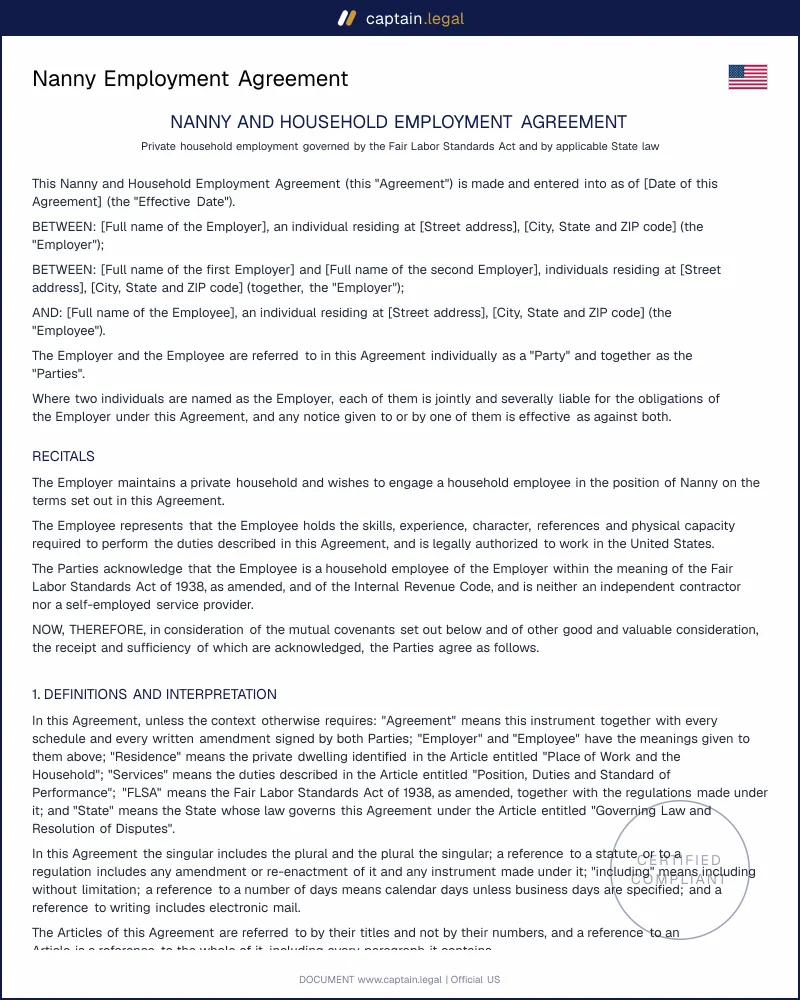
You begin by choosing the state where the work is performed, which drives the overtime thresholds, the mandatory notices and the written-contract rules the template applies. The form asks whether the position is live-in or live-out, and the live-in path opens the sleep, meal and off-duty clauses required by federal regulation. You enter the employing household or households, the employee's details, the start date and any trial period, then the duty mix between care work and household tasks, since that allocation decides which overtime standard prints in a state such as California.

Compensation comes next: gross hourly rate, guaranteed weekly hours, the overtime premium, pay frequency and payment method, plus any lodging credit for live-in staff. You then set paid time off, holidays, sick leave, use of the family car and confidentiality, and the last screen covers notice, severance and return of property. Review the draft, adjust the wording, and download the agreement in Word and PDF. The wider library of US employment templates covers the onboarding paperwork around it.

6

Common mistakes to avoid

The first and costliest error is paying a nanny on a 1099. Families do it for simplicity, sometimes at the worker's request, and it exposes them to back taxes, penalties and interest once anyone examines who set the hours and supplied the equipment. Close behind is the flat weekly salary with no record of hours. A salary is a payment method, not an exemption, and when a family cannot show hours worked, the employee's own reconstruction stands. The burden of proof on hours falls on the employer, not on the household employee.

Deductions for room, board or a broken phone screen are the third trap, since most states demand written authorization and cap what may be credited against wages. The fourth is signing a live-in nanny to a schedule with no written sleep and meal agreement, which turns a whole overnight into paid time on paper. Nothing in a household employment contract can waive minimum wage, overtime or a statutory day of rest. Families also forget the exit, from final paycheck deadlines to the return of keys, and a caregiver who held medical information for an elderly employer needs a HIPAA authorization for release of medical records closed out properly.

Key takeaways

Worker status

Your nanny is a W-2 employee

In a private-home job, the family is the employer and the caregiver is almost always an employee under the IRS common law control test, no matter what you call it. That means payroll treatment, not a contractor setup. Getting this wrong is where household employers get hit hardest, because the worker should be reported on Form W-2 (not 1099), with household employment taxes handled on Schedule H once the IRS Publication 926 cash-wage threshold is met.

Pay rules

Overtime applies after 40 hours

Federal wage law covers domestic service work under the Fair Labor Standards Act rules in 29 C.F.R. Part 552. For a live-out nanny, overtime is time and a half after 40 hours in the workweek, and paying a flat salary does not erase that duty. Commonly cited exclusions like casual babysitting (§552.5) are for irregular, occasional sitting, not a regular scheduled position.

Live-in hours

Put sleep time terms in writing

Live-in staff fall under a different federal overtime rule, but minimum wage still applies and the real battle is what counts as hours worked. Under 29 C.F.R. 552.102, sleep time, meal periods, and true off-duty time can be excluded only by agreement between employer and employee, and interruptions must be paid. Without a written clause, every hour the nanny is under your roof can be argued as compensable.

Frequently Asked Questions

Yes. It binds both parties once signed and is enforceable like any other written employment agreement. A verbal deal is enforceable in most states too, but close to worthless in a wage dispute, and New Jersey, Massachusetts and Chicago now require the written version outright. What no contract can do is override wage and hour law: a clause waiving minimum wage, the overtime premium or a statutory day of rest is unenforceable, and New Jersey voids arbitration clauses in domestic worker contracts.

Almost never. The IRS applies a control test, and a household worker whose hours, tasks, methods and equipment are set by the family is an employee. Publication 926 treats nannies, housekeepers and in-home caregivers as household employees, which means a W-2, employment taxes on Schedule H and state unemployment coverage. A genuine contractor runs an independent business serving several clients, and misclassification usually surfaces when the worker files for unemployment.

Under federal law, no. Section 13(b)(21) of the FLSA exempts an employee who resides in the household from the overtime premium, though minimum wage still applies to every hour actually worked. State law frequently says otherwise: New York requires overtime after 44 hours for live-in staff, California after 9 hours a day for a live-in personal attendant. The answer turns on the state, and on whether the sleep and meal exclusions were agreed in writing beforehand.

Household employment is at-will in most states, so no statutory notice period applies and the contract sets the standard. Two weeks on each side is the norm, four weeks for live-in staff who also lose their housing, often with severance in lieu of notice. Final pay follows state law rather than the contract: some states require the last paycheck immediately on discharge, others by the next payday, and missing that deadline triggers penalties even when the termination was lawful.

Yes, in both. The Word file is the working version, useful when you want to adjust the duties list, add a house rule or change the trial period wording before signing. The PDF is the signature and archive copy you keep with your payroll records, three years in most states. When the rate or the schedule changes, generate an amended version rather than annotating the signed original, and file it with your other US legal document templates.

Signing is the start. You apply for an employer identification number, register with the state for unemployment and withholding, and complete Form I-9 within three business days of the first day of work. You then run payroll on a regular cycle, withhold the employee share of Social Security and Medicare once the annual cash wage threshold in Publication 926 is met, and watch federal unemployment tax on its separate quarterly test. The W-2 and Schedule H close the year.

4.7/5

32 verified reviews · 50 000+ downloads

Nanny Employment Agreement | FLSA & State-Compliant Template
  • Immediate access to the document
  • PDF + Word download
  • Compliant with 2026 legislation
  • Reviewed by lawyers
Fill in the template
Secure payment
Updated on July 30, 2026

You might also like

Return of Company Property Agreement
Offer Letter Template
Nanny & Household Employment Agreement Template | Word & PDF