Create my document
Login

Choose country

United StatesUnited StatesChoose country
Employment

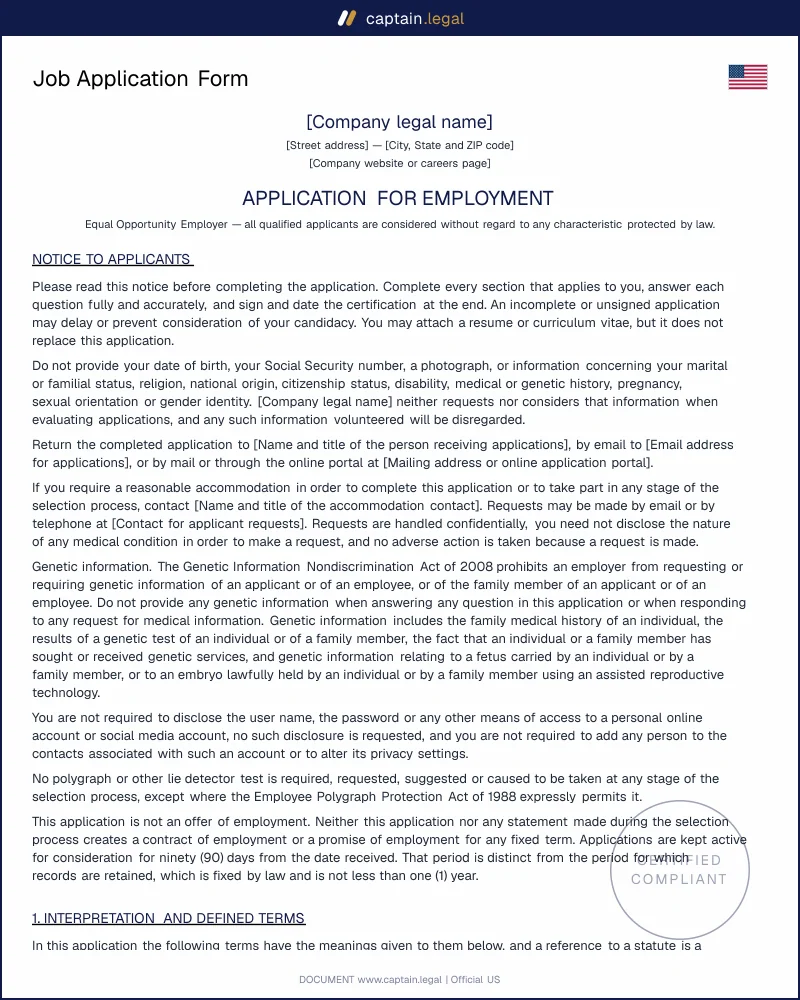
Job Application Form | Title VII & ADA Compliant Template

Lawyer-drafted US job application form built to Title VII, ADA 12112(d) and state fair chance rules. Individualized assessment language. Word & PDF.
4.6/518 reviews50 000+ downloadsInstant download
Share

A job application form is the standardized document a US employer gives every candidate before an interview, and it is the first piece of paper a plaintiff's attorney asks for when a hiring decision is challenged. Everything printed on it is evidence: what you asked, at what stage you asked it, and whether federal or state law allowed the question at that point. This employment application template is drafted for private employers hiring in more than one state, who need a form that respects ban-the-box timing, salary history restrictions and the pre-offer limits of the Americans with Disabilities Act, while still collecting the work history, references and authorizations required to screen candidates properly.

Compliant

2026 Legislation

50,000+ clients

trust us

Affordable

From $4.90 / doc

Secure payment

Instant download

Job Application Form | Title VII & ADA Compliant Template

Secure payment

Fill in the template

What is a job application form?

A job application form is a uniform written questionnaire completed by every candidate for a given role, covering identity, education, employment history, licenses, references, work authorization and a block of signed acknowledgments. Its legal function differs from a resume. A resume is what the candidate chooses to tell you; an application is what you decided to ask, in identical words, of everyone who applied. That symmetry is the point, and it is why the Equal Employment Opportunity Commission and the courts treat the form as the cleanest available proof of a consistent selection process. The signature block carries as much weight as the answers, since it captures the applicant's certification that the information is true, their consent to reference and education checks, and their acknowledgment that any employment offered is at will.

Three documents get confused with the application. The Form I-9 is completed after hire, never at the application stage. The background check authorization required by the Fair Credit Reporting Act sits on its own standalone page. And a candidate you intend to engage as self-employed does not belong in this workflow at all: that relationship begins with a 1099 independent contractor agreement and a written scope of work. Running employees and contractors through the same application hands the other side a misclassification argument before anyone starts.

2

When do you need this document?

High-volume hourly hiring is the clearest case. When a restaurant group processes two hundred applicants for twelve openings, the only realistic defense against a pattern claim is that every candidate answered the same questions on the same form. Multi-state hiring is the second trigger, and it has become the default for anyone recruiting remote staff: a form drafted for one state stops working the moment a candidate applies from California or New York, because the question that was lawful in one jurisdiction is a statutory violation in the other.

A first hire is the third scenario, and founders underestimate it. Companies that hire their first three employees on the strength of a resume and a coffee meeting later find they have no record of what was asked and no at-will acknowledgment. Regulated roles form the fourth category, since a license, a clean driving record or a physical capability has to be captured in writing before the screen rather than after it. Two edge cases deserve attention. Staffing placements are governed by joint employer analysis, so the agency and the host employer should each hold a complete application instead of assuming the other did the paperwork. Federal contractors sit in an unsettled position: the affirmative action obligations flowing from Executive Order 11246 were revoked, while Section 503 of the Rehabilitation Act and VEVRAA remain statutory. Contractors who deleted every self-identification page went too far.

3

Key clauses included in our template

  • The applicant identification block collects legal name, contact details and confirmation that the candidate is at least eighteen. It deliberately omits date of birth, social security number, photograph and marital status, each of which is either an age proxy under the ADEA or an invitation to a Title VII inference you cannot rebut with good intentions.
  • The employment history section asks for employer, dates, title, duties and reason for leaving, with an explicit statement that gaps in employment are not automatically disqualifying. That one sentence heads off the caregiver and disability inferences gap questions tend to generate.
  • The work authorization question is drafted to 8 U.S.C. §1324b wording: authorized to work in the United States, yes or no, plus an optional sponsorship question. No citizenship question, no country of origin, no request to see documents.
  • The criminal history module is conditional. It stays off the initial application in fair chance jurisdictions and appears only post-offer, with individualized assessment language and a written notice path before any adverse decision.
  • The certification and falsification clause makes material misrepresentation grounds for withdrawal of an offer or termination at any point afterward. Employers who omit it routinely lose the after-acquired evidence argument in wrongful termination litigation.
  • The at-will acknowledgment confirms that neither the application nor any subsequent conversation creates a contract of employment, and that only a signed writing from an authorized officer can change that. It pairs with the conditional offer letter template, which repeats the same language at the offer stage.
4

State-specific considerations

California runs the strictest hiring regime in the country. The Fair Chance Act, at Government Code §12952, bars conviction inquiries before a conditional offer and requires a written individualized assessment plus a five business day response window before withdrawal. Labor Code §432.3 prohibits salary history questions and obliges the employer to supply the pay scale for the position on reasonable request. Applicants also count as consumers under the state privacy statute, so a notice at collection must accompany the form.

New York layers state and city rules. Correction Law Article 23-A sets out the factors an employer must weigh before rejecting a candidate over a conviction, and Labor Law §194(4-a) bans salary history questions statewide. Inside New York City, the Fair Chance Act at Administrative Code §8-107(11-a) requires a written analysis and a three business day hold, while the city's automated employment decision tool rules add a bias audit duty when software screens applicants.

Illinois combines the Job Opportunities for Qualified Applicants Act, at 820 ILCS 75, with amendments to the Illinois Human Rights Act that impose an interactive assessment before any conviction-based rejection. The Equal Pay Act at 820 ILCS 112 prohibits salary history inquiries, and employers using recorded video interviews owe advance notice under 820 ILCS 42.

Washington requires employers to hold criminal history questions until the candidate is judged otherwise qualified under the Washington Fair Chance Act, RCW 49.94, while the Equal Pay and Opportunities Act at RCW 49.58 bars salary history questions and requires pay range disclosure. Recent amendments extend the same analysis to internal promotions.

Texas has no statewide fair chance statute covering private employers, which makes it the useful counterexample. Municipal rules still bite, and the Austin fair chance ordinance restricts conviction inquiries for employers above a size threshold within city limits. A national application form written to Texas standards breaches California, New York and Illinois law simultaneously.

5

How to fill out this job application form

You begin by selecting the state or states where the role will be based, and the form adjusts from there. In fair chance jurisdictions the conviction module drops off the initial application and moves to a separate post-offer page. Where a salary history ban applies, the compensation field switches to expectations only. You then set the position title, the essential functions you want acknowledged, and whether the role requires a license, a driving record or a physical capability statement.

The next stage covers your company details, the officer authorized to make binding offers, and the at-will language, retained everywhere except where you indicate a Montana placement, since the Wrongful Discharge from Employment Act replaces pure at-will employment there once the probationary period ends. Finally you choose whether to append the voluntary self-identification page, which prints as a detachable sheet so demographic responses never reach the hiring manager's file. Download in Word to add letterhead and adjust wording, or in PDF to circulate a locked version, then pair it with the employee onboarding checklist so the file moves cleanly from application to first day.

6

Common mistakes to avoid

The most expensive error is burying the FCRA background check disclosure inside the application. 15 U.S.C. §1681b(b)(2) requires a document consisting solely of that disclosure, and the Ninth Circuit held in Syed v. M-I, LLC that adding a liability waiver to the page was a willful violation exposing the employer to statutory damages per applicant. A close second is keeping the conviction checkbox on a national form because most states still allow it. Most is not all, and the fair chance states are the ones with the largest applicant pools and the most active enforcement agencies.

Three quieter mistakes recur. Employers request a date of birth so they can run a background check, creating an ADEA record they cannot explain later, when the request belongs on the post-offer authorization page. Hiring managers annotate applications with comments about family situation, weekend availability or perceived health, which turns a neutral form into documentary evidence for the other side. And recently incorporated companies frequently name the wrong legal entity as the employer, an issue worth resolving before hiring by tidying up the company formation and corporate governance templates that define who actually employs the workforce.

Key takeaways

EVIDENCE

Your application form becomes Exhibit A

Treat the job application as a legal record, not administrative paperwork. If a hiring decision gets challenged, this is often the first document requested because it shows exactly what you asked, when you asked it, and whether you asked everyone the same thing. A uniform form can help show a consistent selection process, but inconsistent or poorly timed questions can just as easily undercut you.

ADA TIMING

No medical questions before an offer

Under the ADA, disability-related questions and medical inquiries are generally off-limits before a conditional offer, even if you think the question is harmless. You can still ask whether the applicant can perform the essential functions of the job, with or without reasonable accommodation, but accommodation requests should be handled separately through a dedicated process rather than embedded in the application itself.

WORKFLOW

Keep I-9, FCRA, and 1099 separate

Do not bundle the job application with other hiring documents. The Form I-9 is completed after hire, not at the application stage, and the Fair Credit Reporting Act background check authorization belongs on its own standalone page. Also, do not run independent contractors through an employee application workflow; mixing the two can hand the other side an early misclassification argument.

Frequently Asked Questions

It binds in a narrow but meaningful sense. The application is not an employment contract, and the at-will acknowledgment says so explicitly. What it does bind is the candidate's certification that the information supplied is accurate, their consent to verification of employment and education, and their acknowledgment of the terms on which any offer would be made. Courts enforce falsification clauses routinely, which is why an employer who discovers a fabricated degree two years after hire can still rely on that signature.

Not in most of the country, and not at that stage. Fair chance laws in California, Illinois, Massachusetts, Washington and well over one hundred cities and counties push conviction inquiries to the post-offer stage, or at minimum until the candidate is judged otherwise qualified. Even where no statute applies, the EEOC expects an individualized assessment weighing the offense, the time elapsed and the job duties. The template keeps that module on a separate conditional page, so one national form does not become a violation the moment someone applies from a regulated jurisdiction.

In roughly twenty states and a comparable number of cities, no. Salary history bans in California, New York, Illinois, Massachusetts, Washington, Colorado and Connecticut prohibit the question, and several go further by forbidding you to use prior pay to set compensation even when the applicant volunteers it. Asking for salary expectations is permitted almost everywhere and gives you the same negotiating information. New York restricts questions about expected pay as well, so stating your own range first is the safest national practice.

Both. The completed application downloads as an editable Word file and as a print-ready PDF. Most HR teams keep the Word version as the master, adding a logo and adjusting the essential functions language role by role, then send candidates the PDF so the text cannot be altered before signature. The PDF also prints cleanly for walk-in applications, which still matter for hourly and field-based roles where people apply on site rather than through a portal.

One year is the federal floor. 29 C.F.R. §1602.14 requires Title VII employers to retain applications and related hiring records for one year from the record date or the personnel action, whichever falls later, and 29 C.F.R. §1627.3 mirrors that period under the ADEA. If a charge of discrimination is filed, the obligation changes at once: every record relating to that charge must be kept until final disposition, including applications from candidates you did not select. Several states go longer, so a two year policy is the practical setting for a multi-state employer.

Only if the form is built to adjust. The base structure, meaning identity, education, employment history, references and acknowledgments, travels nationally without difficulty. The three variables are criminal history timing, salary history questions and state notice obligations, and they differ enough that a static form breaches at least one statute in any multi-state hiring cycle. This template handles that through conditional sections rather than fifty separate documents, and the same logic runs through the rest of the full library of US legal document templates.

4.6/5

18 verified reviews · 50 000+ downloads

Job Application Form | Title VII & ADA Compliant Template
  • Immediate access to the document
  • PDF + Word download
  • Compliant with 2026 legislation
  • Reviewed by lawyers
Fill in the template
Secure payment
Updated on July 30, 2026

You might also like

ADA Accommodation Request Form
At-Will Employment Contract
Job Application Form Template (US) | Word & PDF Download