A layoff notice is the written warning an employer delivers to affected workers, to the state dislocated worker unit and to local elected officials before a plant closing or mass layoff takes effect. Under the federal Worker Adjustment and Retraining Notification Act, that warning has to land at least 60 calendar days before the first separation, and its content is prescribed by regulation rather than left to the drafter. This template produces the employee-facing reduction in force letter and the parallel agency notices in a single pass, with wording that adjusts to the state where the site sits and to the mini-WARN statute layered on top of federal law.
Compliant
2026 Legislation
50,000+ clients
trust us
Affordable
From $4.90 / doc
Secure payment
Instant download
Layoff Notice Template | 29 U.S.C. §2101 & Mini-WARN
Secure payment
What is a layoff notice under the WARN Act?
A layoff notice is a statutory document, not a courtesy memo. The federal WARN Act, codified at 29 U.S.C. §§2101 to 2109, treats it as the event that starts a 60-day clock, and 20 C.F.R. Part 639 dictates what has to appear on the page: whether the action is permanent or temporary, the expected separation date and schedule, whether bumping rights exist, and a named company official with a telephone number. Leave one element out and the notice can be treated as defective even though it went out on time.
Practitioners use "layoff notice" and "reduction in force letter" interchangeably, but the terms sit at different altitudes. A reduction in force is the business decision: a headcount cut driven by budget, consolidation or automation. The layoff notice is the compliance artifact that decision produces once it crosses a statutory threshold. Neither resembles an individual employee termination letter, which addresses one person's conduct and carries no advance-notice duty in an at-will state. A properly drafted RIF letter says almost nothing about the individual receiving it, and that silence is deliberate: the moment the letter explains why this employee was selected, it becomes an exhibit in a discrimination claim.
Legal framework
Coverage is narrower than most employers assume. Federal WARN reaches private employers with 100 or more employees, counting only those who have worked at least six months in the preceding twelve and average at least 20 hours a week. A company below that line is still caught by the alternative test based on aggregate weekly hours. A plant closing is the shutdown of a single site, or of one or more operating units within a site, causing employment loss for 50 or more employees during any 30-day period. A mass layoff is employment loss at a single site for 500 or more employees, or for 50 to 499 where that group represents at least 33 percent of the active workforce.
"Employment loss" is broader than firing. It captures a termination other than a discharge for cause, a voluntary quit or a retirement; a layoff lasting more than six months; and a cut in hours of more than 50 percent in each month of any six-month period. The aggregation rule at §2102(d) is where employers get caught: separations that each fall below the threshold are added together when they occur within any 90-day period, unless the employer proves separate and distinct causes.
The layoff notice runs to three audiences: affected employees or their union, the state rapid response dislocated worker unit, and the chief elected official of the local government. Three exceptions at §2102(b), covering a faltering company seeking capital, unforeseeable business circumstances and natural disaster, permit a shorter period, and each obliges the notice to say why. Liability is back pay and benefits for every day of violation, capped at 60 days, plus a daily civil penalty owed to the local government. Enforcement is private, as the Cornell Legal Information Institute entry for 29 U.S.C. §2102 on notice before plant closings and mass layoffs confirms. Where severance accompanies the cut, the waiver belongs in a separate OWBPA-compliant severance agreement and release, never inside the notice.
When do you need this document?
The clearest case is a site shutdown. A distribution center closes, 80 people separate on the same date, and the employer sits squarely inside the plant closing definition. The second scenario is quieter and riskier: a percentage-driven mass layoff, where a site of 140 employees sheds 50 roles and crosses the 33 percent line without anyone running the arithmetic. Restructuring gives a third pattern, the closure of one operating unit inside a larger campus, which counts even when the rest of the site keeps running.
Sales of a business carry their own rule at §2101(b)(1): the seller holds the obligation up to and including the effective date of the sale and the buyer holds it afterward, so a closing scheduled 30 days after a layoff decision leaves someone with an unsatisfied 60-day duty. Relocations matter too, though not federally, since several state statutes treat a move beyond a set distance as a trigger in its own right. Employers winding down entirely will also need corporate templates for dissolution and asset transfers alongside the workforce paperwork.
One edge case deserves flagging. A furlough announced as temporary converts into an employment loss the day it passes six months, and a layoff notice served at that point does not cure the original failure.
Key clauses included in our template
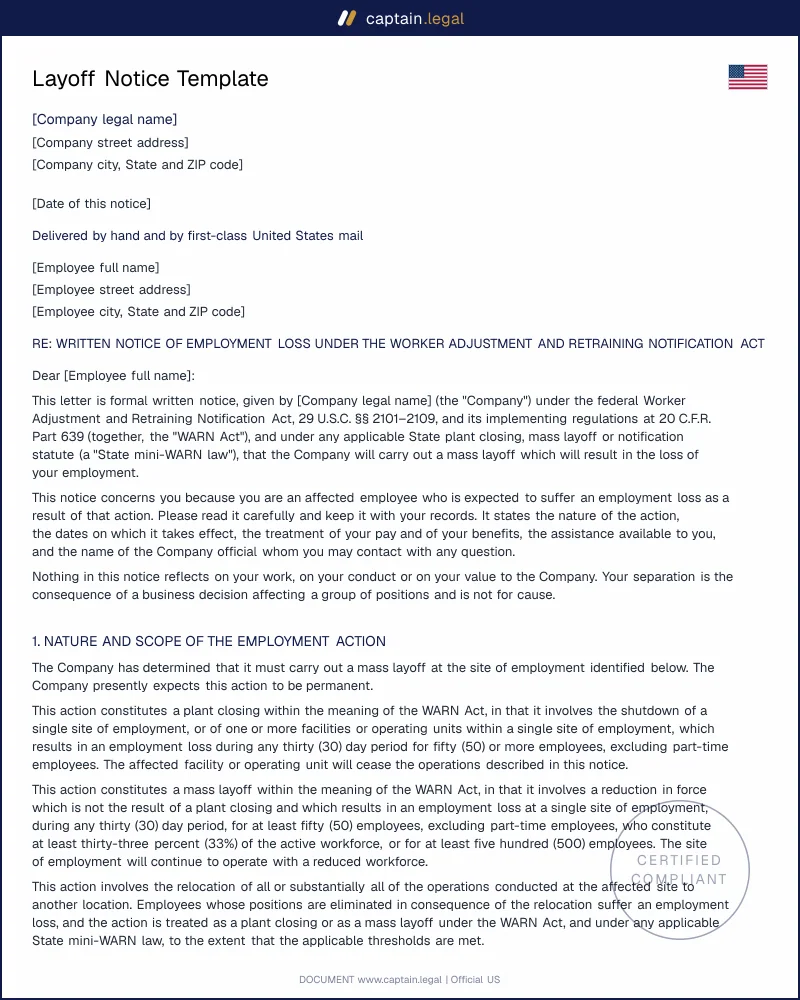
Three coordinated documents are built from one set of answers: the employee letter, the state agency notice and the local government notice, and the clause set reflects what 20 C.F.R. §639.7 requires plus what state statutes add.
- The statement of the triggering event identifies the action as a plant closing or a mass layoff and says whether it is permanent or temporary. Vague phrasing such as "organizational changes" is replaced by the statutory category, because the agency classifies the event from this sentence alone.
- The separation date and schedule gives a specific expected date plus the 14-day window in which separations across the group will occur. Employers who write "on or about" without a bounded window find the date measured from the last possible day.
- The bumping rights statement confirms whether the employee may displace a less senior worker, and records the answer either way, since silence is itself a defect.
- The company contact block names an individual with a direct telephone number rather than a general HR inbox, which is treated as non-compliant. Displaced workers use this line to reach rapid response.
- The agency and local official notice adds what those recipients need: affected job titles, headcount in each title, site address and any union representing the group. This version never goes to employees.
- The benefits coordination clause flags COBRA timing and the final paycheck deadline, both of which run on state clocks that ignore the WARN calendar. Pair it with a state-aware final paycheck and offboarding checklist so nothing slips between notice and last day worked.
State-specific considerations
California applies Cal-WARN at Labor Code §§1400 to 1408 to any covered establishment that has employed 75 or more people, full-time and part-time alike, in the preceding 12 months. There is no percentage test: a layoff of 50 or more within 30 days triggers it whatever the workforce size, and a relocation of at least 100 miles triggers it whatever the headcount. Senate Bill 617 amended §1401 so every layoff notice must now say whether the employer will coordinate rapid response services through the local workforce development board, another entity, or not at all, carry that board's contact details, and describe the CalFresh program.
New York runs a 90-day notice period under Labor Law §860 and 12 NYCRR Part 921 for private employers with 50 or more full-time employees. The mass layoff threshold drops to 25 employees where they are at least a third of the site workforce, or 250 outright. Notice goes to a wider circle than federal law contemplates, including the local workforce investment board, the school district and any locality providing emergency services. The state has also added a filing disclosure asking whether technological innovation or automation contributed.
New Jersey is the outlier every multi-state employer needs to price in. Under the amended Millville Dallas Airmotive Plant Job Loss Notification Act at N.J.S.A. 34:21-1, it reaches employers with 100 or more employees nationwide with no part-time carve-out, triggers on 50 or more terminations statewide in 30 days, and demands 90 days of notice. Severance of one week per full year of service is mandatory even when notice is timely, cannot be conditioned on signing a release, and cannot be waived without approval from the Commissioner or a court.
Illinois and Washington both sit below the federal headcount. Illinois covers employers with 75 or more full-time employees under 820 ILCS 65, filing with the Department of Employment Security. Washington covers employers at 50 under the Securing Timely Notification and Benefits for Laid-Off Employees Act, drops the percentage test, and allows losses across multiple sites to be aggregated. Ohio has joined the group, and Delaware, Hawaii, Iowa, Maine, Maryland, New Hampshire, Tennessee, Vermont and Wisconsin each keep their own thresholds. Scope a national RIF state by state.
How to fill out this layoff notice
You start by selecting the state where the affected site is located, and the form adjusts the notice period, the recipient list and the statutory citations to match the applicable mini-WARN statute. Next comes the headcount picture: total employees at the site, number of separations, and whether any separations occurred in the preceding 90 days, which the tool uses to test the aggregation rule before drafting anything. You then classify the event and enter the first separation date, so the system can work backward and confirm the notice leaves enough runway.
The questionnaire then collects the operational detail: affected job titles and counts, union representation, bumping rights, the contact official and any severance offered. The layoff notice arrives as three separate documents in Word and PDF. Edit the Word version if counsel wants different language, then file the agency copy through the state portal named in the instructions. The rest of the separation file sits in the US employment paperwork library.
Common mistakes to avoid
The most expensive error is a headcount miscount, and it happens the same way every time: someone applies the federal definition of a covered employee to a state statute that counts differently. New Jersey and California count part-timers; federal law largely does not. A company with 92 full-time and 30 part-time employees can sit outside federal WARN and inside two state statutes at once. The second error is procedural. Employers send the employee letters and forget the state dislocated worker unit and the chief elected official, a standalone violation carrying its own penalty even where every worker received timely notice. The third is arithmetic: the 60 days are calendar days counted back from each separation date, not business days counted forward from the announcement.
Two drafting mistakes round out the list. Employers lean on the unforeseeable business circumstances exception without documenting when the circumstance became known, and courts read that exception narrowly against the drafter. And managers add a sentence explaining why a particular employee made the list. Individual rationale has no place in a RIF letter. Selection criteria belong in a separate, privileged analysis reviewed for adverse impact before the letters print.
Frequently Asked Questions
21 verified reviews · 50 000+ downloads
- Immediate access to the document
- PDF + Word download
- Compliant with 2026 legislation
- Reviewed by lawyers
You might also like