Create my document
Login

Choose country

FranceBelgiqueEspañaUnited StatesUnited KingdomالمغربDeutschlandItalia
Employment

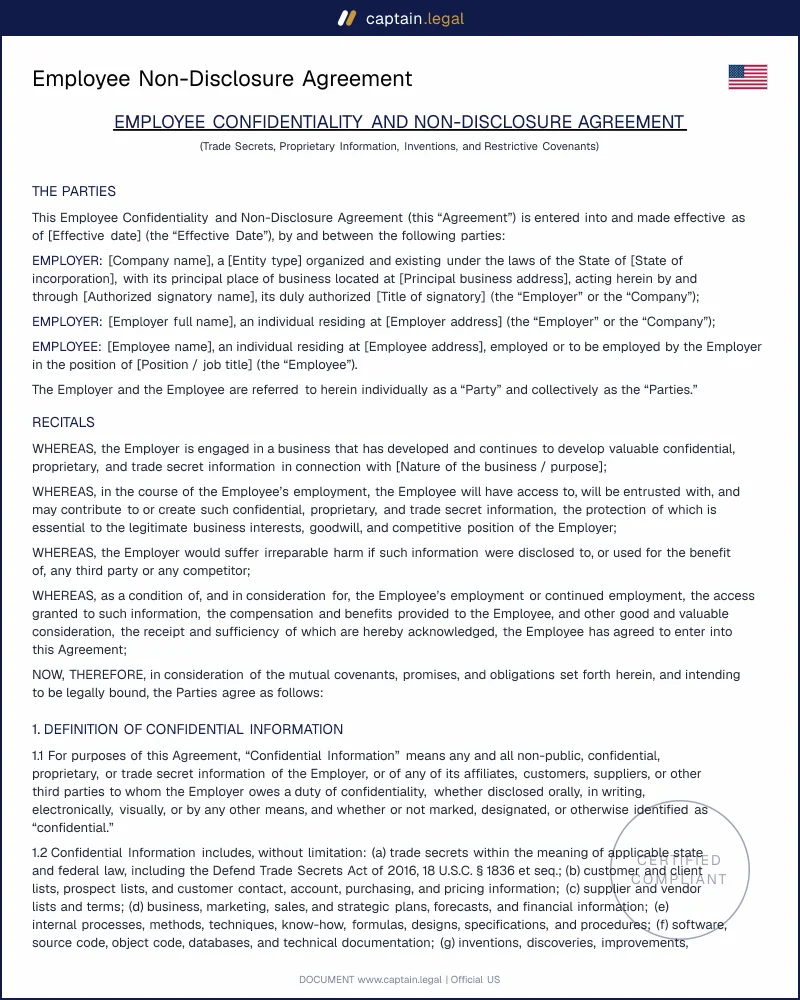
Employee Non-Disclosure Agreement Template | All 50 States

Secure your trade secrets and confidential data with a US employee NDA. Includes DTSA whistleblower notice, return-of-property and remedies clauses.
4.8/528 reviews50 000+ downloadsInstant download
Share

An Employee Non-Disclosure Agreement is a confidentiality contract that binds a worker to protect the trade secrets, client lists, pricing data, and internal processes they encounter on the job. Sometimes called an employee NDA or a confidentiality agreement, it sits at the center of every employer's information-protection strategy in the United States. American businesses lean on it because the country has no single statute that automatically locks down proprietary information once an employee walks out the door. Without a signed agreement, a former staff member who pockets your customer database has often done nothing the courts will punish. This template gives small employers and HR teams a lawyer-grade instrument to define what is confidential, how long the duty lasts, and what happens when the relationship ends.

Compliant

2026 Legislation

50,000+ clients

trust us

Affordable

From $4.90 / doc

Secure payment

Instant download

Employee Non-Disclosure Agreement Template | All 50 States

Secure payment · No subscription

Fill in the template

What is an employee non-disclosure agreement?

An employee non-disclosure agreement is a written promise from a worker to keep designated company information private, both during employment and for a defined period afterward. It identifies the categories of protected material, sets the boundaries of permitted use, and spells out the remedies an employer can pursue if the promise is broken. The document works in one direction: the employee receives the confidential information and owes the duty, while the company is the disclosing party. That makes it a unilateral NDA, distinct from the mutual version two businesses sign before a joint venture.

People often confuse the employee NDA with a non-compete, and the difference matters in court. A confidentiality agreement restricts the use and disclosure of information; it does not stop someone from working for a competitor. A non-compete restricts where and for whom a person can work, which is why so many states scrutinize or ban it outright. An NDA is far more durable precisely because it protects a legitimate property interest rather than blocking employment. Treat these as separate instruments, because courts that strike down an overbroad non-compete will frequently leave a well-drafted confidentiality clause standing. If your business also needs movement restrictions, the right pairing is a dedicated non-compete and non-solicitation agreement built for all 50 states, kept legally distinct from the NDA.

2

When do you need this document?

The clearest trigger is onboarding anyone who will touch sensitive material. Engineers who see source code, sales reps handed the customer database, finance staff who know margins and supplier terms: each should sign before the first login is provisioned. Timing is everything here, because an NDA presented on day one rides on the employment offer for consideration, while the same form handed over six months later may need fresh consideration to bind the worker in stricter states.

A second scenario is the role change. An employee promoted from a junior position into one with access to trade secrets or strategic plans should sign an updated agreement that reflects the new information they will hold. Companies preparing for a financing round, an acquisition, or a new product launch also tighten confidentiality across the workforce, since investors and acquirers conduct diligence on exactly these protections.

Contractors and temporary staff form an edge case worth flagging. A freelancer is not an employee, yet they often see the same confidential systems, so they need a confidentiality instrument too, frequently bundled into the services contract rather than signed separately. Another easily missed situation is the departing employee: an exit interview is the moment to reaffirm continuing obligations and recover company property, and a well-drafted NDA already gives you the leverage to insist on it. Businesses scaling their hiring usually standardize the NDA alongside the rest of their US employment document templates so no new hire slips through without one.

3

Key clauses included in our template

  • The definition of confidential information is the engine of the entire agreement. Our template uses a layered definition that names specific categories (source code, customer lists, pricing models, business plans) while keeping a sensible catch-all, because a definition that is either too vague or absurdly broad invites a court to narrow it. We deliberately exclude information that is already public or independently developed, which keeps the clause defensible.
  • The scope of permitted use restricts the employee to using confidential material only for performing their job. This is what separates an NDA from a property-transfer document. It lets the worker do their work while making any disclosure to outsiders, or any use for personal benefit, a clear breach.
  • The duration of obligations is drafted on two timelines. Ordinary confidential information typically carries a fixed post-employment term of two to five years, while genuine trade secrets remain protected for as long as they stay secret, mirroring how the UTSA itself treats them.
  • The DTSA whistleblower immunity notice appears verbatim as the statute requires, preserving your right to seek exemplary damages and fees. Leaving it out is the most common drafting failure we see in homemade NDAs.
  • The return-of-property clause obligates the employee to surrender all documents, devices, and copies on separation, and to delete company data from personal accounts. Paired with it, the remedies clause authorizes injunctive relief, recognizing that money rarely undoes a leaked secret.
4

State-specific considerations

California treats confidentiality agreements very differently from non-competes. Under Business and Professions Code §16600, California voids most post-employment competition restraints, yet it fully enforces NDAs that protect genuine trade secrets, and the state has its own Uniform Trade Secrets Act at Civil Code §3426. Draft the NDA so it reads as pure confidentiality and never strays into restraint of trade, because California courts will scrutinize any clause that functions as a backdoor non-compete and may invalidate it.

Texas enforces confidentiality agreements readily and adopted the Texas Uniform Trade Secrets Act (Civil Practice and Remedies Code Chapter 134A). Texas courts uphold reasonable confidentiality terms and even view a promise to disclose proprietary information as valid consideration for a current employee's signature, which makes mid-employment NDAs easier to enforce here than in many states.

New York stands out as one of the few jurisdictions without a statutory trade secret act, relying instead on common law shaped by decades of case law and the Restatement of Torts. Courts apply a multi-factor test to decide whether information truly qualifies as secret, so a precise contractual definition does real work in New York. The state also recently moved to restrict certain employer practices around employee speech, making careful drafting more important than ever.

Florida offers strong protection through the Florida Uniform Trade Secrets Act (Chapter 688, Florida Statutes) and a generally employer-friendly posture. Florida courts will enforce confidentiality obligations and, unlike with non-competes, do not require the tight durational limits the state imposes on movement restrictions, giving employers more latitude in how long the secrecy duty runs.

5

How to fill out this employee non-disclosure agreement

You begin by identifying the parties, entering the legal name of your company and the full name of the employee who will receive the confidential information. From there the form asks you to select the state that governs the agreement, and it adjusts the consideration language and any state-specific notices accordingly. The next step is the heart of the document: you describe the categories of confidential information your business actually holds, choosing from common presets like customer data, source code, and financial records, then adding anything specific to your industry.

After defining the information, you set the duration of the post-employment confidentiality obligation and confirm whether the worker is a new hire or a current employee, since that choice changes how consideration is handled. The template automatically inserts the DTSA whistleblower immunity notice and the return-of-property terms, so you do not have to remember them. You then review the assembled agreement, make any edits in the editable sections, and download it in Word and PDF. Most employers store the signed copy alongside the rest of their onboarding paperwork; if you need a broader set, the full catalog of US legal document templates covers the related forms.

6

Common mistakes to avoid

The most damaging error is defining confidential information so broadly that a court refuses to enforce any of it. An NDA claiming that everything an employee sees is secret signals to a judge that the employer never seriously classified its information, and overbroad definitions are routinely struck down. The fix is specificity paired with a reasonable catch-all. A close second is omitting the DTSA immunity notice, which quietly strips you of exemplary damages and attorney's fees against the very employee you are suing. Employers also stumble on consideration: asking a long-tenured worker to sign without offering anything new can leave the agreement unenforceable in states that demand fresh consideration.

Another frequent failure is treating the NDA as a substitute for a non-compete. Confidentiality language cannot stop someone from joining a rival, and drafting it to do so risks invalidation, especially in states like California. Keep the two instruments separate and purpose-built. Finally, many businesses sign the agreement and then never enforce their own secrecy program, leaving documents unmarked and access uncontrolled. Courts look at whether you actually behaved as though the information was secret, so a signed NDA paired with sloppy handling can still fail. Pairing the NDA with a written data-handling policy, such as the approach in a CCPA and CPRA-compliant privacy policy, reinforces that the protection is real.

Key takeaways

Purpose

An NDA makes confidentiality enforceable

In the U.S., proprietary information is not automatically protected just because someone learned it at work. A signed employee NDA spells out what counts as confidential (trade secrets, client lists, pricing, internal processes), how it may be used, and how long the duty lasts after employment ends. Without that written promise, a departing employee who takes a customer database may face limited consequences in court.

DTSA Notice

Include the whistleblower immunity language

If your NDA covers trade secrets, it should include the Defend Trade Secrets Act (DTSA) immunity notice. The notice tells employees they can disclose a trade secret to a government official or an attorney solely to report a suspected legal violation without liability. Leave it out, and you give up exemplary damages and attorney’s fees under the DTSA, even when misappropriation is obvious.

Scope

Do not confuse NDAs with non-competes

An employee NDA restricts use and disclosure of information; it does not block someone from taking a job with a competitor. Non-competes limit where and for whom a person can work, and many states scrutinize or ban them. Keeping these tools separate matters: a court may strike an overbroad non-compete but still enforce a well-drafted confidentiality clause that protects a legitimate property interest.

Frequently Asked Questions

Yes, when it is properly signed and supported by consideration. An NDA becomes binding once both parties sign and the employee receives something of value in exchange for the promise, which for a new hire is the job offer itself. Our template builds in the elements courts look for: a clear definition of confidential information, a reasonable duration, the DTSA whistleblower notice, and governing-law language matched to your state. It is enforceable in all 50 states, though a current employee asked to sign mid-tenure may need fresh consideration in stricter jurisdictions. The agreement does not require notarization to be valid.

An NDA protects information, while a non-compete restricts employment. A confidentiality agreement stops a worker from disclosing or misusing your trade secrets and proprietary data, but it does not prevent them from taking a job with a competitor. A non-compete does exactly that, which is why many states heavily limit or ban it. Because the NDA protects a recognized property interest rather than blocking someone's livelihood, it survives legal challenge far more reliably. If you need both protections, you can review the dedicated employment agreement templates for US employers, keeping each instrument legally distinct.

It depends on the type of information. For ordinary confidential material, our template sets a fixed post-employment term, commonly two to five years, which you select during drafting. For genuine trade secrets, the obligation runs for as long as the information remains secret, with no expiration date, mirroring how the Uniform Trade Secrets Act protects them. This two-tier structure matters because a single short term applied to everything would strip protection from your most valuable secrets the moment it expired, while an indefinite term applied to routine information tends to be unenforceable.

In most cases, yes, though it often takes a different form. An independent contractor is not an employee, so the consideration and at-will assumptions built into an employee NDA do not fit cleanly. The cleaner approach is to fold confidentiality and invention-assignment language directly into the services contract the contractor signs. That said, where a contractor will have deep access to sensitive systems, a standalone confidentiality agreement adds a clear, enforceable record. The key is that anyone touching your proprietary information should be bound by some written confidentiality obligation before access is granted.

You can, but how you do it determines whether it holds up. When an employee signs at hiring, the job offer supplies the consideration. When you ask a current employee to sign later, some states accept continued employment as enough, while others require something additional like a raise, a bonus, or a promotion. Check your governing state before rolling out a mid-employment NDA. Presenting the agreement around a genuine event, a promotion or access to a new project, both supplies natural consideration and makes the request feel reasonable rather than arbitrary to your workforce.

The agreement is delivered in both Word and PDF formats. The Word file lets you edit the customizable sections, adjust the confidential-information categories, and track changes if your legal team reviews it before signing. The PDF gives you a clean, print-ready version for signature and recordkeeping. You can store the signed copy with the rest of your HR documentation and reuse the editable version for future hires, simply updating the employee name and any role-specific details rather than starting over each time.

A breach opens several paths. Because money damages rarely undo a leaked secret, the remedies clause authorizes the employer to seek injunctive relief, a court order forcing the former employee to stop the disclosure and return materials. Where the information qualifies as a trade secret, the Defend Trade Secrets Act and your state's UTSA allow claims for actual damages, unjust enrichment, and, in willful cases, exemplary damages and attorney's fees, provided the agreement includes the required immunity notice. Acting quickly matters: courts respond best to employers who move promptly to contain the breach rather than waiting months to react.

4.8/5

28 verified reviews · 50 000+ downloads

Employee Non-Disclosure Agreement Template | All 50 States
  • Immediate access to the document
  • PDF + Word download
  • Compliant with 2026 legislation
  • Reviewed by lawyers
Fill in the template
Secure payment · No subscription
Updated on May 28, 2026

You might also like

Independent Contractor Agreement
US Employee Termination Letter