Create my document
Login

Choose country

FranceBelgiqueEspañaUnited StatesUnited KingdomالمغربDeutschlandItalia
Employment

ADA Accommodation Request Form for US Employers (Template)

Lawyer-drafted ADA accommodation request form. Build a defensible interactive-process record, keep medical info separate. Word & PDF, all 50 states.
4.8/521 reviews50 000+ downloadsInstant download
Share

An ADA Reasonable Accommodation Request Form is the document a US employer uses to capture, evaluate, and record an employee's request for a workplace adjustment tied to a disability under the Americans with Disabilities Act. It standardizes the first step of the interactive process, the back-and-forth dialogue federal law expects between an employer and a worker with a disability. The form serves two audiences at once: the HR coordinator who needs structured information to make a sound decision, and the litigation file that may one day need to show the company acted in good faith. Built for businesses with 15 or more employees, it documents the limitation, the accommodation sought, and the employer's response, while keeping medical details walled off from the personnel file the way the statute demands.

This template is drafted for HR managers, business owners, and ADA coordinators who want a defensible record without buying a separate HRIS module. It works alongside your medical-inquiry letter and your accommodation decision memo.

Compliant

2026 Legislation

50,000+ clients

trust us

Affordable

From $4.90 / doc

Secure payment

Instant download

ADA Accommodation Request Form for US Employers (Template)

Secure payment · No subscription

Fill in the template

What is an ADA reasonable accommodation request form?

The form is the intake instrument that converts an informal request into a documented, trackable process. Under the ADA, an employee does not need to use magic words or even mention the statute to trigger an employer's duties; a worker who says their back condition makes it hard to sit for eight hours has effectively asked for an accommodation. The form gives that conversation a paper home. It records who made the request, what job function the disability affects, what change the employee proposes, and what the employer ultimately decided and why.

A request form is not the accommodation decision itself, and it is not a medical certification. Those are separate steps. The form opens the file; the interactive process fills it. People often confuse the request form with the medical documentation letter sent to a treating physician, but they do different work. The request form is completed by the employee and the HR reviewer and captures the business side of the analysis: the essential functions, the proposed adjustment, the cost and feasibility assessment. The medical letter, by contrast, goes to a health care provider and asks narrowly about functional limitations. Keeping the two documents distinct matters, because the ADA requires that any medical information be stored separately from the regular personnel file and shared only with people who need it. A form that blends business notes and clinical detail in one place creates a confidentiality problem before the analysis even begins. Our employee write-up and incident form follows the same separation logic for performance records.

2

When do you need this document?

The most common trigger is an employee who tells a supervisor that some part of the job has become hard because of a health condition. A warehouse worker who mentions a lifting restriction, an analyst who asks for a quieter desk because of a concentration disorder, a receptionist who needs an adjusted start time for dialysis: none of them has to file anything formal to start the clock. The form exists precisely so the manager who hears that comment has a clean way to route it to HR instead of making an on-the-spot promise or, worse, brushing it off. The duty to engage begins at the request, not at the paperwork.

A second scenario is the leave request that turns into an accommodation question. When an employee asks for time off for a medical condition and the leave cannot be handled under the FMLA, workers' compensation, or your own PTO program, the ADA may require you to treat additional leave as a reasonable accommodation. The form captures that pivot so the file shows you considered it rather than defaulting to a denial. Our state-compliant PTO policy template pairs naturally with this analysis, since the two programs often overlap.

You also need the form during return-to-work and reassignment situations. An employee coming back from surgery with permanent restrictions, or one whose role has changed in a way their condition no longer fits, both fall inside the accommodation framework. One edge case worth flagging: a request can come from a manager's own observation, not just the employee's words, when a known impairment plainly interferes with work, and a savvy employer documents that it offered the process rather than waiting to be asked. Another underappreciated trigger is the recurring informal arrangement, where a supervisor has quietly let someone leave early for months; once that becomes contested, you want a dated record showing the accommodation was evaluated, not improvised.

3

Key clauses included in our template

  • The requesting employee and position section identifies the worker, the job title, and the essential functions of that role as the employer understands them. Pinning down essential functions early matters because the entire analysis turns on whether the accommodation lets the employee perform them, and a vague job description weakens every step that follows.
  • The description of the limitation asks the employee to explain, in plain language, which work activities the condition affects, without forcing a diagnosis into the file. This mirrors the EEOC's position that the employer needs to understand the functional barrier, not the clinical label, to evaluate the request properly.
  • The requested accommodation field records what the employee is proposing, whether a schedule change, equipment, a modified workspace, reassignment, or leave. It leaves room for the employer to note alternative accommodations considered, which preserves the statutory right to choose among effective options.
  • The medical documentation tracker logs whether documentation was requested, what was received, and the date, while keeping the substance in a separate confidential file. It is a pointer, not a repository, so the request form itself stays free of protected health information.
  • The interactive process log captures each meeting, call, and email by date, building the contemporaneous record that defeats a claim the employer stonewalled. Our employee handbook template cross-references this log so your written policy and your case file stay consistent.
  • The employer determination and undue-hardship analysis documents the decision, the reasoning, and any cost or operational factors weighed. A denial recorded with specifics holds up far better than a one-line refusal.
4

Common mistakes to avoid

The first and costliest error is treating silence as a safe response. Employers often sit on a request while they "look into it," and the EEOC reads unnecessary delay as a denial in its own right. A manager who receives a request and does nothing for six weeks has already exposed the company, even if the accommodation would eventually have been granted. The fix is procedural: route every request to a named coordinator the day it lands, and start the log immediately. A close cousin of this mistake is letting front-line supervisors deny requests on their own authority, when they lack the training to assess essential functions or undue hardship.

The second cluster of mistakes involves medical information. Over-collecting is the classic trap, where an employer demands full medical records or a diagnosis it does not need, which itself can violate the ADA. Equally damaging is sloppy storage, dropping a doctor's note into the regular personnel file where any manager can see it; the statute requires that medical material live in a separate, access-restricted file. A third recurring failure is the unwritten accommodation, where everyone agrees verbally and no one records it, so when a new manager arrives or the arrangement is challenged, there is nothing to show the process happened. Finally, employers forget that accommodation is ongoing, not one-and-done; a condition that worsens or a job that changes can reopen the duty, and a form filed once does not close the file forever. Your non-compete and non-solicitation agreement and related restrictive documents should never be used to discourage a worker from raising an accommodation need.

5

How to fill out this ADA reasonable accommodation request form

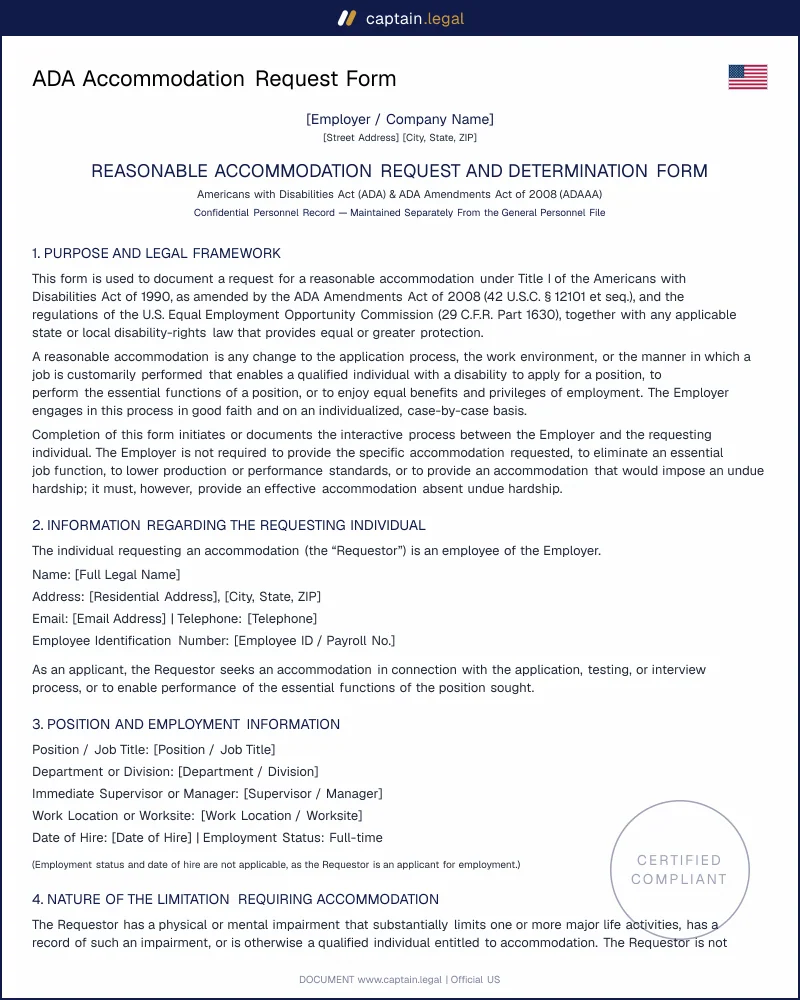
You begin by entering the employee's details and the position involved, then describing the essential functions of that job as your organization defines them. From there, the form prompts the employee to explain the limitation in functional terms, what the condition makes difficult at work, rather than supplying a medical diagnosis. The next field captures the accommodation the employee is requesting, with space for the reviewer to record alternatives the employer wants to explore during the dialogue.

The middle of the form walks you through the documentation question: whether the disability or need is obvious, and if not, what reasonable medical information you are requesting and when it arrives. You then log each interaction in the interactive-process section, dating every meeting and message so the record builds itself as the conversation unfolds. The form closes with the employer's determination, where you document the decision, the reasoning, any undue-hardship factors, and the effective date of any approved accommodation. Throughout, the template keeps the business analysis and the confidential medical notes in separate sections, so you can store them in different files the way the law requires. Once complete, you download it in Word for internal editing or PDF for the signed record, and you can browse the full US employment document library for the companion forms.

Key takeaways

Interactive process

Document the request and the dialogue

This form turns an informal comment into a trackable ADA accommodation file. An employee does not need to mention the ADA or use special phrasing to trigger duties; saying a condition makes an eight-hour shift hard can be enough. Use the form to capture who asked, which essential job functions are affected, what adjustment is requested, and what you decided and why, showing good-faith follow-through.

Confidentiality

Keep medical details out of personnel files

Do not blend business analysis and clinical information in one document. The request form should cover the workplace side: limitations at work, proposed accommodation, and feasibility considerations. Medical information belongs in a separate medical-inquiry letter and related records, stored separately from the regular personnel file and shared only with people who need it. Mixing them creates a confidentiality problem before the evaluation even starts.

Coverage rules

Know when the ADA applies

This template is built for employers covered by Title I of the Americans with Disabilities Act, generally private businesses with 15 or more employees. The framework comes from the ADA (42 U.S.C. §12101 and following) as amended by the ADA Amendments Act of 2008, which broadened disability coverage. The EEOC enforces these rules, and its guidance shapes how HR should respond once a need is signaled.

Frequently Asked Questions

The form is a documentation and process tool, not a contract, so "binding" is the wrong frame. What gives it legal weight is that it creates a contemporaneous, dated record of how your organization handled a request under the Americans with Disabilities Act. In an EEOC charge or a lawsuit, that record is often the difference between a defensible good-faith process and a he-said-she-said dispute. The template tracks the interactive process, the documentation requested, and the final determination, which are exactly the elements an investigator examines. It does not replace legal advice on a specific request, and it does not by itself approve or deny anything; the employer's written determination does that.

The ADA does not fix a numeric deadline, but the EEOC's standard is "expeditiously," and it has stated plainly that ignoring a request or causing unnecessary delay can itself be a violation. In practice, that means acknowledging the request within a day or two and starting the interactive process promptly rather than letting it sit while other priorities crowd it out. Complex requests that require medical documentation reasonably take longer, but the file should show continuous movement, not silence. The interactive-process log in this form is built to demonstrate that momentum, with each contact dated so a reviewer can see the matter never stalled.

Only what is reasonable, and only when the disability or the need for accommodation is not obvious. Under EEOC guidance, sufficient documentation describes the nature, severity, and duration of the impairment, the activities it limits, and why the requested accommodation addresses that limit. An employer may not demand a complete medical history or unrelated records, because full files contain protected information that has nothing to do with the request. The form deliberately separates this clinical material from the business analysis, prompting you to log that documentation was received without parking the contents in the same file an ordinary manager could open.

Yes. The ADA is federal law and applies nationwide to covered employers, so the core process this form documents is consistent everywhere. That said, several states impose stronger disability-rights statutes that cover smaller employers or define disability more broadly, California's Fair Employment and Housing Act being the prominent example, which reaches employers with five or more workers. The template captures the federal framework as the floor, and you can add state-specific notes where your jurisdiction goes further. When state law grants more protection, the more generous standard controls, so the documentation discipline this form encourages serves you in every state.

Yes. You can download the completed form in Word when you need to edit fields, add internal policy language, or adapt it to a particular request, and in PDF when you want a clean, fixed version for the signed file. Many HR teams keep the Word version as a reusable internal template and archive the PDF once a determination is final. Because the ADA requires medical material to be stored separately, a common workflow is to save the business sections and the confidential medical attachments as distinct PDFs in different access-restricted folders.

No. A request opens the interactive process; it does not dictate the outcome. Where more than one accommodation would let the employee perform the essential functions of the job, the employer may choose among them, provided the chosen option is genuinely effective at removing the barrier. You are not required to pick the employee's preferred solution, and you are not required to provide an accommodation that would impose an undue hardship given your size and resources. The form's determination section is structured to record both the accommodation selected and the reasoning, including any undue-hardship analysis, so your choice is documented rather than left to memory.

The interactive process is the informal, good-faith dialogue the ADA expects once an accommodation need surfaces. It is how the employer and employee clarify the limitation, explore options, and land on an effective solution. Courts and the EEOC scrutinize whether an employer actually engaged or merely went through the motions, and a missing or thin record often sinks an otherwise reasonable decision. The form's process log captures each step by date so the file proves engagement happened. That paper trail is your strongest protection, because it shows you treated the request as the law intended rather than reacting after a complaint was filed.

4.8/5

21 verified reviews · 50 000+ downloads

ADA Accommodation Request Form for US Employers (Template)
  • Immediate access to the document
  • PDF + Word download
  • Compliant with 2026 legislation
  • Reviewed by lawyers
Fill in the template
Secure payment · No subscription
Updated on May 29, 2026

You might also like

Employee Attendance Policy
Exit Interview Form Template