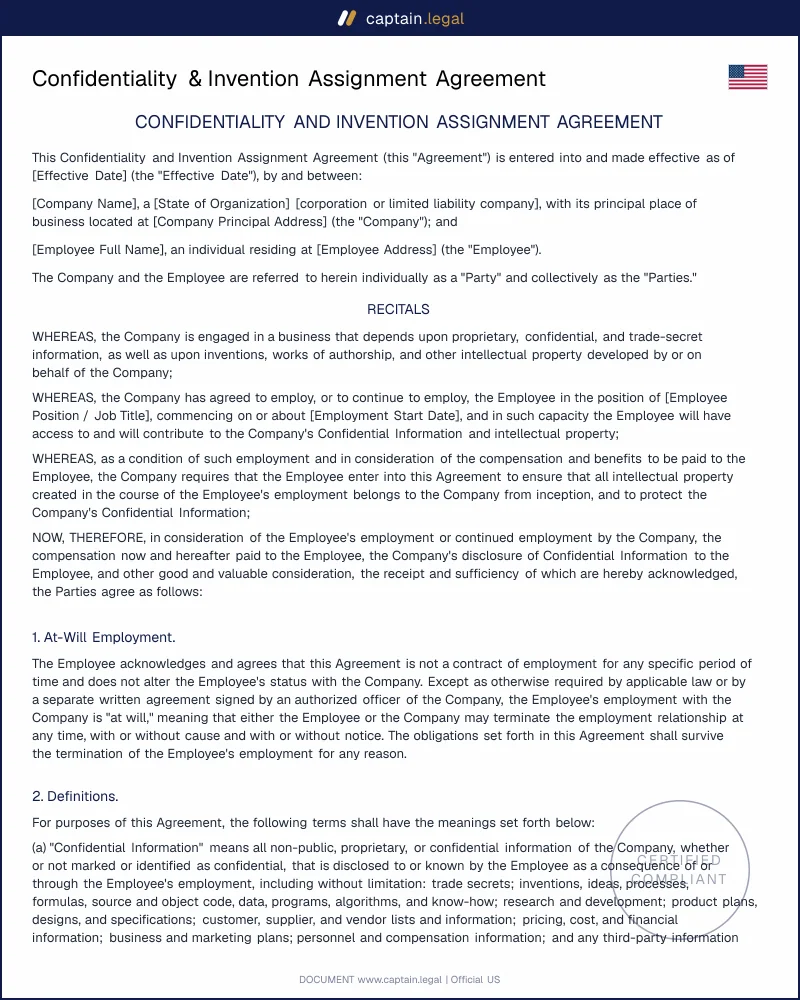
California sets the strictest limits on invention assignment in the country. Labor Code § 2870 voids any attempt to claim inventions an employee developed on their own time, without company resources, and outside the employer's field, and § 2872 requires you to give written notice of that limitation. California also bars most non-compete clauses outright under Business and Professions Code § 16600, so the confidentiality and assignment provisions carry the protective weight that non-competes do elsewhere. A California agreement that omits the § 2870 notice can expose the employer to a finding that the entire assignment was overbroad.
New York has no statutory equivalent to California's carve-out, which gives employers somewhat broader assignment rights, but New York courts still scrutinize confidentiality and restrictive terms for reasonableness. Trade secret claims here draw on both the common law and the federal DTSA, and recent legislative attention to non-competes means employers should keep restrictive covenants narrow and lean on confidentiality language instead. Clear definitions of what counts as proprietary matter more in New York than blanket prohibitions.
Texas enforces invention assignment and confidentiality agreements readily, treating them as ordinary contracts supported by consideration. Texas trade secret protection runs through the Texas Uniform Trade Secrets Act, and the state is generally friendlier to employer restrictive covenants than California, provided they protect a legitimate business interest and stay reasonable in scope. A Texas agreement still benefits from precise definitions, since vague confidentiality language is the most common reason these contracts fail.
Florida follows its own Uniform Trade Secrets Act and enforces reasonable restrictive covenants under § 542.335, which expressly recognizes legitimate business interests including trade secrets and substantial customer relationships. Florida employers often combine the assignment agreement with the non-compete and non-solicitation agreement because the state's statute gives those covenants more reliable footing than in many other jurisdictions. As everywhere, the DTSA notice should appear regardless of state.