Create my document
Login

Choose country

United StatesUnited StatesChoose country
Real Estate

Vacant Land Purchase Agreement | All 50 States Template

Land contract drafted to your state's Statute of Frauds, CERCLA all appropriate inquiries and mineral severance rules. Survey and zoning clauses. Word, PDF.
4.7/518 reviews50 000+ downloadsInstant download
Share

A vacant land purchase agreement is the written contract that transfers unimproved real property from a seller to a buyer, setting the legal description, the price, the due diligence window, and every condition that has to be satisfied before closing. It covers raw acreage, infill lots, agricultural tracts, recreational parcels, and development sites, and it is used by private sellers, builders, investors, and buyers closing without a broker.

Land deals fail on different things than house deals fail on. There is no roof to inspect and no water heater to replace, so the risk sits somewhere else: in title, in legal access, in zoning, in soil, in water, and in whatever a prior owner severed from the surface estate forty years ago. A land purchase contract is where those risks get allocated, priced, and made enforceable.

Compliant

2026 Legislation

50,000+ clients

trust us

Affordable

From $4.90 / doc

Secure payment

Instant download

Vacant Land Purchase Agreement | All 50 States Template

Secure payment

Fill in the template

What is a vacant land purchase agreement?

A vacant land purchase agreement is a bilateral contract for the sale of real property that has no habitable structure on it. It creates equitable title in the buyer the moment it is signed, while legal title stays with the seller until the deed is delivered and recorded at closing. That distinction matters more than most buyers realize: the contract is not the transfer. The deed is. Anyone who signs a purchase agreement and never records a deed owns a lawsuit, not a parcel.

The document is often confused with the standard residential form, and the two are not interchangeable. A residential real estate purchase contract for improved property is built around inspection of a dwelling, appraisal, lead paint disclosure for pre-1978 construction, and a mortgage contingency tied to conventional financing. A land contract strips all of that out and replaces it with survey, soils, utility availability, entitlement, and environmental contingencies. Lenders treat the two differently too, since raw land rarely qualifies for standard secondary market financing and usually needs a lot loan or seller carryback.

It is also distinct from a land installment contract (sometimes called a contract for deed), where the seller keeps legal title while the buyer pays over years. Do not use a purchase agreement when you mean an installment contract, or the reverse. Several states regulate installment sales heavily, with forfeiture restrictions and recording duties that a plain purchase agreement never triggers.

2

When do you need this document?

The most common trigger is a private sale of acreage without an agent, where a farmer, an heir, or a long-term holder wants out and the buyer wants a build site. Those deals move on handshake terms and then stall for months because nobody wrote down who pays for the survey. A close second is the builder or developer acquiring an infill lot, where the whole economics depend on getting a zoning and entitlement contingency long enough to run a site plan past the planning commission before the deposit goes hard.

Investors use the agreement for assemblage, buying two or three adjoining parcels under separate contracts with cross-conditions so that failure on one kills all of them. Family transfers are another steady use, particularly when siblings split inherited land and want a priced, arm's length paper trail for basis and gift tax purposes. Seller financing shows up constantly in land, because banks dislike unimproved collateral, so the contract has to carry the note and deed of trust terms rather than a bank commitment. Buyers running a 1031 exchange also need a written contract with assignment language, since the qualified intermediary has to be able to step into the buyer's position before closing.

Two edge cases justify slowing down. A landlocked parcel with no recorded easement is worth a fraction of what the listing suggests, and an implied easement by necessity is a lawsuit, not a driveway. Confirm recorded legal access before the deposit becomes non-refundable. The second is the parcel that was never legally created: land split off decades ago without going through the local subdivision process may need a certificate of compliance or a lot line adjustment before any permit issues.

3

Key clauses included in our template

  • The legal description and acreage clause carries the metes and bounds or platted lot reference exactly as it will appear on the deed, with an express statement of whether acreage is stated as approximate. The template pairs it with a survey contingency so a shortfall gives the buyer a defined remedy instead of a dispute.
  • The due diligence and contingency period sets a dated window for title review, survey, soils and percolation testing, wetlands delineation, utility confirmation, and zoning verification, with a written waiver mechanism. Silence at the deadline is treated as waiver, which is the market standard and the reason calendars matter more than intentions.
  • The mineral, water, and timber rights allocation states plainly what transfers and what the seller reserves, including any existing leases. In severed estate states this single paragraph decides whether an operator can put a pad site in the middle of the buyer's building envelope.
  • The access and easement representation requires the seller to confirm recorded legal access to a public right of way and to identify every easement, utility corridor, and shared road maintenance obligation affecting the parcel.
  • The title and deed clause specifies the deed type the seller will deliver, most often a general warranty deed, and sets the standard for marketable title subject to permitted exceptions. Where the parties intend a limited conveyance instead, a quit claim deed for a boundary correction or family transfer may be the right instrument.
  • The earnest money, escrow, and default provisions name the escrow holder, set when the deposit goes hard, and define the seller's remedy on buyer default, usually liquidated damages capped at the deposit.
  • The closing costs and prorations clause allocates transfer tax, recording fees, title premium, survey cost, and the property tax proration, including rollback taxes on land leaving an agricultural use classification.
4

State-specific considerations

California treats unimproved land as outside the residential Transfer Disclosure Statement regime, but natural hazard obligations under Civil Code §1103 can still reach a vacant parcel sitting inside a mapped flood, fire, or seismic zone. The bigger issue is the Subdivision Map Act (Government Code §66410 and following). A parcel conveyed in violation of the Act can be denied permits, and the cure is a certificate of compliance under §66499.35. Land under a Williamson Act contract carries a nine or ten year non-renewal tail that follows the buyer, and cancellation fees are steep. Water is a separate diligence track entirely, because a groundwater basin under a SGMA adjudication may cap what a new well can produce.

Texas exempts unimproved land from the seller's disclosure notice at Property Code §5.008, which applies to single family residences. Statutory notices still bite: Water Code §49.452 requires a district notice for property inside a municipal utility district, and Property Code §5.014 covers public improvement districts. Mineral severance is the defining Texas issue, since the mineral estate is dominant and its owner has an implied right of reasonable surface use. A surface waiver or accommodation agreement negotiated during due diligence is often worth more than the price reduction a buyer would otherwise chase.

Florida imposes documentary stamp tax on the deed under Fla. Stat. §201.02, which the contract should allocate expressly. Property partly seaward of the coastal construction control line triggers the affidavit requirement at Fla. Stat. §161.57. Wetlands and stormwater permitting run through the water management districts under Chapter 373, and a lot inside a platted subdivision may still fail concurrency review. Sinkhole history and karst geology belong in the environmental contingency, not in the buyer's optimism.

New York exempts vacant land from the Property Condition Disclosure Statement in Real Property Law Article 14, so the negotiated representations carry the full weight. Closings are attorney driven by custom, and the freshwater wetlands amendments to Environmental Conservation Law Article 24 expanded the parcels that need a DEC jurisdictional determination. Agricultural district land carries a rollback exposure on conversion.

In the prior appropriation states of the Mountain West, water rights are separate property and do not pass with the deed unless the contract says so. A land contract that is silent on water in Colorado, Montana, or Idaho is an incomplete contract.

5

How to fill out this vacant land purchase agreement

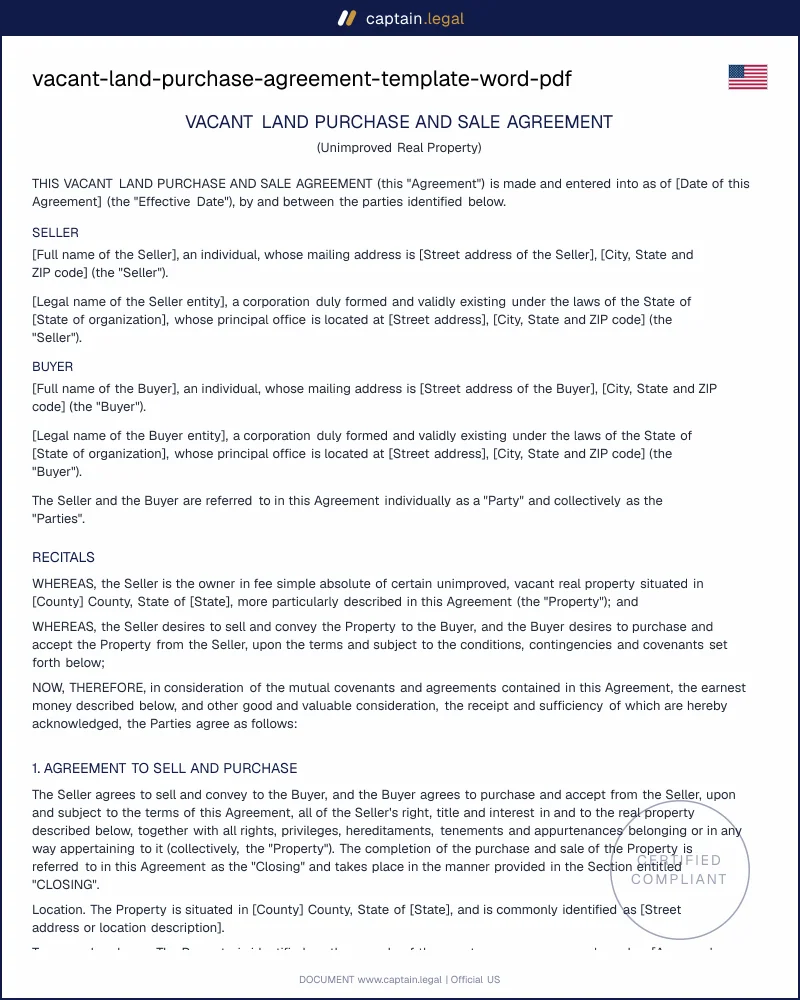
You start by selecting the state where the parcel sits, and the form adjusts the statutory references, deed type, transfer tax allocation, and any required district or hazard notices. Next you enter the parties and the property, pasting the legal description from the current vesting deed rather than the tax roll, and you flag whether acreage is stated exactly or approximately. The form then asks for price, earnest money, escrow holder, and financing structure, and it branches if you choose seller carryback so the note and security instrument terms are captured in the same pass.

Contingency setup is where the form does most of the work. You pick which diligence items apply, from survey and Phase I to percolation and rezoning, and you set the number of days for each rather than accepting a single generic window. The mineral, water, and timber section follows, along with the access representation. You finish with closing date, possession, and default remedies, then download and route for signature. Buyers who want to see how this fits alongside the rest of a transaction file can browse the wider library of US real estate documents before drafting.

6

Common mistakes to avoid

Copying the legal description off a listing or a tax statement is the error that surfaces most often, and it surfaces late, usually at the title company two days before closing. Assessor parcel numbers describe a billing unit, not a boundary. The related mistake is skipping the survey on a rural tract because the seller "knows where the corners are"; fence lines drift, and a fence that has sat wrong for the statutory period can transfer ownership by adverse possession without anyone signing anything. Buyers also set a due diligence period based on how fast they want to close instead of how long the local agency actually takes, then find themselves waiving a rezoning contingency with the application still in queue.

The second cluster is about what the buyer assumes comes with the dirt. Minerals, water, timber, and development rights are all severable, and silence in the contract does not mean the buyer gets them. Sellers make a mirror image mistake by reserving rights vaguely, which produces litigation about scope years later. Never let the deposit go hard before title, survey, and access are all confirmed in writing. Finally, buyers who plan to build routinely forget the cost side of raw land: a parcel priced attractively per acre is not a bargain when the power drop is half a mile away and the county requires a paved approach.

Key takeaways

CONTRACT BASICS

The contract binds, the deed transfers

Signing a vacant land purchase agreement gives the buyer equitable title, but legal title stays with the seller until the deed is delivered and recorded at closing. That gap matters: if the deal collapses before a recorded deed, you do not own the parcel, you own a claim. Make sure the agreement clearly states the conditions to closing and the path to recording.

LEGAL DESCRIPTION

Use a real legal description, not APN

To be enforceable under your state’s Statute of Frauds, the agreement must be in writing and signed, and it must identify the parties, the property, and the price with enough certainty for a court to order specific performance. A tax bill description is often too thin. Assessor parcel numbers are administrative and can change when maps are redrawn, so they are a risky substitute.

DUE DILIGENCE

Land risks are not house risks

Vacant land deals turn on title, legal access, zoning, soils, water, utilities, entitlements, and what rights were severed from the surface estate years ago. The right contract allocates those risks through survey, soils, utility availability, and environmental contingencies rather than home-style inspection clauses. If contamination is a possibility, completing all appropriate inquiries (often a Phase I to ASTM E1527-21) can affect CERCLA defenses.

Frequently Asked Questions

Yes, provided it meets your state's Statute of Frauds. The contract must be in writing, identify the parties and the parcel with reasonable certainty, state the price, and be signed by the party being held to it. No state requires attorney drafting for validity. Practice varies at closing, though: New York, Georgia, South Carolina, and several other states run attorney closings by custom or rule, and the deed and title work in those states pass through counsel. A properly drafted agreement is enforceable and supports a specific performance claim if the seller backs out.

Both formats come with the document. The PDF is print ready and signature ready, with the signature blocks, notary acknowledgment, and exhibit pages already laid out. The Word file stays fully editable, which matters on land deals because attorneys and escrow officers almost always want to redline a contingency deadline or add a parcel-specific exhibit. Most buyers use the Word version during negotiation and the PDF for execution and recording backup. Keep the executed version and every amendment in the same file, since the closing agent will ask for the complete chain.

Longer than you think. Thirty days is realistic only for a platted lot with utilities at the street, a clean title report, and no permitting. A rural parcel needing a boundary survey, a percolation test, a well yield test, and a wetlands delineation usually needs sixty to ninety days, because the field work is weather dependent and the labs are seasonal. Anything requiring rezoning, a conditional use permit, or a subdivision approval should be measured in months, tied to published hearing calendars. Build in an extension right that the buyer can exercise by paying an additional deposit.

Only if they were never severed and the contract does not reserve them. The default common law rule is that a conveyance of land carries the entire fee, surface and subsurface. In practice, mineral estates in Texas, Oklahoma, West Virginia, Pennsylvania, Colorado, and much of Appalachia were split off generations ago and now sit with owners who have never seen the property. A standard title commitment does not always chase the mineral chain, so a specific mineral title search is the only reliable answer. Where the estate is severed, negotiate a surface use agreement rather than assuming the risk away.

Usually there is no statutory form, because most state disclosure laws apply only to residential dwellings. The common law duty survives: a seller cannot actively conceal a known material defect or make an affirmative misrepresentation, and in states following the Johnson v. Davis line the duty to disclose known latent defects is broader. Practically, the buyer's protection comes from the representations and warranties in the contract, not from a statute. Ask about failed perc tests, prior dumping, buried tanks, flooding, and access disputes in writing, and put the answers in the agreement.

That depends on how the contract describes the acreage. A description stated as approximate, or qualified with "more or less," generally protects the seller against minor variance, and courts have treated small shortfalls as immaterial. A material shortfall is different, and a well drafted survey contingency gives the buyer three defined options: terminate and recover the deposit, close with a price adjustment on a per acre basis, or close as is. Set the materiality threshold as a percentage in the contract rather than leaving it to argument later.

Yes, and it is common on land. Investors and builders usually take title through a single purpose entity to isolate liability and simplify a future sale of the whole parcel. Family buyers often direct title into a revocable trust so the land passes outside probate, which avoids an ancillary proceeding when the parcel sits in a different state from the owner's residence. The contract needs assignment language permitting the buyer to designate the vesting entity before closing. Estate planning instruments for that structure are available among the US personal and estate documents.

4.7/5

18 verified reviews · 50 000+ downloads

Vacant Land Purchase Agreement | All 50 States Template
  • Immediate access to the document
  • PDF + Word download
  • Compliant with 2026 legislation
  • Reviewed by lawyers
Fill in the template
Secure payment
Updated on July 29, 2026

You might also like

Lease Amendment Agreement Template
Month-to-Month Rental Agreement