Create my document
Login

Choose country

United StatesUnited StatesChoose country
Real Estate

Lease Renewal Agreement | State Notice & Holdover Rules

Lawyer-grade lease renewal covering Civil Code 1945, state notice periods, and auto-renewal rules for CA, TX, FL, NY. Editable Word & PDF.
4.7/522 reviews50 000+ downloadsInstant download
Share

A lease renewal agreement is a short written contract that extends an existing tenancy past its original end date, usually with an updated rent figure and a handful of refreshed terms, without forcing either side to draft a brand-new lease from scratch. Landlords and tenants use it when the relationship is working and both want another fixed term rather than the uncertainty of a rolling month-to-month arrangement. The document carries forward the original lease by reference, changes only what needs changing, and keeps every state-mandated disclosure current so nothing lapses at the transition. For property owners, its real job is defensive: a signed renewal is what stops a fixed-term lease from quietly converting into a periodic tenancy the moment the term expires.

Compliant

2026 Legislation

50,000+ clients

trust us

Affordable

From $4.90 / doc

Secure payment

Instant download

Lease Renewal Agreement | State Notice & Holdover Rules

Secure payment

Fill in the template

What is a lease renewal agreement?

A lease renewal agreement is a written instrument that continues a residential tenancy for a new defined term, typically another six or twelve months, on terms substantially identical to the expiring lease except for the specific items the parties negotiate. It is not the same thing as a lease extension, though the two are often confused. An extension technically prolongs the same lease and treats the tenancy as one continuous agreement, which can matter for guarantor liability and for any clause tied to the "original" term. A renewal creates a fresh term that stands on the shoulders of the old contract. In practice the distinction rarely changes the outcome, but the wording you choose should be deliberate rather than accidental.

It is also distinct from a lease amendment, which changes one or more terms mid-tenancy without touching the end date, and from a wholly new lease, which replaces the prior contract entirely and re-triggers every disclosure, deposit, and signature requirement. The renewal sits in the useful middle: it preserves the deposit already held, keeps the incorporated house rules intact, and asks the parties to sign off only on the delta. The one thing a renewal must never do is leave the rent, the term length, or the parties ambiguous, because ambiguity at renewal is exactly what pushes a disputed tenancy into holdover territory. If you are choosing between formats, our guidance on the month-to-month rental agreement template explains when a rolling tenancy is actually the better fit.

2

When do you need this document?

The cleanest trigger is a fixed-term lease approaching its end date where both parties want to continue but the rent needs to move. Rather than accept an accidental month-to-month conversion, the landlord offers a renewal at the new figure and locks in another defined term. This is by far the most common scenario, and it is also the one where doing nothing is most expensive: silence plus an accepted rent check equals a holdover almost everywhere, and a holdover strips the landlord of the very term certainty a lease is supposed to buy.

A second situation is the mid-portfolio rent adjustment, where an owner renewing several units at once wants uniform updated terms, refreshed late-fee language, and current disclosures across the board. A renewal that references the master lease keeps the paperwork thin while still resetting the clock. Tenants initiate renewals too, usually when they want to secure a rate before a hot rental market pushes it higher, or when a relocation, a new job, or a school year makes another fixed term worth committing to. If a tenant's circumstances have changed enough that a co-signer is now involved, pairing the renewal with clean supporting paperwork matters, and our rental application form template covers the screening side of that.

Two edge cases deserve flagging. First, a unit in a just-cause or rent-controlled jurisdiction may restrict a landlord's ability to refuse renewal or to raise rent beyond a capped percentage, so the "renewal" is really a controlled continuation. Second, when a guarantor signed the original lease, a renewal (as opposed to an extension) can inadvertently release that guarantor unless the renewal expressly re-binds them. Never assume a guarantee carries forward automatically into a renewal term.

3

Key clauses included in our template

  • The incorporation-by-reference clause ties the renewal back to the original lease and states plainly that all terms survive except those the renewal changes. This is the spine of the document. Without it, a court may read the renewal as a stripped-down new contract that silently drops the deposit terms, pet rules, or maintenance allocations both parties assumed were still in force.
  • The new term and rent clause states the exact start and end dates of the renewed period and the updated monthly rent, written so the increase is unambiguous. Vague phrasing such as "rent to increase modestly" is replaced with a specific dollar figure and effective date, which is what makes the change enforceable if the tenant later disputes it.
  • The deposit continuation clause confirms that the security deposit already held rolls forward and is not re-collected, closing off the argument that a "new" agreement required a fresh deposit. It also restates any interest or itemization duties the state imposes on held deposits.
  • The updated disclosures clause carries current lead-paint, mold, bed-bug, smoking-policy, and landlord-identity disclosures into the renewal so nothing goes stale at the transition. Skipping this is one of the quiet ways landlords forfeit deposits or trigger statutory penalties even on a routine renewal.
  • The guarantor re-affirmation clause expressly re-binds any co-signer to the renewed term, curing the release risk that a renewal otherwise creates. When there is no guarantor, the clause is simply omitted rather than left dangling.
4

State-specific considerations

California treats holdover as a presumed renewal under Civil Code §1945, capped at the rent interval and never beyond a year, so an unsigned continuation becomes month-to-month at the old rent by default. Any automatic-renewal clause must satisfy the eight-point-boldface requirements of §1945.5 or the tenant can void it. Statewide, the Tenant Protection Act of 2019 layers rent-cap and just-cause rules onto many renewals after twelve months of occupancy, which can limit how far a landlord may raise rent even in a properly signed renewal. A renewal here should state the new rent and confirm it sits within the applicable cap.

Texas gives the parties broad freedom of contract, and Texas Property Code §91.001 sets the default notice framework for terminating month-to-month tenancies that arise when a fixed term lapses without renewal. There is no statewide rent cap, so a Texas renewal can reset rent to any negotiated figure, but the document should still specify the new term precisely because a held-over Texas tenant otherwise defaults to a monthly tenancy terminable on one rental period's notice.

Florida converts a held-over fixed term into a month-to-month tenancy under Fla. Stat. §83.46(2), which then requires the strict notice of §83.57(3) to end. A signed Florida renewal is what prevents that automatic conversion and keeps the landlord's control over duration intact. Florida imposes no general rent cap, so the renewal's value is term certainty rather than rate limitation.

New York is the strictest of the four on automatic renewals. Under General Obligations Law §5-905, an auto-renewal clause is inoperative against the tenant unless the landlord serves written reminder notice fifteen to thirty days before the deadline. New York City and several other localities add rent-stabilization renewal rights that dictate permissible increases and mandatory renewal offers, so a renewal for a stabilized unit must track the local rent-guidelines figure rather than a freely negotiated number.

5

How to fill out this lease renewal agreement

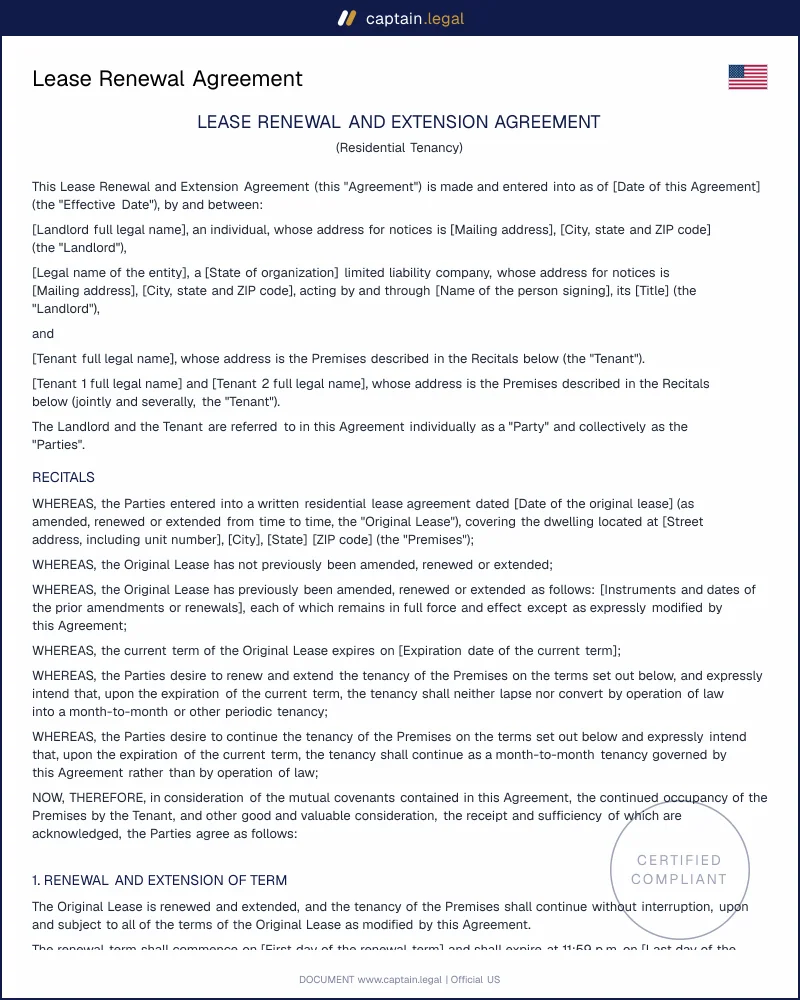
You start by identifying the original lease, entering its date and the property address so the renewal can incorporate it by reference rather than repeating it. From there the form asks for the renewed term, the new start and end dates, and the updated monthly rent, and it flags where a state rent cap may apply based on the jurisdiction you select. The tool then walks you through which disclosures need to be refreshed for that state and that property age, so a pre-1978 unit prompts the lead-paint attachment automatically. If a guarantor signed the original lease, you indicate that and the renewal generates the re-affirmation language rather than leaving the guarantee in doubt. You confirm that the existing security deposit carries forward, add any negotiated changes to house rules or fees, and the document assembles a clean signature block for every adult party in possession. The finished renewal downloads in editable Word and ready-to-sign PDF, so you can adjust wording before printing without breaking the structure. If your situation is closer to a full re-draft than a renewal, the residential lease agreement template is the better tool.

6

Common mistakes to avoid

The most damaging mistake is doing nothing and letting the term lapse. Landlords assume a lease "just continues," but in most states an accepted rent check after expiration creates a month-to-month holdover at the old rent, which quietly erases the term certainty and the negotiated increase the landlord wanted. A close second is relying on an automatic-renewal clause that does not meet state formatting or notice rules, then discovering at the worst moment that the tenant can void it. In California the clause fails without the boldface recital, and in New York it fails without the fifteen-to-thirty-day reminder, so a landlord who leans on a defective clause often has no renewal and no notice trail either.

The other recurring errors are quieter but just as costly. Renewing without refreshing state-mandated disclosures leaves the file exposed to statutory penalties even though the tenancy is routine, and letting a guarantor fall out of a renewal term destroys security the landlord thought was still in place. Some landlords also raise rent past a local cap without realizing the unit is covered, turning a clean renewal into an unlawful one. Finally, verbal renewals invite exactly the "we agreed on something different" fight the document exists to prevent, so anything renewed by handshake should be reduced to writing before the next rent is due. For the employment paperwork that often accompanies a tenant's job change during renewal, the employment document templates sit alongside these real estate forms.

Key takeaways

Renewal basics

Extend the tenancy without rewriting everything

A lease renewal agreement carries your existing lease forward and updates only the negotiated changes, most often the new rent and the new fixed term (commonly six or twelve months). It is used when both sides want certainty instead of drifting into month-to-month. Treat it as a short, signed bridge: the old lease stays in force by reference, with refreshed terms and current disclosures.

Clarity

Never leave rent, term, or parties vague

A renewal should spell out the rent, the exact start and end dates of the new term, and who the landlord and tenant are. If those basics are fuzzy, disputes tend to slide into holdover territory after the prior term ends, where the rules change and leverage shifts. A clean renewal focuses on the delta, but it cannot be ambiguous about the core deal points.

Holdover rules

No signature can mean month-to-month

When a fixed term expires and the tenant stays, many states presume an implied renewal if the landlord accepts rent. In California, Civil Code 1945 generally treats a holdover plus rent acceptance as a renewal on the same terms, but only up to the rent-payment interval and never beyond one year. A signed renewal is the practical way to prevent an unintended periodic tenancy at the old rent.

Frequently Asked Questions

Yes. A lease renewal is a contract, and once both parties sign it, it is enforceable like any other written lease for the new term it defines. What makes it binding is the same thing that makes any lease binding: identified parties, a defined term, a stated rent, and mutual signatures. Because a renewal incorporates the original lease by reference, it also carries the enforceability of every surviving clause from that first contract. The one caveat is state-specific formality, such as California Civil Code §1945.5's boldface rule for any automatic-renewal language. Get the core terms and signatures right, and the renewal holds up in court exactly as the original lease did.

A renewal creates a new fixed term built on the terms of the expiring lease, while an extension prolongs the same lease and treats the tenancy as one continuous agreement. The practical difference usually surfaces around guarantors and around any clause tied to the "original" term. An extension keeps a guarantor bound automatically because the lease never technically ended, whereas a renewal can release that guarantor unless it expressly re-binds them. For most tenancies the outcome is identical, but the wording should be a deliberate choice. If you want a rolling arrangement instead of either, a month-to-month format may suit you better.

This depends entirely on your state and the type of tenancy, and it is one of the most misread rules in landlord-tenant law. For fixed-term leases, most states expect thirty to sixty days' notice of non-renewal before the end date, and California requires sixty days once a tenant has lived in the unit for more than a year. New York imposes its own reminder-notice window of fifteen to thirty days for any automatic-renewal clause under General Obligations Law §5-905. Check the exact figure for your state before you rely on a deadline, because serving short notice is the same as serving no notice at all in most courts.

Usually yes, and the renewal is precisely the right moment to do it, because a fresh signed term lets you set a new figure cleanly rather than fighting the old-rent presumption that attaches to a holdover. The limit is jurisdictional. In rent-capped or rent-stabilized areas, such as California under the Tenant Protection Act of 2019 or New York City's stabilization rules, the increase cannot exceed the applicable cap or the local rent-guidelines figure. In states with no cap, such as Texas and Florida, the increase is whatever the parties negotiate. Always confirm your unit's status before naming a number.

The renewal generates in both editable Microsoft Word and ready-to-sign PDF. The Word version lets you fine-tune wording, add a negotiated house rule, or adjust a fee before finalizing, while the PDF gives you a clean, print-ready document with proper signature blocks for every adult party in possession. Both formats keep the incorporation-by-reference language and the disclosure attachments intact, so editing one field will not quietly break the structure of the document. Most people customize in Word, then export to PDF for signing.

In most states you become a holdover tenant, and what happens next depends on what your landlord does. If the landlord accepts your next rent payment, the tenancy typically converts to month-to-month on the same terms under doctrines like California Civil Code §1945 or Fla. Stat. §83.46(2), and either side can then end it on the statutory notice. If the landlord refuses rent, you have no permission to stay and can face eviction. A signed renewal avoids that ambiguity by continuing the tenancy on defined terms. The security deposit demand letter template covers the separate question of getting a deposit back once a tenancy finally ends.

The deposit normally carries forward and is not re-collected, and a well-drafted renewal says so explicitly to close off any argument that a "new" agreement required a fresh deposit. Disclosures are different: lead-paint, mold, bed-bug, and landlord-identity disclosures should be refreshed at renewal so nothing goes stale, because a missing disclosure can trigger statutory penalties even on a routine continuation. The renewal document folds current disclosures back in rather than assuming the originals still cover you. Treat the deposit as continuous and the disclosures as something to re-verify every time you renew.

4.7/5

22 verified reviews · 50 000+ downloads

Lease Renewal Agreement | State Notice & Holdover Rules
  • Immediate access to the document
  • PDF + Word download
  • Compliant with 2026 legislation
  • Reviewed by lawyers
Fill in the template
Secure payment
Updated on July 26, 2026

You might also like

Seller Disclosure Statement Template
Pet Addendum to Lease Template