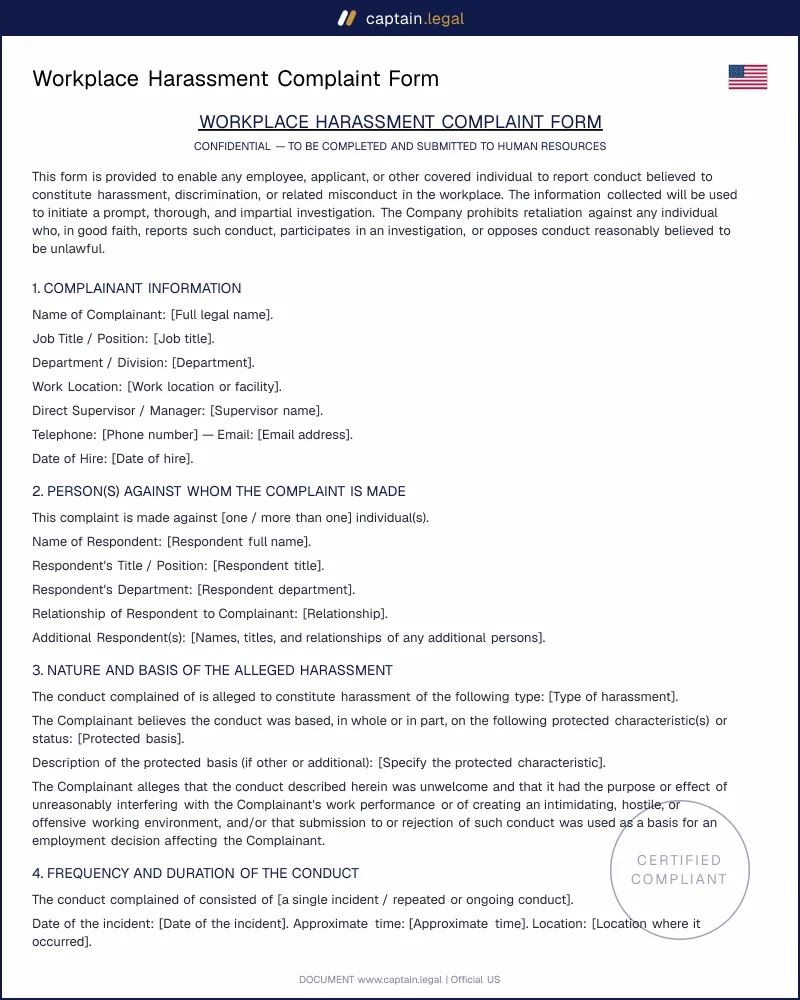
California runs the strictest regime in the country through the Fair Employment and Housing Act (FEHA), which covers employers with five or more employees and reaches conduct that would not yet rise to the federal "severe or pervasive" bar after recent amendments. California also mandates sexual-harassment prevention training and imposes detailed posting and recordkeeping duties, so your complaint form should align with the state's required notices and the Civil Rights Department complaint pathway. The state's anti-retaliation provisions are broad, and damages are uncapped, which raises the stakes on documenting a prompt, thorough response.
New York applies an unusually employee-friendly standard under the New York State Human Rights Law, which since 2019 covers all employers regardless of size and rejects the federal "severe or pervasive" threshold in favor of conduct that exceeds "petty slights and trivial inconveniences." New York also requires every employer to maintain a written sexual-harassment policy and a model complaint form, so your intake document should mirror the state's template structure. A New York employer that cannot produce its distributed complaint form is at a real disadvantage in any investigation.
Texas follows the federal framework more closely through Chapter 21 of the Texas Labor Code, administered by the Texas Workforce Commission Civil Rights Division, and generally applies the Title VII standards for liability. Even so, a 2021 amendment expanded sexual-harassment protections to employers of any size and extended the filing window, so the form remains essential for businesses that once assumed they were below the coverage threshold.
Florida enforces harassment claims through the Florida Civil Rights Act, which tracks federal law and covers employers with 15 or more employees. Florida does not impose a statutory training mandate, which makes a well-documented internal complaint process and a clean intake form the primary evidence of reasonable care under the Faragher-Ellerth defense.