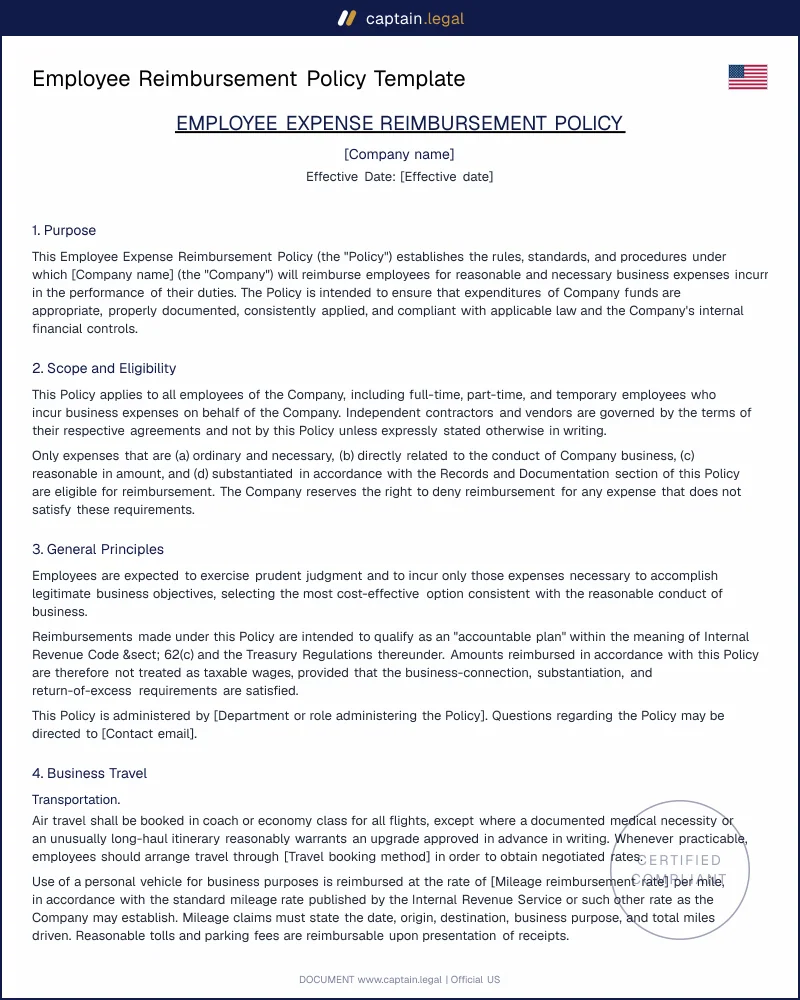
An Employee Reimbursement Policy is the internal document that tells your team exactly which out-of-pocket costs the company will pay back, how much, and what proof they need to submit. It governs the everyday spending that keeps a business running: airfare and hotels for a client visit, a working lunch with a prospect, the home internet bill of a remote employee, a laptop bought to hit a deadline. Most US employers treat reimbursement as an afterthought until a former employee files a wage claim or the IRS reclassifies a year of payments as taxable income. A written policy closes both gaps. It protects the company from disputes over who owed whom, and it gives finance a clean, auditable trail for every dollar that leaves through an expense report.
Compliant
2026 Legislation
50,000+ clients
trust us
Affordable
From $4.90 / doc
Secure payment
Instant download
Employee Reimbursement Policy Template | Travel, Meals, Remote Work
Secure payment
What is an employee reimbursement policy?
An employee reimbursement policy is a written set of rules that defines the business expenses an employer will repay, the spending limits attached to each category, and the documentation an employee must provide to be paid back. It usually lives inside an employee handbook or stands alone as a signed acknowledgment, and it covers four recurring buckets: travel, meals and entertainment, remote-work costs, and approved business purchases such as software, equipment, or professional dues.
People often confuse a reimbursement policy with an expense report form. They are not the same thing. The form is the request an employee files after spending money; the policy is the governing document that decides whether that request gets approved, at what cap, and within what deadline. A policy answers the questions a form cannot: Is a $300 dinner reimbursable or does the per-meal limit stop at $75? Does the company pay the IRS standard mileage rate or a flat car allowance? Will home-office furniture be reimbursed, or only consumable supplies?
The distinction matters most for tax treatment. A policy structured as an accountable plan under IRS Publication 463 keeps reimbursements off the employee's W-2 and out of payroll tax. A loose, undocumented practice risks being treated as a non-accountable plan, which turns every repayment into taxable wages. The same paperwork that feels bureaucratic on day one is exactly what shields both sides during an audit, which is why a clean policy belongs alongside your at-will employment agreement built for all 50 states from the start of the relationship.
Legal framework
Federal law sets a surprisingly thin floor here, and that thinness is itself the trap. The Fair Labor Standards Act does not require employers to reimburse business expenses at all, with one consequential exception known as the kickback rule. Under 29 CFR §531.35, wages must reach an employee "free and clear," so if an unreimbursed work expense effectively drags a worker's pay below the federal minimum wage, the employer has violated the FLSA's minimum-wage requirement. The classic litigation pattern is delivery drivers using personal vehicles: a flat per-delivery payment that fails to cover real mileage can quietly push effective hourly pay under the legal floor and trigger a class action. If you employ anyone at or near minimum wage, your reimbursement rates are a wage-and-hour issue, not a perk. The federal authority on this is the U.S. Department of Labor, and the mechanics are explained in the Cornell Legal Information Institute text of the FLSA free-and-clear wage regulation.
The tax layer comes from the Internal Revenue Code. To keep reimbursements tax-free, a policy must qualify as an accountable plan, which means three conditions under Treasury Regulation §1.62-2: the expense has a business connection, the employee substantiates it with receipts within a reasonable period, and any excess advance is returned. Fail any prong and the IRS treats the money as supplemental wages, subject to income and payroll tax. Most disputes that reach an accountant start here, with a well-meaning employer who reimbursed generously but never collected documentation.
State law is where the real obligations live. California Labor Code §2802 requires employers to indemnify employees for all necessary expenditures incurred in the discharge of their duties, a standard far broader than the FLSA and one that courts read aggressively, including a portion of home internet and cell phone bills for remote staff. Illinois followed with 820 ILCS 115/9.5, and Massachusetts, Montana, New Hampshire, and the District of Columbia impose comparable duties. A national policy has to flex to the most demanding state in your footprint, a point that ties directly into your remote work agreement covering §2802 reimbursement and equipment.
When do you need this document?
The most common trigger is a growing remote or hybrid workforce. The moment employees work from home, they start incurring internet, phone, and equipment costs that §2802 states treat as the employer's responsibility, and a vague verbal promise of "we'll sort it out" becomes a liability the day someone quits unhappy. A clear written cap and a defined claim process replace that ambiguity. The second trigger is routine business travel: once more than a handful of people fly, drive, or expense client meals, inconsistent approvals create both morale friction and audit exposure. One manager approves business class, another rejects an Uber, and finance has no rule to point to.
Companies also need the policy when they cross into multi-state operations. A startup that hires its first employee in California or Illinois inherits reimbursement duties that did not exist when everyone sat in a no-mandate state, and the old informal habit suddenly carries statutory penalties. A related scenario is the shift from reimbursing actual costs to paying stipends or allowances, which changes the tax analysis and demands written terms to stay inside an accountable plan.
Two edge cases legitimize a careful policy. First, the employee who buys a $2,000 laptop without pre-approval and expects full repayment: without a stated approval threshold, you are arguing after the fact. Second, the commuting versus business travel line, which trips up almost everyone. Mileage from home to the regular office is a non-reimbursable commute under IRS rules, but travel from the office to a client site is reimbursable, and getting this wrong is a frequent source of both employee resentment and tax error. A standalone policy works best when paired with the broader rules in your all-states employee handbook with PTO and discipline sections.
Key clauses included in our template
- The scope and eligibility clause defines which workers the policy covers, separating full-time employees from contractors who bill expenses through their own invoices. This matters because reimbursing a 1099 contractor the same way you reimburse staff can blur the line that protects you from misclassification claims, a risk your 1099 independent contractor agreement is designed to keep clean.
- The eligible expense categories section sets out travel, lodging, meals, remote-work costs, and approved purchases, each with its own treatment. Travel covers airfare class, ground transport, and the IRS standard mileage rate for personal vehicles; meals carry a per-day or per-meal cap; remote-work costs name the specific items the company will share, such as internet and phone.
- The spending limits and pre-approval thresholds clause states the dollar figure above which an employee must get written sign-off before spending. A common structure requires manager approval for anything over a set amount and a second signature above a higher one, which stops surprise purchases before they happen rather than after.
- The substantiation and deadline clause is the heart of accountable-plan compliance. It requires itemized receipts, a business-purpose note, and submission within a fixed window, often 30 to 60 days. Miss the substantiation rules and the IRS can reclassify every reimbursement as taxable wages.
- The prohibited expenses clause lists what the company will never reimburse: personal travel upgrades, alcohol beyond policy limits, traffic fines, or commuting mileage. Naming these in advance removes the awkward case-by-case denial that breeds resentment.
- The repayment and offset clause explains how the company recovers unspent advances and addresses what happens at separation, coordinating with your employee termination letter covering final-pay deadlines.
State-specific considerations
California sets the national high-water mark through Labor Code §2802, which obligates employers to reimburse all necessary business expenses, a phrase courts construe broadly. The leading case, Cochran v. Schwan's Home Service, held that an employer must pay a reasonable percentage of an employee's personal cell phone bill used for work, even when the employee had an unlimited plan and paid nothing extra. California also bars waivers: an employee cannot sign away the §2802 right, so a policy that tries to shift costs onto staff is void. Penalties include the unpaid amounts, interest, and attorney's fees, which is why California reimbursement disputes so often escalate.
Illinois enacted 820 ILCS 115/9.5 in 2019, requiring reimbursement of necessary expenditures within the scope of employment, subject to a written expense policy. The statute is employer-friendlier than California's in one respect: a compliant written policy can set reasonable limits, and an employer is not liable for amounts that exceed those limits or that an employee fails to submit within the policy deadline. That single feature makes a documented policy not just advisable but legally protective in Illinois.
New York has no statewide reimbursement mandate comparable to §2802, so the FLSA kickback rule governs the floor, but New York Labor Law §198-c treats promised expense reimbursements as a form of wage supplement, meaning a failure to pay what the policy promised can become a wage claim. The practical lesson is that in New York your written policy effectively defines your own obligation, so loose drafting creates liability you could have avoided.
Texas imposes no specific reimbursement statute beyond the federal floor, leaving employers free to set terms by contract or policy. That freedom is a double-edged sword: without a clear written policy, disputes default to whatever was promised verbally, and the Texas Payday Law can be invoked to enforce an agreed-upon reimbursement as unpaid wages. Even in a low-regulation state, the document is what protects you.
How to fill out this employee reimbursement policy
You start by selecting the state where most of your employees work, because that choice drives whether the template applies the broad §2802 standard, an Illinois-style written-policy carve-out, or the federal FLSA floor. From there, the form asks you to define your eligible expense categories, and you toggle on the buckets that fit your business: travel only, or travel plus remote-work stipends, or the full set including equipment purchases. Each category you enable then prompts you for the specific limits, such as a per-meal cap, a mileage rate that follows the IRS figure, or a monthly internet contribution.
Next you set your approval thresholds, entering the dollar amounts above which pre-approval is required and naming the role that signs off, usually a direct manager or finance lead. The template then builds your substantiation rules, where you choose the receipt requirement and the submission deadline that keeps you inside an accountable plan. You finish by adding the prohibited-expense list and the separation-offset language, after which the document assembles into a clean, signature-ready policy. The whole flow mirrors how you would adapt the rules across roles, much as you would when building a PTO policy with accrual and final-pay payout rules.
Common mistakes to avoid
The error that costs the most is treating reimbursement as informal goodwill rather than a written obligation. Employers who reimburse generously but never collect itemized receipts within a defined window destroy their accountable-plan status, and the IRS then reclassifies a full year of payments as taxable wages, hitting both company and employee with back payroll tax. Close behind is ignoring state law in a multi-state team: a policy drafted for a Texas headquarters that quietly violates California §2802 invites a class action the moment the California employees compare notes. The cell-phone and home-internet reimbursement question is the single most litigated gap, because employers assume an unlimited plan means zero cost when Cochran says otherwise.
A second cluster of mistakes lives in the details. Setting no pre-approval threshold means you are negotiating after an employee has already spent the money, with no leverage to refuse. Confusing commuting with business travel produces both employee resentment and tax errors, since home-to-office mileage is never reimbursable while office-to-client mileage is. Many employers also forget separation logistics entirely, leaving unspent advances unrecovered and final expense claims unresolved, which is precisely the moment a departing employee is most likely to dispute. Reconcile every outstanding advance before you issue a final paycheck, not after. Finally, copying a generic template without adjusting the meal caps or mileage rate to current figures leaves you defending numbers you never actually chose.
Frequently Asked Questions
36 verified reviews · 50 000+ downloads
- Immediate access to the document
- PDF + Word download
- Compliant with 2026 legislation
- Reviewed by lawyers
You might also like